
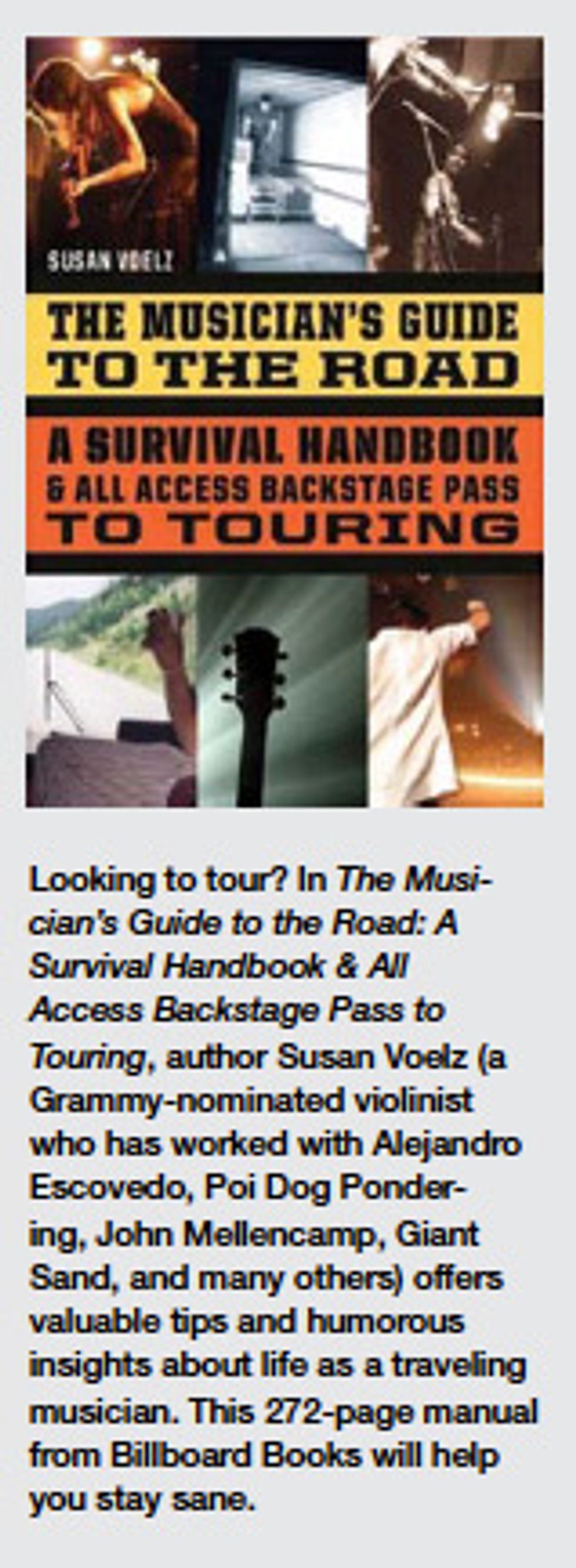
In the August issue of Premier
Guitar, my column “Risk
... and Survival” considered a
bassist’s risks for taking on new
gigs, along with some tips for
how to come through it all with
a happy ending. In the same
issue, an interview with the
legendary bassist Stanley Clarke
concluded with his statement,
“Don’t pass up nothin’. If you
have the ability to try it out, try
it out.”
Frank—a PG reader from
Portland, Oregon—emailed me
shortly after the issue came out
and suggested considering new
musical possibilities according to
the “opportunity cost” involved.
The term sounded familiar—
something out of my undergrad
economics class way back
when—but it was lost in the
cobwebs of my mind. To recall
the concept, I did a quick search
and landed on About.com’s economics
section, which offered
this plain-language explanation:
Unlike most costs discussed
in economics, an opportunity
cost is not always a number. The
opportunity cost of any action is
simply the next best alternative to
that action, or put more simply,
“What you would have done if
you didn’t make the choice that
you did.”
And there you have it.
Opportunity cost is a way of
assessing potential gigs based on
the musical, rather than monetary
gains you might receive
from choosing among them.
As a semi-pro player, pay is
rarely at the top of my list of
choice factors. If I took gigs
based solely on pay, I’d be gigless.
It’s a rare gig that pays
enough to turn me into a bass
mercenary, but when I do run
across one of those unusual
opportunities, I start wondering
how the other factors will
weigh in. A perfect example is a
corporate gig that pays well, but
involves a night of constantly
being told to turn down, receiving
painful requests, and getting
the second-class treatment
of eating dried-out sandwiches
while standing in the kitchen.
On the other hand, if the gig
means playing with some really
hot musicians, it might be a
different story.
Personal growth is often
one of my top choice factors.
When I can play with musicians
a step above me in their
abilities, the adrenaline starts
pumping and I’ll try my best
to stay sharp the whole night.
If the gig is a rousing success,
I’ll temporarily bask in the
glory. And if I hit some snags,
it’s time for a large serving of
humble pie and a new practice
agenda to build up lagging
skills. In any case, this is a time
for putting on the poker face,
learning not to wince when I
hit a clunker, and turning mistakes
into new ideas.
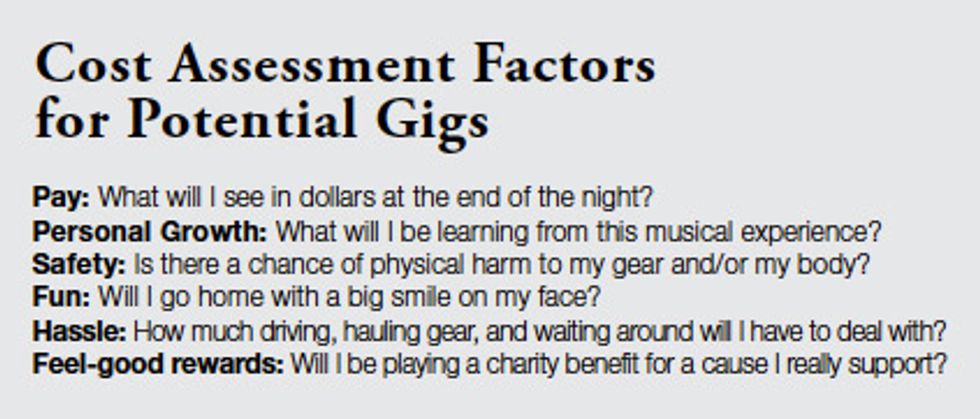
Safety may not always come to mind right away, but I’ve played a few gigs I’ve regretted— gigs where someone insisted on sitting in, people were falling-down drunk, or attendees getting a little combative when their repeated requests got overlooked. I once played a biker gig with a “Neutral Territory” sign posted, and I remember really hoping they meant it. Likewise, if it’s a rowdy, crowded bar with a tight band space, I have to hope my gear will survive without getting knocked over and busted up.
The longer I play, the more fun fits into my opportunity-cost evaluation. I’d rather play for low pay and high fun than vice-versa. Fun does not necessarily equate with audience size, either. If a small audience is really digging it, I go home happy. If the music really gels and I connect with the other band members, that equals fun. I remember one bar gig where a group of exotic dancers stopped in after work and showed off some of their talents. Now that was interesting and fun.
The older I get, the less patience I have for the hassle factor. I need more pay from a gig to drive a couple hours late at night than I used to. Likewise, I’m not that enthused about playing a gig with a big lineup of bands that requires waiting around for one, short set that hardly pays. Hauling heavy PA gear has lost the appeal it once had too—just another hassle. Loud gigs at crowded, noisy bars—ditto. Give me a club with good acoustics, an in-house PA with a pleasant, experienced sound tech, a roomy stage, and an appreciative audience. With all that, I might even think about paying to play!
Finally, there are the feel-good rewards. Sure, these gigs don’t pay well—or at all. But the audiences, such as they are, are happy you’ve come to help make their benefit a better event. For the band, there are the usual gear-hauling hassles and some inexperienced people running the show, but it’s also a chance to try out some new tunes—or work out the between-gig rust—in a low-risk setting. At the end of your set, you’ll feel that you’ve given back a little of what you’ve received over the years. It’s also possible that an audience member might talk to you about a future booking. If you go into a feel-good gig with a positive outlook, you’ll reap the rewards.
So there’s my system for deciding which gigs to take on and which ones to let pass. You might put together a somewhat different list and weigh the factors differently. But when you carefully consider the opportunity cost of potential gigs overall, you can take what your gut tells you and bring it to a well-reasoned conclusion.
 Dan Berkowitz
is a professor by day and
a bassist when the sun
goes down. He plays
upright and electric bass
for blues, jazz, orchestra,
and musical theater.
Contact him at profdanb@gmail.com.
Dan Berkowitz
is a professor by day and
a bassist when the sun
goes down. He plays
upright and electric bass
for blues, jazz, orchestra,
and musical theater.
Contact him at profdanb@gmail.com.