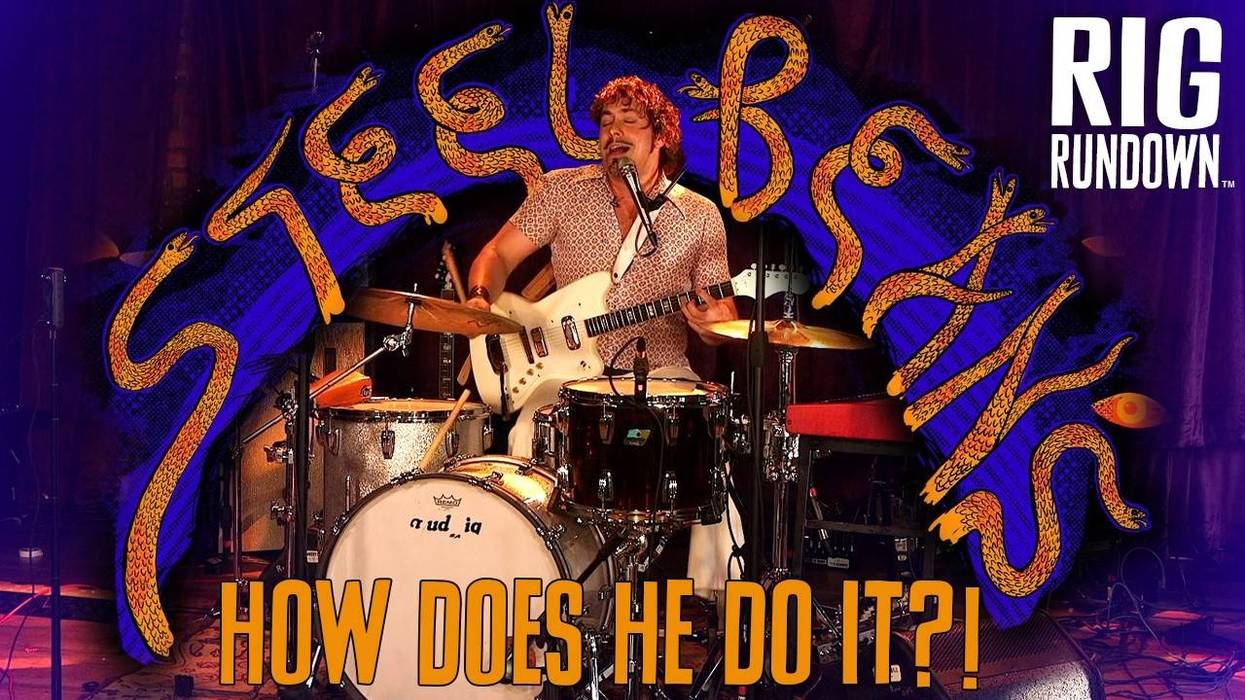
At this point, Nashville heavy hitters All Them Witches are friends of the show. They’ve had their rigs rundown twice before, but like they say, the third time’s the charm. PG’s Chris Kies rendezvoused with bassist/vocalist Charles Michael Parks Jr., guitarist Ben McLeod, and keyboardist/violinist Allan Van Cleave at Nashville’s Brooklyn Bowl for this new Rig Rundown, packed with tone goodies you’re gonna wanna see. Tune in for the full scoop, and skim the highlights below.
McLeod’s 2010 GibsonLes Paul Traditional is his first pick. It’s been modified with a bone nut, Tone Pros bridge, DiMarzio Super Distortion in the neck position, and a custom bridge pickup, plus a string butler. No doubt about it—this one is ready to rock.
Black Beauty
This Knaggs Honga is used for certain songs in alternate tunings, like those off the band’s 2015 record, Dying Surfer Meets His Maker. McLeod mainly uses D’Addario NYXL .011s, tuned to drop C and D standard.
Take It to the Bank
This Banker V-style is tuned to D standard for slide playing; McLeod’s slides wait atop his Fender Twin. The Martin acoustic beside it is used for collaborative live performances with tourmates King Buffalo.
Fruit and Fender
The Orange AD30 head is McLeod’s main amplifier, running into a Marshall 1960B cabinet loaded with Celestion Greenback speakers. The Fender Twin beside it is on hand as a backup.
Ben McLeod’s Pedalboard
McLeod carries a Dunlop Cry Baby 95Q wah, TC Electronic PolyTune Mini, WEM CCB-1 Copicat Boost, Lehle Mono Volume S, Analog Man-modded Boss BD-2, Stomp Under Foot Silverfish, Boss DM-2W, and Strymon TimeLine.
Boomsticks
On the left, we have Parks’ number-one “Doom Broom”—a custom copy of a 1972 Rickenbacker 4001 bass—with its distinctive horns sheared, of course. The ’60s-era Fender Precision/Jazz hybrid beside it, which belonged to Parks’ dad, is a backup, and features unique out-of-phase switching.
Sovtek Siblings
<p>This Sovtek MiG 100 recently came out of retirement for this tour, and its smaller relative—the not-so-sensitively-named Sovtek Bassov Blues Midget—runs into a custom cabinet with a single 12" speaker. A Milkman The Amp is nearby in case of emergencies. </p>
Charles Michael Parks Jr.’s Pedalboard
PArks runs a Shure GLXD16+ Guitar Pedal System, Radial ABY switcher for switching between bass and guitar, Boss EQ, Electro-Harmonix Hum Debugger, Ibanez Echo Shifter, Amptweaker Bass Tight Fuzz, Greer Little Samson, Keeley 30ms Double Tracker, Electro-Harmonix Pitchfork, and Hiwatt Fuzz.
Keys to the Kingdom
<p>Allan Van Cleave’s Fender Rhodes runs into a Twin Reverb, with a couple of pedals perched atop the Nord keyboard. These include a Donner Hexadrive, Fender Pugilist, Electro-Harmonix Canyon, Moog MF Delay, and MXR Carbon Copy, all powered by a Voodoo Labs Pedal Power 2 Plus. </p>
Allan Van Cleave’s Violin Pedalboard
Van Cleave’s 5-string Yamaha violin has its own humble board, loaded with a Boss TU-2, JHS Series 3 Reverb, MXR Carbon Copy, Electro-Harmonix Pitchfork, Demonfx Overdrive Preamp, and a wah pedal.
It's no slag to pin Rich Robinson as a rhythm-guitar master. He actually prefers that lane of rock. His musical heartbeat pulses on complex chord changes and moving, harmonious melodies that you can hum. If big brother and Black Crowes' lead singer Chris Robinson is the driver, Rich is the rumbling Hemi motor. It's not always been easy, and it's not always been pretty, but the duo has rock and rolled for 36 years producing 11 groovy albums including their brand-new release, A Pound of Feathers.
Leading up to the record's release Rich sat down with host John Bohlinger to speak on several topics: riding the band's meteoric rise in 1990, dealing with their unimaginable success as a teenager, explaining why he never forces creativity or guitar playing, sharing the reasons he regularly relies on open tunings, reminiscing being shaped and inspired by the Atlanta music scene (including bands like R.E.M. & the B-52s), and trying to remain true, honest, and pure to their simpatico sibling songwriting approach.
Italian shredder Matteo Mancuso, celebrated for his dazzling, jazz-inspired prog-rock guitar wizardry, recently touched down in Nashville for a show at City Winery, where he spent some time with PG’s John Bohlinger for this new Rig Rundown. Check out the video for a more in-depth chat on specifics, and have a look at the essentials of Mancuso’s fly rig below.
Mancuso’s sunburst Yamaha Pacifica Custom features a Vega-Trem whammy bar, rosewood fingerboard, and locking tuners. The pickup configuration includes two DiMarzio Area 68 pickups and a DiMarzio PAF 36th Anniversary in the bridge position.
The sunburst Revstar, meanwhile, was built for Mancuso by Yamaha’s custom shop. It features a chambered Honduran mahogany body, pill-style inlays, and Luminlay fluorescent side dots. Rather than the Revstar’s typical 3-way selector, Mancuso’s uses a 5-way blade switch, with wiring for coil-splitting on the Lollar Imperial pickups.
Mancuso runs both guitars with .009–.042 strings.
Stadium and Stomp
While Mancuso loves his JCM800 back home, for international travel, he rolls with a Line 6 Helix Stadium XL for consistency night after night. In case the Stadium XL goes down, a Line 6 HX Stomp is on hand to keep the show going.
"Jingle" John Osborne is a certified twangin' telemaster. His main squeeze for nearly the Brothers Osborne decade-plus run has been a '68 Tele he bought for $700 when he first moved to Nashville. It already had the B-bender in the body, but Osborne but enough staink and groovy grease on it to wipe away any of the previous owners' DNA. It's become so crucial to his sound that Fender recognized the companionship and honored the master and his tool with a signature model mirroring its inspiration. Here old friend John Bohlinger grabs a Osborne sig and the pair chat about guitar playing, why Teles are the best for country music, and share a couple jams. Enjoy!
The guitarist for the classic rock revivalists proves old amps, paired with even older guitars, is still a recipe for tonal success.
Tyler Armstrong, lead guitarist for St. Louis, Missouri, rockers the Band Feel, recently invited PG’s John Bohlinger out to Smoakstack Studios in Berry Hill, just south of Nashville, for this Rundown of the axes, amps, and effects he’s using to conjure the classic rock ’n’ roll sounds of the ’70s. Aside from his pedals, Armstrong sticks to the tried-and-true recipe: American guitars through British amps. Scroll for some highlights of the Rundown, and watch the video to get the nose-to-tail treatment.
This all-original 1959 Gibson Flying V is on loan from Gibson’s Certified Vintage program. Armstrong secured it for some recent studio work, and attests that out of five he test-drove that were built in the same period, this one is the best of the bunch. He’s gotta give it back, right? “We’ll see what happens,” Armstrong grins.
Friend from ’53
Armstrong acquired this “super messed-up” 1953 FenderTelecaster with the help of a friend in Illinois. The warped neck was heat-treated to make it playable, and the body has been contoured on the back and front to give it a Jeff Beck feeling. It’s kept in open-G tuning for some live performances.
Dynamic Duo
<p>In studio, Armstrong uses a 1965 Vox AC15 2x12 combo and a Marshall JMP Super Bass. When playing live, he runs the JMP alongside a 1963 Fender Bassman.<br/></p>
Tyler Armstrong’s Pedals
<p>Among Armstrong’s select studio weapons are a Sonic Research ST-200 tuner, Mythos Oracle, Electro-Harmonix Small Stone EH4800, Mythos Luxury Drive, EarthQuaker Devices Swiss Things, R2R Electric Pre-Amp with an extra knob for EQ, <a href="https://www.sweetwater.com/store/detail/Phase90--mxr-m101-phase-90-phaser-pedal?irclickid=Sy72HhyqAxycWp1UwTUUjyKJUkp2l10ArRo1X80&irgwc=1&utm_source=Impact&utm_medium=Premier%20Guitar&utm_campaign=Online%20Tracking%20Link" target="_blank">MXR Phase 90</a>, vintage Maestro PS-1A, and an <a href="https://www.premierguitar.com/tag/lr-baggs">L.R. Baggs</a> Voiceprint D.I.</p>