

Some ultra-premium amps are packed with a dizzying array of features. But the only dizzying things about Little Walter amps are their superb tones and boldly minimalist designs. (Well, that, and their hefty price tags.)
Little Walter mastermind Phil Bradbury won the endorsements of A-list Nashville players with two previous amps: a 22-watt model driven by two 6V6 power tubes, and a 50-watter with dual 6L6s. And now there’s the Twin 22/50, which combines both amps in a single head.
Super Duper Two-In-One
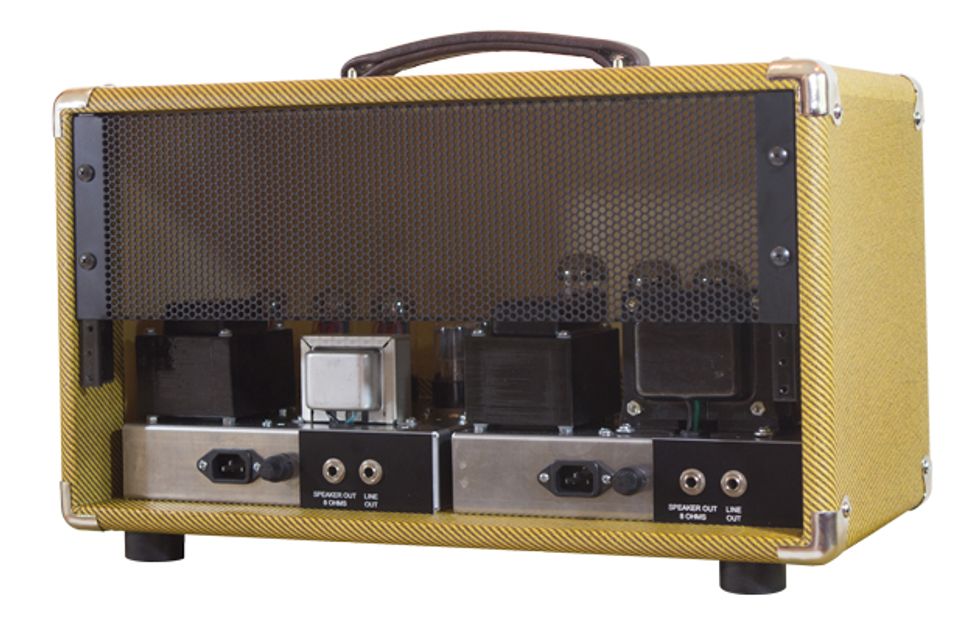
When I say “both amps,” I mean it. We’re not talking channel switching or some tricky circuit-swapping architecture. Inside the head are two discrete steel chassis, each with its own transformers, tubes, and power supply.
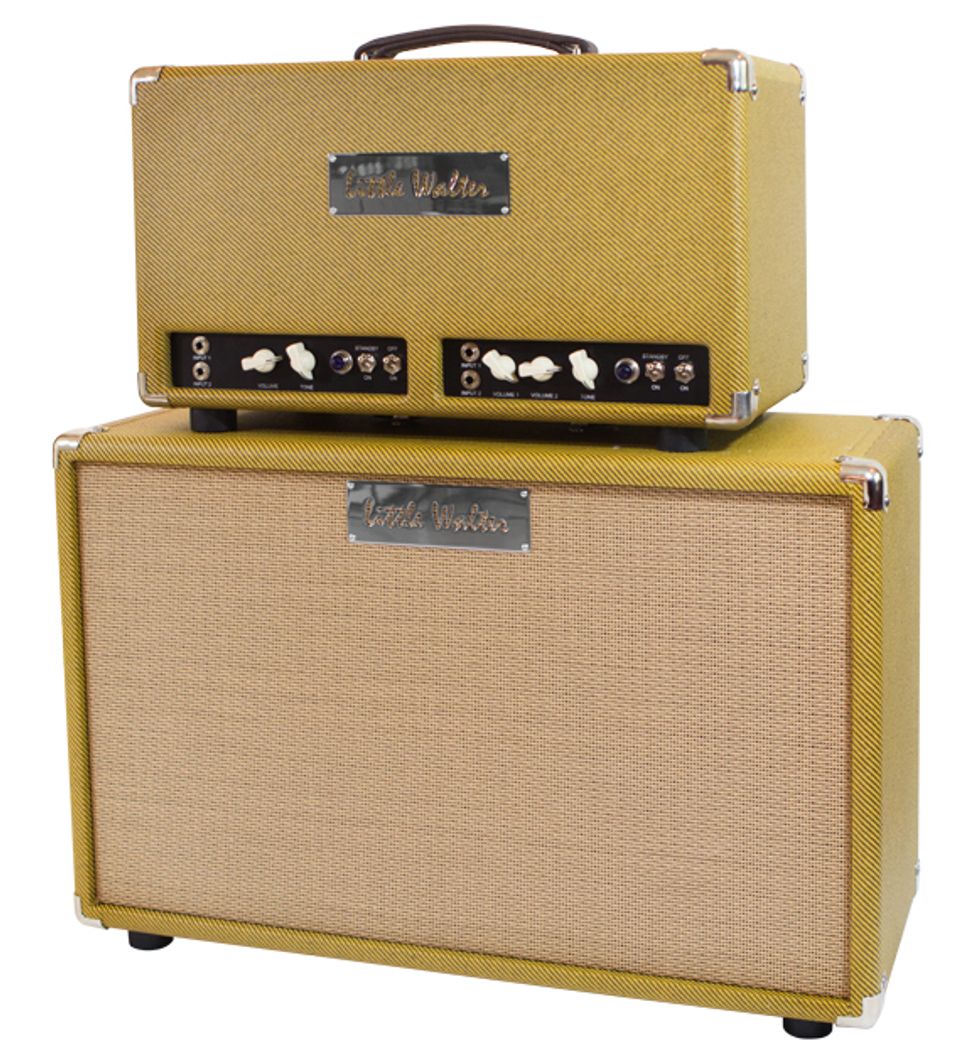
We reviewed the 50/22 with its matching 2x12, semi-open-backed cabinet, which lets you run both amps in true stereo. The cabinet features two contrasting Celestion speakers (a G12 Alnico Gold and a ceramic-magnet G12-T75). You can route either amp to either speaker, or run either through one or both speakers. It’s a clever and versatile arrangement.
Both head and cab reveal top-tier workmanship. They’re garbed in ravishing honey-tinged lacquered tweed, and the speaker cabinet is solid pine. The dual amp chassis are mounted to the bottom surface of the head, tubes and transformers facing up, and everything else encased in metal. The head’s unusual height lets you access the tubes from above (and provides critical ventilation, because these amps runs hot). As on all Little Walter amps, the wiring is strictly point-to-point—they don’t even use turret board, let alone circuit board. The transformers are hefty Hammonds, and the review model arrived stocked with JJ tubes.
Simple, Not Stupid
Both of the Twin’s amps draw inspiration from classic combos of the 1950s, but they’re not retro for retro’s sake. Bradbury and his amps convincingly make a case that the simpler the circuit, the better the tone. There are no master volume controls. No reverb or trem. A single tone control on each amp siphons off treble, but nothing else. These amps are all about sending the loudest, most harmonically rich signal to the power amp tubes, and generating gorgeous distortion there.
That’s the motive for another retro detail common among all Little Walter amps: Bradbury employs strictly octal tubes. That’s no surprise when it comes to the 6V6 and 6L6 power tubes, but it’s an unusual choice for preamp tubes. Octal preamp tubes were common in the 1940s and ’50s, before the advent of nine-pin (“noval”) tubes such as the 12AX7. Octal tubes distort less readily than noval ones, which means less compression, fatter lows, more high-end headroom, and a purer signal to the power amp section. The downside is, they can be harder to source, and relatively large bottles make them prone to microphonics. (It’s almost impossible, for example, to find a non-microphonic replacement for the EF86 tubes that appeared in some early Voxes.) But like early Fender tweed amps, the 50/22 employs 6SC7 preamp tubes. (According to Tube Depot’s Rob Hull, these are in relatively good supply and not terribly expensive.)
The preamp tubes in the review model sounded fine, and you definitely hear their character blasting from the speaker. If the words “power amp distortion” make you salivate, fetch the drool bucket before plugging in.
Nifty 50
The 50-watt 6L6 side sounds glorious. Clean tones crackle and shimmer. Ample headroom provides strong note definition and a sense of “air” around each note. Meanwhile, the stout transformers, streamlined circuitry, and resonant cabinet deliver buff lows. Individual notes and frequencies never leap out too aggressively, even when digging into a bright, single-coil bridge pickup.
While this is the Twin’s “clean side,” distortion sounds equally excellent. Tones grow fatter and smoother as you advance the gain, yet they retain strong attacks. (This thing excels at Stones-style raunch.) The amp is biased hot, though—diming the volume introduces harsh, buzzy distortion. Most players will probably get best results by following builder Bradbury’s recommendation for parking the volume knob somewhere in the middle of its range and shaping the tone via touch and guitar knob adjustments.
Likewise, many players will prefer to leave the tone control maxed. As Bradbury correctly notes, the passive tone circuits in vintage amp amps are strictly subtractive, and you get the maximum signal to the power amp with the circuit wide open. The tone control’s voicing promotes that approach: It nixes highs only modestly throughout most of its range, with a rapid roll-off at the very lowest settings. But with such beautifully balanced tones and graceful treble attenuation at higher volumes, you may never need to fiddle with the tone control.
This amp sounds great through both speakers, together and separately. (As expected, the ceramic-magnet speaker is a bit tighter and crisper than the alnico one.) Why not mike both, and perfect your blend at the mixing board?
Ratings
Pros:
Stellar ’50s-style amp sounds. Superb workmanship. Extraordinarily dynamic and responsive. Great tonal variations via clever cabinet configuration.
Cons:
Did you say five grand?
Tones:

Playability/Ease of Use:
Build/Design:
Value:

Street:
$4,000 (head); cabinet $900 w/ Celestion G12-T75s ($1,000 as reviewed with one G12-T75 and one Celestion G12 Alnico Gold)
Company
littlewaltertubeamps.com
Let’s Get Small
The dual-6V6 22-watt side nails what most players love about early tweed amps— and then some. It distorts gorgeously at relatively low volumes, and reveals many lovely overdrive colors as you advance the volume.
Just as the “clean” amp generates great distortion sounds, the “dirty” 6V6 amp offers fabulous clean tones. They’re not as sparkly as the 50-watt tones—there’s always a bit of “hair” at all but the lowest settings. But you may be startled by how chimy and clear this small amp can sound. (I don’t know if I’ve ever heard such strong pick attack from an overdriven 2x6V6 circuit.) Parking the volume anywhere near the middle of its range puts you in that sought-after sweet spot where you can control the breakup by touch alone.
This tone control feels more linear than that the one on the 50-watt side—there’s a smooth, even roll-off across its range. (Personally, I’d set the tone to max, station the volume at 2 o’clock, and make all tonal adjustments by playing them.)
This amp is small but powerful, simple yet versatile. It sounds as good as any tweed-influenced head I’ve heard.
Plugging into both amps simultaneously via an A/B box sounds as good as you’d hope. You can dial in many useful tones that blend smooth, small-amp overdrive with big-amp definition.
The Verdict
The Twin 50/22’s look, tones, and workmanship are unimpeachable. You don’t need great technique to summon great tones from either amp, but they were clearly designed by and for guitarists who rely on subtleties of touch and technique, and they’re the players likeliest to love the 50/22 the most. Obviously, if you have five grand to play with, there are many other options, including a pair of the antique amps that inspired the Little Walter line. Also, some players who might be attracted to the notion of a true dual amp might wish for a Vox- or Marshall-style side, rather than two Fender-influenced circuits. But recording and touring pros who live and die by the signature sounds of the great mid-century amps will cherish this extraordinary instrument.