
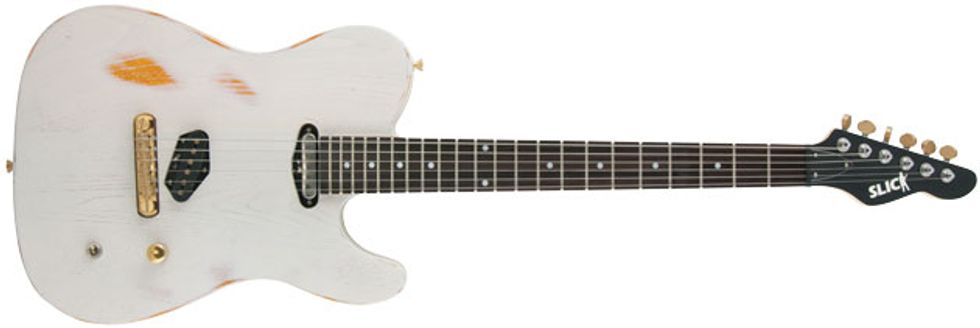

When Leo Fender introduced the Telecaster in 1950, he could scarcely have imagined just how many variations his own company would spin on this straightforward solidbody platform, not to mention the number of other great builders—from Chihoe Hahn to Rick Kelly—who would use the Tele as the foundation of their own idiosyncratic designs.
There’s no shortage of mid-priced and high-end T-styles these days, but offerings as inexpensive as the Slick SL50—which is around 240 bucks street—can be hit or miss. The SL50, however, delivers the goods to be a solid contender in the realm of affordable T-style guitars.
Interesting Variations
The “Slick” on the SL50’s headstock comes courtesy of Earl Slick, the guitarist best known for his associations with David Bowie, and John Lennon and Yoko Ono. He’s lent his name and design input to a line of solidbodies inspired by classic 1950s single- and double-cutaway designs. And the 25.5"-scale SL50, at its core, is as classic as they come. The body is made from solid swamp ash, and the neck, affixed with four bolts, is solid hard-rock maple with an East Indian rosewood fretboard.
country-and-western players.
But the SL50 departs from the Telecaster in some interesting ways. There’s no pickguard, so the pickups are mounted directly onto the body. It also loses the traditional Telecaster tone knob (though the guitar has an elongated control cavity, allowing the owner space to add the control). Instead of a string-through-body setup, it has a wrap-around bridge made from solid, unfinished brass mounted to the top of the guitar with two posts, like a Gibson Les Paul Junior. Solid brass abounds elsewhere: The volume knob is brass. So are the buttons of the Slick-designed tuners and the tuning gears, which are both smooth and accurate.
The SL50’s finish is another departure. The swamp-ash grains are not prepared with pore filler or sealant, and the body is sprayed with a single coat of cream-colored automotive enamel, sanded down for a distressed look. Theoretically, this allows the wood to breathe, enhancing resonance. But rather than coming across as aged, the finish looks rather crude.
Overall, our review model was decently built, but it suffered from a few quality-control issues common in guitars around this price range. Firstly, it was in want of a setup. The notes at the lowest frets buzzed, and when I bent certain higher notes they fretted out. The 22 medium-jumbo frets could’ve been more smoothly crowned and polished, and there are anomalies in the smaller details—for instance, the neck plate isn’t mounted perfectly level to the body, and the control cavity cover does not sit flush with the body.
Ratings
Pros:
Lightweight. Solid-wood construction. Quality hardware and electronics yield impressive array of tones.
Cons:
Poor factory setup. Craftsmanship could be better overall. No tone control.
Tones:

Playability:
Build/Design:

Value:

Street:
$239
Slick Guitars SL50
slickguitars.com
Great Electronics Equal Expensive Tones
When I removed the SL50 from its included hardshell case (checkered like a pair of Vans sneakers and a very nice addition to this package), I was pleased to feel how light it is: 6 pounds, 15 ounces. The satin-finished neck, despite the problematic setup and fretwork, has a comfortable C-shaped profile, along with a 43 mm (about 1.69") nut and 11" fretboard radius.
Best of all, the SL50’s Slick-designed electronics more than make up for its craftsmanship shortcomings. The SL119 Fullerton (bridge) and SLP121 Fullerton (neck) pickups are made with vintage-correct materials: sand-cast alnico 5 rod magnets and Formvar wire. The bridge pickup is overwound to 9.4K and the neck to 5.6K. Like the body of the guitar, they’ve received a distressed treatment, with oxidation on the cover of the neck pickup and rust on the bridge unit’s exposed pole pieces.
Plugged into a Fender Blues Junior, the SL50 sounded great. With a clean tone, the bridge pickup delivered the bright, clear sound that made the Telecaster the axe of choice for country-and-western players. The more subdued neck pickup sounds buttery and warm. Both pickups are clear and reveal a lot of picking detail.
The volume knob’s smooth taper—something you don’t often see in affordable instruments—is great for pedal-steel-type effects. Given how nice the pickups and volume pot feel, you do start to miss the tone knob, which would be so useful for extracting jazzier sounds from the neck pickup. And unfortunately, hiring a tech to do this mod might set you back as much as the guitar itself.
The SL50 pairs nicely with distortion, too. Its neck pickup is plenty aggressive both for rhythms and leads, and retains a great deal of clarity in overdriven settings. The bridge pickup, meanwhile, really makes overdriven leads sing. The same balance that makes it sound great with distortion also makes it great for alternate tunings with a lot of doubles and octaves.
The Verdict
Despite some problems with its setup and fit and finish, the Slick SL50 is a very good Telecaster-style guitar that delivers classic T-style tones and more aggressive sounds as well. With a proper setup, our test model would make a great instrument for recording and for gigging—one that, thanks to its super-low price and distressed finish—you’ll be willing to subject to a beating every night.