

The original Mosrite Fuzzrite has always lurked in the shadowy recesses of the classic fuzz temple. To most ears, it’s not as flexible as a Fuzz Face, as meaty as a Muff, or as detailed and defined as a Tone Bender. These perceived shortcomings have mostly relegated the Fuzzrite to worship by the garage punk and biker fuzz cults (and even among these sects, divisions over the merits of germanium and silicon versions persist). But all dogma, bias, and historical slights aside, a good Fuzzrite is a way-cool and super-spirited stomp overflowing with personality.
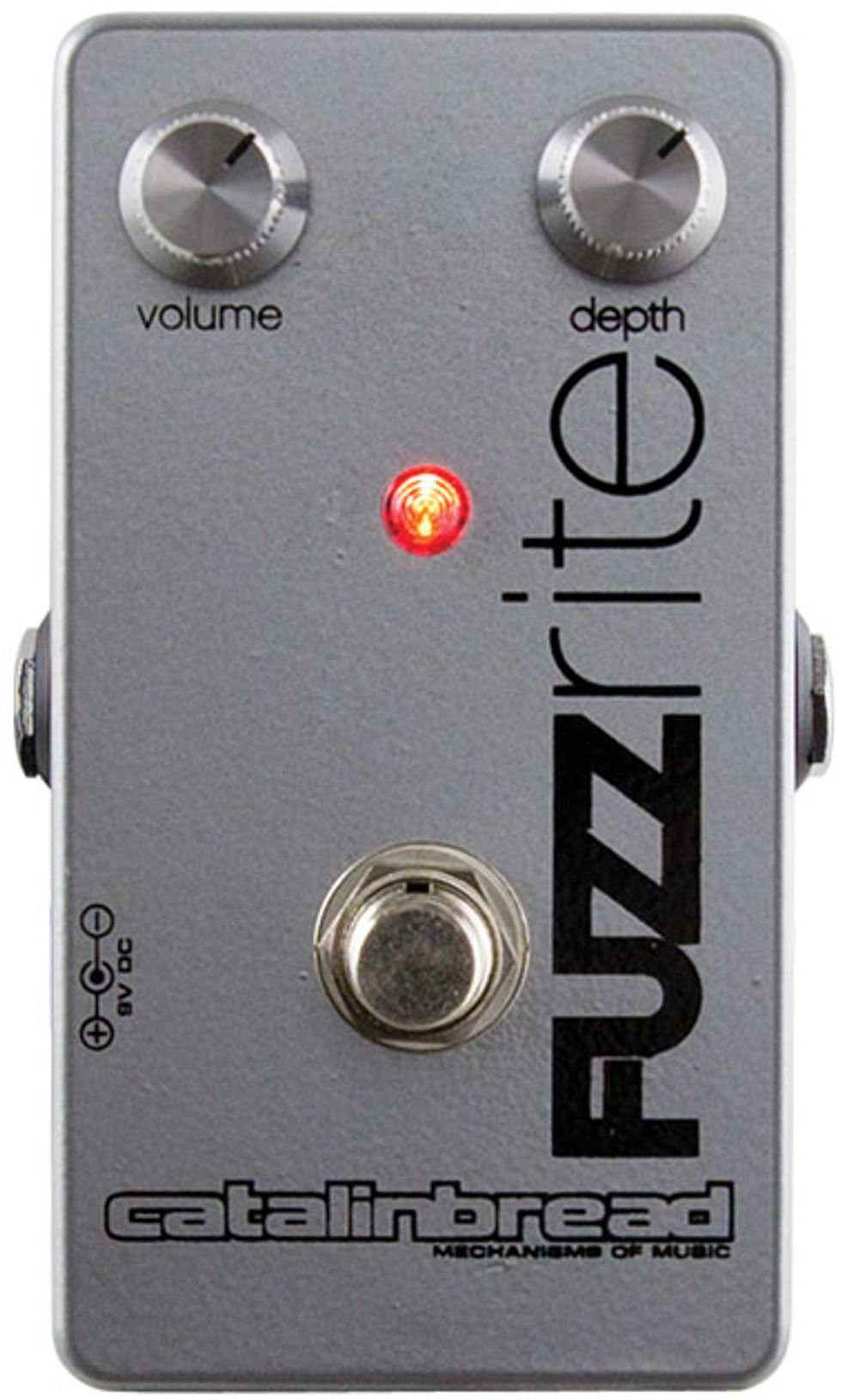
Catalinbread’s new Fuzzrite (we’re not sure how they managed to secure the rights to this legendary name) is a take on the silicon version of the circuit that first appeared in the late ’60s. And though it might not appeal to germanium Fuzzrite fans or super-obsessive ’60s sonic purists, it’s a fat, substantial, and buzzing fuzz that occupies a hard-to-nail sonic niche where ’60s sizzle and modern heaviness meet.
Built Like a Buzzing Brick
Catalinbread pedals tend to be superlatively built, and on the Fuzzrite you don’t have to look hard to find evidence of this quality. You can’t see the transistors, capacitors, and resistors because the circuit board is mounted with those components facing the enclosure’s interior. But like any Fuzzrite circuit, it’s a simple affair. And apart from the two transistors at the heart of the circuit, there probably aren’t more than a dozen additional components on the board.
Foreseeing, perhaps, the potentially rowdy environments in which the pedal might be put to work, Catalinbread made sure the guts are locked down tight as submarine latches on this beautifully robust box. The circuit board is held in place by the sturdy footswitch and volume and depth knobs, but it’s also held in place by small steel braces that are affixed directly to the enclosure. The two knurled knobs are easy to grip with the toe of your sneaker if you want to nudge the fuzz or volume on the fly. But they provide the perfect amount of resistance for doing so, and are unlikely to be bumped out of whack once you’ve set them where you want them.
In a Fuzz Kind of Eden
Silicon Fuzzrites tend to respond to chords in a cool and unique way. The Catalinbread gets especially high marks on this count, injecting power chords with throaty, muscle car mass topped with just the right amount of ’60s rasp. The Catalinbread’s marriage of vintage and meatier, contemporary fuzz personalities pay big dividends in this chordal context.
Probably one of the biggest obstacles to a wider acceptance of the original silicon Fuzzrite was its inorganic pick attack. Where a germanium Fuzz Face—or Tone Bender in particular—tend to communicate the interface between string and pick in a relatively transparent way, a Fuzzrite sounds more like fuzz floodgates opening and slamming shut. That hasn’t changed profoundly on this Fuzzrite, but by highlighting pick attack and adding definition about as well as a silicon Fuzzrite circuit can, the Catalinbread proves itself exceptionally responsive for the breed. Fast flurries of fuzz-fried licks sound a lot airier and detailed as a result.
Ratings
Pros:
Cool mixture of contemporary fat silicon fuzz tones and sizzling ’60s sounds. Superlative build quality.
Cons:
Not very responsive to guitar volume changes. Lacks some seat-of-the-pants character of ’60s fuzzes.
Tones:

Ease of Use:

Build/Design:
Value:

Street:
$149
Catalinbread Fuzzrite
catalinbread.com
The sometimes binary attack of the Catalinbread Fuzzrite makes it a great match for amps with a bit of natural compression. It loved my blackface Tremolux and a silverface Champ—even a much less squishy blackface spec’d Bassman sounded smooth, contoured, and dynamic with the Fuzzrite torturing the front end. It’s easy to imagine how the Fuzzrite’s scathing top and a squishy Fender tweed circuit would add up to bliss. And the Fuzzrite’s happy relationship with small amps makes it a fantastic studio tool for generating hairy vintage fuzz tone that doesn’t feel out of control.
Guitar volume-control responsiveness? Well, there’s not a lot—at least if you looking for Fuzz Face-style fuzzy-to-clean dynamics. Reducing guitar volume can re-color the fuzz in interesting ways, however, and you can enhance the cool, sputtery gated-fuzz effects by setting the depth (gain) control to lower levels.
In general, the Fuzzrite sounds happiest with the fuzz at or near it’s maximum level. That said, the volume control has a wide, effective range, and some of the coolest and most authentically ’60s-sounding tones come at very low pedal volumes, a trait that further bolsters the Fuzzrite’s utility in the studio.
The Verdict
Bold, brawny, and buzzy as a pissed-off wasp, the Catalinbread Fuzzrite is the rare fuzz that might appease paisley and Chelsea-booted fuzz purists, as well as players who think they love ’60s fuzz but really need a touch of modern silicon muscularity. There might be slightly more affordable and authentic takes on the Fuzzrite circuit, and some vintage-fixated players will certainly find the Catalinbread’s relative smoothness a bit too civilized for their garage punk needs. But few Fuzzrite clones out there are built to the exacting tolerances or offer the battle-ready robustness of this little unit. And for many players who are discovering the joys of this menacing and monstrous circuit, the sounds on tap will be a revelation.