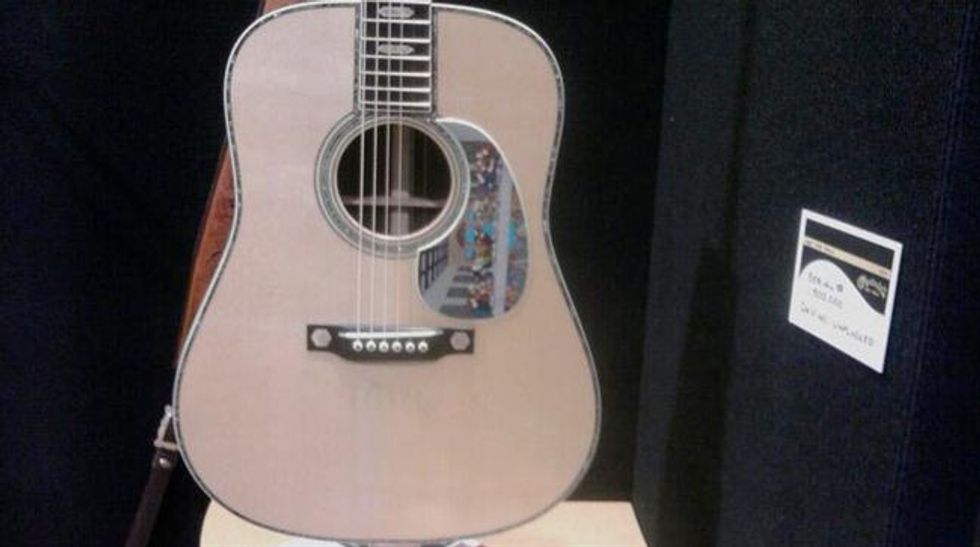
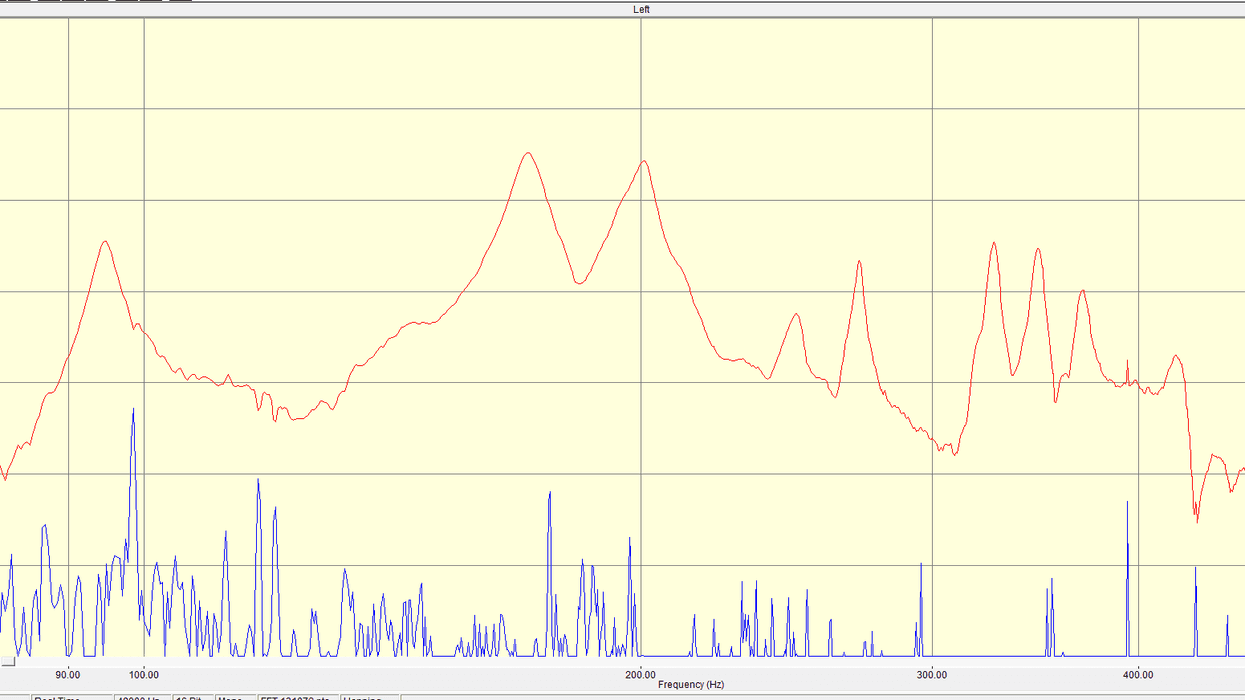
In this snapshot from a Fast Fourier Transform (FFT) analyzer, we can clearly see the instrument at work, the peaks representing how it moves and breathes, along with the emergence of higher-order harmonics.
When most people look at an acoustic guitar, especially the body, they assume they understand how it works. A common belief is that it behaves like a speaker. In a very loose sense, that’s not entirely wrong. But it also misses what’s really happening.
At its core, the acoustic guitar is a system in balance. When the instrument is strung to pitch, the tension placed on the top is significant, often around 140 pounds of total string load. How that top is thicknessed and how the braces are carved is in direct response to that force. The tension of the strings is constantly being opposed by the structure of the top, and that balance is what allows the instrument to store and release energy in a controlled way. The strings pull, and the structure counters—and this balance is not incidental; it is the foundation of how the instrument functions.
When a string is struck, energy is introduced into that system. What follows is not just vibration, but organization. The top begins with what is known as monopole motion, which is the primary pumping action of the instrument and the source of its fundamental voice. Within that motion, a core resonance develops, often referred to as the Helmholtz frequency; however, it is more accurately titled “air resonance.” The Helmholtz effect is similar to blowing across the top of a glass bottle, but an acoustic guitar is not a rigid system. The top and back flex, they move and breathe, forming a coupled system in which the air, top, and back interact to create the lower register of the instrument.
“At its core, the acoustic guitar is a system in balance.”
This air-top-back interaction becomes clear when the body is excited and observed on a Fast Fourier Transform (FFT) analyzer. Three primary features emerge: the air resonance, the top mode, and the back mode of vibration. Every guitar exhibits these frequencies. Even inexpensive instruments reveal them, though at that level they are largely functions of geometry. If the guitar does not respond well sonically, those same markers often reveal why.
In a more refined and controlled instrument, this system is shaped by physical choices. A more flexible top and back will generally lower the air resonance, while a stiffer system will raise it. The same is true of the sound hole: Smaller openings lower the resonance, while larger ones raise it. These are direct mechanical consequences.
Beyond this first layer is where the character of the guitar begins to emerge. Within the wooden structure of the instrument are nodes and antinodes, regions of stillness and motion, that organize how energy moves through the system. In a refined instrument, these patterns begin to drive the next level of behavior. Higher-order harmonics are excited, and more advanced modal patterns come into play. This shift, from simple motion to a more organized system, is what shapes tone, response, and identity.
From this geometry-driven foundation, the guitar reveals a ladder of higher-order behavior, dipoles, tripoles, and quadrupoles, that shape its character. While nodes and antinodes extend into higher frequencies, contributing to clarity, shimmer, and a sense of reverb, it is these mid-to-upper-order modes that define an acoustic instrument’s voice. When functioning properly, independent in motion yet unified in effect, they organize the instrument’s response into a clear hierarchy of tone and balance. This is where a world-class instrument begins to separate itself from the average, everyday guitar.
When these modes are present and active, the instrument takes on a different level of refinement. This is what players perceive as depth, clarity, and responsiveness. On a great guitar, these modes are not hidden; they are evident, both in sound and, if measured, on an analyzer or visualized through Chladni patterns. Whether seen or measured, their role is the same: They define how the instrument speaks. If a guitar is built too heavily, often in the interest of durability, these modes become dampened. The instrument still functions, but the refinement and subtlety are reduced.
When the wood is well-chosen and the structure properly balanced, these patterns, nodes, antinodes, and modes are allowed to develop. This is where material properties come into play. The speed at which sound travels through the wood, and how efficiently that energy is converted into sound, influence how these patterns emerge and resolve. These are not secondary considerations; they are central to the outcome.
In the end, what separates a great instrument from an average one is not a single feature. It is the way these small, interconnected behaviors come together. The balance of tension, the flexibility of the system, and the presence of higher-order harmonics—all these subtle things are what turn an instrument into an ideal conduit of musical expression.
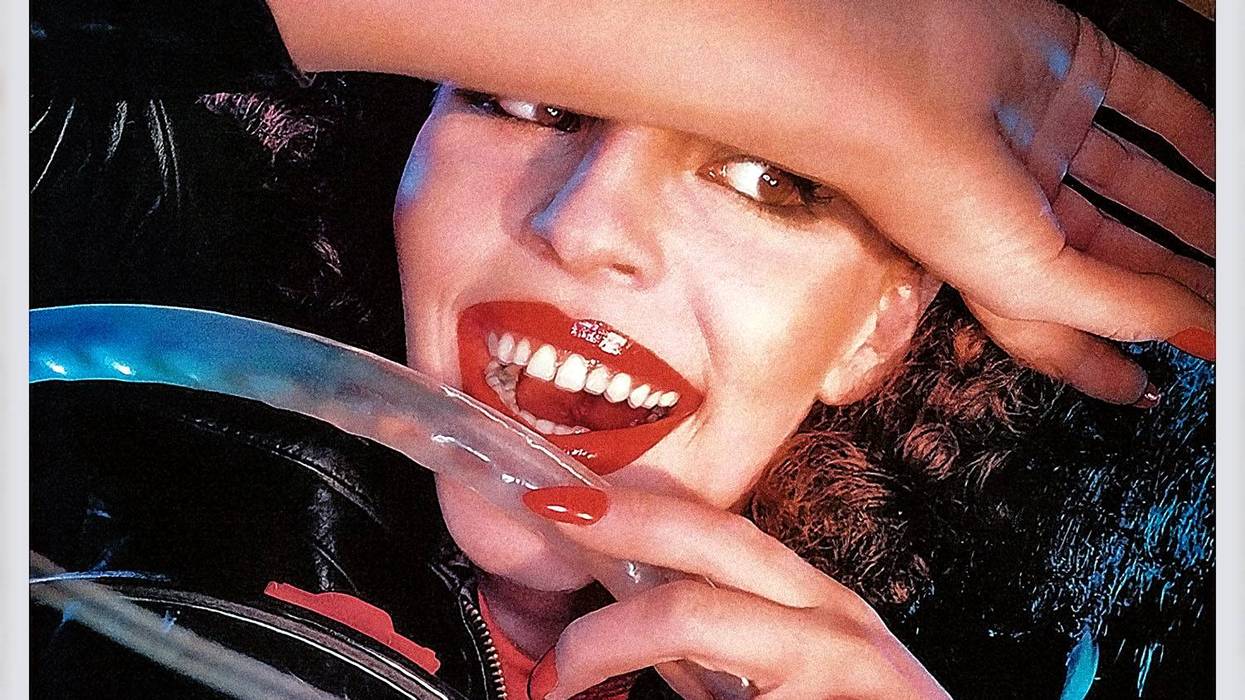
The Cars burst onto the national music scene in the late 1970s, capturing the attention of rock radio listeners when the demo of their now-classic “Just What I Needed” went what today we would call “viral.” In the 1980s, the band was also a constant presence on MTV. Like the uniqueness of the Cars’ music, with its quirky mix of pop, rock, and new wave, guitarist Elliot Easton’s playing defies labeling, his genre-hopping blend of rock, blues, jazz and rockabilly seamlessly knit together by his savvy and adventurous musical sense.
Easton’s classic solos and creative rhythm playing turned so many of the Cars’ songs into thrilling guitar adventures, without overshadowing them. Let’s see if we can decipher just how he did it.
Knowing Your Stuff
Easton attended Boston’s Berklee College of Music, where he studied guitar, arranging, and composition. While his peers were leaning heavily on Eric Clapton, Jeff Beck, and Jimmy Page, Easton—who is a big Clapton fan—also loves classic Telecaster players like James Burton, Steve Cropper, and Clarence White. Armed with the skills he learned at Berklee, Easton approached his solos from more of a jazz perspective, wending his way through the chord changes creatively, without relying on simply playing pentatonic licks in the song’s key. He deftly shows us how in his solo from the title track of 1981’s Shake It Up. It packs quite a wallop and is widely considered to be one of his best.
In the key of C, Ex. 1 illustrates how Easton nimbly navigates the chord change between Am and Bb, the bluesy b7 chord.
Ex. 1
Over Am, he plays a wicked lick based on the A blues scale (A–C–D–Eb–E–G). Now, he could have continued to use the same scale over the Bb chord. However, in bar two, Easton instead chooses to slide into a Bb triad (Bb–D–F) starting on the “and” of beat 1. He then tops things off with a tasty whole-step bend into D, the 3 of Bb.
Let’s see how we can apply Easton’s approach to create our own phrases. First, Ex. 2 shows how to play the three Bb triad shapes up and down the neck. (You’ll find these on any set of three adjacent strings, though the fingerings change slightly.)
Ex. 2
Now, we can create more Easton-inspired licks with the two new triad shapes. Ex. 3 begins with an A minor pentatonic (A–C–D–E–G) phrase in the eighth position, leading into the new Bb triad shape at the 10th position, and ending with a nod to Easton’s tasty final bend.
Ex. 3
For the Bb chord in measure two of Ex. 4, we lend a new bluesy touch on beat 2 by employing a half-step bend from Db to D, moving between the chord’s b3 and 3. This makes the lick sound less “clinical” and gives it some fire. Staying aware of these subtle elements will serve to add genuine personality to your playing. Easton’s is chock full.
Ex. 4
Expanding Your Horizons
Most mainstream rock guitarists of the 1970s and ’80s didn’t openly draw very much from disparate styles of music. As mentioned above, Easton was drawn to the pedal-steel-inspired playing of Clarence White, guitarist for the bluegrass group the Kentucky Colonels and the rock band the Byrds. He was also a fan of the Bakersfield sound, the offshoot of country music coming out of the California city, played by the likes of Merle Haggard and Buck Owens.
Easton notably pays homage to those styles in the Cars classic “My Best Friend’s Girl” from their 1978 self-titled debut. First, there’s his rhythm part in the chorus.
A boilerplate country guitar part of this variety would generally be played fingerstyle (or with hybrid picking) and include a Travis-picked bass line, as illustrated in Ex. 5. Note that it is traditionally played with a slight palm-mute on the lower three strings only.
Ex. 5
Let’s look at how Easton retrofits his part to make it just right for this song. Ex. 6 is based on what he plays in the chorus.
Ex. 6
Note how Easton omits the bass notes, which don’t quite jibe rhythmically with what bassist Benjamin Orr is playing. He also exclusively uses his pick, adding brightness to a part that is the star of the show here. (Note that the studio version is sped up, causing it to sound a half-step higher.)
In the second bar of his solo, Easton neatly slips in a Clarence White-style like (Ex. 7) that fits the song to a T.
Ex. 7
The opening dyad involves simultaneously executing two bends, one a half-step, the other a whole-step. To pull this off, it’s best not to think too much about it, as the 1st string has more tension than the 3rd, lending itself more easily to bending just a half-step. Lastly, to get that genuine country sound, play the dyad with your pick and middle finger. The rest of the phrase can be played the same way, though Easton chooses to use his pick.
Style with Substance
Easton’s penchant for colorful bends is also apparent in the title track of the Cars’ 1979 album, Candy-O. His solo enters like a freight train, fueled by achingly slow bends, which again include both the half- and whole-step variety. (He even repeats the phrase a couple of bars later.) Ex. 8 is both challenging and fun.
Ex. 8
An effective way to execute this phrase is to fret both strings with your 3rd finger, bending them downwards towards the floor. But be sure to use your 1st and 2nd fingers to help support the bend. Again, personality rules the day in Easton’s playing; his entrance here is deceptively simple and is both striking and unforgettable.
Part of the charm of Easton’s style is the imaginative way in which he constructs his parts, as in the pre-chorus of “Magic,” a hit from 1984’s Heartbeat City. Singer and guitarist Rik Ocasek’s song presents Easton with a standard VIm–IV–V–VIm chord progression, which in the key of A is F#m–D–E–F#m. Ex. 9 is based on the magic Easton conjures. It’s doubled by keyboardist Greg Hawkes’ synth for effect.
Ex. 9
Here, Easton takes a commonplace progression and creates an earworm of a part by allowing the open 1st and 2nd strings to ring through all of the chords. It’s a new hook we look forward to hearing as the section approaches, and, as is often the case, Easton’s guitar makes the song that much better.
In “Magic,” Easton again begins his solo in a unique and ear-catching way (Ex. 10). He simply plays one note over the entirety of the first three bars, continually re-striking it to propel it rhythmically. It couldn’t be simpler, as the note is A, the root of the key. But fueled by imagination, simplicity can create remarkably powerful statements.
Ex. 10
Easton has said he doesn’t improvise his solos, but instead works them out beforehand. Still, his playing is imbued with a sense of inspired spontaneity, as is the Cars’ music, some of which goes back almost 50 years. The hits still sound fresh, and, together with the deep cuts, they are a treasure of Easton’s guitar goodness.
Question:What’s the loudest gig you’ve ever been to?
Scott Brigham (The Flatliners)
Toronto punk vets the Flatliners launch their new record, Cold World, on May 8 via Equal Vision Records and Dine Alone Records.
A: I believe the loudest gig I ever attended was Fu Manchu at the Opera House in Toronto back in 2004. I would have been around 16-17 years old at the time, and I’m pretty sure I had to borrow my older brother’s ID to get into the 19+ show. I remember being very excited to see them play, and then instantly fearful that I was going to go deaf as they absolutely blared through the speaker. The bass was so loud that I started feeling convulsions in my chest and thought I was going to die. Fantastic show!
Obsession: I recently watched a live performance from Beck where I was just floored by his guitar tone, so I had to dive in. Not sure if he was actually using this, but my quest ended with me obsessively looking up articles and videos of the Foxx Tone Machine fuzz pedal. Just such a fantastic ’70s octave fuzz sound that I realized was probably used on a lot of my favorite records growing up. I would have to sell a body part to get one of the original pedals now, but there seem to be more affordable retro-minded options out there that I’m excited to explore.
Richard Bienstock, Editorial Director
A: Appropriately, the loudest show I’ve ever seen came courtesy of one of this month’s featured artists—and no, not José González. It was, of course, Sunn O))), what I believe was a late-night CMJ set at the Bowery Ballroom in New York City, sometime in the early-to-mid 2000s. I’ve looked for information about it online and can't find anything, so if any of those details are wrong, I blame Messrs. O’Malley and Anderson for melting my brain that evening, as intended, with their sub-atomic Sunn amp transmissions. It was almost unbearably loud, but the low end also gave the feeling of both levitating you and piledriving you into the ground—mesmerizing, transporting, and, again, as intended, fairly nauseating.
Ted Drozdowski, Contributing Editor
A: Slayer, on the Clash of the Titans tour in 1991, along with Anthrax and Megadeth, at the Great Woods amphitheater in Mansfield, Massachusetts. I was in the 13th row when Slayer took the stage. They were absolutely blistering and inspired, but so loud that the double-kick drum was vibrating my nasal septum—hard! It freaked me out and I decided to fall back to the safety of the lawn, where the show was still a mighty, muscly spectacle.
Ted’s latest songwriting inspiration, Annabelle.
Obsession: Dogs are a constant obsession. I wrote a song for my dear late dog Dolly when she was still with us in 2020, called “An Old Dog’s Love.” Now I’m about halfway into one for her successor, Annabelle. As people in the music biz might say, she has great ears.
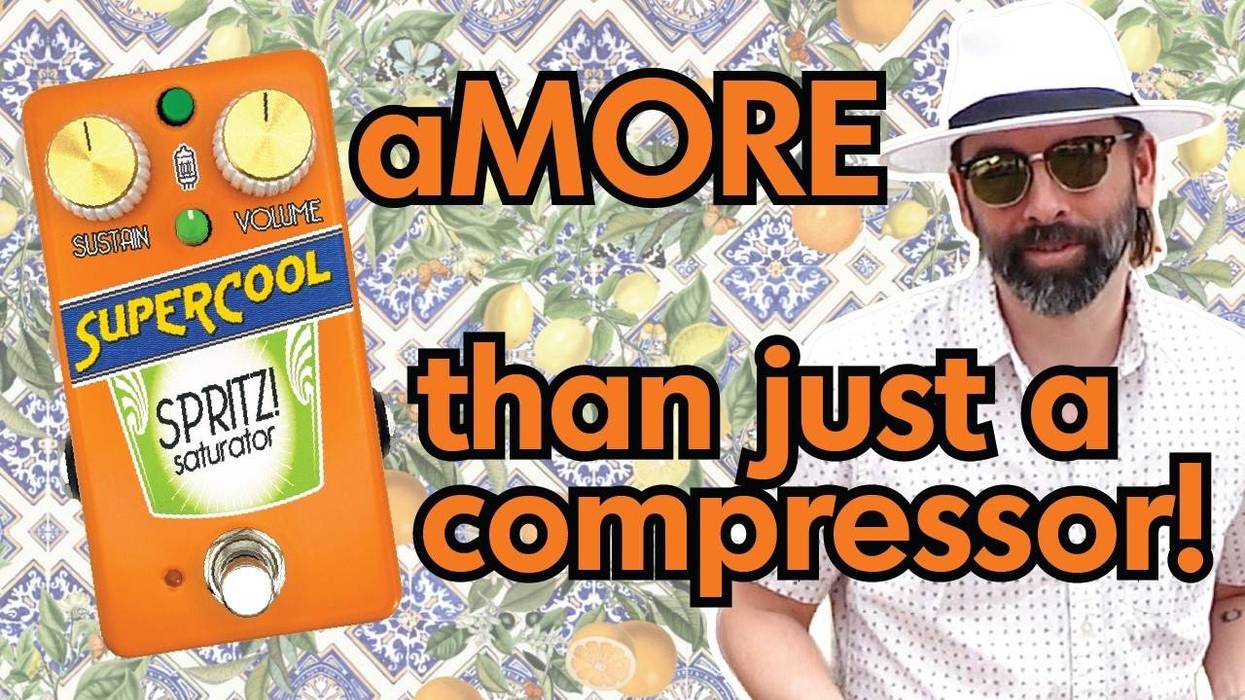
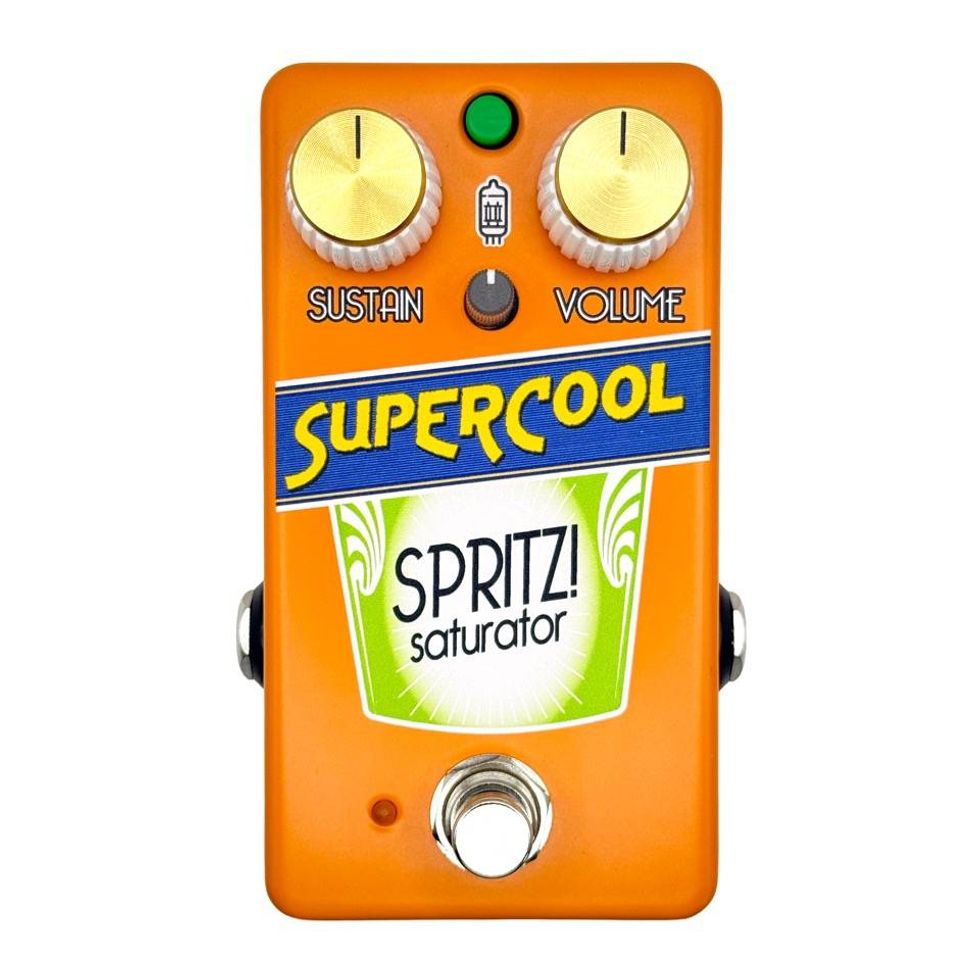
Supercool Pedals has announced the next pedal in their ever-growing lineup: The SPRITZ! Saturator – a clever take on a classic compression circuit mixed with a NEW “tube simulator” drive circuit that is sure to please even the most refined palettes.
Inspired by cult-classic OTA-based compression circuits (Ross Compressor, Dyna Comp), the SPRITZ! Saturator is, at its core, a wonderfully clean and easy-to-dial-in compressor that delivers crisp and juicy saturation with improved bass response. However, the SPRITZ! Saturator takes things even further with its clever “tube simulation” circuit, which adds a single JFET transistor into the mix to deliver a wide range of grit from natural amp-like breakup and harmonically-enhanced attack, all the way to searing-hot tube amp and overdrive tones.
Dripping with iconic Italian style and satisfyingly simple controls, the SPRITZ! Saturator is the perfect addition to both guitar and bass pedal boards, achieving a perfect mix of subtlety, grit, and musicality to inspire players and enthusiasts alike.
The SPRITZ! Saturator highlights include:
Based on the cult classic ROSS Compressor/MXR Dyna Comp circuits
Simple but diverse compression controls (SUSTAIN/LEVEL)
Full and focused low-end response
Adjustable TUBE SIMULATION circuit for natural saturation and overdrive (enabled via push button and adjusted via illuminated dial control)
True Bypass switching with standard 9v centre negative power supply
Designed and assembled in Canada
The Cutback is the 12th installment in the Supercool Pedals lineup with a street price of $179 USD, and is available for purchase with worldwide shipping through www.SupercoolPedals.com as well as in select independent retailers.
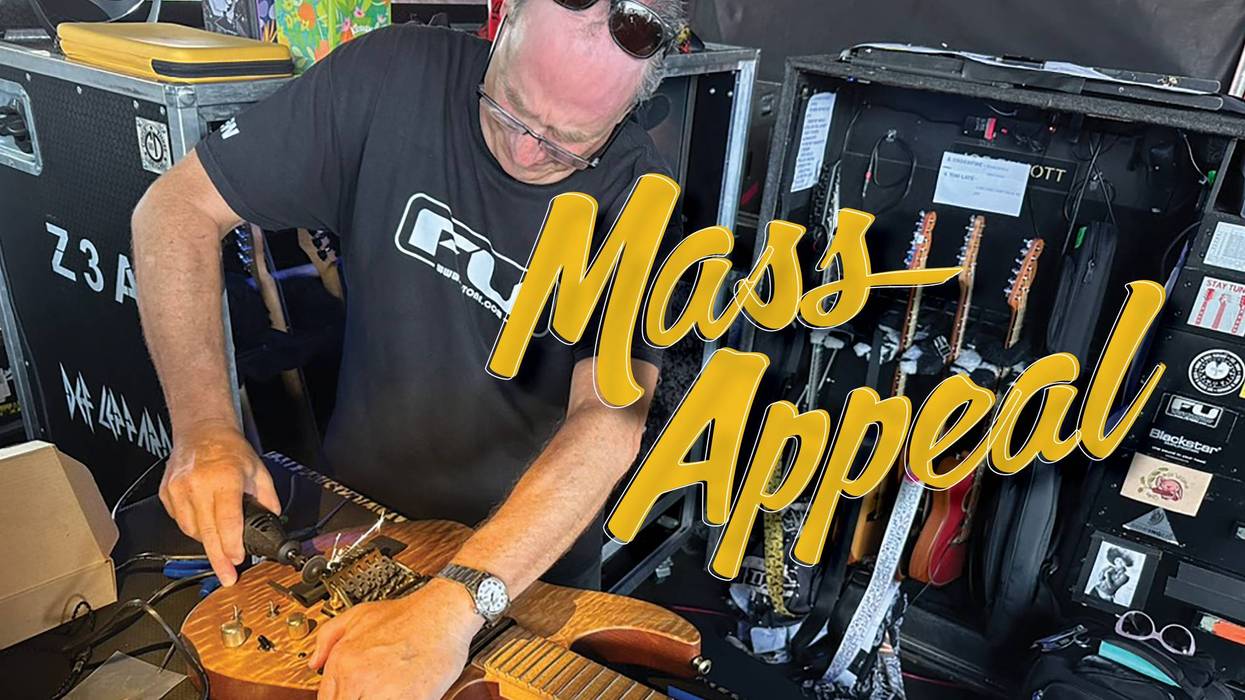
Reiver modifies and upgrades a locking tremolo for Def Leppard guitarist Phil Collen.
Photo by Nadine Joy
If you phone FU-Tone on a Sunday, there’s a decent chance company president Adam Reiver will be the one who picks up. Even after decades in the industry and building a global customer base, he hasn’t distanced himself from his clients—something that, in the age of AI chatbots, can still catch customers off guard.
“People will call, and they go, ‘Oh my god, is this the guy in the video? Is this Adam? I can’t believe I’m talking to you,’” he tells Premier Guitar. “And I go, ‘I can’t believe I’m talking to you!’”
That interaction captures something elemental about FU-Tone and Reiver: He’s one of us. “I'm just a guitar player like you, or some kid in Kansas, or the guy on the cover of Rolling Stone,” he says.
This connection isn’t just a customer service quirk. It reveals a philosophy at the heart of his brand. From the early days of designing the EVH D-Tuna to the present, this approach has shaped FU-Tone into a tight-knit community of dedicated musicians from all walks of life.
It also explains why so much of what Reiver builds and talks about centers on helping players take full control of their tone—not just upgrading their instruments, but understanding them.
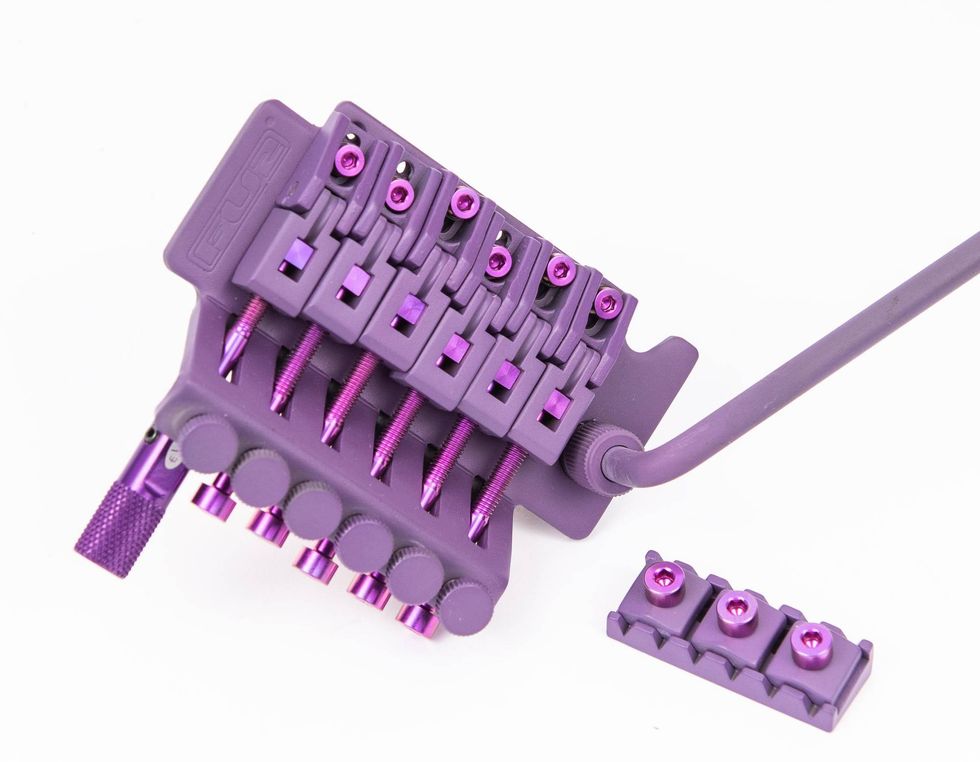
Custom FU-Tone tremolo bridge with EVH D-Tuna and locking nut.
Photo by Nadine Joy
To fully grasp how deeply this mindset is embedded, it helps to look at Reiver’s own journey as a player. His story began at a moment when guitar culture ruled the world, during a shift from traditional sounds into more experimental territory.
“It was around ’81 when I first really found the guitar,” he says. “And if you roll the clock back two or three years from there, it was basically, ‘Do you want a Strat, a Tele, or a Les Paul?’ And then off you go. I didn’t think modding and hot-rodding guitars were a thing.”
Reiver was there at ground zero to witness the shift toward customized superstrats, the rise of early custom-shop brands like Jackson and Charvel, and brand-new horizons in playing technique. Not wasting any time, he jumped in headfirst, becoming fascinated with how he could change, improve, and completely reimagine his favorite instruments.
“My first guitar was like a cheap, $200 Hondo Flying V,” he says with a touch of pride. “But by the time I was done with it, it had a Kahler in there. It had an Invader pickup in the bridge. It had a Mighty Mite triple-coil pickup in the neck. It was like, do anything you could do to just tinker and play with the guitar.”
Just about everyone who’s played electric guitar for any amount of time is familiar with that unexplainable pull to hot-rod their favorite instrument. In Reiver’s case, however, it was more than curiosity. It was a new paradigm. The guitar was not a finished product. It was a platform.
“The advent of FU-Tone was, ‘How do you make this guitar sound better?’”
While other tinkerers of his era pursued those same goals by winding pickups, building guitars, and adding wild finishes, Reiver’s curiosity found its outlet in fabrication. Thanks to his high school’s metal shop, he wasn’t modifying existing parts—he was making new ones.
“I was not a good student, except for that class,” he recalls with a laugh. “I got straight As in metal shop. I liked how you could fabricate parts from an idea in your head. Like, ‘How do we do this? How do we get this idea from here to there?’”
That experience translated directly into how he would later develop products. Even before founding Floyd Upgrades—FU-Tone’s original name—his process was simple and immediate. Draw something, build it, test it, refine it. Still, Reiver admits he’s no machinist.
“I know enough just to be dangerous, just to get myself in trouble. So I contracted with this guy who was a professional machinist. I would literally sketch something on the side of a box and say, ‘Can you make this?’ He would whip it up old-school and bring it back to my office.”
This spirit of experimentation wasn’t just limited to those early years. That same trial-and-error approach still defines FU-Tone products today. Instead of designing in isolation, Reiver works through ideas with the instrument in hand, adjusting based on feel and response. And as with his in-house machinist, he doesn’t work alone.
One of Reiver’s most celebrated “assistants” was Eddie Van Halen himself. Working in a small team alongside Eddie, he helped develop the EVH D-Tuna through a similar cycle of experimentation, providing locking-trem players access to instant drop-D riffage.
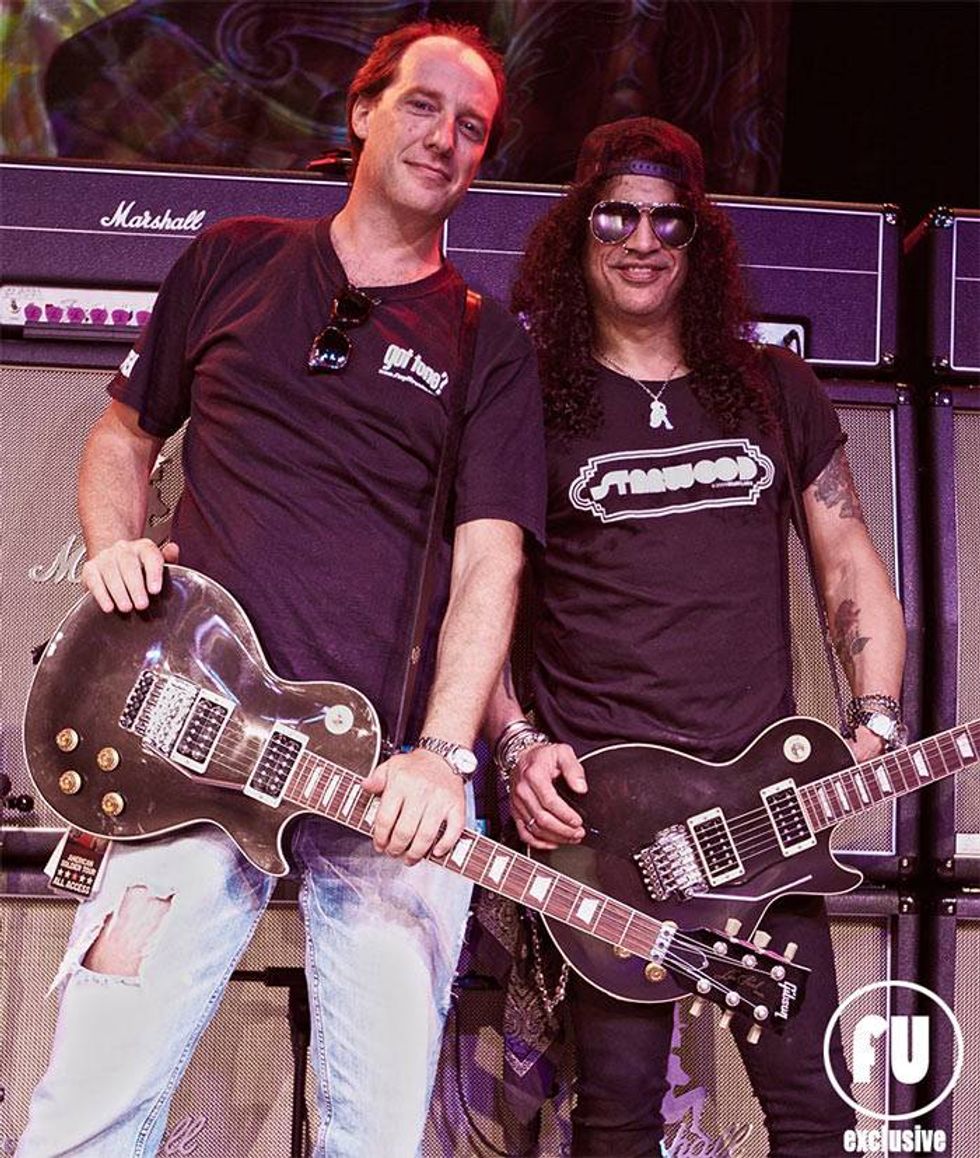
Reiver with Slash
Photo by Nadine Joy
“[That process] became a melting pot,” Reiver says. “It would be one of those side-of-the-box conversations. I would say, ‘Well, maybe we should angle it a little, make this longer, make that shorter, make this, do that.’ I would put it on a guitar, and [Ed] would monkey with it, and say, ‘No, no, no. Do this. Do that.’”
Like Reiver, Van Halen used the guitar as a testing ground, emphasizing constant refinement in pursuit of maximizing tone. And their early success only signaled the start for Reiver.
“You know, the advent of FU-Tone was, ‘How do you make this guitar sound better? How can you make this sustain more? How can you make it clearer? How can you make it louder?’ That’s where it came from.”
With tone chasing now an obsession, Reiver turned his attention to a specific piece of hardware, one most players assumed Floyd Rose had already perfected: the tremolo. The way Reiver saw it, the point where the guitar strings terminate in the body was the most important piece of the tonal equation.
“I don’t care if you play rock, metal, death metal, country, or pop—you want to have a good guitar tone.”
“In the beginning, that was the biggest thing, and I started making one product, a 37 millimeter Big Block,” he says. “I was like, ‘Wow! It sustains way more, it sounds better, and it’s more articulate. Okay, I’ll do this.’ I invested $880 to make a run of the blocks, and said, ‘Well, worst-case scenario is I could just give them to my friends, or, you know, sell them online.’”
In theory, the Big Block was exceedingly simple: a larger, heavier brass tremolo block designed to replace the smaller stock versions that came with most locking systems. With its increased mass, it maintained more string vibration, which translated into more sustain and articulation.
The Big Block was a hit, and soon enough, some of the world’s most notorious tone-hound guitarists were spreading the Floyd Upgrades gospel. Reiver realized that if one overlooked component could make that much of an impact, there were probably others.
Soon, he was manufacturing highly regarded double-locking tremolo replacement parts for the most popular trem models available. From titanium fine tuners to the little metal inserts found in each saddle, his theory about the effect of mass on tone proved correct, time and time again.
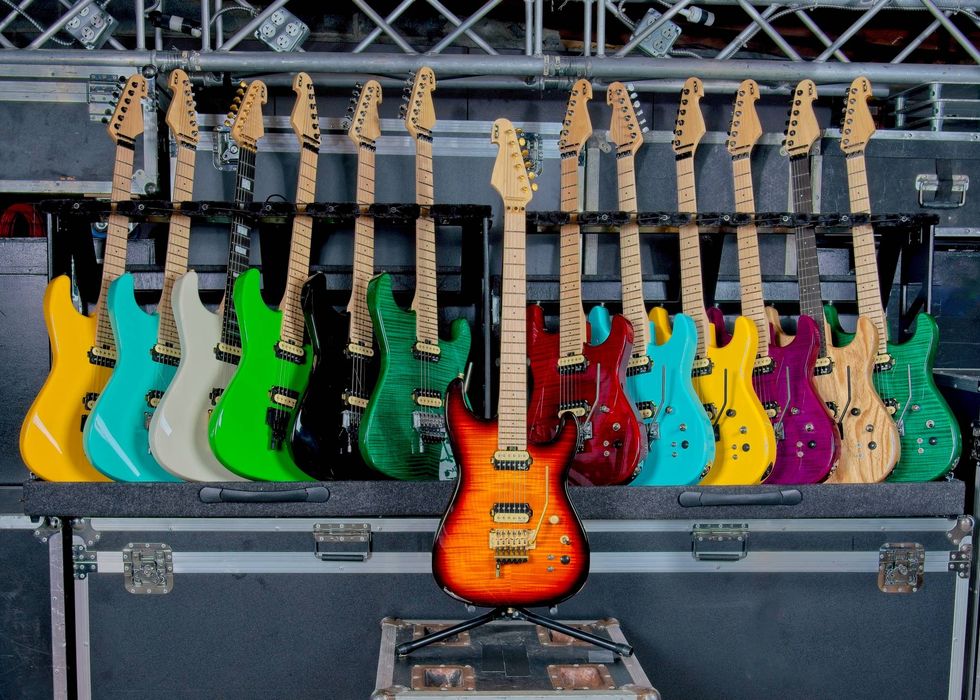
FU-Tone guitars
Photo by Nadine Joy
But while he was gaining users, not everyone was a fan of the moniker: Floyd Upgrades.
“A certain company didn’t like me using part of their name in my little company, and that’s fair enough,” Reiver acknowledges. “But the real blessing in disguise was that I became FU-Tone. And thank god I did, because I ended up going on to do so many other guitar parts and projects that have nothing to do with someone else’s brand.”
With a new name over the office door, FU-Tone was free to innovate and expand much further into the electric guitar market.
“FU-Tone encompasses a lot now,” Reiver says. “I make stop tail bridges. We make Tele parts. I make my own locking tremolos. We make guitars. We even make pickups.”
This relentless expansion is about more than just product lines. From tiny titanium (or brass or copper) saddle inserts to full guitar builds, every FU-Tone offering still reflects Reiver’s original conviction: tone isn't tied to any single component, but to how everything works together. It’s what Reiver has characterized as the “FU-Tone vein of tone.”
“I still pinch myself every day that I get to work with people I looked up to and tried to play like, and now I’m sitting in their living rooms.”
But what is that tone? Reiver explains: “FU-Tone vein of tone means lots of sustain, clarity, and articulation. It’s considering the wood and essence of your guitar, your hands and your playing, and then moving far beyond that.”
That idea shifts the conversation away from chasing specific gear and toward understanding how your instrument actually responds—where every material choice becomes another variable in the final sound. So what can you expect when you swap out your Ibanez Edge tremolo block for a brass or titanium one? What’s the tonal difference in the metals used in their Nancy Wilson-approved acoustic guitar bridge pins? Forever a gear nerd, Reiver’s always happy to explain.
“Brass is big and warm and round. When you think of brass, think of Eddie Van Halen, Warren DeMartini, or a George Lynch-type of sound. Titanium has a lot of sustain, but with a certain level of clarity to it, almost like a layer of glass, with really nice note separation. And copper I find to be very similar to brass, with more of a scooped-out midsection.”
From icons like Nuno Bettencourt and Slash to modern players like Lzzy Hale and Nita Strauss, countless A-listers have credited FU-Tone upgrades with having a meaningful impact on their signature sounds.
But FU-Tone products aren’t just for stars. They’re for all guitar players, and they’re also very DIY-friendly. Reiver swears that if you give him a few minutes and watch one of the company’s detailed how-to YouTube videos, you’ll be customizing your favorite instrument in no time. “If you’ve never done any of this, it can seem very intimidating,” he says. “But if you have the ability to change your own strings, you can do this.”
As a guitarist himself, Reiver knows firsthand how badly a trip to the local “expert” can go—which is exactly why he’s worked to democratize the process.
“I’ll get a guy who will buy some parts and take them to his local guy,” Reiver explains, “and he’ll say the same thing [I always hear]: ‘My guy said…’ And I’m thinking, ‘Here it comes!’ I’ve even gotten on a Zoom with guys and walked them through it. And by the end, they’re better than ‘their guy.’ I tell them, ‘You’ll never pay someone else to do it again [laughs].’”
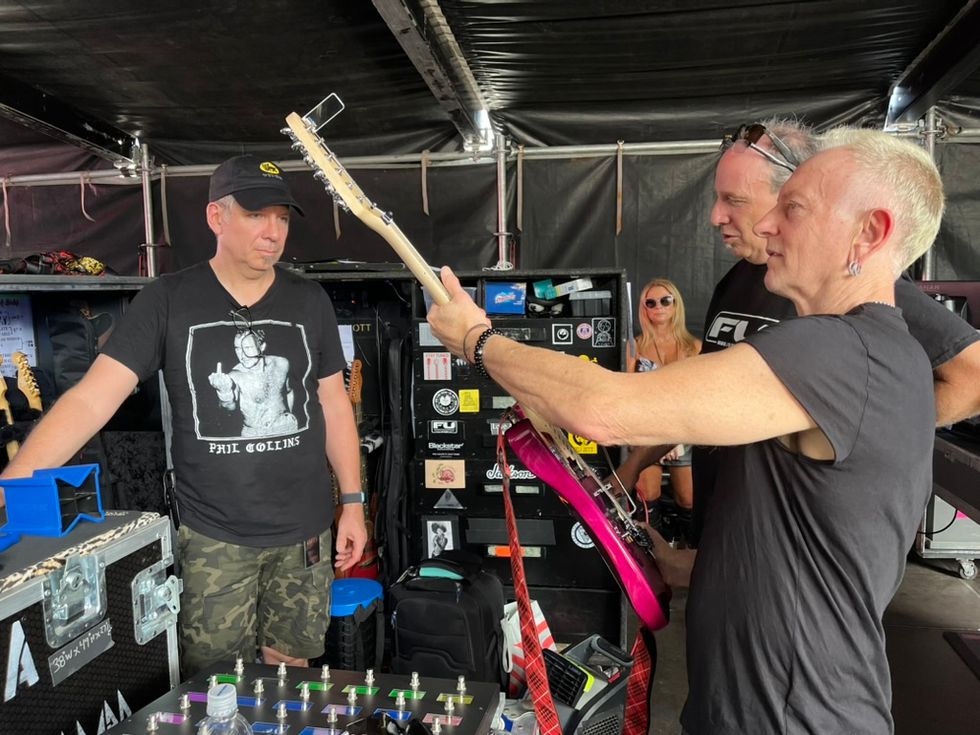
Reiver examines an FU PRO guitar with longtime FU-Tone client and friend, Def Leppard guitarist Phil Collen.
Photo by Nadine Joy
Personal Zoom calls from a company president aren’t exactly standard practice in this industry. For Reiver, though, that’s the point—growth through relationships, not traditional marketing. “I have a handful of core guys that are all still dear friends to this day,” Reiver says. “But one of the guys who was there in the very beginning was Phil Collen from Def Leppard. After that, my phone would ring, and it would be some big artist, and they would say, ‘Phil has this on his guitar, and said to call you.’”
That kind of connection establishes a level of trust that can’t be manufactured. And for Reiver and the FU-Tone team, it also shapes how those relationships develop.
“These are not clients—they’re friends,” he says. “We’re at each other’s houses. We’re at each other’s events. It’s organic, and it’s real. I still pinch myself every day that I get to work with people I looked up to and tried to play like, and now I’m sitting in their living rooms.” He laughs. “But I play it totally cool.”
With an artist roster that includes Gary Holt (Exodus, Slayer) and Michael Wilton (Queensrÿche), it might be easy to assume FU-Tone is strictly for shredders. But Reiver’s products have found traction with players across genres and styles, and though he’s a rocker himself, he’s consistently surprised by the range of sounds and approaches the broader FU-Tone community brings.
“I’m not a big country fan, but I can tell you, those guys are the most badass musicians,” he says. “We’ll get the guys in Rascal Flatts, Jim Kimball from Reba [McEntire]’s band, Paul Sidoti from Taylor Swift’s band. I don’t care if you play rock, metal, death metal, country, or pop—you want to have a good guitar tone. I’ve been doing this for over 30 years, and that never gets old.”
FU-Tone may operate on a global scale, but it’s still rooted in the same instinct that led a high school kid to start modifying a budget guitar—and the same belief that the best conversations about tone happen one player at a time. Which is why, if you happen to call on a Sunday, you just might end up talking tone with Adam Reiver.