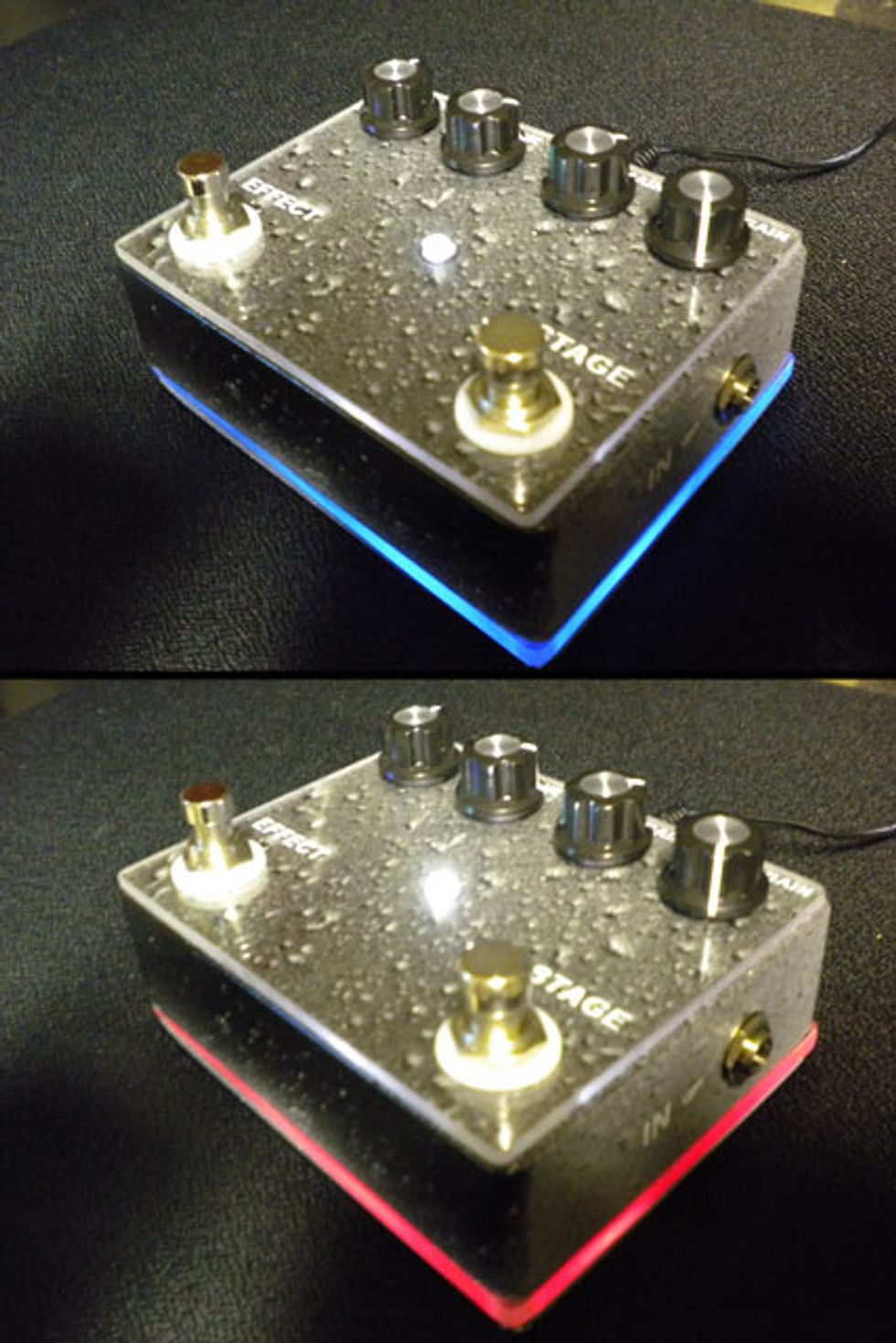
"Scrase's DIY overdrive pedal has Level, Tone, and Red and Blue gain knobs. The pedal's glowing LED border changes colors based on which gain setting is active. "
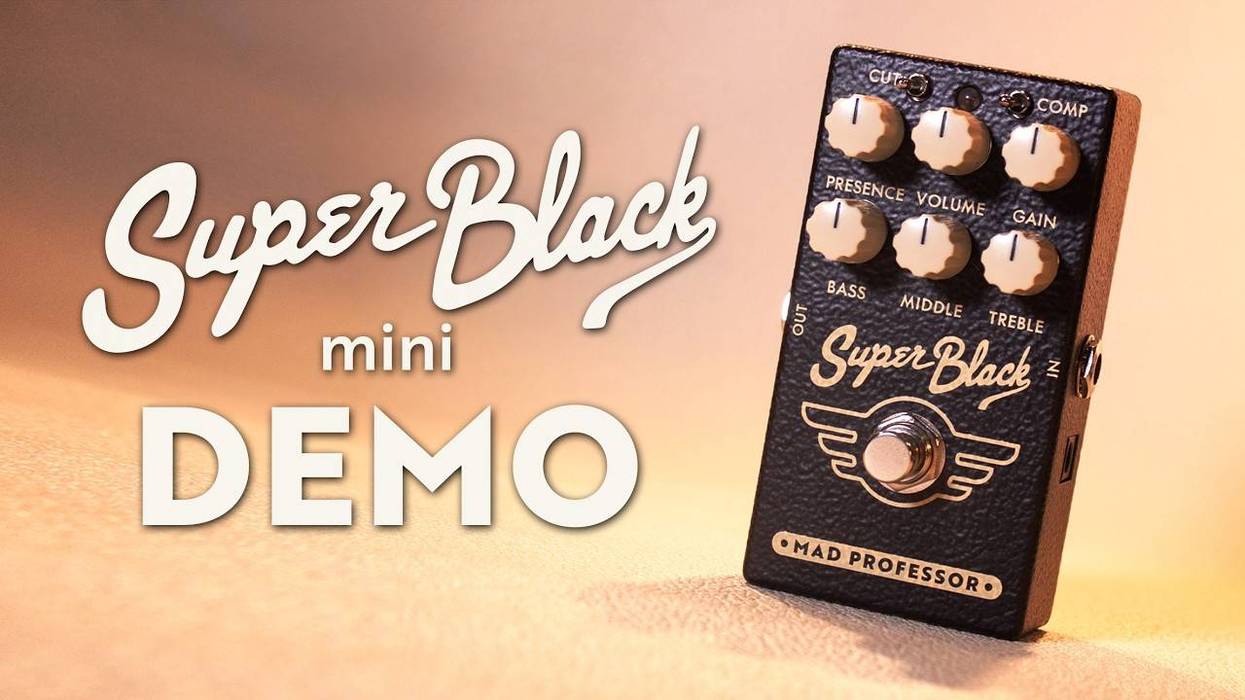
Mad Professor Amplification has released an updated version of the award winning Super Black pedal. This new compact version has increased headroom and output level along with the new smaller footprint.
The all analog circuit replicates the whole signal path of the legendary 60’s Black Panel amplifier in a pedalboard friendly format. From sparkly clean tone to powerful overdrive, this pedal will give you all the dynamics of the amp with no need for excessive volume. The SB mini can be used as a tone shaping overdrive in front of an amp or as a standalone preamp straight into a cabinet IR or FX loop return of an amplifier.
High headroom preamp/overdrive pedal for guitar and bass
Can be powered from 9V to 18V – increased headroom with higher voltages
Super Black mini is part of Mad Professor’s factory series manufactured in Taiwan. Preorders now open at www.mpamp.com and pedals will ship on July 1st. Available also from official retailers. Suggested retail price 219€ (US street price 219$).
Pearl Jam outlasted just about everyone who came out of Seattle, and more than three decades on, they still command one of the most devoted followings in rock. To dig into their guitar work, we called on Mark Hopkins—host of the YouTube show At Home with Mark and the biggest Pearl Jam fan we know—who walks us through Stone Gossard's songwriter's instinct, the surprising difficulty of soloing cleanly over "Yellow Ledbetter," and his case for Yield as the band's masterpiece. And of course, we settle once and for all whether Pearl Jam is a jam band.
Thanks to our Sponsor!
Brought To You By Rocky Mountain Slides www.premierguitar.com
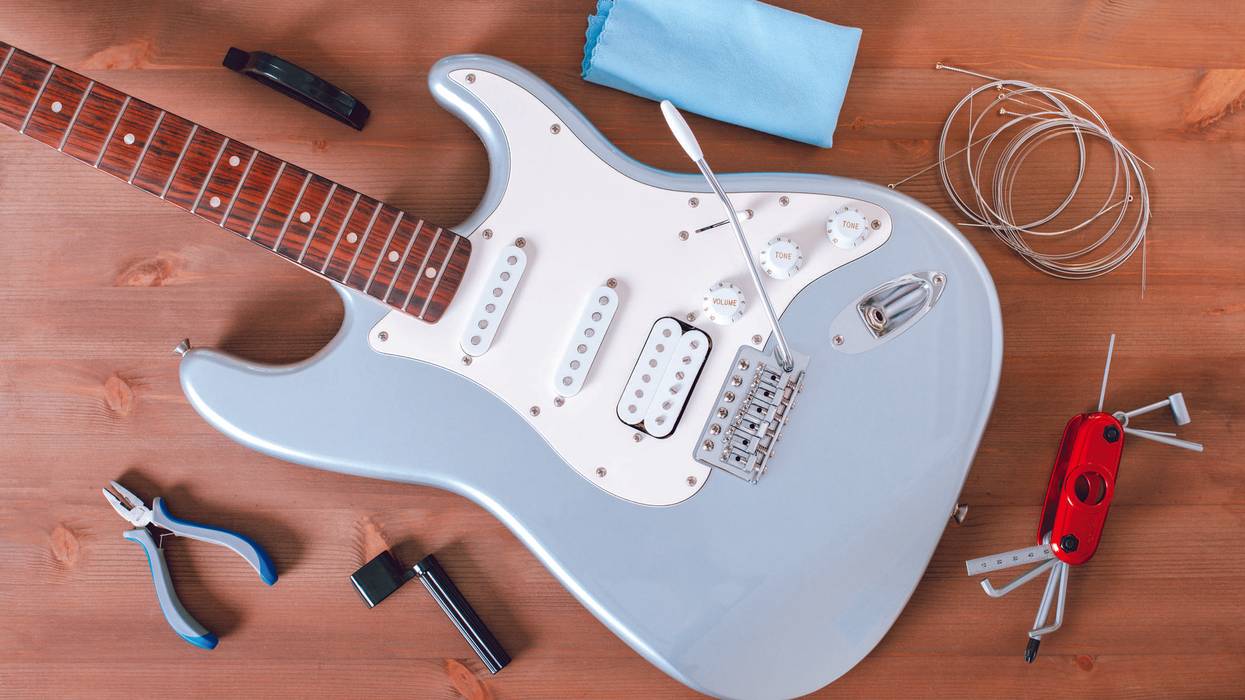
There are a lot of different personal choices in the world of guitar. We all have our priorities, but they usually revolve around things like sound, versatility, comfort, and, of course, aesthetics. After over five decades in the business of making, repairing, and playing guitar, I don’t believe I’ve actually reached the end of how varied guitarists’ priorities can be. Playability is right near the top of concerns, yet almost every guitarist might define that term differently—if they can articulate it at all. Some are concerned about string height, while others are oblivious to the difference it can make. Others feel that the width of a neck is the most crucial factor, while some insist that all fret buzz must be eliminated. As you can see, it’s a complicated equation.
Generally speaking, setup is a personal choice, and the metrics to achieve a good setup are always a compromise—which is a tough pill for some to swallow. The idea that a setup can be a universal and definite truth is a fallacy, which makes the technician’s life difficult. This is also why one repair tech might get rave reviews from some clients, yet dissatisfaction from others. I’ve built instruments that were rejected by one player, yet went on to become a number one for another. The obvious way to bridge the gap is to rank your likes and dislikes, and learn what factors affect them so you can arrive at a suitable compromise.
Don’t Fret the Buzz
Fret buzz is like any ingredient—a little is alright, but too much is, well, too much. I have a small solid-state practice amp on my bench with a 5" speaker. Despite its famous brand name, it can make any guitar sound pathetic. I use it to set up instruments because if I can get a guitar to sound okay through it, I know it will sound great on a decent amp. So before you blame the buzz for robbing your tone of muscle, check your amp and its settings. This isn’t just for high gain—even sparkling clean sounds can sound better with a change of scenery. Of course, the more gain you employ, the lighter your touch can be, which can be the reason behind most buzzing. If you insist on pounding the notes out à la SRV, raise your action a little and carry on. I’ve played Stevie’s No. 1, and yeah, it buzzed acoustically.
How Do You Gauge Tone?
String gauge seems to be a continually hot topic in the guitar universe, and rightfully so. Heavier-gauge strings generally need more tension to reach the same pitch, while lighter gauges need less tension. So a set of .011s will feel tighter and stiffer than .009s on the same guitar, if all else is equal. The practical tradeoffs are well known: Lighter gauges are easier to bend and require lower finger effort, but may buzz more in lower tunings. Heavier gauges offer more resistance to bending and require more effort to press down on the frets. The benefit is a more solid feel if you play hard and more output since more metal is waving in the pickup’s magnetic field.
Still, don’t be afraid to try a lighter gauge if you use a lot of gain. I worked with the guys in Judas Priest for two decades and was surprised that they strung their guitars with .0075" gauge sets! The gain masked any fret buzz. If anything, it helped create their trademark sound.
Step on the Scale
String gauge isn’t the only factor that changes the feel of your guitar—scale length can be the secret sauce that unlocks something you like. In the 1980s, I designed guitars for a respected guitarist from New York. He had an identifiable sound, but he became enamored with Ed Van Halen’s tonal attack. I mentioned that perhaps he’d like a guitar with a longer scale. I explained that to bring a longer length of string to pitch, it required more tension, resulting in a change in tone. He agreed to give it a try, and the result was a move in the right direction for him.
Balancing Scale and Gauge
It’s easier (and cheaper) to change string gauge than scale length. If you do get a guitar with a different scale, keep your same string set on at first, but be open to the idea of trying a different gauge, too. Also, the simple rule of thumb is if you tune lower, move up in gauge to recover the tension, although I’ve seen guitarists who break that rule with great results. The beauty and mystery of the guitar is that despite the physics—which never change—the results of trying different setups might result in something you like even if it’s counterintuitive. The important takeaway is that you and your setup tech should be patient while finding what works for you best. Once you understand the tradeoffs and accept them, you’ll be happier with the results.
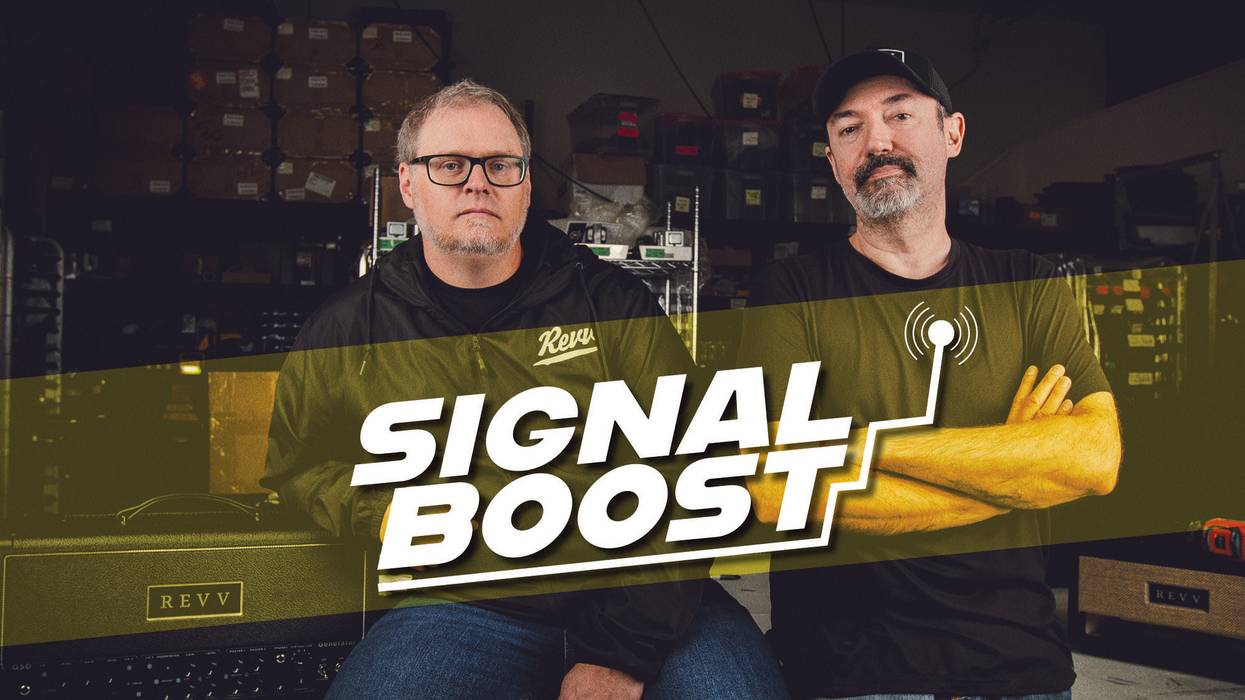
Early on in his run at Revv Amplification, Derek Eastveld knew the company needed a jolt of visibility—a way to supplement the conventional route of print ads and trade shows, a path toward placing gear into the hands of more players. In a prescient move, the VP of sales and marketing turned to YouTube—making human-to-human connections with the folks doing demos and reviews. That organic, word-of-mouth approach, both online and off, became crucial to the Canadian company’s vision.
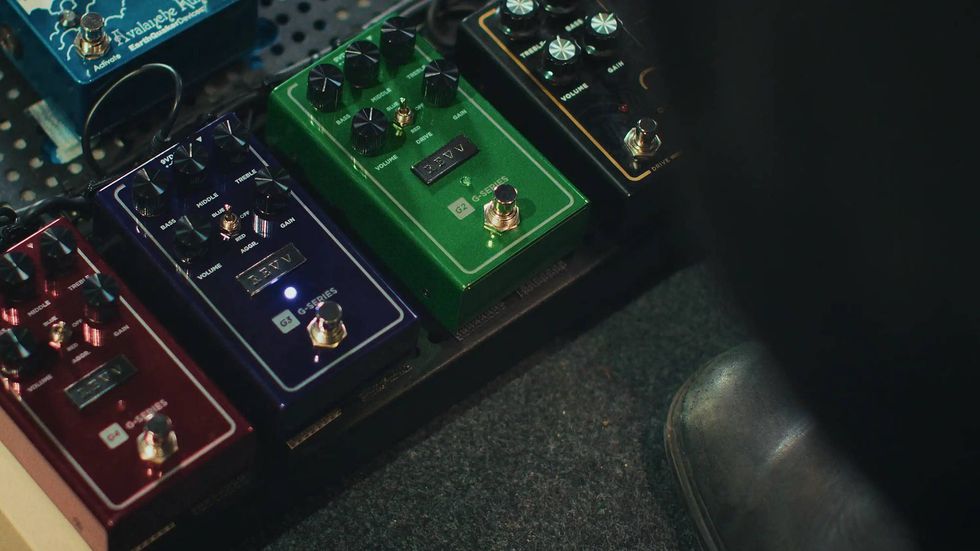
Take, for example, the 2018 launch of their revered high-gain pedal, the G3. Motivated by a Strymon campaign, Eastveld brainstormed an ambitious plan: “[I said], ‘We’re gonna do what [they] did, but on steroids,” he tells Premier Guitar. “We’re going to blanket YouTube with the G3 pedal over a month.” Eastveld remembers flying to Europe as the first videos launched, having no clue what to expect. (Revv, he says, “sees the video almost always at the same time as the consumer,” staying out of the creator’s way.) “When I landed, I opened my email, and we’d sold almost 200 pedals,” he says. “We thought we were going to sell 500 in the first two years. That really spring-boarded Revv into becoming more of a household name.”
These days, Revv might not have the brand recognition of, say, Marshall or Mesa/Boogie, but they’ve become sleeper staples in certain scenes, gracing the rigs of hard-rock slingers, pop-punk riff-merchants, and versatile Nashville session aces. (Dann Huff used the Dynamis D40 amp head to record his 2025 debut solo effort, When Words Aren’t Enough.) That rise has been fueled not by exorbitant budgets but by genuine, grassroots guitar-geek curiosity—a trajectory solidified back in 2013, when Eastveld randomly struck up a friendship with Revv President & Designer Dan Trudeau.
Becoming a partner in an amp company wasn’t exactly on Eastveld’s radar back then, even if it basically amounted to a dream gig for the gear-obsessed guitarist. Growing up in Manitoba, he was introduced to music by the classic rock spinning on his parents’ record player. “We’d play music trivia, where my dad put on the Beatles and Led Zeppelin and we’d have to guess the tune,” he says. He started playing guitar at age 10, with his older brother Scott (now also part of the Revv team) picking up drums around the same time. Six years later, he began giving entry-level guitar lessons at a local music store, and that’s where he caught the bug for gear. (He recalls, for example, encountering the Danelectro Cool Cat and Daddy O pedals and being impressed by the retro aesthetic.) “I wanted to collect every pedal I could, and I would always have extra jobs on the side that would fund me being able to buy cool gear,” he says.
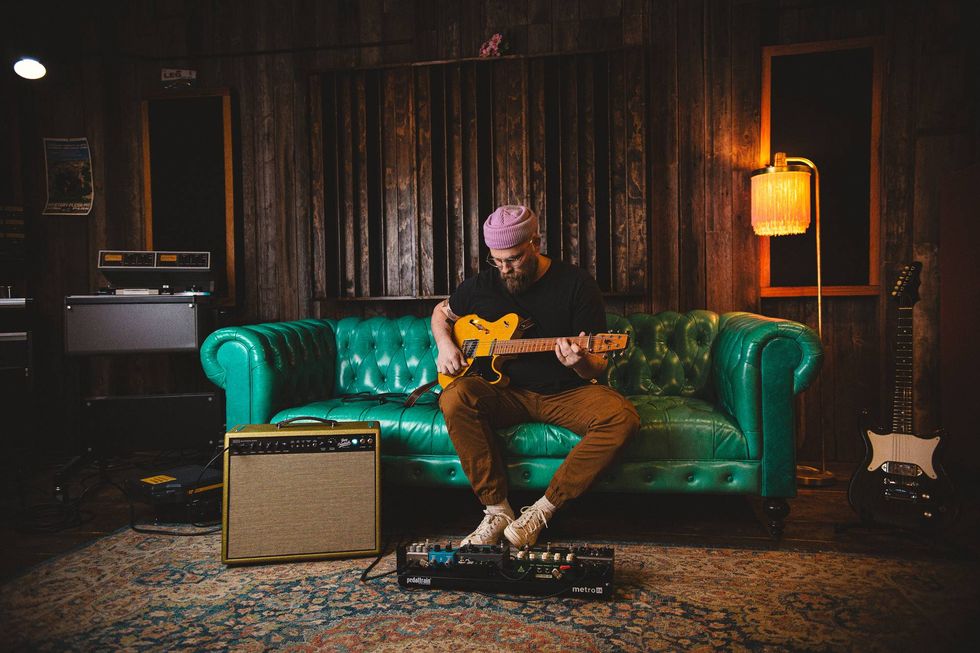
Joey Landreth Playing His Signature D25JL
As exuberant young musicians with loads of gear often do, he started making his own music—and for a while, that seemed like a legitimate career path. “I got involved with Christian hard rock and pop-punk bands around 2000, and we had some regional success in Western Canada, where we’d do mini tours,” he says. “I did that for about seven years, and, like a lot of musicians, I had other jobs.” Some were steady side gigs: He became a stagehand and, eventually, a concert rigger, working “pretty much every major concert that came to Manitoba.” Another day job was equally cool, but more practical: making decals and signs at a screen-printing company, with a speciality in printing on metal. Then, as his band fizzled out, he wound up starting his own screen-printing business—and that’s where Trudeau comes in.
“One day my foreman came up to me and said, ‘I got an email from this guy who used to work for me at another company,’” Eastveld remembers. “‘He’s asking me if we can help out his buddy who’s building guitar amps. I know you’re into the guitar thing. He wants, like, 10 pieces of a panel for the front and 10 pieces of a panel for the back of the amp printed. The job is not worth doing for us, but I know you’re into this stuff, so maybe you want to take a look at it.’”
His curiosity piqued, Eastveld called for more info. Trudeau, it turns out, was having a hard time finding a company that could screen print onto metal. It was a strangely perfect match, given that Eastveld was still a huge gearhead, with a collection that had grown to roughly 10 guitars, eight amps, and 80 pedals. Trudeau, a metal fan and electrical engineer, had been working on amps for local guitarists, but struck sonic gold with his prototype for the Generator, which seemed to fill a void on the high-gain marketplace. When he brought the amp over for a demo, Eastveld promptly plugged it in and was blown away: “I said, ‘Where did you build this, and how did you do it? If you could build me one of these, I’d buy it.’ He starts laughing, and says, ‘Man, I didn’t tell you how much it costs yet!’ I said, ‘That’s okay, because I didn’t tell you how much the printing costs.’”
Back then, Trudeau was hand-wiring the Generators and, given the constraints of his day job, could only finish one per month. But Eastveld knew there was potential here. So he went to Trudeau with a pitch: “I was like, ‘Have you ever thought about having a partner?’” he recalls. “‘No, why, do you know anyone?’ I said, ‘I was kinda thinking about me.’ We went back and forth for a couple weeks and decided in December 2013 that we were gonna partner up.”
He was confident people would flip out over the amp—including guitarist friends like Mark Tremonti, whom Eastveld met through doing band merch. After Trudeau delivered the amp, Eastveld sent it to Tremonti’s manager, Tim Tournier, and asked for his feedback. “He called me right after and said, ‘Holy shit, where did you get this thing?’” he recalls. “I said, ‘It’s a local guy. I just started a partnership with him.’ Tim was playing in a band called Man the Mighty. He said, ‘I want one. I would happily play these live.’ Tim came onboard as an artist. I went to a show and brought one for Mark to check out. He picked one up, and it started to snowball a bit from there.”
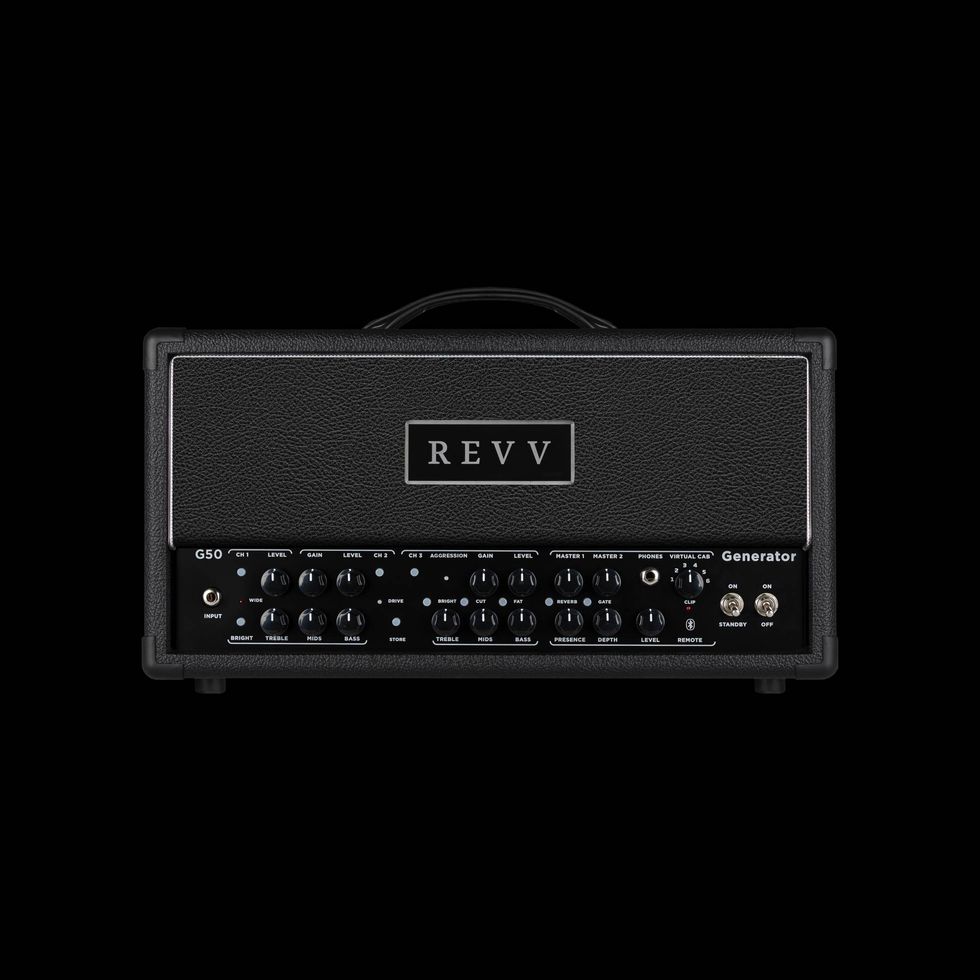
The Generator G50 50-watt head
The Generator 120 has since become Revv’s “flagship” product, featuring four color-coded channels: blue clean, green crunch, purple tight gain, and red fat gain. Everyone who played one back in those early days seemed to rave over it. “We had a product that we felt competed really well against Mesa/Boogie, Peavey—it would at least be in the same class,” Eastveld says. “They’re different things, different flavors. Not saying we’re better in any way, shape, or form, but we knew people would like this.”
But it wasn’t exactly smooth sailing as Revv tried to spread the word, reflected by the company’s confusing first experience at the NAMM trade show, in 2015. They thought they would walk away with 50–100 amp orders, but after the first day, “it became very evident that we were not going to sell anywhere close to that.”
They networked and hustled, even created a promotion to give away a free amp. But with their numbers so minimal, they realized they had to rethink the strategy—which led to their lightbulb-idea with the YouTube community. They reached out to guitarists who had their own channels, some of which were fairly small at the time, and discovered a whole new layer of visibility. Some of these folks would play the amps during guitar demos, which “really started to bring some brand awareness” for the company. By the time of their G3 marketing blitz a few years later, YouTube had become a vital piece of doing business.
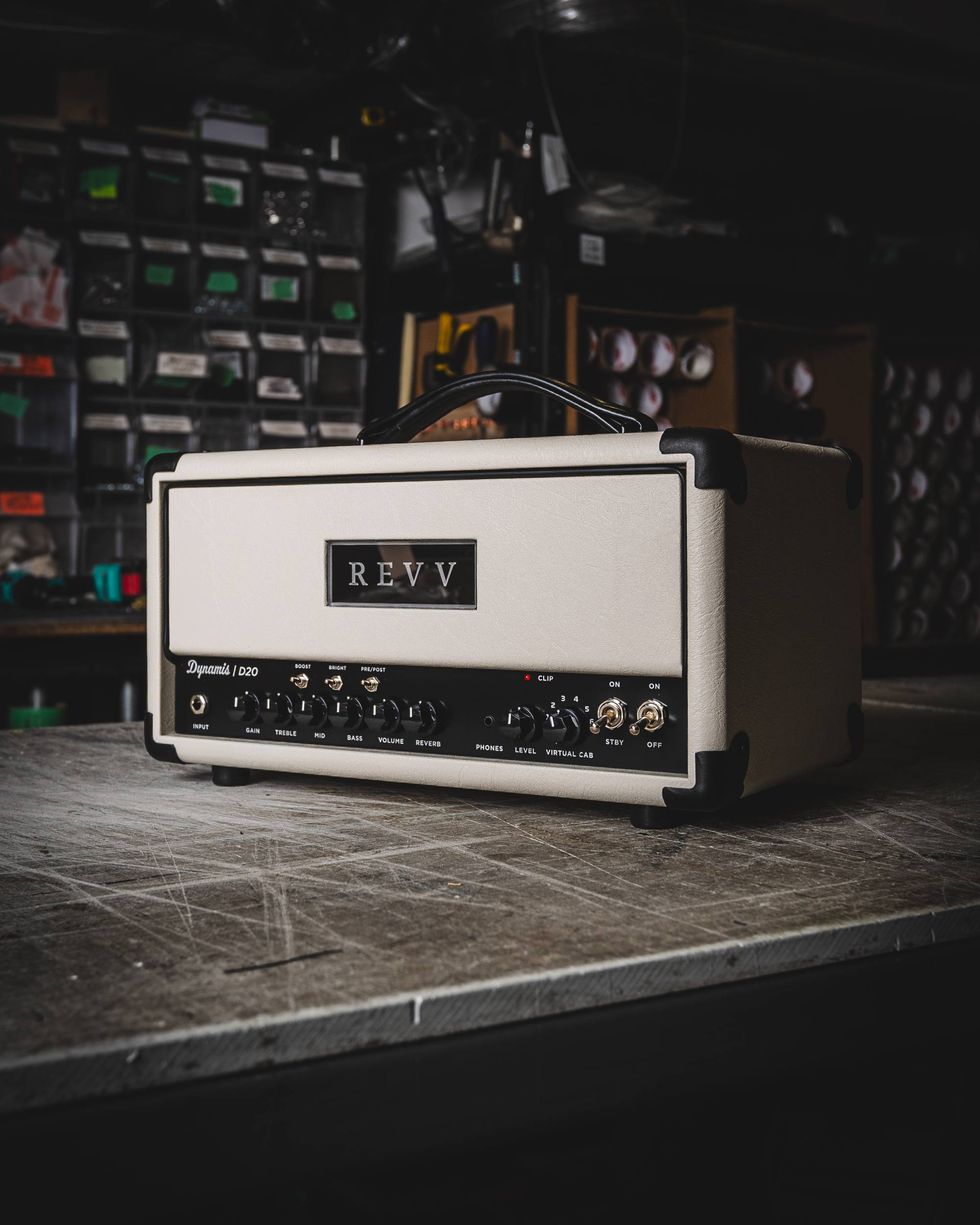
The Dynamis D20 MK2 head
For Revv, it’s all about that hands-on artist connection—getting gear into the right hands, letting people fall in love with it, and trusting that the quality will keep the momentum surging. And there’s no better place to foster a community than Nashville—it may be over 1,300 miles from the Winnipeg area, but it’s become a sort of spiritual home for their Dynamis series. There are currently multiple variants of this amp, including the D20, which has embedded reactive load virtual-cab tech, and the classic D40, voiced with the help of session/touring player Shawn Tubbs (Stone Temple Pilots, Carrie Underwood), with dedicated clean and overdrive channels.
As for how the Dynamis series came to be, Eastveld says, “I told Dan, ‘The clean channel on the Generator is really impressive.’ And I’d never really played a good high-end amp that had a great clean channel. I thought the house-of-worship market and the country market overlaps with the CCM market quite a bit now. And the tones these guys go for—if we just warmed up the clean channel on the Generator a little bit to where it took pedals a little better, I think it would do really well in that space. That being said, I don’t think anyone will pay attention to it if it’s a four-channel amp that just has a great clean channel. Most people hear with their eyes first. They see the Generator and see a lot of knobs and four channels and that it looks like a high-gain amp—if we do something a little different, maybe a nice clean channel and then maybe a crunch channel that can get saturated but not super high-gain, I think there would be a really big market for that. We’re probably going to want more than one line.’”
Working with Tubbs was crucial on two levels—first, he was “really influential” in the voicing of the D40, but he also “opened a bunch of doors” through his connections with other session players. Eastveld has also found a home-away-from-home in Nashville, traveling there for weeks at a time to work and host events. “It’s unbelievably welcoming,” he says. “The Southern hospitality thing is very true. There was no gatekeeping.” These days, you’ll probably find Revv all over the studios of Music City.
The company is continuing to evolve: Their current lineup features numerous amps, including the recently unveiled Generator G25, their “high-gain answer to the D20”; a handful of speaker and cabinet models; and an array of pedals, highlighted by their recent invention, the Dirtdog, which replicates the sound of a modded—and, eventually, blown-out—Princeton amp clone Joey Landreth used to record Dog Ear, his 2025 album with the Bros. Landreth. “That’s the kind of stuff we get excited about,” Eastveld says, “where we’re like, ‘Yeah, that’s something that doesn’t exist.’”
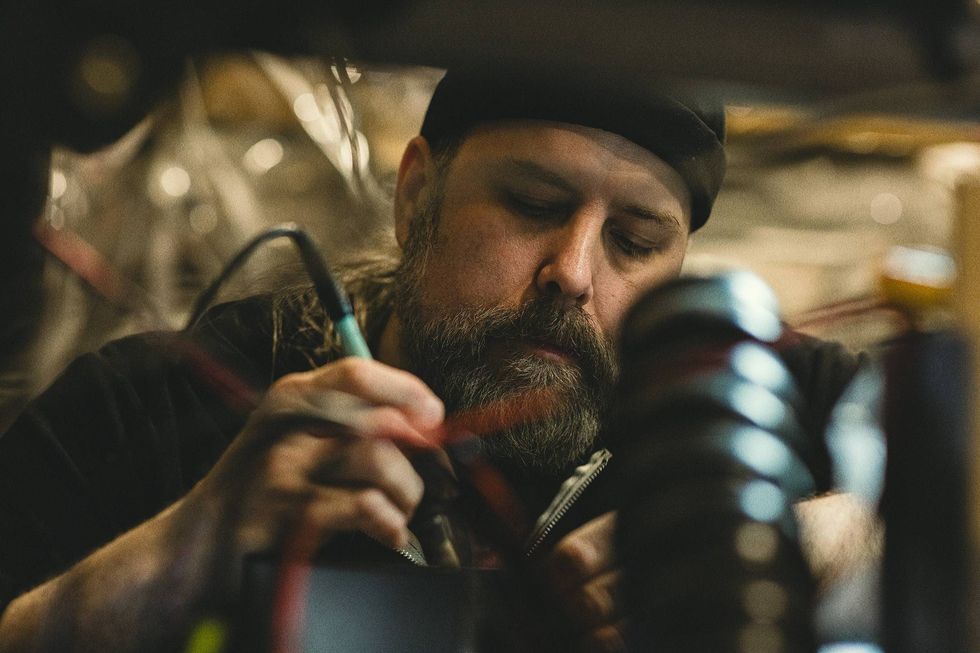
Revv’s Scott Kroeker building a Dynamis D40
That’s the whole philosophy—bringing to life the specific sounds that guitarists can’t currently access, that may only exist in their heads. “We all have different tones that we’re going for,” he says. “People don’t realize—there isn’t much stuff out there that’s bad. It’s just not for you.”
And that quest to seek out the next inspiring tone is what keeps Revv from feeling like just a job, “It’s connected to the thing that I’ve loved since I was 10,” Eastveld reflects. “I still love going to guitar stores and finding a new amp or pedal or something I’ve never played, then plugging into it and having that moment: ‘This is so cool. This feels so different or sounds so different.’
“Most of what I do is not playing guitar,” he continues. “But I don’t get up in the morning and go, ‘Ugh, I have to go to work today’—ever. This is the best job I could ever ask for.”
Godin Guitars has introduced the ACS Steve Stevens Signature 25th Anniversary LTD, a limited-edition nylon-string instrument celebrating more than 25 years of creative collaboration between legendary guitarist Steve Stevens and the Canadian guitar maker.
Crafted in Canada, the new model marks a significant evolution of the renowned ACS Multiac platform. Designed to reflect Stevens’ unmistakable musical identity, the anniversary edition blends elegant craftsmanship with modern performance, resulting in a nylon-string instrument as visually striking as it is sonically versatile.
“When I first discovered the Godin Multiac, it completely changed the way I thought about guitar,” says Steve Stevens. “I wanted to merge flamenco, rock, and electronic music into something cinematic and modern, and Godin was the first company that truly understood that vision.”
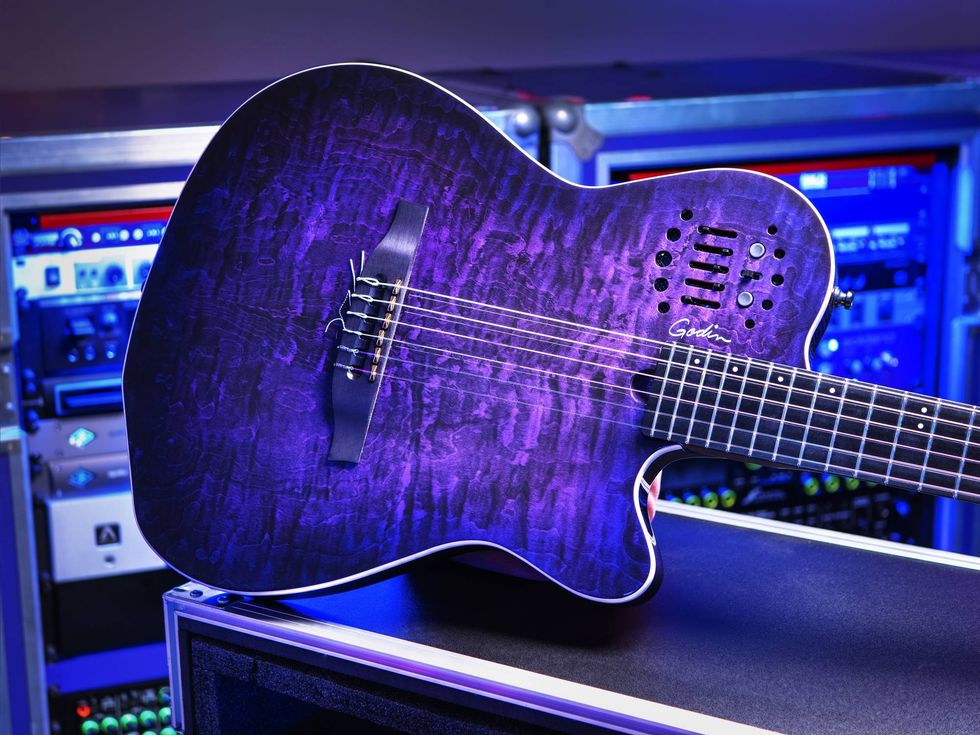
Built with a purple quilted maple top, custom purple tuning pegs, and a gloss-finished neck, the 25th Anniversary nylon-string model delivers a bold stage presence, effortless playability and tonal flexibility. Adding a deeply personal touch, Stevens’ iconic raygun logo is featured prominently on the front of the guitar, while his signature appears on the back of the headstock.
The mahogany neck and Richlite fingerboard and bridge, combined with a 16" fingerboard radius and 1.9" Graphtech nut, provide effortless playability and precise response across the full 25.5" scale length—perfectly suited to Steve Stevens’ dynamic and expressive playing style.
Equipped with an on-board preamp, this ACS Multiac captures every nuance with clarity and control, making it equally powerful on stage or in the studio. The initial production run of 100 guitars will each be signed by Stevens and numbered (1 to 100). They will include a custom hardshell case with purple plush interior, a Steve Stevens guitar pick, and a Certificate of Authenticity. More than a guitar, the ACS Multiac Steve Stevens Signature 25th Anniversary LTD is a celebration of artistry, collaboration, and legacy.
“This 25th Anniversary model represents everything I love about guitars, craftsmanship, innovation, and inspiration,” Stevens adds. “From the purple finish to the upgraded electronics, every detail was designed to create an instrument that feels both elegant and exciting the moment you pick it up.
”Known for his groundbreaking work with Billy Idol, his acclaimed solo career, and his genre-defying approach to guitar, multi-platinum selling, Grammy Award-winning artist Steve Stevens has long relied on Godin instruments to move seamlessly between acoustic, electric, flamenco-inspired, and cinematic textures. A 2026 Rock and Roll Hall of Fame inductee alongside Billy Idol, Stevens has helped shape generations of rock guitar playing while continually pushing the boundaries of the instrument. The ACS Multiac became a cornerstone of that sound, helping define a unique playing style that blends technical precision with emotional intensity.
“This was a unique project for us,” says Mario Biferali, Vice President of Sales at Godin Guitars. “Steve has been part of the Godin family for over 25 years, and that kind of relationship allows for a deeper level of trust and creative freedom. This guitar isn’t just a new finish or a cosmetic update, it's a true reflection of Steve’s personality, his history with the Multiac, and the evolution of our partnership.”
Simon Godin, CEO of Godin Guitars, adds: “Steve Stevens represents everything we value in an artist relationship: longevity, creativity, and a genuine connection to the instruments we build. After more than two decades of working together, this guitar feels like a celebration of that journey. It’s modern, expressive, and unmistakably Steve.”
Handcrafted in Canada, the ACS Steve Stevens Signature 25th Anniversary LTD maintains the core design elements that have made the Multiac series beloved by players around the world, while introducing exclusive visual and performance upgrades worthy of this milestone collaboration.
The ACS Steve Stevens Signature 25th Anniversary LTD carries a street price of $2999. For more information visit godinguitars.com.







 Brought To You By Rocky Mountain Slides www.premierguitar.com