A-list performances, gear exhibits and over 200 workshops draw record crowds to the nation’s largest customer-focused music trade show
Fort Wayne, IN — For the 17th year, Sweetwater hosted its annual GearFest on Friday, June 22 and Saturday, June 23, 2018 at its campus in Fort Wayne, Indiana, drawing record crowds with more than 15,000 attendees from across the world — including guests from Australia, Brazil and Japan. This year’s event also saw a 15-percent increase in music equipment sales during the event
Considered the nation’s largest customer-focused music and pro-audio trade show, GearFest 2018 offered something for every music lover — from over 200 workshops to new gear releases from top musical instrument manufacturers to performances by some of the biggest names in the industry, including Greg Koch, Peter Erskine and John Scofield.
“We are thrilled that GearFest continues to attract more and more musicians from across not only the U.S., but the world, who are searching for a unique music experience unlike any other,” said Steve Dwyer, Senior Director of Brand at Sweetwater Sound. “Through GearFest, Sweetwater is reaching today’s music creation community and bringing them the opportunity to learn and interface with some of the brightest minds in the music industry. We are certain that anyone who attended GearFest walked away with a new piece of knowledge and are ready to take their passion for music to the next level.”
For those who couldn’t make the event, Sweetwater live streamed select panels, performances and workshops on Facebook Live so everyone could be a part of the GearFest experience. The live streamed videos can be viewed at: https://www.sweetwater.com/gearfest/watch-live/.
Unforgettable Performances
Inspiring the crowd, this year’s GearFest was full of memorable, impromptu performances by some of the biggest names in the music industry, including guitarist Nita Strauss who took the stage during her seminar with Nick Bowcott and performed an impromptu performance of Pantera’s “Walk” as a tribute to the late Pantera/Damageplan drummer Vinnie Paul.
Another unforgettable performance came when drummer Steve Ferrone, who has worked with top talent like Tom Petty, Eric Clapton and Duran Duran, learned that his former bandmate — keyboardist, arranger and music director Greg Phillinganes — was also at GearFest. The two legends connected and jumped onstage, entertaining the audience with a spontaneous rendition of Clapton’s “Pretending.”
Serious ‘Master’ Classes
Performances aside, GearFest also offered attendees the opportunity to learn from some of the best and brightest in the industry during expert panels and workshops which featured names like Periphery guitarist Misha Mansoor, drummer and producer Russ Kunkel, and former Megadeth guitarist Chris Broderick. The more than 200 workshops and seminars covered such topics as getting discovered on YouTube, music creation with computers, and tips on improving technique and theory.
A perennial GearFest favorite, this year’s Producer’s Panel offered a high-powered discussion on what it takes to be a producer, how to help artists perform their best and what makes a song great. The panel was made up of Sylvia Massy (Tool, Prince), Neal Pogue (TLC, Pink), Kevin Killen (Shakira, U2), Fab Dupont (Jennifer Lopez, Bon Jovi), Chris Lord-Alge (James Brown, Prince) and Rich Chycki (Dream Theater) along with Sweetwter’s own Mitch Gallagher moderating the panel.
Among the most popular of the events was “Getting Great Electric Guitar Tone” which featured Butch Walker (Taylor Swift, Panic! at the Disco), Buddy Miller (Emmylou Harris, Robert Plant), Tim Pierce (Bon Jovi, Bruce Springsteen), Lyle Workman (Bourgeois Tagg, Todd Rundgren), and panel moderator and Nashville session star Corey Congilio. During this session, the group dug deep into capturing electric guitar tones and demonstrated the power of Universal Audio’s OX.
Next year’s GearFest 2019 will be held June 21-22nd.
Want more of our stories on Google?
Click here to make us a Preferred Source.
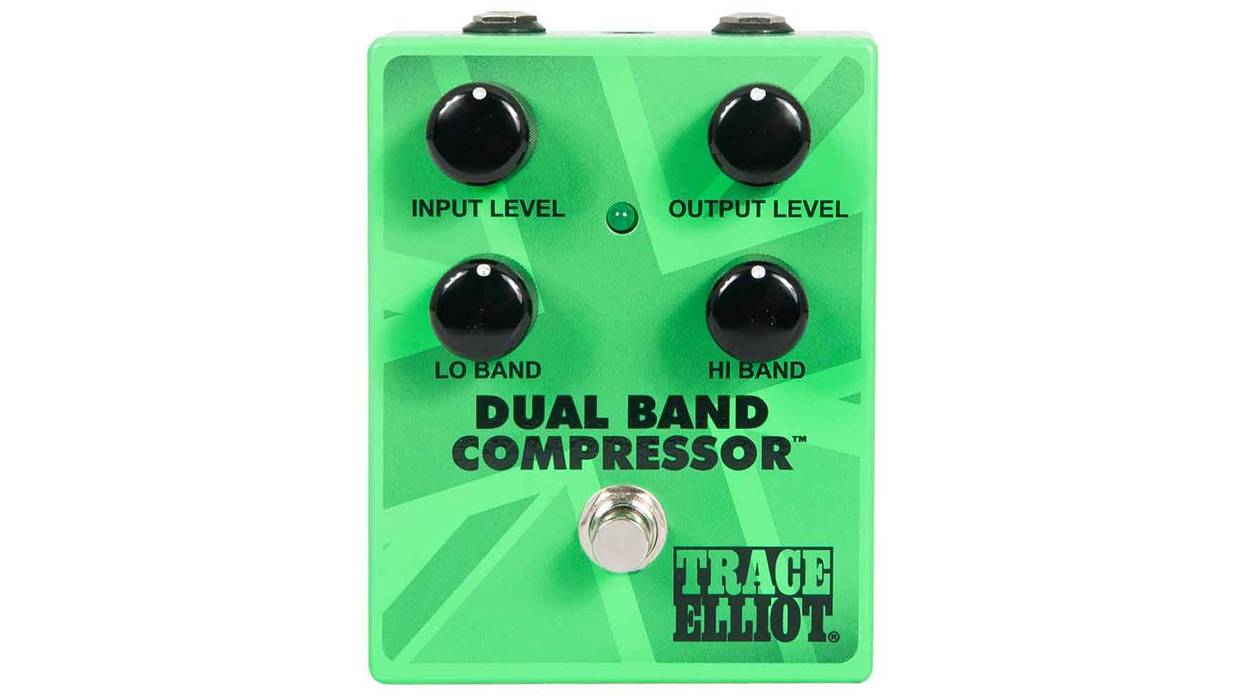
Trace Elliot® introduces the new Dual Band Compressor™. By extracting the compression circuit from the TE-1200 bass amplifier and dropping it into a pedal format, classic dual band compression is readily available for any bass guitar application. The sturdy, compact pedal gives bass players control over their tone under any circumstances. The pedal is now available worldwide online or at local retailers.
Whether in the studio or live on stage, compression is critical to a bass guitar signal. The compression enhances consistency in dynamics and allows the instrument to simply sit better in the mix. With separate LO BAND and HI BAND controls, the Dual Band Compressor allows the player to adjust the amount of compression separately for the best results. Built in make-up gain is applied after the compression to maintain the original volume level or desired loudness. The separate INPUT LEVEL allows the player to adjust the input volume of the instrument while the OUTPUT LEVEL adjusts the volume of the output leaving the pedal. Having the individual controls makes this pedal adaptable to all types of signal and line level scenarios. And with its true bypass operation, this pedal integrates seamlessly into any signal chain.
With its ¼” input and outputs and black domed knobs, the Dual Band Compressor is built to endure any hard-hitting performance with a rugged die cast enclosure and top shelf components. Bipolar 18v internal supply is achieved from any standard 9VDC power supply or battery.
Bill Frisell lives in a perpetual cycle of activity. For decades, he’s jumped from project to project, a new album with a new configuration of collaborators always on the horizon, dates constantly being added with a growing swath of different projects. In a given month, he could be playing gigs on any continent with one group and heading to another, then back again. It’s a way of life that keeps his musical universe expanding in every sonic direction all at once. And through it all, no matter how diverse the musical setting, he’s always so undeniably himself. As Neil Young famously said, “It’s all one song.”
It’s exciting to be a Frisell devotee, and it always has been. And when we caught up over video recently, I, of course, wanted to ask about his new album, In My Dreams, which features four of his long-time collaborators—a rhythm section of bassist Thomas Morgan and drummer Rudy Royston, and a string section of violinists Jenny Scheinman and Eyvind Kang, with cellist Hank Roberts. To hear Frisell in any situation is always a gift, but long-time relationships like these are so rare, this is one to cherish.
Given the forward-facing nature of Frisell’s work, though, it’s easy to talk about what’s happening now and what’s next. The downside of that approach is that we don’t get to check back in on things. With a series of concerts celebrating his 75th birthday coming up when we spoke, it struck me that I hadn't really heard—or read—him discuss the Telecaster much since it became his de facto guitar of choice in the 2000s, effectively revolutionizing the instrument’s possibilities for adventurous jazz players everywhere. (That’s not to imply that Frisell is the first guy to play jazz on a Tele—arguably, that distinction belongs to Jimmy Bryant. But when Frisell plugged in a Tele and his pedals, something shifted across the entire jazz and jazz-adjacent guitar universe.) Sure, he’s talked about this a ton and it’s all out there on the internet. But have his feelings evolved? I’ve seen Frisell play quite the assortment of different guitars, but the Tele remains his mainstay. What is it that keeps him coming back to it, as well as acquiring new variations from builders like JW Black and Creston Lea, all these years later?
“A Telecaster, it can withstand the most ridiculous dropping and throwing it around. And if it breaks, you can just screw it back together.”
As we caught up, I casually dropped a reference to Ornette Coleman’s Prime Time band and we veered off into a story that, although it’s not tied to the guitar or the album, demanded to be included here. If there’s a loose theme to this conversation, it’s the idea of dreams. And not only did this story have me cracking up, I think it’s the kind of anecdote that pulls together a worldview, both personally and musically, about the surreality of life and long-term thinking. If nothing else, it brightened my day.
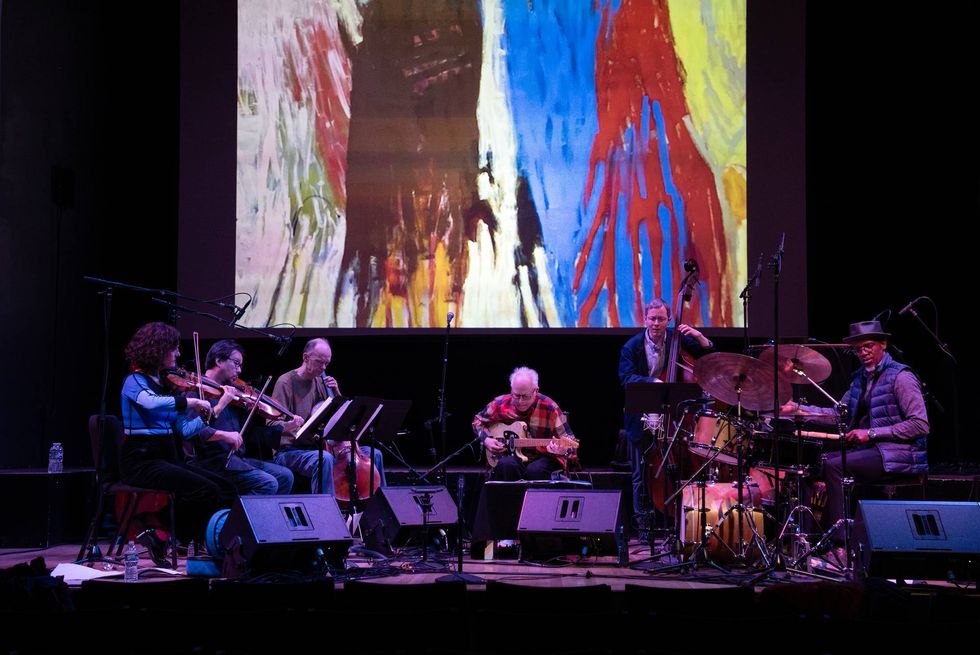
From left: Jenny Scheinman, Eyvind Kang, Hank Roberts, Frisell, Thomas Morgan, and Rudy Royston.
Photo by Kyra Kverno
You’ve been playing Telecasters for a while now, but you keep developing your relationship with the model, and also acquiring new ones. What keeps you excited about the Tele?
Bill Frisell: Pretty much everything is there that you need. There’s the thing about the familiarity with where everything is. If you have a Telecaster, you know the volume control’s here, and the switch is here, so all the instinctual things are there. But having said that, it also becomes this open platform. I have a couple just stock or normal Teles, and even there, there’s so much variety—if there’s a rosewood fingerboard or a maple fingerboard, they sound different. The exact same model guitar even from the same year … it seduces you. You play one and there’s some overtones that come out that don’t come out in another. Even from the most straight ahead one, there’s enough variation that can lure you into trying another one.
I have some that have a humbucker, and some that are straight, and some that have a P-90, then at the same time I can switch around and everything is where I know it will be.
The weight and placement of everything is going to be different if you pick up a Jaguar or something else.
And I have a Jaguar and I love a Jaguar! When I was a kid, the first guitar I got was a Fender Mustang, when I was 14, I guess. And then not long after that, I went to a pawn shop—and I’m talking about the mid, late ’60s, when Fender guitars that had maple necks were just, like, “that old junk, nobody wants that.” You’d go to a pawn shop and there’d be all these ’50s Strats and Teles hanging there for nothing, 50 bucks or whatever it was. I went to this pawn shop and I got an Esquire. If I remember, it was a top-loader. I bought it for $75, just to have a bigger guitar. So, that shape and weight and size is in my blood from when I was 15 years old.
“I’m just so lucky with the folks I’m playing with. They’re my best friends, and we’re all doing it together.”
Having said all that, I also love playing archtop guitars. I love my Collings—I have an I-30 and an I-35 that are awesome, they’re incredible. But I’m a little more nervous about them. There’s a thing about a Telecaster. I travel so much and I don’t have roadies, I’ve gotta carry all my stuff, and I gave up on trying to carry it onto the plane, so I just check it. A Telecaster, it can withstand the most ridiculous dropping and throwing it around. And if it breaks, you can just screw it back together. So, there’s also that aspect, that it’s just super practical.
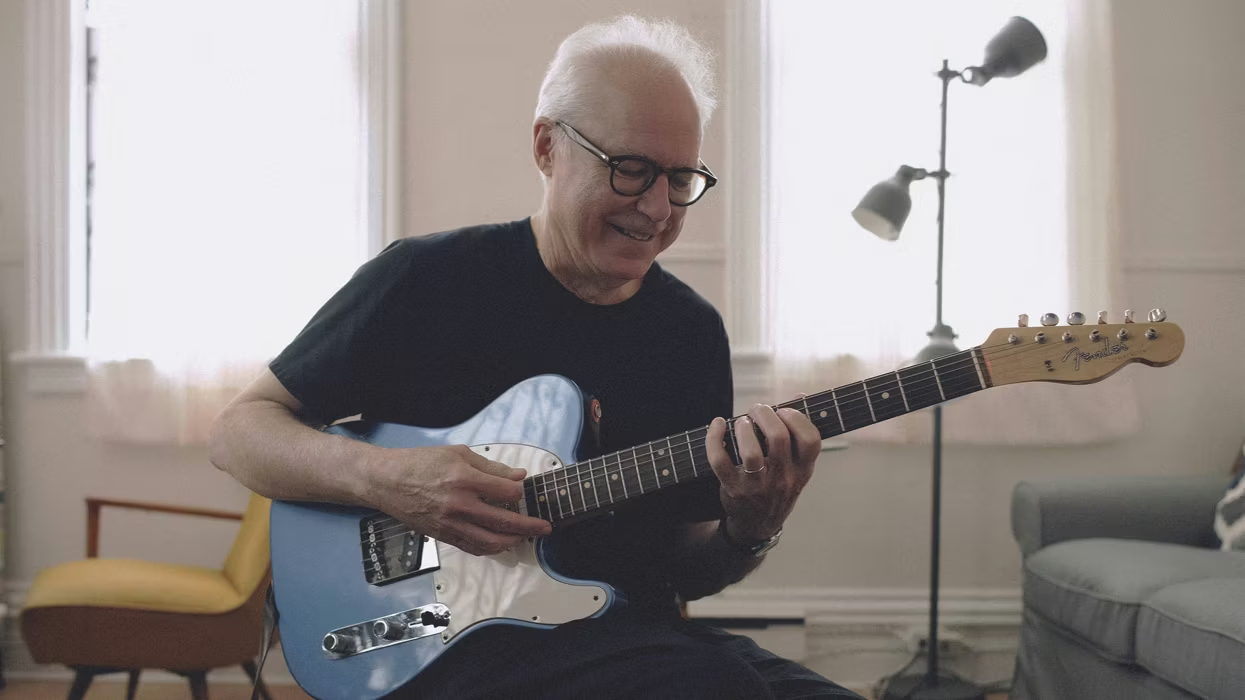
Frisell, seen here with a blue neck-humbucker-loaded model, remains inspired by the Telecaster.
Photo by Marko Mijailovic
What kind of case do you use these days?
The case probably costs more than the guitar. It’s a Hoffee, it’s carbon fiber, and it’s really light. You can’t carry stuff on [airplanes] any more. So far it’s gotten lost a couple times, but I got it back. They haven’t broken it yet.
And then I have a Calton case for the Collings. But just because it’s a much more fragile instrument—it’s solid—I don’t feel comfortable throwing that thing around as I do a Tele. And the case is much heavier, too.
You've been traveling all over the world for a long time now, and as you said, it's only gotten harder. You're constantly moving from one group to another, one location to the next. I find that variety inspiring—why is it so important to you?
With travel, it just seems like a miracle the way music can lift you up. Sometimes it’s just absurd when you think of how many hours we’ll spend to get somewhere. You don’t sleep, you travel for 12 hours, and then you get to some place where you’re gonna play for like an hour. The ratio is way out of whack.
So, I get there and I’m feeling like, “I can’t hardly stand up, how am I gonna do this?” But as soon as the music starts, it’s bam! It’s not just adrenaline, it’s the power of the music, and it blows my mind how it just keeps happening like that. I can’t imagine stopping doing it.
It’s like they keep throwing these roadblocks up in front of you, but it’s like, “Fuck you, I’m gonna do this. I wanna play.” And I’m just so lucky with the folks I’m playing with. They’re my best friends and we’re all doing it together. It’s this ever-expanding family of folks I get to play with. It’s so exciting. It’s not just one group, and even if it’s the same group, the music is changing from night to night.
Everybody’s doing their own thing as well. Folks go off somewhere and then we come back, and then they have news from somewhere else. Everyone’s learning and traveling around, and we stay together for periods of time, and when they come back, they have some other thing they learned from someone else, and they bring that. It’s this snowball effect of inspiring each other all the time.
Do you have a secret to staying healthy when you’re traveling?
No … just hoping for the best.
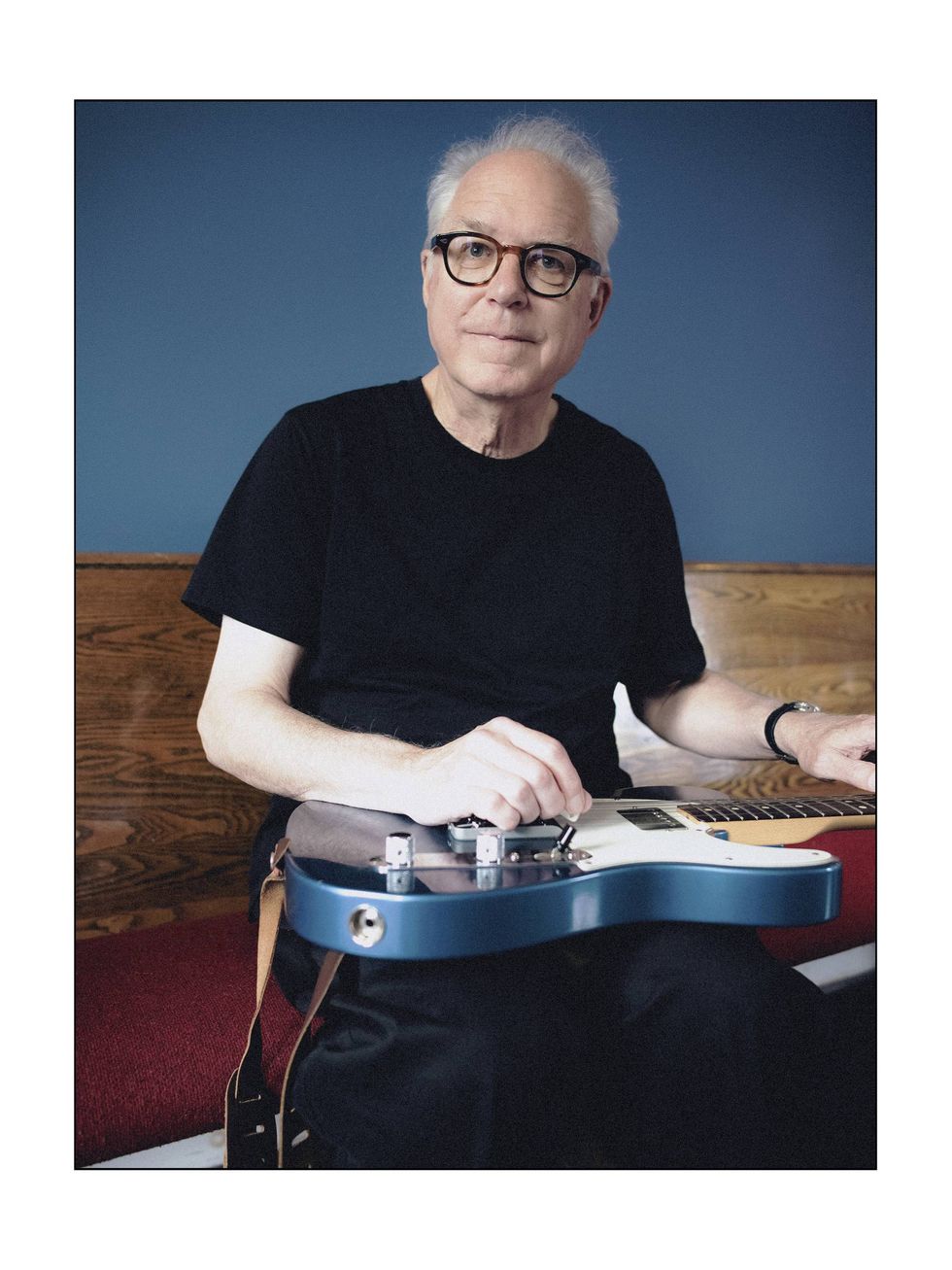
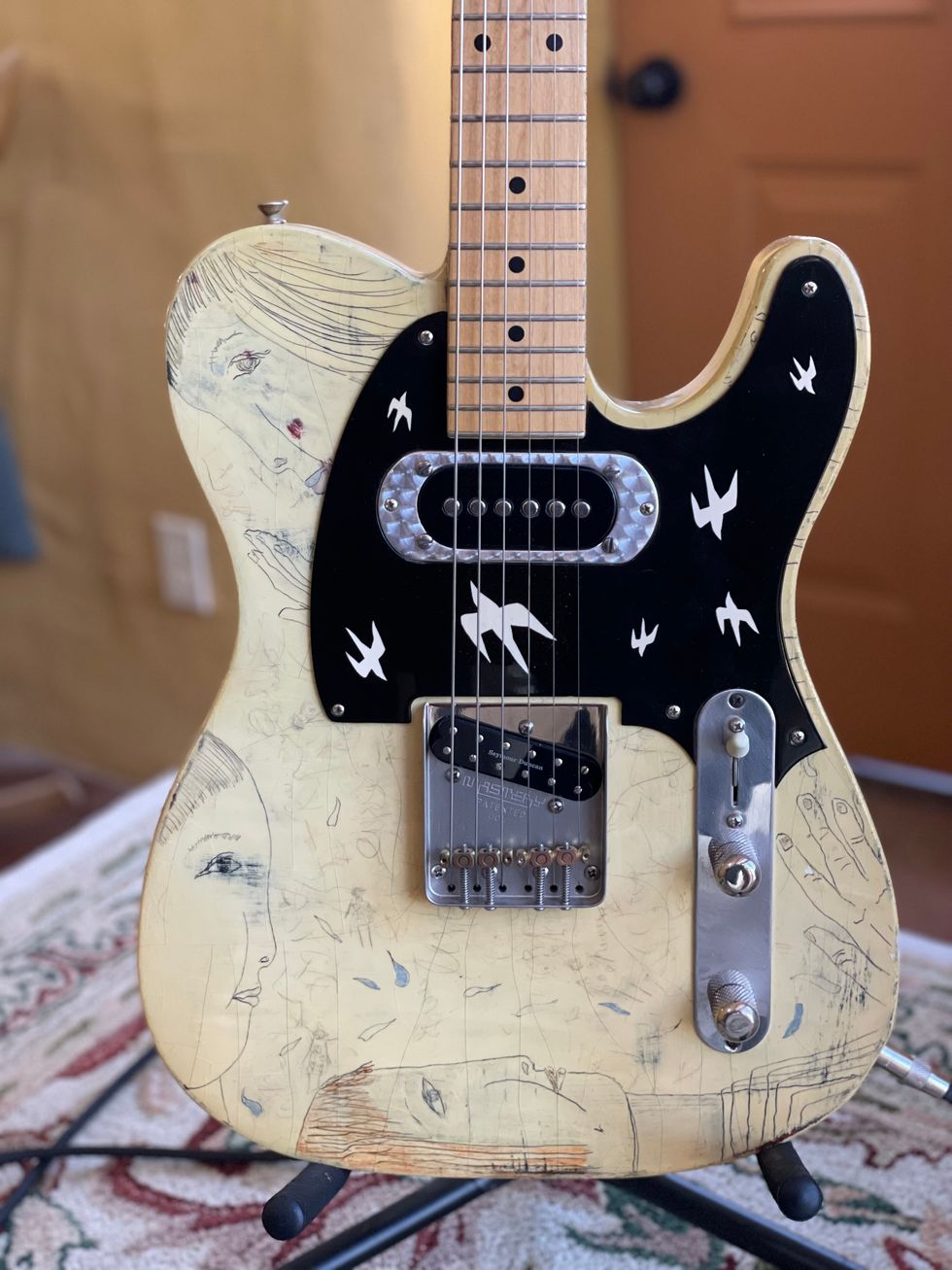
This JW Black T-Style was used on Frisell’s In My Dreamsand features artwork from Seattle artist Terry Turrell.
Bill Frisell’s Gear List
Guitars
JW Black T-Style custom painted by Terry Turrell (24 3/4” scale with Mastery bridge, TK Smith neck pickup, Seymour Duncan Little ’59 bridge pickup, neck plate by Eric Daw)
Early 1960s Gibson J-45 (belongs to producer Lee Townsend)
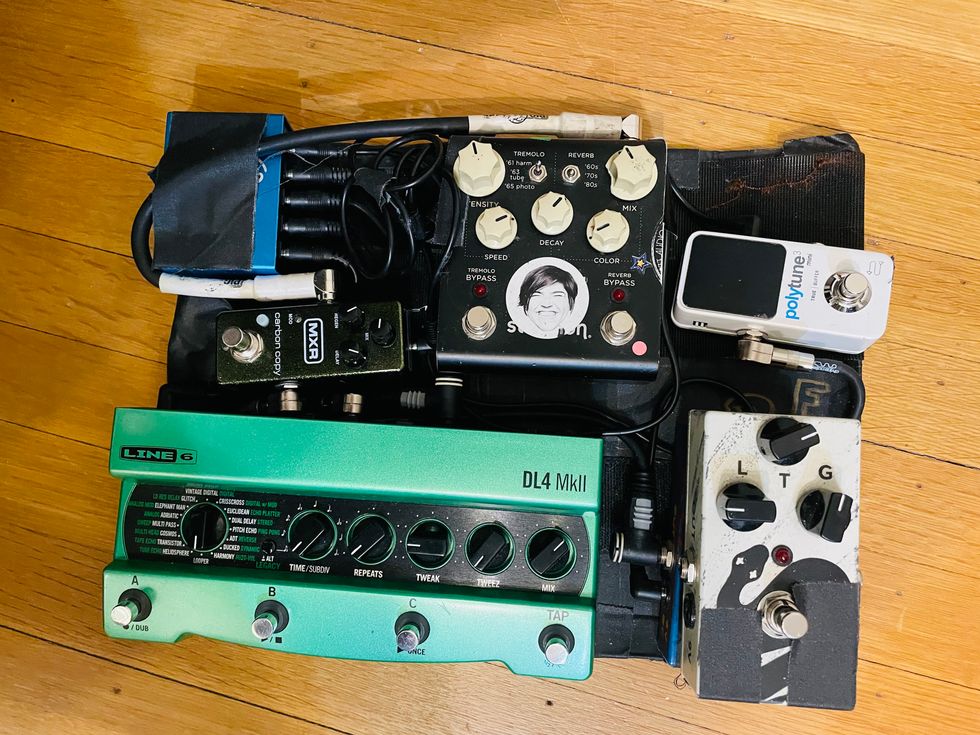
A constant traveller, Frisell keeps his board simple.
With your albums, I always love hearing a favorite song turn up in a new setting. On In My Dreams, you revisit “When We Go” and “Again”—songs you’ve surely played many times with the musicians on this album over the years.
“When We Go,” maybe I played that with Hank 40 years ago or something. That one, I can’t remember how it came into my mind to play. And “Again,” I don’t think I’d played with Rudy or Thomas, but I might have played it with Hank.
I met Hank more than 50 years ago! We met when I went back to Berklee in 1975. Pretty soon after that, we started playing. He was around before I ever even wrote a tune. He was in my first band that I ever tried to put together. There’s an album called Lookout for Hope with Kermit Driscoll and Joey Baron, and Hank’s on that.
My daughter was born at the end of 1985, and that was right around the time I got those guys together. I’d made two albums before that, but this was like, now I’m going to have my own band.
Before my wife and I had our daughter, I received some great life advice about how having a family would help me focus my creativity from friend, sometime collaborator, and all-around inspiration Jamaaladeen Tacuma [of Ornette Coleman’s Prime Time band].
The first time I saw Ornette Coleman was in 1979. This is a crazy story. Do you want to veer off for a moment?
Yeah—this sounds interesting.
I was in Boston in the mid ’70s, and I moved to Belgium and lived there for a year. That’s where I met my wife. We were living in a jazz club in a tiny little town called Spa. This Belgian saxophone player Steve Houben, invited us all—guys from Boston—to move to Belgium and start a band. It was this incredible year of living above this jazz club. We’re in this tiny town and all these people would come—Art Blakey, Art Ensemble of Chicago, Dexter Gordon, Woody Shaw, Betty Carter, on and on. They’d feed us spaghetti and we’d play for a bit, and that’s how we lived for a while. I met my wife, she worked in the bar.
I’d never seen Ornette Coleman, and I was just like, “Man, I’ve got to see Ornette Coleman.” And we found out he was coming to the North Sea Jazz Festival. We drove all night, it was in Den Haag. It was an early version of Prime Time. It was “Blood” Ulmer and Bern Nix and Jamaaladeen, and I’m pretty sure it was Shannon Jackson.
I wasn’t doing drugs or anything. I swear. Nothing. Maybe I had a beer or something. But we go into this big auditorium, and it was like, “What is this?” It was so drastically different from what I was expecting to hear from Ornette. And he was wearing this fluorescent suit. It was so far out.
So, I saw the gig, and it was in the afternoon, and I was so happy that I saw Ornette. It was in this festival situation and it’s really crowded. I’d gone there especially to see Ornette, but then I’d gone and seen Oscar Peterson, I saw Stefan Grappelli, Anthony Braxton. I’m walking around and walking through this mass of people, and I had a Coke, and I’m holding it in my hand and Ornette comes up to me and he goes, “Where’d ya get that Coke?” And I’m like: What the fuck? Ornette just talked to me! I came all the way here to see him, and he just talked to me. So I said just over there’s this concession stand.
Now, I swear this is true, I’m not dreaming. The day goes on, and I go see some other stuff. And I’m tired and I’m getting kind of burned out. It was in this convention center, and there’s this door and a stairway. So I open the door and I’m sitting on the stairs, just resting next to the door. There’s a knock on the door, and it’s Ornette, again. And he says, “What’s back here?” And I go, “I don’t know … nothing.” And the door closes and he goes away. And I couldn’t believe it.
Some years later, I got to play with him a little bit. The last time I was at Ornette’s place, he kept going to the refrigerator and getting Cokes out of the refrigerator and he’d say “Do you want a Coke?” Like … what is going on with this?
You have a story about how the true sound of music was once revealed to you in a dream, and this record is called In My Dreams. How important are dreams to your music? And how important is the goal of recreating that sound that was revealed?
I’ll never get that. I wish I could bring that dream back. It was one of those things where I know forever that you can’t get there, but I keep reaching for this beauty. You know, you get closer and it gets farther away and you get closer. But that’s just the deal. You just keep striving for that. It’s something I know, anyway. You have to love being in whatever the struggle is you’re going through, the hope that you’re going to find something.
The whole idea of having a goal, it doesn’t quite work. You set up these little goals, you want to learn more, but then the goalpost keeps moving, or you do achieve something, then you realize by doing that, you just messed up this other thing. Then you struggle with that. So there’s that with dreaming.
I’m fascinated with that thing, like the way a dream, when you’re sleeping and you wake up, it’s just like a vapor—“Wait, what was that?” It’s so hard to grasp that. There’s a place you go, and you’re there, and you want to bring something back into this realm, but it’s so elusive.
That’s kind of like when you’re playing music, and you’re really in it, and the moment you realize something good is happening, it’s gone again. To try to stay in that state where you’re really not sure what’s going on, and you’re just in it and you’re playing, that’s the most amazing feeling.
But then there’s also the dream of Martin Luther King, especially these days. Somehow, we have to keep dreaming. We have to get through this, whatever this mess is that’s going on right now, and not get beaten down. Music is the place, again, where I feel things come together in a beautiful way. You know, all the things you do in music, you listen to each other, and you share things, and you watch out for each other, it’s all in music. There’s all kinds of dream stuff you can go off on.
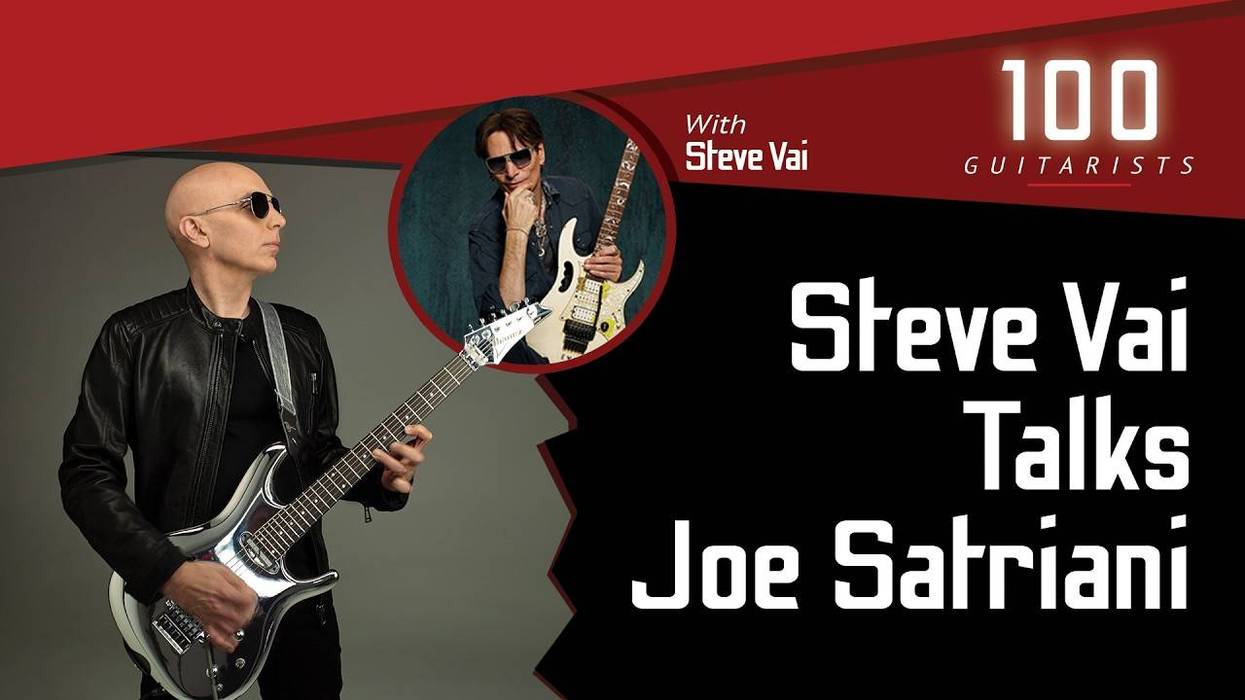
On our last episode, we had Joe Satriani join us to talk about his long history with his old pal Steve Vai. In celebration of the new SATCHVAI band, we've made this a two-parter, and Vai is here to return the favor.
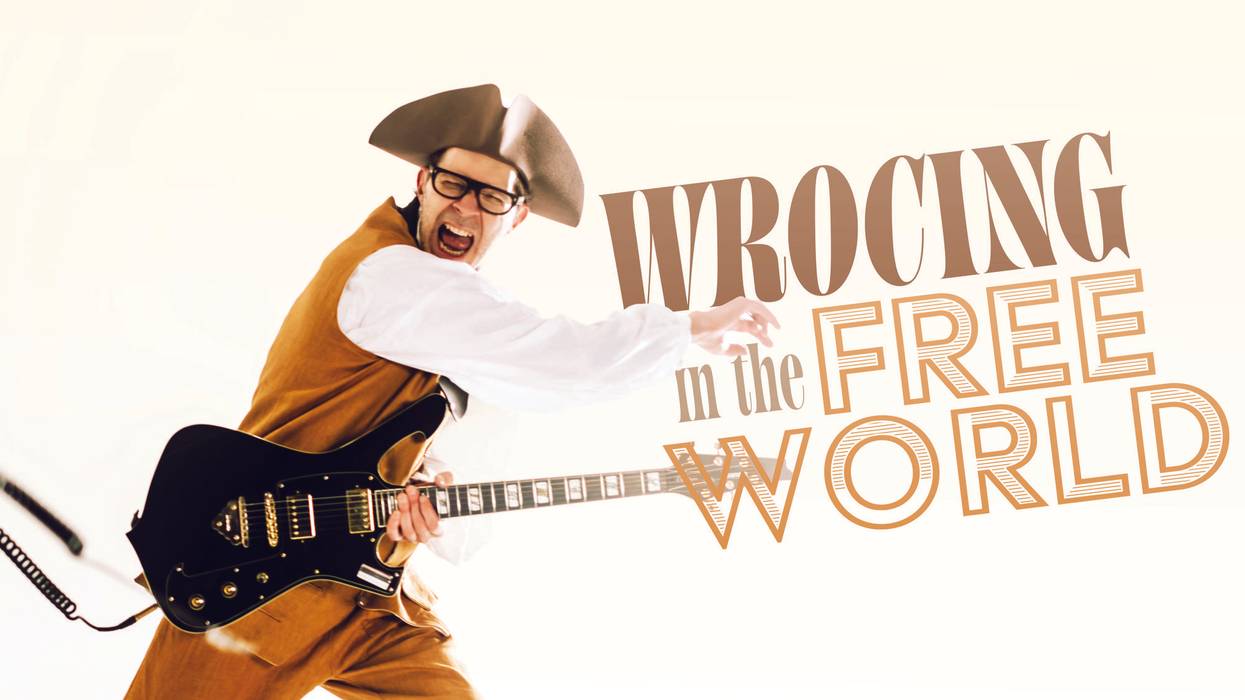
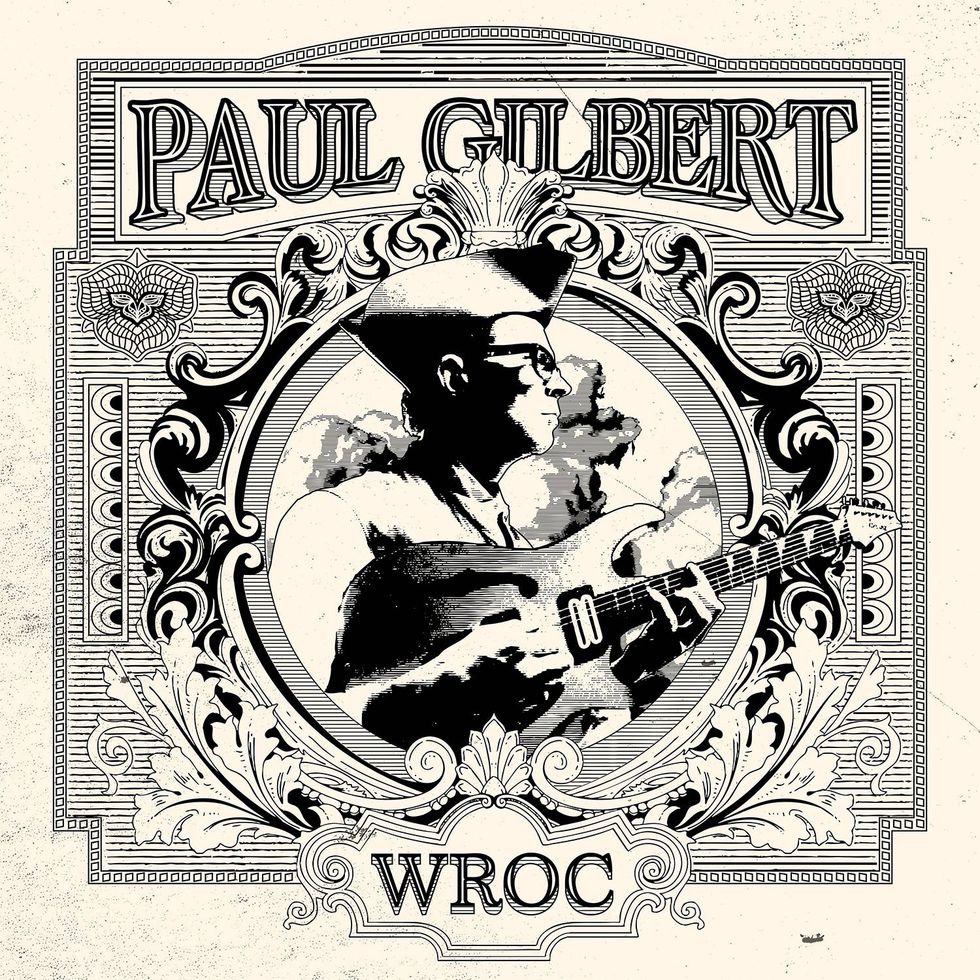
Guitar virtuoso/singer-songwriter Paul Gilbert’s latest release, WROC, a homophone of “rock,” is based on George Washington’s Rules of Civility and Decent Behaviour In Company and Conversation. Yes, the George Washington you learned about in middle school—Gilbert’s one of the few people on the planet that can make a history lesson fun!
While Gilbert’s peers in his early metal days were more inclined to doodle pentagrams and flip through the Satanic Bible, Gilbert had vastly different interests. “I read a bunch of Founding Father writings decades ago,” he explains to PG. “I was curious, so I bought the full, thick compendium of everything written by Ben Franklin, Thomas Jefferson, and George Washington. There are no stories there; instead it’s almost like finding somebody’s emails from hundreds of years ago. That was the first time I came across Washington’s Rules of Civility, and the idea of being more civil, of having better manners, somehow that was appealing to me.”
In February of last year, Gilbert had just wrapped up the final concert of Mr. Big’s “The Big Finale” tour at Tokyo’s storied Budokan, and on the flight home, both inspiration and Rules of Civility struck. “I was thinking, ‘Okay, it’s a new start for me,’ and I was excited about what to do next. I had an internet connection on the plane, and that excitement turned into this conversation with AI,” he recalls. “I couldn’t remember what they were called, I just sort of remembered there were these rules that Washington tried to follow when he was a kid. So I Googled around and asked AI, and refreshed my memory.”
Gilbert and his chatbot then worked in tandem to dissect lyrics out of Washington’s rules. “I said, ‘Take a random Washington rule and turn it into a blues lyric.’ And in three seconds, I got this Washington rule turned into a blues lyric,” he says. Gilbert then proceeded to ask AI to do additional things: Make the chorus repeat more. Find a different Washington rule for the bridge. “I was sort of telling AI what to do. That was my initial process,” he says. “As I went on, I realized it was better if I did it myself, because I know what I want. So then my conversation with AI changed. Instead of having AI do it, I said, ‘AI, give me the list of rules.’ There’s 110 of them, so I said, ‘Put them in order according to length—the short ones first and the longest last.’ That way, when I’m searching around, if I just need a short line, I don’t have to hunt through the whole book.”
Washington’s rules were the perfect springboard for Gilbert. “I love writing from a lyric—it’s so much easier than any other way of songwriting,” he says. “It was maybe the most fun I’ve ever had writing songs in my life. It’s almost escapism—I can get out of myself and enter some other world. I would take [Washington’s] lines and try to make it into a melody. Then once I had that, all the jobs that follow are my favorite jobs. I love finding chords for a melody, I love the balance of repetition—but not too much. You get to that point where it’s like, ‘Okay, that’s too many repeats, I’ve got to pull it back and find, like, a weird note that I haven’t used yet.’ And that will inspire a chord I didn’t think of. That whole craft is something I really have fun with.”
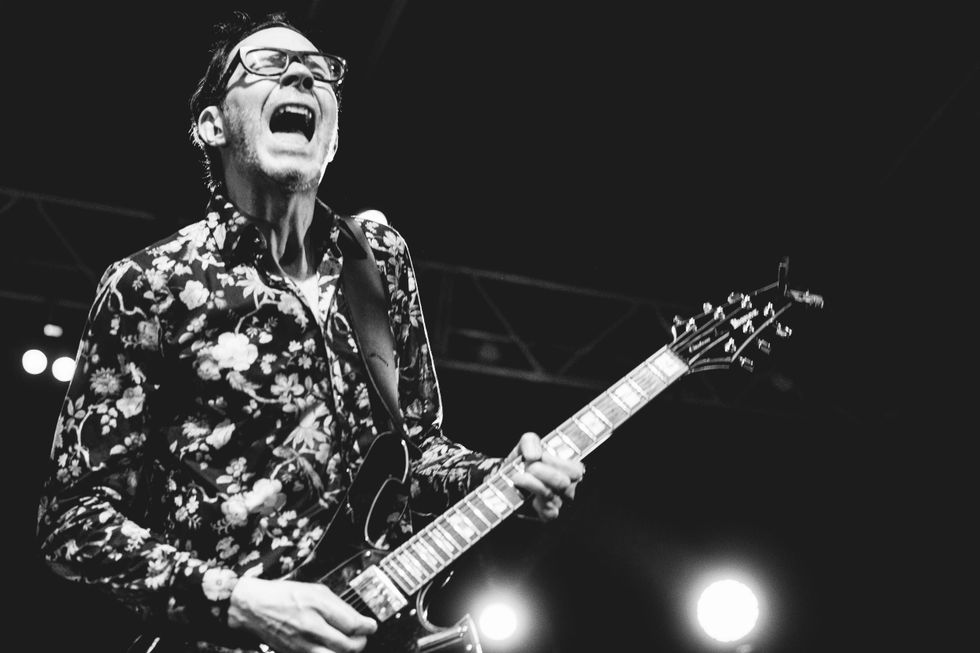
Gilbert wails on his Ibanez during a recent gig.
Simone Cecchetti
Paul Gilbert’s Gear
Guitars (live)
*Paul uses DiMarzio pickups in all his guitars
Ibanez FRM350 Paul Gilbert signature
Ibanez PGM50 Paul Gilbert Signature
1970s Ibanez IC200
Ibanez RS530
Ibanez Custom Shop PGM Paul Gilbert Signature (pink)
1970s Ibanez double neck (set neck version)
Guitars (studio)
Ibanez AS7312
1970s Ibanez 751 acoustic
Amps
1990s Fender Custom Vibrolux Reverb into a Randall isolation cabinet
1960s Fender Vibrolux Reverb as a wedge monitor
Victoria Club Deluxe (turned on for solos as a volume boost)
Effects
Distortion pedals for main amp:
Xotic AC Booster (always on)
JHS Overdrive Preamp
Mojo Hand Colossus
Distortion pedals for solo boost amp:
MXR Distortion+
Xotic AC Booster
Voodoo Labs Pedal Power 2 Plus
Boss LS-2 Line Selector (Gilbert has two: one to switch between distortion and clean, the other to switch on solo boost amp)
“Clean” pedals:
Boss CS-3 Compression Sustainer
Catalinbread Callisto
“Modulation” pedals:
JAM Pedals RetroVibe
MXR Stereo Chorus
Home Brew Electronics THC Three Hound Chorus
Sabbadius Tiny-Vibe
Strings, Picks, Slides & Cables
Ernie Ball Mighty Slinky (.0085–.040; Gilbert replaces the .040 with a .046)
Dunlop Tortex III .73 mm picks
Dunlop 318 Chromed Steel slide
Divine Noise coiled cable
DiMarzio straight cables, patch cables, and speaker cables
In a perfect world, Gilbert would have loved to use Washington’s rules exactly as they were written, but each song went a different way. To turn the rules into songs and make them singable, Gilbert had to resort to some basic rules of songwriting. “The first trick is just to repeat things. Or repeat an ending,” he explains. “Like, ‘If you soak bread in the sauce, let it be no more, let it be no more.’ You sing the last line twice, it becomes more like a song. So a lot of that is, you sing a line and then take the end of it and repeat it. And then once I had the verse, I might grab the book and flip through to find the bridge. Some of the songs are really simple in that I just sort of repeat the same part, but the second verse will have a harmony to it, so that’ll take it to a different direction.”
The chord progressions on some WROC songs like “Orderly and Distinctly” reveal a harmonic palette that stands out among today’s songwriters. When I covered Gilbert’s Great Guitar Escape camp in 2013, the nightly jams featured harmonically rich songs like the Bee Gees’ “How Deep is Your Love,” and ABBA’s “Dancing Queen.” These types of compositions inform Gilbert’s writing style, and their influences can be heard on many of the chord progressions on WROC.
“The idea of being more civil, of having better manners, somehow that was appealing to me.”
“That comes from growing up in the ’60s and ’70s and hearing a lot of piano-composed songs,” he says. “I was listening to Elton John, the Carpenters, Todd Rundgren, Queen, the Beatles, the Beach Boys. And you know, there’s some chords in there. That was the hard thing for me as a kid—and it was really helpful for me to go to school [in 1984 Gilbert enrolled at GIT, now called Musician’s Institute] to learn that stuff, because I was essentially an ear player. I’ve learned by ear mostly. I never had a deep knowledge of harmony until I went to school, and then I started filling in the missing puzzle pieces.”
Gilbert continues, “I remember learning ‘God Only Knows.’ I’m ruminating about the half-diminished chord in that song because it was so important to me. Or another one is, ‘When I Grow Up to Be a Man.’ The opening vocal harmony, I don’t even know what it’s called—I know what it looks like. It’s like a sharp 11 or something. It’s really a crazy chord and it starts the song off. And I don’t necessarily have to know what it’s called—whenever I hear one of those things I know it’s the ‘When I Grow up to Be a Man’ chord. My wife [Emi Gilbert] is amazing at jazz piano, but she began as a classical piano player. So some of the jazz chords are new to her and she’ll be like, ‘What is that?’ Well, there’s that Beach Boys chord. I can spot it. And I think the Beatles were like that. They weren’t trained in the vocabulary of the terminology. But they were really well trained with songs.”
Paul Gilbert’s latest, WROC, is a treatise on good manners. Sort of.
As the songs for WROC started coming together, Gilbert made an interesting, and unfortunate, discovery about AI, his writing partner. “I learned that AI doesn’t always tell you the exact truth. It’ll make stuff up,” he says. He found this out when he did a Google search for a rule he used for a song title—and nothing came up. Gilbert recalls, “I then asked AI, ‘Which Washington rule is this?’ And AI was like, ‘That’s not any Washington rule.’ I said, ‘Well, you gave it to me. You were the one that told me.’ And the response was, ‘Oh, I’m sorry, I must have hallucinated.’ So I was searching through this list, and now I know it was about 80 percent correct and 20 percent hallucinated. And that was a good learning experience.”
The lesson? “Always double check your AI, because it’ll just make stuff up,” he says. Nevertheless, one song on the album, “Conscience is the Most Certain Judge” features some of these AI hallucinations—Gilbert kept them because he felt they were still in the correct spirit. He also took poetic license and composed variations with his own words on “Show Yourself Not Glad at the Misfortune of Another.”
WROC, of course, is more than a mere (AI-assisted) history lesson. Since his Racer X days, Gilbert’s fanbase has been heavily populated by guitar geeks that salivate at every 16th-note run he unleashes. As is to be expected, WROC showcases Gilbert’s fiery six-string work. The opener, “Keep Your Feet Firm and Even,” kicks off with characteristic neoclassical licks and harmonized melodic lines. “Maintain a Sweet and Cheerful Countenance,” meanwhile, is built on an incendiary harmonized jazz/fusion and prog-influenced riff in the intro, which leads to a solo that sees Gilbert tearing it up on the slide—a texture he’s been exploring over the past decade.
“I learned that AI doesn’t always tell you the exact truth.”
Gilbert’s slightly unusual guitar setup accommodates both his newfound slide inclinations and his legacy speed-demon licks. While Gilbert’s strings are very light—he uses .0085 for his high-E string (at this year’s NAMM convention, while performing with Steve Morse at the Ernie Ball booth, he even admitted to using .007s on that day)—the guitar’s action is set fairly high. “It’s funny, I did a guitar clinic in Italy where I didn’t bring my own guitar,” he says. “All the students let me use their guitars, so there were, like, ten guitars on a stand. They said, ‘Use any guitar you want,’ and I picked this one up and I hurt myself. Everybody had .010s and low action and, man, I can’t play .010s with low action. I can’t get a grip on the string, and I bend all the time.”
Even though he’s been most often identified throughout his career as a guitar hero, Gilbert’s focus hasn’t been strictly on the guitar. Since King of Clubs, his 1997 debut solo album, his abilities as a lead vocalist have come to the forefront. Gilbert is a charismatic frontman who can belt out songs in a multitude of styles. He readily admits, however, that guitar is still more natural for him. “As a lead singer—which, really, if you want to be a pop musician, singing is very important—my voice always had limitations that my hands didn’t have,” he says. “If I sat down and practiced, you know, I could play this Van Halen thing. Whereas if I practice singing, I still couldn’t sing ‘Oh! Darling’ by the Beatles, no matter how much I practiced.”
Currently, Gilbert’s guitar practice goals are less about mechanics and more about melody. The days of endlessly repeating outside picking exercises with an ever-increasing-in-tempo metronome have taken a backseat to his new obsession with mastering the ability to instantaneously play the melodies he hears in his head on the guitar. Being able to produce a melody on the guitar with the proper inflections is an art that isn’t nearly as easy as it might sound (especially doing it on the spot in real time), even if you can shred scales and arpeggios at supersonic speeds. “It’s funny, right before this interview I was practicing improvising over Gary Moore’s ‘Still Got the Blues,’” he says. “Which has challenging changes, almost like ‘Autumn Leaves.’ To me, that’s a rough, rolling rapid of rocky river to navigate, but I’m getting better at it. Step one is I found all the shapes—the shape for the B half-diminished and for the E7. But then I’m using my eyes to navigate, like, ‘This shape goes into this shape.’ That’s useful to some extent, but it’s not coming from my singer’s voice. So now I sit down and go, ‘Don’t play it if you can’t sing it.’ And I force myself to sing and solo at the same time.
“I’m not great at it yet,” Gilbert continues, “so it’s risky to do it because it does slow everything down. But the more I do it, the better it gets, and there’s a real payoff at the end. But it feels like I’m telling the truth when I really play what was in there. Suddenly everything’s connected and it tells a story.”
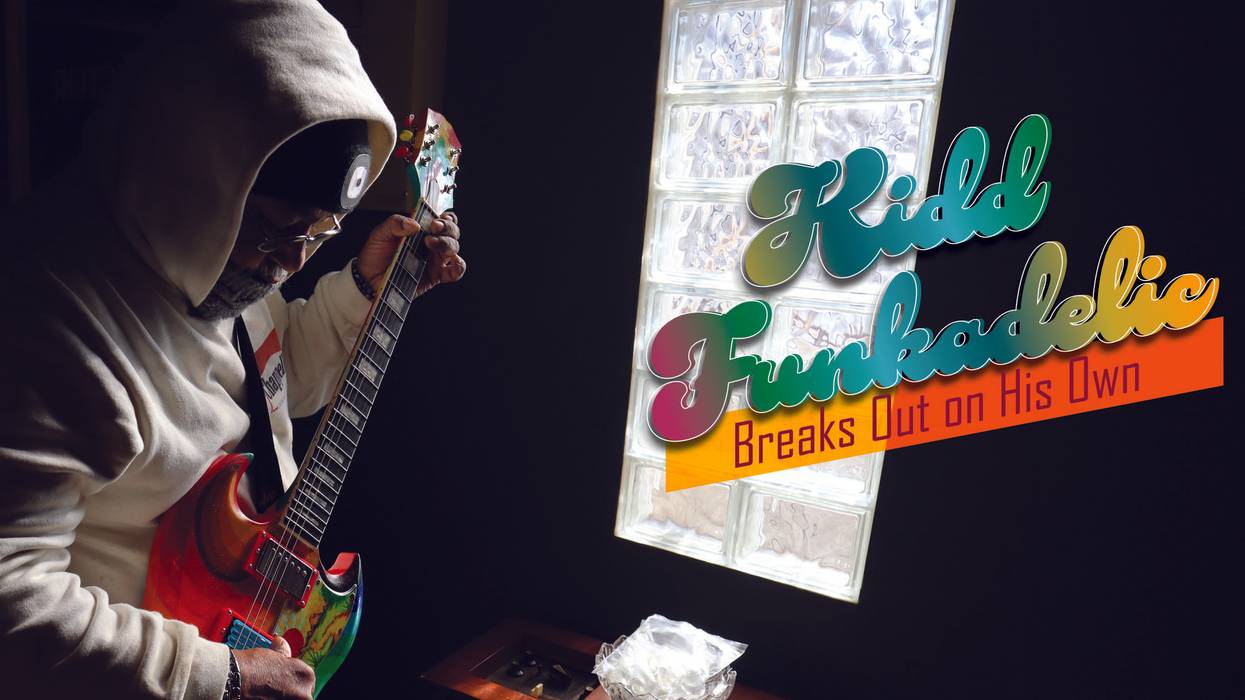
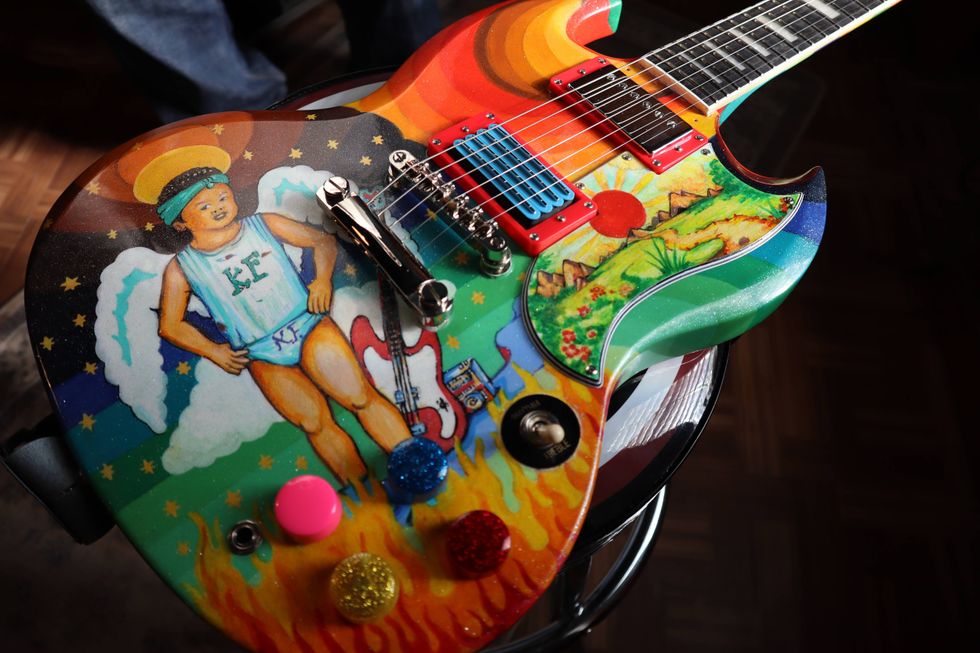
Michael Hampton with the Kidd Funkadelic guitar, a tribute to The Fool, the SG once owned by Eric Clapton and Todd Rundgren.
Photo by Nick Millevoi
Michael Hampton’s whole career started with a single song.
As a teen growing up in Cleveland, Ohio, he taught himself to play along with records on just one string. The Temptations’ “Get Ready,” Led Zeppelin’s “Dazed and Confused”—those worked. Then he expanded, adding strings and songs like Kool & the Gang’s “Jungle Boogie” and Edgar Winter Group’s “Frankenstein” to his repertoire. Somewhere in there, he started jamming along with Funkadelic’s 1971 psychedelic guitar opus, “Maggot Brain.”
On the opening track to the band’s album of the same name, guitarist Eddie Hazel defined new boundaries of post-Hendrix fuzz-and-wah-soaked psychedelia. George Clinton’s Echoplex manipulations cranked the mind-melt factor further afield. It moved the young guitarist, and he kept coming back to that song.
By 1974, the band rolled through Cleveland and the 17-year-old had a chance to witness the live P-Funk extravaganza. Around that time, he had been playing music with his cousin, Lige Curry, and “a guy on the east side called Ed Sparks, he was an older guy playing bass,” according to Hampton. Together, they went to catch the show at Public Hall. Afterward, they all ended up with some of the band back at Sparks’ house.
“Ed’s like, ‘Go play “Maggot Brain,”’” Hampton recalls in his soft-spoken voice, “and I just played it til I couldn’t play it no more.”
About two weeks or so later, P-Funk drummer Tiki Fullwood called and invited the teenager to join the band. Driven to the airport by his cousin—who would also go on to join the band in 1978—he recalls, “I took my first plane ride to a sold-out show at the Capital Center in Landover, Maryland. I put my head down and played ‘Maggot Brain.’ Bernie [Worell, the band’s keyboardist] was accompanying me, which helped a lot. They wanted just Bernie and myself to do it. He was good at putting that backdrop behind me so I could solo freely.”
At first, Hampton’s only role in the Parliament-Funkadelic stage show was to play “Maggot Brain.” He eventually learned the whole set, somewhere along the way earning the nickname Kidd Funkadelic. (A recording of Hampton’s “Maggot Brain” from 1978 is included on the CD edition of Funkadelic’s One Nation Under a Groove, showing his soaring, liquid phrasing and searing tone.)
Hampton doesn’t keep track of which guitars he uses on which tracks, but this guitar, a gift from PhilipTheArtist, hit the road on a recent Hampton solo tour.
Photo by Nick Millevoi
Ever since that first night, Hampton has been a fixture in the P-Funk universe, and the band and its music have been the centerpiece of his musical life. Though he’s done some collaborating beyond P-Funk, his own solo work has maintained an orbit, as can be heard on his 1995 release, P-Funk Guitar Riffs for DJ’s, or on the more solo-minded but still related Heavy Metal Funkasonfrom 1998, which features Curry as co-producer and Clinton on guest vocals. More recently, with drummer Chuck Treece and guitarist PhilipTheArtist (Philip Smith), he’s released music as Punkadelic, which includes original material, but remains reverential in name.
Now, he seems ready to set himself apart. But that might not be a conscious effort. In fact, sitting and talking to Hampton on one of the couches at SoundPlex Studios in South Jersey, just outside of Philadelphia, I get the distinct sense that Hampton makes his way through life by going with the proverbial flow. He takes it as it comes, and for a guy who’s been playing a lot of the same music for decades, he seems surprisingly in the moment, not lingering on the past.
“Since Parliament-Funkadelic is one of the most sampled groups of all time, it’s probably safe to say you’re among the most sampled guitarists around,” I point out. “Do you ever reflect on that?”
“Nah,” he tosses off. “I don’t reflect on it. I’m honored.” He pauses, adding, “It’d be cool if I could get some more sessions or be a fly on the wall at some of these sessions that they do.”
What does get him excited is a lifetime of listening. Hampton cites his musical inspirations off the cuff: Pink Floyd, Herbie Hancock’s solo on “Chameleon,” Kiss—he stops to show me a recent gift from guitarist PhilipTheArtist, the owner of retro-minded Goldfinch Guitars, an LP-style guitar with an Ace Frehley tribute finish. “This was a gift after Ace passed,” he explains. “That’s what’s gonna get me inspired to do more—‘I wanna do something Kiss-like with that guitar’ or whatever.”
“Everything I hear, I want to play.”
He jumps to a host of more recent references—cosmic jazz saxophonist Kamasi Washington, bass futurist MonoNeon, blues phenom Christone “Kingfish” Ingram, and electric blues rocker Joe Bonamassa—then goes more big-picture. “The grooves to a lot of things—it could be commercials—whatever catches my ear, it could be electronica, it could be classical, everything I hear, I want to play.”
Hampton gets stoked thinking about all the music he loves. He mentions Les Paul, then catches himself—“Django … his ass! Man, come on!” It’s a wide musical world, full of inspiration.
It’s not just music itself that gets him going, it’s the instruments as well. Hampton loves to collect guitars, and figures he currently owns around 50 or so. In addition to the Ace Frehley tribute, he’s also brought another recent gift, also from PhilipTheArtist, this one an SG-style guitar with a finish in the style of The Fool—the Gibson once owned by both Eric Clapton and Todd Rundgren. On this one, the iconic angel has been replaced by the Kidd Funkadelic logo from Funkadelic’s 1976 Tales of Kidd Funkadelic.
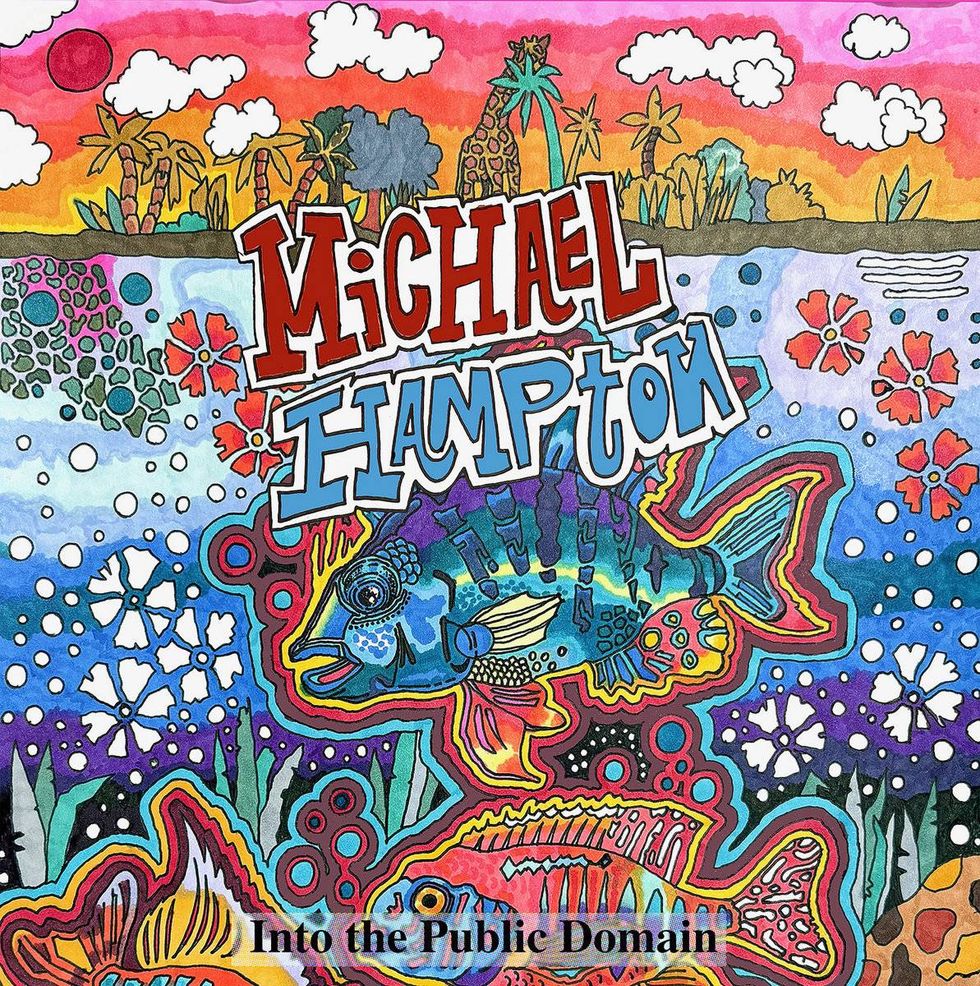
That guitar made it out with Hampton for some solo band dates to celebrate the release of Into the Public Domain, the first of two EPs plus an LP that he’s releasing. The name is literal: He’ll also be releasing the multitrack files, which can be used royalty free.
Hampton’s latest, Into the Public Domain, is the first of three records that he’ll be releasing, alongside King Kong and The Kidd.
It’s a large project with a lot of moving parts and a long cast of collaborators, but it came together at the behest of PhilipTheArtist, who co-produced the record along with Hampton, Joe “the Butcher” Nicolo, and John Schreffler. Recorded at Fort Wolf Studios in Canyon Country, California, and Los Angeles’ Sunset Sound, much of the music was initiated by PhilipTheArtist and Schreffler in order to create something, according to the former, “like if National Geographic or Nova wanted something in the background—not just rock ’n’ roll.”
A song like the off-kilter funky rocker “Steve’s Kadillac” strikes an experimental funny bone that could certainly work in that direction, with warped riffs floating in and out across the groove-centric soundscape. But there is plenty of rockin’ to be found, as on the opening “Fight or Flight” and the title track, where Hampton’s distortion-drenched leads crack the stratosphere wide open and launch into space.
PhilipTheArtist explains that “Technicolor Mobile Home” has roots that reach beyond the studio. “When me and Michael play ‘Hit It and Quit It’ [from Funkadelic’s Maggot Brain] live,” he explains, “there’s a certain way he plays the chorus that is different than the record. That way he plays it evolved into ‘Technicolor Mobile Home,’ then I recorded what I remembered he came up with.”
Hampton remembers the sessions as a laid back affair, where the vibe, from his perspective, was “just do what ya feel.” He recalls, “Phil would call me up from California and say, ‘You got time, Mike?’” If he was available, he’d fly out from his Philly area home. “If I didn’t jump on and do it then, I wasn’t gonna do it,” he says.
“Today, there are some serious issues and it’s like, what am I gonna write to that? Am I gonna write about it? Or not gonna write about it? Or just play?”
Nicolo, a nine-time Grammy winner and co-founder of legendary hip-hop label Ruffhouse Records, assembled the jammy tracks into songs. “I had so many colors of the rainbow to paint with,” he says.
Hampton will follow Into the Public Domainwith King Kong, a musical telling of the classic story, and The Kidd. With a preview of rough tracks from the latter, it seems as though the trilogy will showcase just how singular and varied Hampton’s guitar playing is. The early tracks indicate a world that’s all over the sonic map, his still-distinctive guitar fitting right into ’90s ZZ Top-style heavy blues, warped disco funk, soul jazz, and beyond.
Nicolo will release the albums through his SMN Records imprint—a part of his Sound Mind Network, a nonprofit whose “mission is to change the way the world looks at trauma suicide and drug abuse with the arts.” He says the records display Hampton’s “splintered genius” and calls him a “chameleon" who is “so unlike traditional guitar players.”
Joe “the Barber” Nicolo, of production team the Butcher Bros., whose credits span pop stardom, calls Hampton a “chameleon” and a “splintered genius.”
Photo by Philip Samuel Smith
Hampton is all about the vibe, and that seems to be what makes him such an adaptable player. He gets the vibe, and dives in. It’s an approach that any improvisor knows requires staying in the moment and keeping overthinking at bay, and that’s where Hampton is most natural.
“I like to remain ‘not-knowing,’” he muses. “I like to practice a lot, but at the same time, I want it to be new.” (It’s also the answer he gives when I ask if he likes messing around with pedals, which he doesn’t really get into extensively: “Every time I hook something up, I want it to be brand new.”)
“Staying inspired,” he continues, “it’s just life itself. Today, there are some serious issues and it’s like, what am I gonna write to that? Am I gonna write about it? Or not gonna write about it? Or just play?”
This recent burst of activity is intentional, though; Hampton tells me he’s trying to be more available to new musical things. In this case, it’s been working out. Jams that started some years ago in Philadelphia turned into sessions—he mentions some early jams related to the project at Bam Margera’s house—that led to more sessions and eventually to the L.A. recordings. Throughout, he’s just been trying to be open to saying yes. Where that will lead next is anybody’s guess.
“I like to remain ‘not-knowing.’ I like to practice a lot, but at the same time, I want it to be new.”
If all that sounds like he’s always on to the next thing, that’s only partially true. P-Funk continues to take it to the stage, and when we talk, Hampton is getting ready to head out for a few dates. The group’s large ever-changing lineup has sounded powerful on recent tours. And at the recent Hampton-band live shows in California, the pickup band assembled by PhilipTheArtist opted to stick to versions of P-Funk classics, namely “Butt-to-Butt Resuscitation,” “Red Hot Mama,” “Hit It and Quit it,” and, of course, “Maggot Brain.”
While the classics remain in all parts of his life, Hampton says he hopes to get a live band playing the new material. He adds that when the time comes to play those songs, “I don’t want to know them too well.”
The driving force in Hampton’s camp, it seems—the one making sure this all goes down—is PhilipTheArtist, and he’s passionate about the music. He wants people to hear the breadth of what’s possible. The world knows his work with P-Funk, but he wants Hampton to be heard as an individual. “It’s time for Michael to get out there,” he says. “Every legendary guitar player has a set of solo records and has a sound people can put their finger on. Michael was under-celebrated in that way. It was time.”
What is it about Hampton that has driven this project? “Michael has the ability to give you goosebumps with his playing,” PhilipTheArtist says. “He’s one of those guys who can make you cry or make you smile with his playing.” Or to put it simply, “He just knows how to make you feel something.”





 www.premierguitar.com