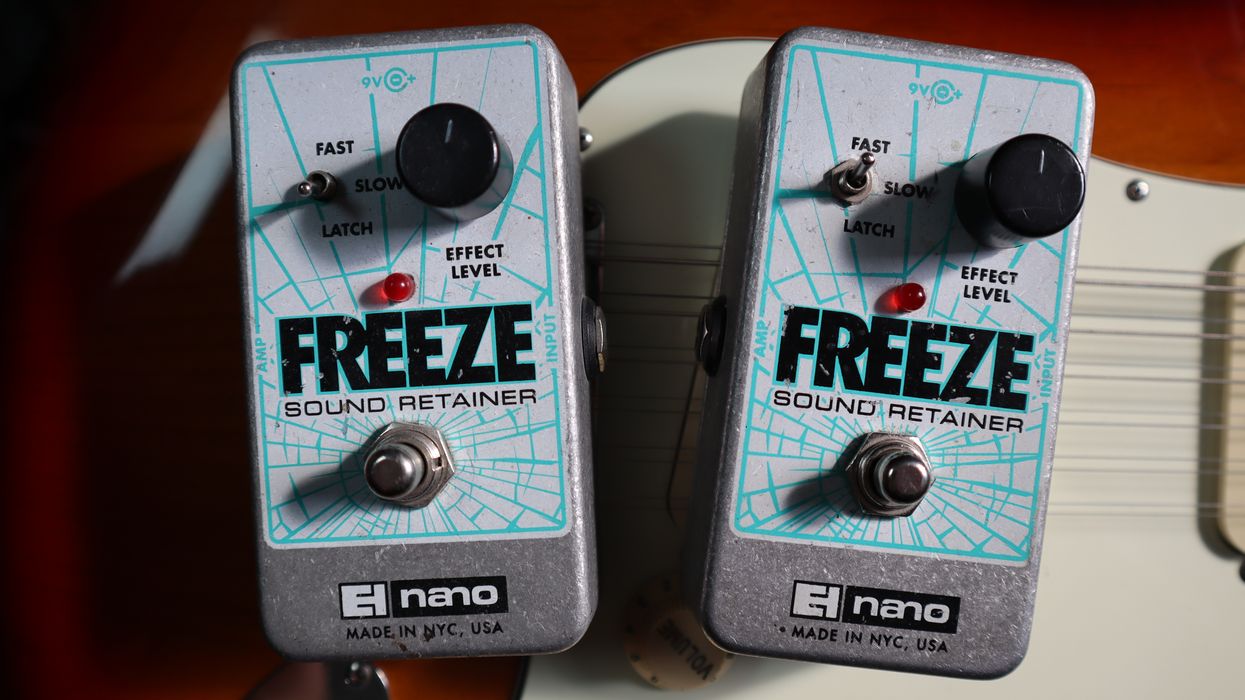

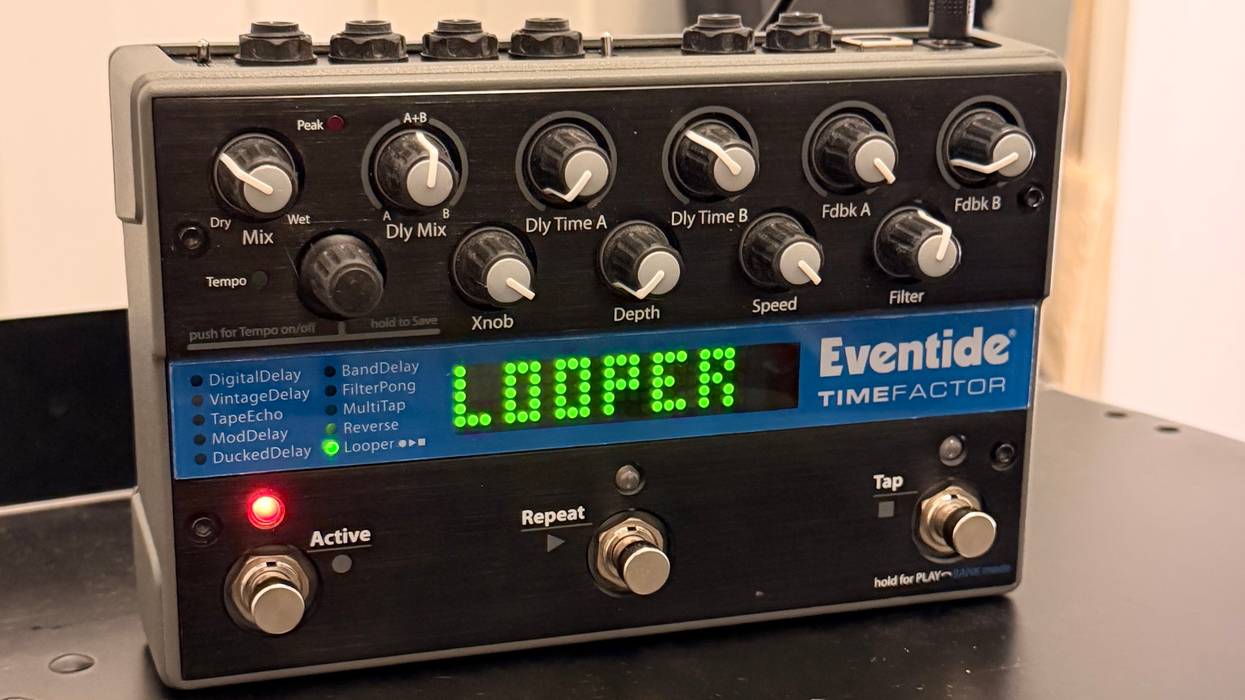
Sometimes in a musician’s life, gear design aligns with the needs of the artist. Picture this: It’s 2014. You’re surrounded by several pieces of inadequate and unobtainium looping gear in various states of disrepair, wondering if there will ever be a time when a single device is available to help you meet your ambient, pan-rhythmic, non-band-in-a-box playalong-looping desires. Then, you read about the brand new update to the looper algorithm of the Eventide TimeFactor. Once upon a time, this happened to me.
This was back when, seemingly, the powers that be saw fit to regress looping hardware devices back to the dark ages, as if the Lexicon PCM 42 and original Electro-Harmonix 16 Second Digital Delay had never existed. You’d be hard pressed to know that now, what with the plethora of forward-looking looping and sampling devices available today from the likes of Hologram Electronics, Red Panda, Chase Bliss, Expedition Electronics, Kinotone, and many, many more. But sandwiched right in the time zone between these two eras is where I found the Eventide TimeFactor’s looper algorithm.
The TimeFactor had been out for several years at this point (released, in fact, on my birthday a few years prior to this—how’s that for a sign?). It was marketed primarily as the latest super delay with a variety of dual parallel delay engines available with presets. An Eventide product, there’s no doubt about the sound and build quality of this device. But the looper seemed kind of basic and a bit of an afterthought initially, doing little more than recording and overdubbing. The major update delivered access to options like overdub order, reverse, retriggering, loop windowing, tap tempo (sort of…), and up to two octaves up or down of intervallic scanning and recording—from octaves and fifths to completely smooth linear movement, all mappable to expression pedal and AUX switches.
So, I’d like to make a case for this large-ish piece of hardware, by modern standards, with many knobs and switches, if I may. For the type of music I strive to make, swift access to parameters is essential—with little to no latency and minimal hindrance to making changes. No menu diving to reassign a knob mid-song or mid-improvisation when the fancy strikes.
It’s true that this exact same looper algorithm lives within the Eventide H9. But with only one giant knob and a couple buttons, how can I reasonably be expected to have access to the 13+ parameters available to me at the surface level of the TimeFactor hardware? It’s also true that the H9 has a digital facsimile of the TimeFactor’s hardware available in the tablet app that can control the H9 over Bluetooth, but, unfortunately, the latency introduced is still a … “factor.” (Sorry.) In fact, I think it speaks volumes that one of the best ways the Eventide engineers could come up with to control the parameters of the H9 was to simply replicate the TimeFactor control layout in the tablet app.
“For the type of music I strive to make, swift access to parameters is essential—with little to no latency and minimal hindrance to making changes.”
The TimeFactor also speaks to the priority of immediacy by allowing an expression pedal and (not or) an aux switch for further parameter control. Another great aspect of the design, and one I don’t hear much talk about, is that you can assign two instances of any knob on the unit to an auxiliary switch. If I want to jump between 0 percent and 70 percent decay in my looping overdubs at the click of a switch? No problem, we can make that happen!
Still need convincing? The pristine Eventide tone can be vintage-ified by setting a longer loop length and lowering the bit rate. The instrument/line-level switches on the back panel add further tonal shaping—some players love running that line-level boost into a guitar amp. All of this has kept me from feeling any need to "upgrade" for the past 12 years.
Please allow me to end my love letter to the TimeFactor’s looper with the following: When a legendary company known for great sound and creative devices drops a product like this—one that allows an artist to not only find a way to serve their musical ideas inspired by great guitarist looping effectors like Robert Fripp, Brian Eno, Daniel Lanois, David Torn, Henry Kaiser, Bill Frisell, and Nels Cline, but also builds enough in there to allow any artist to find their own way forward in their music into the future of their own voice—I truly believe they have done an unquestionable service for the good of all creative artists everywhere. And for that, I thank them, heartily!

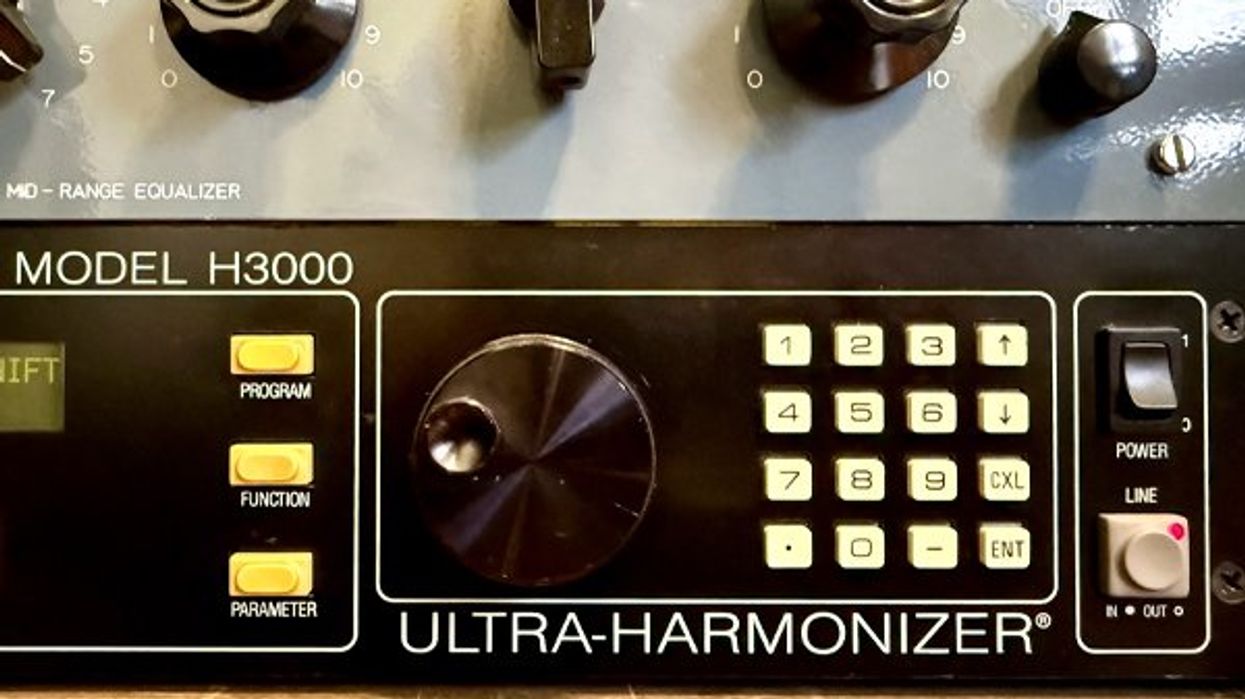
 Guitarists are used to coveting cranky, old gear, but if you’re not a rack user, the H3000 might not be for you! If you ever see one of these in a studio, be sure to take some time to check it out, and maybe give the plugin a try.