For more than 20 years, English guitarist Barrie Cadogan (aka Little Barrie) has been one of the go-to 6-string collaborators for England’s biggest rockers, from Morrissey and Liam Gallagher to Primal Scream, Paul Weller, and more. The Better Call Saul theme song composer has also made a name for himself in the U.S., notably as a trusted creative collaborator for Dan Auerbach and his Easy Eye Sound studio. That’s where PG’s Chris Kies linked up with Cadogan for this Rig Rundown. Tune in for the full interview for all the fascinating details, and peek at a quick preview roundup below.
Cadogan acquired this P-90-loaded goldtop Murphy Labs Les Paul from the Gibson Garage in Nashville last year. It was fitted with a Bigsby later, and the neck has been slimmed down. Cadogan uses a custom set of ProSpec Pyramid flatwound strings (.011–.014–.018–.028–.038–.048).
Blue Bomber
Cadogan designed this 6-string himself, inspired by a guitar owned by John Squire of the Stone Roses. A bit of a hybrid between a Jaguar and Jazz bass body, it’s also equipped with P-90s and a Bigsby, and holds up well to touring abuse. Plus, Cadogan had a killswitch installed.
Tarulli Tones
Black Keys’ front of house engineer Jason Tarulli built these two combos. One of them is inspired by the early-’70s Fender Musicmaster Bass amp circuit, while the other takes after a tweed Deluxe. Cadogan loves the sound of them running together.
Barrie Cadogan’s Pedalboard
Cadogan’s few-frills board carries a Boss TU-3W, Sola Sound-modded Boss TB-2W, Fredric Effects Super Unpleasant Companion, Strymon Deco, Fredric Effects West Germany Vintage Tremolo, and an Echo Fix EF-P2 Spring Reverb.
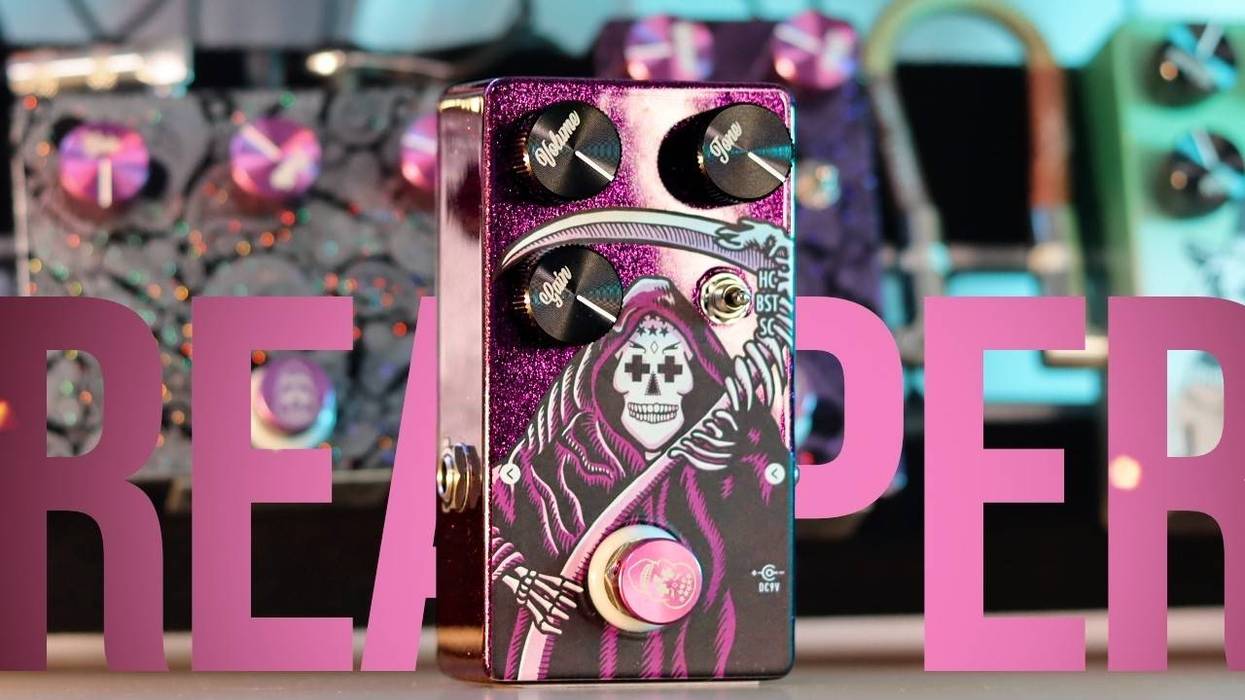
The Warm Audio Reamper does what the name says, but that's the least interesting thing about it. Tom Butwin runs through three use cases of the latest studio stalwart from @WarmAudioOfficial: pulling old direct recordings back through a real amp and pedalboard, splitting your signal to capture a dry safety track alongside your live rig tone, and even routing a vocal through a guitar overdrive pedal. For something this compact, the feature list runs long: JFET and op-amp switching for analog color or transparency, plus a built-in 50-watt power soak for silent amp recording with IRs or cab sims added after the fact.
Warm Audio
Reamper
Analog Studio Routing Hub with Independent Preamp and Re-Amp Signal Paths, Variable Impedance Control, and Silent 50W/8 ohm Power Soak
Spoiler alert: the new RK2000 Funk Siren from Keeley Electronics ain’t your ordinary delay pedal – and that’s a massive understatement.
Designed in collaboration with Trey Anastasio and his guitar tech Justin Stabler, the RK2000 is based on the iconic Ibanez DM2000 rackmount delay, a classic from the 1980s and an integral part of Anastasio’s sound in Phish and other projects.
The RK2000 delivers the exact “Funk Siren” ambient loops made famous by Anastasio, with rock solid reliability, a ton of modern updates and expanded functionality, including adding modulation to your delay, tap tempo, full MIDI integration, five presets, expression pedal control and more.And did we mention that it also happens to be a great sounding delay pedal? But that’s just the tip of the iceberg.
Keeley
RK2000 Funk Siren Delay
DM-style Stereo Digital Delay Guitar Pedal, Signature, with Blend, Feedback, Filter, Depth, Input, Time, Rate, Sub, Mod, Tap, and Hold Controls
The Cry Baby BB535 Wah Reissue is an authentic restoration of the expressive, throaty growl that became the collective voice of a new generation of wah. Designed with extensive input from the top early ’90s rock acts, it gave players the power to shape their own sound with a frequency selector, built-in boost, and custom inductor tuned for a uniquely warm, vocal tone. We dusted off the best-sounding model in our collection and recreated it part by part, original inductor included. For modern convenience, we added on/off LEDs for both the wah effect and boost circuit. Find your voice, and put some attitude into it, with the Cry Baby BB535 Wah Reissue.
Dunlop
Cry Baby BB535 Multi-Wah Reissue
Wah Guitar Pedal with Boost, Range Selector, and High-Impedance Buffer
New Orleans heavyweights Crowbar have been on a relentless tour of sellout shows this spring, with a schedule of dates that would have bands half their age fainting. Ahead of their gig at Eastside Bowl in Madison, Tennessee, PG’s Chris Kies talked with guitarist/vocalist Kirk Windstein, guitarist Matt Brunson, and bassist Pat Bruders to see what gear they’re using to conjure their crushing wall of sludgy hardcore.
This is Windstein’s latest signature model with Solar Guitars, the X1.6KW, in Mardi Gras purple. It’s loaded with a pair of passive pickups at the moment—a Seymour Duncan Invader in the bridge, and a Seymour Duncan ’59 in the neck. It’s currently his go-to instrument for Crowbar dates, and he strings it with DR Strings (.013–.060). Though the band’s down-tuned heft would lend itself well to a 7-string, Windstein grew up on six, and that’s where he’s going to stay.
Not-So-Small Fry
Windstein is running through a Neural Quad Cortex unit, working in tandem with a Fryette Two/Ninety/Two power amp, recommended to him by his sound man.
Dean’s List
Brunson shreds with this 7-string Dean Exile Select, kitted out with a burl poplar top, maple neck, and EMG 57/66 pickups. He digs these pickups for their vintage-voiced, cleaner sound, which pairs well with the band’s high-gain environment.
Kemper and Kab
Brunson is running through this Kemper Profiler MK2, primarily using the stock Diezel VH4 profile. He likes the ease of use and consistency he’s found in the digital platform. The Kemper runs through SonicTone Amplification cabinets loaded with Celestion Vintage 30 speakers.
From the Ashes
Bruders has used this EST LTD Phoenix II since 2005. It features active EMG pickups, and he runs it with DR Strings sets.
Extra-Large Amp
Bruders plays through a Darkglass Microtubes 900v2, often blending it with the signal from his Tech 21 SansAmp Bass Driver DI. His signal is pumped through an Eich Amplification XLCab cab, which is stocked with a range of speakers: two 15", two 12", four 10", and two NT1 tweeters.
Pat Bruders’ Pedalboard
Bruders’ DIY board couldn’t be simpler. It’s got a Boss TU-2, and the aforementioned Tech 21 Sans Amp DI unit.