

I fell hard for the Echoplex. I bought my own as soon as I had bread to spare. And when digital engineers delivered the first good simulations, I rejoiced. Because you haven’t really experienced an Echoplex if you haven’t watched in horror as a tape ripped or some other irreplaceable part turned to dust and smoke.
MXR’s EP103 is the first compact digital stompbox to wear the Echoplex name. The good news? MXR didn’t just slap a cool logo on a digital delay and call it a day. The EP103 is an excellent delay and an authentic homage to the Maestro Echoplex EP-3 and it’s many quirks.
Tape Crinkle, Numbers Crunched
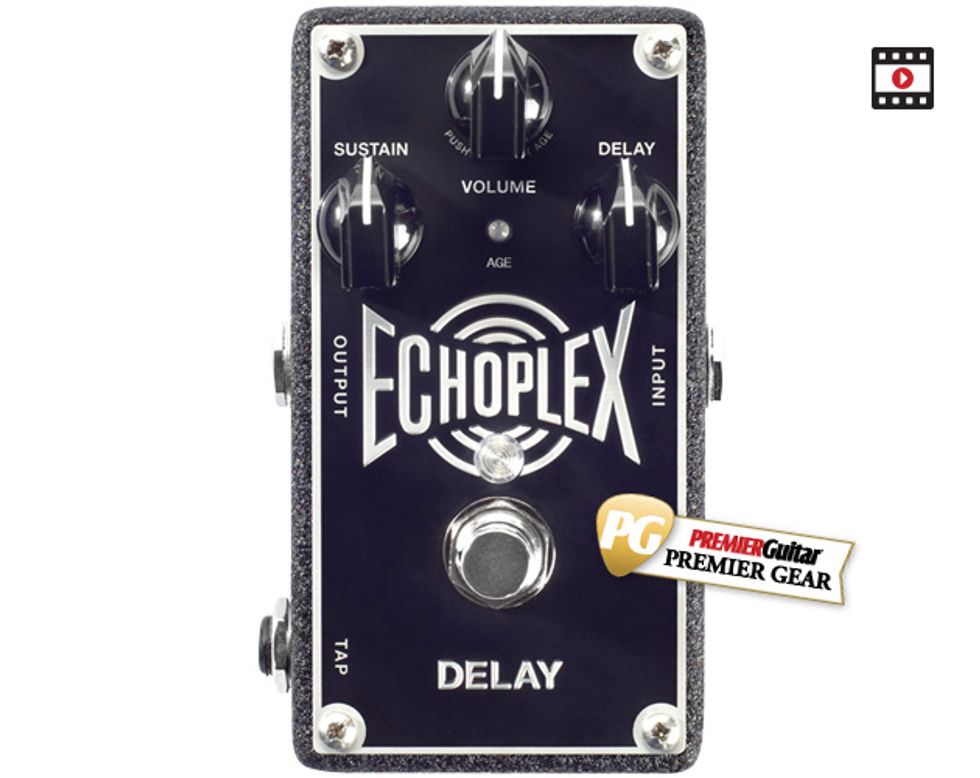
The EP103’s interior hints at the digital horsepower required to simulate a whirring, wheezing contraption like the Maestro EP-3. It’s a busy, but near-immaculate circuit that bristles with enough compact ICs to look like a little city viewed from 35,000 feet. The exterior is classy and functional. And though the three-knob array is simple, the volume knob cleverly doubles as a push-button that activates age mode—introducing tape-warble-simulating modulation and a filtering effect that approximates tape degradation. It’s a clever setup that’s intuitive to use and keeps the pedal surface free of clutter. The sustain control regulates the number of repeats, while the delay control sets delay time. The delay knob ranges to 750 ms. But by using a tap tempo switch (not included), you can extend maximum delay time to 4 seconds.
Age mode isn’t the only concealed function. An internal switch activates stereo mode, which requires two TRS splitter cables. The pedal ships set up for an analog dry signal path. But sticklers for authenticity may prefer the wet mode, which delivers only effected signal to your amp. You can also activate a trails mode at startup.
Steadily Wobbling
While I didn’t test the EP103 against other digital Echoplex simulators, I did compare it to my own early-’70s Maestro EP-3, and I was very impressed with how close the MXR came to nailing the Maestro’s complex overall sound picture. We’ll get to the similarities, but at least one critical difference bears mentioning.
Specifically, the EP103 does not contain an EP-3-style preamp. It’s a critical omission, because while the EP-3’s preamp is a very simple piece of circuitry, it adds much to the EP-3’s tone signature. MXR has a solution in the form of the EP101 Echoplex preamp pedal. (And in truth, most good JFET or FET boosters that don’t color your signal too much can be a serviceable stand in.) But it’s hard to fully approximate the EP-3’s sonic whole without that flavor, and it stinks to have to buy or use a separate pedal to get it.
What the EP103 does really well is approximate the EP-3’s complex combination of tape modulation, high-end taper, and the gentle, organic, bright-to-patinaed fade in the echoes. In most respects, the EP103’s darkish echoes feel more natural and pleasing than some of my favorite analog delay units. And though the initial attack and first echo from the EP103 are not as bright as my EP-3 (which can be surprisingly bright), the tone inhabits a potentially ideal middle ground between digital brightness and analog darkness that players unconcerned with tape-echo authenticity are likely to dig.
Ratings
Pros:
Complex echo tones. Wide dynamic range. Great sensitivity in all controls.
Cons:
No onboard preamp.
Tones:

Ease of Use:
Build/Design:

Value:


Street:
$199
Company
jimdunlop.com
Modulation is key in any tape echo simulator for creating the illusion of tape warble. The EP103’s modulation sounds good, though single-coil pickups and bright amps can highlight a faint regularity in the modulations when the pedal is in standard mode. Activating the age mode, however, darkens the repeats, adds cool coloration, and at times even seems to lend randomness to the modulation. Typically, I kept the pedal in age mode. The range of the control is wide and useful, making it easy to add just a touch of filtering or simulate a decades-old tape loop chasing dust bunnies.
The authentic functionality of the EP103’s volume and sustain controls also bears mentioning. The volume control allows you to either tuck the repeats well behind the original signal or actually make the first few repeats quite a bit hotter before they begin to fade. The dynamic range is narrower than on my EP-3, but it adds impressive tone variations. The EP103 sustain control also approximates the odd taper of the EP-3’s sustain control. In the first half of the range, you’ll rarely hear more than two repeats and a very subtle, pleasing fade. In the second half of the sustain control’s range, however, the repeats seem to get almost exponentially more prominent depending on the echo volume until you reach self-oscillation at maximum settings. The interactivity and odd dynamic curve of the controls make the pedal feel tricky and twitchy at times, but they add up to very organic dynamism and sensitivity that enables you to tuck and tailor repeats for a song or arrangement in very precise ways.
The Verdict
In purely sonic terms, it’s hard to imagine getting much closer to an EP-3 without employing prohibitively expensive processing power and a complex control set. The EP103 strikes a smart, elegant, and sensible balance between simplicity, affordability, and authenticity that can get you 90 percent of the way to EP-3 sounds without the attendant hassles. That’s an impressive achievement in my book. And while it’s near impossible for any compact, affordable digital pedal to replicate a Maestro Echoplex’s arcane and expressive mechanical functionality, the MXR EP103 is about as fine a sonic approximation as you’ll find in its price range.
Watch the Review Demo: