

Bob Taylor has a knack for knowing when to heed tradition and when to forge ahead on his own path. His bolt-on NT neck may be the most obvious example, but Taylor has never been shy about tinkering with his guitars or embracing new designs when he thinks it’s a step in the right direction.
Take Taylor’s jumbos: The original design was the work of Sam Radding, the luthier behind the American Dream collective that fostered Bob Taylor’s early development. Knowing a good thing when he saw one, Taylor retained the Jumbo design when American Dream became Taylor Guitars. The model became a pillar of the early Taylor line, and when Neil Young played a 12-string 855 version in his 1978 Rust Never Sleeps film, the model was cemented in legend.
Times being what they were (there were no hordes of online guitar nerds dissecting a guitarist’s every onstage move and model choice back in ’78), Neil’s use of the instrument didn’t translate into immediate sales. Maybe that’s why Bob Taylor feels less sentimental about the model. Whatever the reason, Taylor saw room for improvement in the venerable Taylor Jumbo. And the result is the new Grand Orchestra—an evolution of the biggest Taylor that’s unique in voice and shape, and that in the mahogany-and-spruce 518e incarnation reviewed here, inhabits an intriguing and expansive tonal spectrum.
New Directions
If a new shape for one of Taylor’s most
adored body styles isn’t testament enough to Bob Taylor’s open-mindedness, the fact
that he shelved his idea to redesign the jumbo and instead went with the Grand Orchestra idea brought to him by the company's new master builder, Andy Powers, is more than ample evidence.
Taylor has not been shy about all but
anointing Powers as his successor, and though the new master builder is relatively young at 30 years old, he's got more than 20 years of building under his belt—enough to earn him the gig as sole designer at Taylor these days.
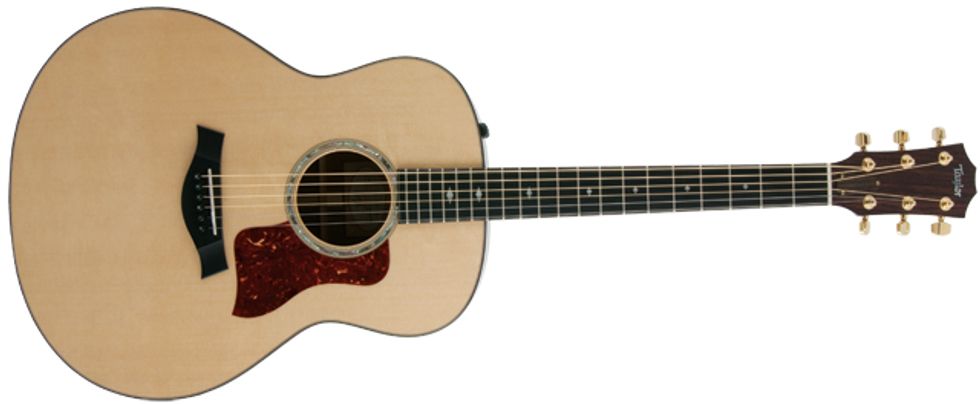
A first gaze at the 518e suggests that Powers and Taylor Guitars may be onto something. The body profile Powers drew for the Grand Orchestra is attractive and well balanced. Measuring 16 3/4" at the lower bout, it’s got the voluptuous dimensions that make the classic jumbos—the Guild F-50, Gibson J-200, and the Taylor 855, for that matter—such formidable and beautiful instruments. But the taper at the waist and the slim silhouette of the upper bouts assert a Taylor family connection.
With a trace of what you might call melted bear claw pattern in the Sitka spruce top, the 518e has beguiling and organic visual presence. It manages to seem simultaneously light and deep in texture (a visual foretelling of its most pronounced sonic qualities, as it turns out), and the swirling, reddish faux-tortoise pickguard is a perfect complement to the spruce top’s visual complexity. This is the kind of attention to aesthetics we see from luthiers trying to make a splash at Healdsburg, but coming from the Taylor factory, it has a way of bolstering your hope for art and craft in mass manufacturing.
The 518e has just enough in the way of flash accoutrements to assert up-market status without looking ostentatious. The three-ring rosette has a center ring of abalone and a super-fine pinstripe inlay around the fretboard is a blink-and-you’ll-miss-it detail that up close, imparts a luxurious sense of bespoke detail.
Visually, there’s almost nothing wrong with the 518e, save for the Expression system controls, which are mounted on the upper bout. While it’s hard to argue the functionality of the controls, they’re a jarring presence on a guitar that’s otherwise this exquisite. The same goes for the battery drawer located at the endpin. It’s fast and convenient, but looks terribly out of place on a guitar that will set you back more than $2,500.
Though the plastic parts of the Expression system detract from a near perfect exterior, a peek inside the soundhole reminds you why Taylor remains among the most-esteemed builders in the business. The construction is virtually flawless—all precision cuts and tidy glue work. Look closer and you’ll notice that Powers’ rethink of the Taylor jumbo model applies to more than its shape. The bracing is light and thin—a big part of what makes the 518e and its cousins in the Grand Orchestra series sound so very different.
Boom and Bounce
Whether you’re used to the power of a
dreadnought or the control and harmonic
balance of an OM, picking up the 518e is a
pronounced departure. That said, it exhibits
some of the best performance aspects of
both styles. When I lightly fingerpicked a
chord progression in double-drop D, the
518e sounded alive and responsive. It has
the mellow presence and definition in the
midrange you’d expect from a mahogany-backed
small body like a 000-18—or
Taylor’s own Grand Concert—but with a
lot more body. Even with a light touch you
hear and feel the extra oomph and presence
in the low end as well as baritone, harp,
and dulcimer overtones—a cool and very complex voice.
The low end has a sort of elasticity that’s attributable to the light bracing, the body’s considerable depth, and the expansive real estate behind the bridge. There’s a lot of vibrational surface and it seems to work with the lighter bracing to create a very bouncy and reactive—if not immediately responsive—feel. If you use a thumbpick or hybrid picking approach, you’re more likely to notice the less immediate attack and a touch of natural compression in the bass and midrange. In the first few sessions with the 518e, the sonic sum can be a little bit confusing. There’s no doubt that the low-end is big—you can feel it in your ribs. But the rubbery bass and the way it blends with the compressed, almost scooped low-mid output blunts the otherwise remarkable articulation just a touch. For folks who play fingerstyle without a thumbpick or flatpick, this might not be an issue at all. But players who use an aggressive picking approach may favor the more reflective, immediate, and responsive properties of the rosewood 918 version.
Ratings
Pros:
Killer low end. Complex sound that’s full of color and overtones when played with a light touch.
Cons:
Heavy picking makes midrange blurry and compressed. Expression controls detract from a beautiful design.
Tones:

Playability:

Build/Design:

Value:

Street:
$2,649
Company
taylorguitars.com
The bouncy low end and compressed low mids can make heavy strumming with a heavy pick sound paradoxically small as well. Put a thinner celluloid pick and a light touch in the mix, though, and the 518e sounds positively orchestral. Open tunings built around doubles and octaves sound enormous, lending propulsive force and color to Fahey-style workouts and giving languid Indian-flavored drone pieces an intricate and rich harmonic foundation. Strum with a light pick in standard tuning and this guitar is a Jeff Lynne-style producer’s dream—bright, detailed, balanced, and precise enough to contribute hi-hat-like rhythmic textures and add texture to chord melodies.
The Verdict
Bob Taylor’s willingness to tinker is one of
the great creative energies in the guitar business.
In the case of the 518e, that spirit, and
Taylor’s incorporation of the adventurous,
player-centric design skills of Andy Powers,
yields a guitar just a few shortcomings shy
of being a modern masterpiece. Its most
pronounced drawback is a sound that can
be confoundingly small and compressed and
a bit blurry under heavy picking attack. But
for players who use a more dynamic and
generally lighter fingerstyle approach, the
518e is a wonderland of color, overtones,
and rich, low-end throb that can make a
solo composition sound massive and lend
body to a spare band mix.
Like most high-end Taylors, the craftsmanship is exemplary. But whether the mahogany-and-spruce tonewood recipe of the 518e is the best match for the light bracing and big body of this new Grand Orchestra model is debatable. Players who incorporate heavy picking may prefer the greater definition and projection from the rosewood 918e or the brighter, more-even, maple-backed 618e. There is no debating, however, that Taylor and Powers have created an exciting and gorgeous new shape in the Grand Orchestra. It’s an instrument that’s full of sonic potential, and given the way these guys are inclined to innovate, odds are even that this design will yield magical guitars in the years to come.
Watch our video review: