

If you’re a fan of fusion—not the flaccid new-age drivel playing over the decrepit sound system of a declining department store, but the merging of stellar jazz musicianship and unpredictability with rocking tones and instrumentation—then you’re probably no stranger to legendary drummer Tony Williams and his hugely influential band. The Tony Williams Lifetime was arguably the first, full-on jazz-rock fusion band, and in its many incarnations it was the launching pad for some of jazz-rocks biggest giants. It was the band from which jazz god Miles Davis—who, less than a decade before, had hired Williams to man the skins in his band at age 17—somewhat controversially, plucked the young John McLaughlin, who would later go on to form the mighty Mahavishnu Orchestra. It was also the band from which Allan Holdsworth, following his stint with the Soft Machine, would influence an entire generation of guitarists with his startlingly fluid chops. (Perhaps most notable was his influence on Eddie Van Halen, whose phrasing, note choices, and tone owe hugely to Holdsworth’s playing on Lifetime songs like the classic “Red Alert” from 1975’s Believe It.)
Of the many players influenced by Tony Williams, Jack Bruce and Vernon Reid aren’t necessarily best known for their fusion work. Bruce practically wrote the book on power-trio rock bass playing with his groundbreaking work in Cream with Eric Clapton and Ginger Baker. And Reid found fame as the ferocious fret-burner who, along with his bandmates in Living Colour, was at the forefront of the late-’80s funk-metal vanguard. However, as their discographies prove, both players are avowed fans of the aforementioned fusion icons. Which is why they recently joined forces with former Lenny Kravitz drummer Cindy Blackman-Santana and Hammond B3 guru John Medeski to pay their respects to Williams and the Lifetime as Spectrum Road.
On their eponymously titled debut, the four virtuosos revisit Lifetime’s surging, stylistically expansive material, digging into deep, free-flowing improvisations as well as poetic vocal tunes. Most of the Lifetime songs on Spectrum Road (with the exception of Believe It’s “Wild Life”) are drawn from Lifetime’s earlier albums, including 1969’s Emergency! and 1970’s Turn It Over. The latter of these two fusion classics featured none other than Bruce on bass and vocals.
While Bruce is most often remembered as the voice and brawn powering hits like “Sunshine of Your Love” and “White Room,” the fact is that just a couple years after his short tenure in Cream, he was whisked into Lifetime when Williams dropped by the Fillmore East to check out Bruce’s band. Jazz, and rock, would never be the same.
Jack, how did you first connect with
Tony Williams, and what attracted you
to this genre of music that was emerging
in the late ’60s?
Jack Bruce: Well, I had first heard
Tony playing on [jazz saxophonist] Eric
Dolphy’s Out to Lunch!. When I listened
to that record, I just fell in love with his
style, because he completely turned the
drums around. He wouldn’t necessarily
play the snare drum part on the snare
drum—he might play it on the bass
drum or something else altogether.
One night I was playing with my own band at the Fillmore East. There were a bunch of people down at the East that night, including Hendrix, and John McLaughlin had brought Tony along with him. Tony said to me, “Do you want to join my band?” I said “Sure, okay.” And I did! [laughs].
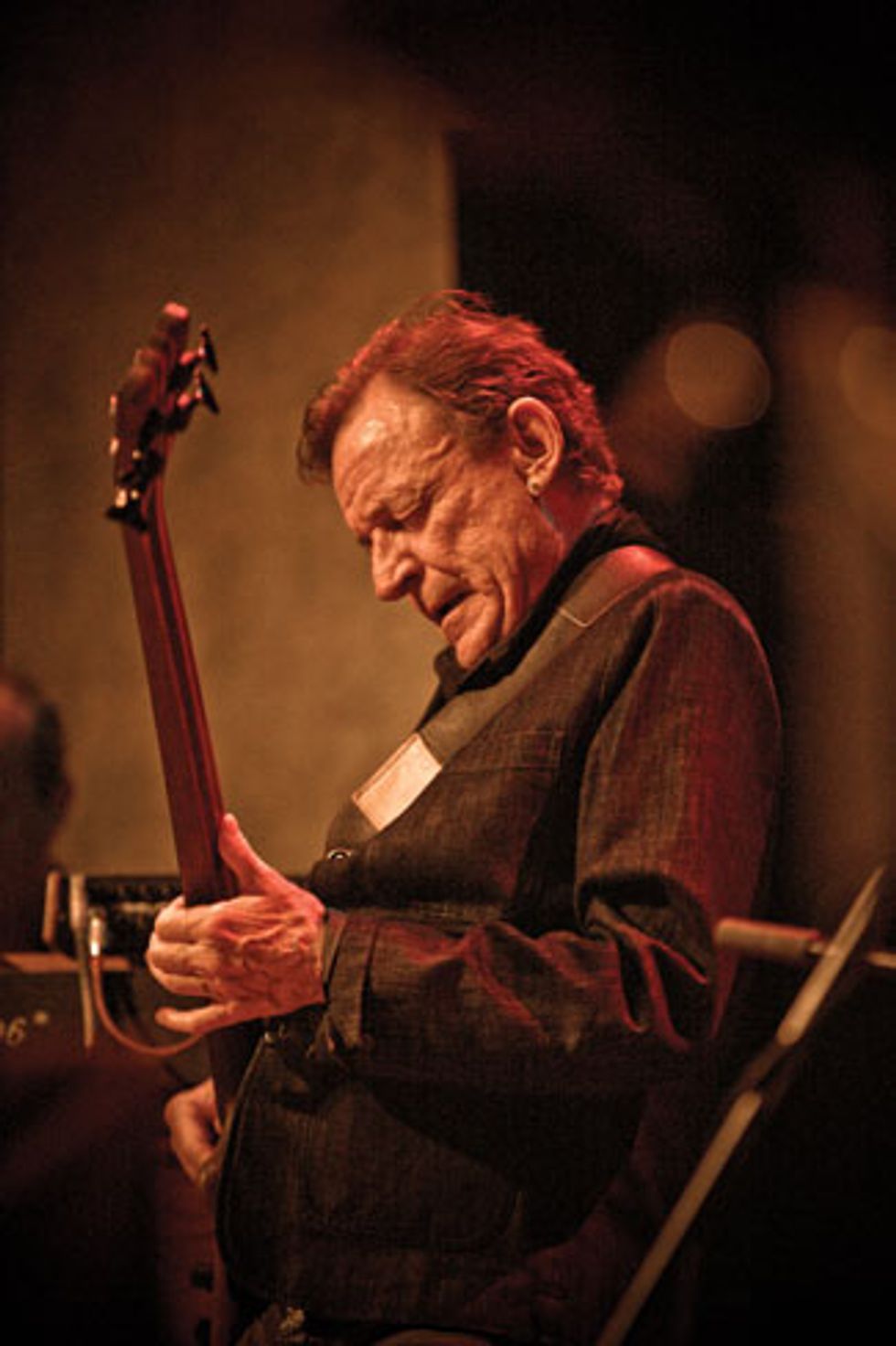
Bruce with Spectrum Road live at the legendary Yoshi’s Jazz Club in Oakland, California, on February 5, 2011. Photo by Jerome Brunet
You’ve said your experience with the
Tony Williams Lifetime was “the musical
time of my life.”
Bruce: It was exactly like when Cream
was just beginning and getting really
hot—that kind of magic, with all the
aspiration and the psychedelic thing
happening in the best possible way. The
same thing applied to Lifetime, because
it seemed like that was happening all
over again for me. In fact, it was probably
on another level from Cream.
What sort of influence would you say
Lifetime had on music?
Bruce: I think the band probably had
quite an influence on Miles and various
others, but I don’t think the Lifetime
had as much of an impact as it might
have had. It was more on individuals
who managed to hear the band live or
on their records. It was not long lasting
enough, but the people who were fortunate
enough to hear that band—or in
my case, play with them—certainly changed
their attitude to music in many ways.
Vernon Reid: I would say that the impact of Lifetime is discreetly massive. Jazz-rock, from the jazz side, actually started with the emergence of Lifetime. Yes, you already had improvising rock bands—from King Crimson to the Soft Machine—and you could even say that Hendrix’s approach was very improvisational. You could argue that the psychedelic era had created a space for fusion to happen. And somewhere in there, a young Tony Williams created his own expression of this collision of those sounds.
From the standpoint of the guitar, the Lifetime’s influence has been tremendous. After Santana and Hendrix, McLaughlin’s playing with Lifetime certainly changed my life. The roots of his genius are inside the Lifetime album Emergency! By the time you get to Miles’ Live-Evil and A Tribute to Jack Johnson, and eventually Mahavishnu Orchestra’s Inner Mounting Flame, there’s a remarkable transformation.
Although Holdsworth had played with the Soft Machine, his big impact on the world of guitar came with Lifetime’s Believe It, which almost overnight became the musician’s-musician record. On Believe It, Holdsworth simultaneously inspired a generation and flipped them completely out! Holdsworth was as original as McLaughlin, but completely different. And while people often focus on Holdsworth’s chops, to me he’s just incredibly lyrical with this great facility and legato feel.
Lifetime included other great guitarists like Ted Dunbar and Ronnie Montrose. There was even a version of Lifetime that never recorded. It featured Ryo Kawasaki as the guitarist. So a big part of Tony Williams’ legacy is that he loved guitar and clearly had an ear for rock-inflected guitar. That certainly all had a giant impact on me. In many ways, this is the music that forged who I am.
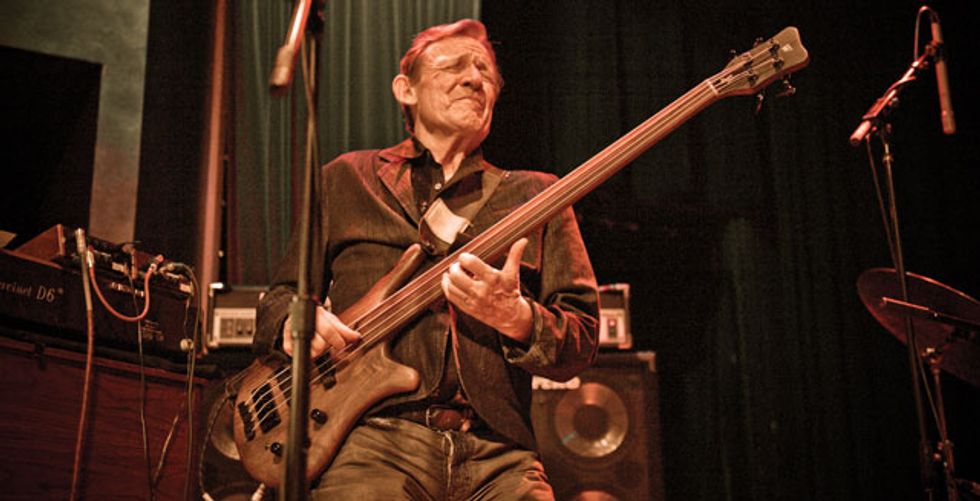
Bruce slides way up high on his signature Warwick
Rio Rosewood Thumb NT during a Spectrum
Road jam in early 2011 at Yoshi’s Jazz Club in
Oakland. Photo by Jerome Brunet
The two of you also played together back
in 2001 with the Cuicoland Express.
Bruce: Vernon actually played on a record
of mine called A Question of Time around
1990. It was right around the time Living
Colour really hit when he came in and
played on a track, and I just fell in love with
his playing. Since then, whenever I’ve had a
chance to play with him, I’ve gone for it.
Reid: That happened during a time when I was meeting a lot of my heroes—a crazy, wonderful time in my life where I was playing with Garland Jeffreys and doing stuff with Santana. Jack reached out to me, and he’s continued to be very supportive of me. I’ve been very fortunate to play on a couple of his solo projects.
What would you say are each other’s
greatest strengths?
Reid: Jack brings an extraordinary passion
to things, and he’s able to access the entire
stylistic range of the bass, because he’s just
so incredibly knowledgeable. I love his take
on “There Comes a Time.” The interplay
between how he sings that and plays the
bass, and the way that allows space to open
up for my playing is just so lyrical.
He also has a great ability to reharmonize things and to create bass motion that emerges as a distinct voice. In fact, the key thing I always learn from my heroes—and this certainly applies to Jack—is to stay away from the “licks mentality,” where it’s all about this lick and that lick, as if a player is basically the sum of his licks.
I really prefer to think in terms of the voice of these great players. With the Lifetime stuff, I’ve found it useful to think about playing things similar to the original guys, but not the same things. The reason I got into guitar to begin with was that Carlos Santana’s guitar sounded like a totally individual voice to me. It wasn’t a collection of scales and licks—it had a singularity, if you will. And sure, that singularity, as with all players, can be broken down into its component parts—certain tonalities and techniques.
The key thing as a player is to transcend the influence in order to have a voice. It’s easy—and, I think, especially easy for guitarists— to get caught up in the poetry of someone else, and not find the poetry in themselves. I’d like to think that Jack reached out to me because he heard the poetry in my playing. And that makes me feel good. I mean, this is a guy who’s played with Clapton, Robin Trower, and Gary Moore!
Bruce: Vernon’s chops are such that he plays so much and so fast that you have to kind of slow it down in order to really hear it properly. I think he plays so great that people aren’t really aware of what he’s doing. A lot of people don’t really hear what he’s doing. It’s like listening to a songbird or something—you have to slow it down because it’s going about 40 times faster than anything human, you know? He’s definitely not human, but he’s great!
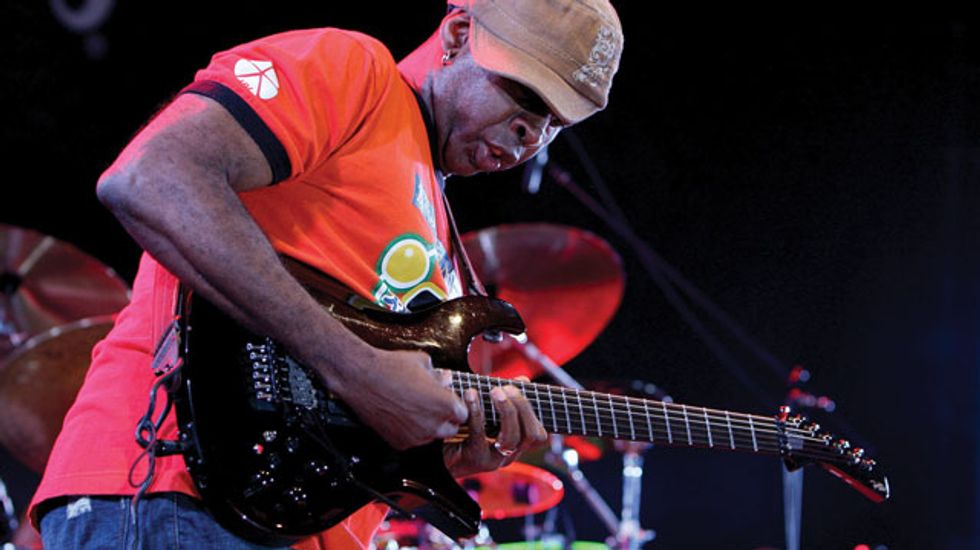
Reid busts out his inimitably
catonic licks on his MIDI-outfitted
signature Parker. Photo by Pino Fama
Have there been any instances where you
guys surprised each other, musically?
Reid: Man, Jack just swings really hard. I
mean, in “Blues for Tillman”—one of the
originals on the record—he swings the doors
off! He’s got that amazing, behind-the-beat
swing. But the biggest surprise for me was
when he first sang in Scottish Gaelic on the
traditional song “An t-Eilean Muileach.” I
mean, that was a jaw-dropping and indelible
moment. I was totally gobsmacked.
Bruce: The very first time I played with Vernon, we did a song of mine called “Life and Earth,” and he was playing these bebop lines on this very rock song. I knew then he was the guy for me [laughs].
You come from entirely different musical
generations. Was it hard to bridge that gap?
Bruce: I don’t think there are any real differences
in generations of music. If your goals
are the same, it’s got nothing to do with age
or anything like that. Great music is timeless,
and the same thing applies to musicians.
Jack Bruce's Gear
Basses
Warwick Jack Bruce Rio Rosewood
Thumb NT, Warwick Jack
Bruce JB3 Survivor, Gibson EB-1
Amps
Hartke HA3500C head, Hartke
410XL and 115XL cabinets
Strings
SIT Rock Brights Nickel Medium
sets (.050–.105)
Vernon Reid's Gear
Guitars
Parker DF824VR Vernon Reid
Signature MaxxFly, ’58 Gibson ES-345,
’90s Hamer Custom Chaparral,
’90s PRS McCarty
Amps
Mesa/Boogie 100-watt Dual Rectifier,
Randall MTS Series RM100M (including
Treadplate, Kirk Hammett KH3, and
Blackface modules), Fender Twin
Reverb, Randall RV412 cabs
Effects
Roland VG-99 V-Guitar System and
FC-300 MIDI Foot Controller, Eventide
PitchFactor, Eventide ModFactor,
Strymon El Capistan, Schumann
Electronics PLL analog square-wave
harmonizer, Moog MoogerFooger
MF-107 FreqBox and EP-2 Expression
Pedal, Fractal Audio Axe-Fx Ultra with
MFC-101 MIDI Foot Controller, Z.Vex
Fuzz Factory, Z.Vex Lo-Fi Loop Junky,
Pefftronics SB-101 Super Rand-
O-Matic, Pigtronix Echolution
Strings, Picks, and Accessories
D’Addario EXP115 (.011 to .049),
Dunlop JD JazzTone 205 and 208,
Dunlop TeckPick Aluminum, Surfpicks,
Brossard custom picks
Is there any track on the record that was
particularly important for each of you to
be included on the album?
Bruce: For me, it was “Vuelta Abajo,”
which I feel was a really great composition
of Tony’s. It was very important for me
to get that on there because I was actually
present at the beginning. When I joined
Tony’s band, “Vuelta Abajo” was the first
thing we recorded. Tony didn’t write all the
tunes on the record, but they’re all pretty
important. There’s “Coming Back Home”
by Jan Hammer, and a couple of John
McLaughlin tunes, as well as a couple of
tunes that come from this band, Spectrum
Road—it’s a bit of a mixture.
Reid: I really wanted to do “Coming Back Home”—it’s one of my favorite Jan Hammer pieces. Tony played it on his 1978 solo album The Joy of Flying with George Benson, and it’s a delightful melody. It was really daunting to take on. There’s a lot of influence from George Benson on the first half, with the whole clean-tone thing, but after that I felt, “I really have to make this thing my own.” It’s one of my favorite moments on the whole record.
With the level of improvisation happening
when the group is playing live, how
comfortable are you going into each show?
Bruce: That’s the exciting thing, because
we quite often don’t know what’s going to
happen. And, obviously, with improvisation,
anything can happen—because everybody’s
the leader and nobody’s the leader,
y’know? I find that very exciting, and I
believe audiences do nowadays, too. There
was a period when that wasn’t happening,
but I think people like it again.
Reid: In terms of improvising, we play live much like the record, and follow a certain order for the solos. And yes, we do follow much the same script that the original tunes dictate. Sure, there’s always some risk involved with the totally improvised pieces—it can work, or it can totally not work. But that can happen with any piece of music, even one that’s composed to the nines. Every piece of music ultimately faces the same issues in performance.
I also find it really gratifying that people are becoming interested in Tony again. He was an artist who I feel was really misunderstood in a lot of ways. When I hear a band like Medeski Martin & Wood or the Mars Volta, which are totally different from each other, I hear a real connection to the impulse that the Lifetime had. By virtue of the Bonnaroo Festival—which we’re playing this summer—and the jam-band culture that the Grateful Dead spawned, this style of music is possibly more accepted now than it was then.
Bruce slides way up high on his signature Warwick
Rio Rosewood Thumb NT during a Spectrum
Road jam in early 2011 at Yoshi’s Jazz Club in
Oakland. Photo by Jerome Brunet
The two of you also played together back
in 2001 with the Cuicoland Express.
Bruce: Vernon actually played on a record
of mine called A Question of Time around
1990. It was right around the time Living
Colour really hit when he came in and
played on a track, and I just fell in love with
his playing. Since then, whenever I’ve had a
chance to play with him, I’ve gone for it.
Reid: That happened during a time when I was meeting a lot of my heroes—a crazy, wonderful time in my life where I was playing with Garland Jeffreys and doing stuff with Santana. Jack reached out to me, and he’s continued to be very supportive of me. I’ve been very fortunate to play on a couple of his solo projects.
What would you say are each other’s
greatest strengths?
Reid: Jack brings an extraordinary passion
to things, and he’s able to access the entire
stylistic range of the bass, because he’s just
so incredibly knowledgeable. I love his take
on “There Comes a Time.” The interplay
between how he sings that and plays the
bass, and the way that allows space to open
up for my playing is just so lyrical.
He also has a great ability to reharmonize things and to create bass motion that emerges as a distinct voice. In fact, the key thing I always learn from my heroes—and this certainly applies to Jack—is to stay away from the “licks mentality,” where it’s all about this lick and that lick, as if a player is basically the sum of his licks.
I really prefer to think in terms of the voice of these great players. With the Lifetime stuff, I’ve found it useful to think about playing things similar to the original guys, but not the same things. The reason I got into guitar to begin with was that Carlos Santana’s guitar sounded like a totally individual voice to me. It wasn’t a collection of scales and licks—it had a singularity, if you will. And sure, that singularity, as with all players, can be broken down into its component parts—certain tonalities and techniques.
The key thing as a player is to transcend the influence in order to have a voice. It’s easy—and, I think, especially easy for guitarists— to get caught up in the poetry of someone else, and not find the poetry in themselves. I’d like to think that Jack reached out to me because he heard the poetry in my playing. And that makes me feel good. I mean, this is a guy who’s played with Clapton, Robin Trower, and Gary Moore!
Bruce: Vernon’s chops are such that he plays so much and so fast that you have to kind of slow it down in order to really hear it properly. I think he plays so great that people aren’t really aware of what he’s doing. A lot of people don’t really hear what he’s doing. It’s like listening to a songbird or something—you have to slow it down because it’s going about 40 times faster than anything human, you know? He’s definitely not human, but he’s great!
Reid busts out his inimitably
catonic licks on his MIDI-outfitted
signature Parker. Photo by Pino Fama
Have there been any instances where you
guys surprised each other, musically?
Reid: Man, Jack just swings really hard. I
mean, in “Blues for Tillman”—one of the
originals on the record—he swings the doors
off! He’s got that amazing, behind-the-beat
swing. But the biggest surprise for me was
when he first sang in Scottish Gaelic on the
traditional song “An t-Eilean Muileach.” I
mean, that was a jaw-dropping and indelible
moment. I was totally gobsmacked.
Bruce: The very first time I played with Vernon, we did a song of mine called “Life and Earth,” and he was playing these bebop lines on this very rock song. I knew then he was the guy for me [laughs].
You come from entirely different musical
generations. Was it hard to bridge that gap?
Bruce: I don’t think there are any real differences
in generations of music. If your goals
are the same, it’s got nothing to do with age
or anything like that. Great music is timeless,
and the same thing applies to musicians.
Jack Bruce's Gear
Basses
Warwick Jack Bruce Rio Rosewood
Thumb NT, Warwick Jack
Bruce JB3 Survivor, Gibson EB-1
Amps
Hartke HA3500C head, Hartke
410XL and 115XL cabinets
Strings
SIT Rock Brights Nickel Medium
sets (.050–.105)
Vernon Reid's Gear
Guitars
Parker DF824VR Vernon Reid
Signature MaxxFly, ’58 Gibson ES-345,
’90s Hamer Custom Chaparral,
’90s PRS McCarty
Amps
Mesa/Boogie 100-watt Dual Rectifier,
Randall MTS Series RM100M (including
Treadplate, Kirk Hammett KH3, and
Blackface modules), Fender Twin
Reverb, Randall RV412 cabs
Effects
Roland VG-99 V-Guitar System and
FC-300 MIDI Foot Controller, Eventide
PitchFactor, Eventide ModFactor,
Strymon El Capistan, Schumann
Electronics PLL analog square-wave
harmonizer, Moog MoogerFooger
MF-107 FreqBox and EP-2 Expression
Pedal, Fractal Audio Axe-Fx Ultra with
MFC-101 MIDI Foot Controller, Z.Vex
Fuzz Factory, Z.Vex Lo-Fi Loop Junky,
Pefftronics SB-101 Super Rand-
O-Matic, Pigtronix Echolution
Strings, Picks, and Accessories
D’Addario EXP115 (.011 to .049),
Dunlop JD JazzTone 205 and 208,
Dunlop TeckPick Aluminum, Surfpicks,
Brossard custom picks
Is there any track on the record that was
particularly important for each of you to
be included on the album?
Bruce: For me, it was “Vuelta Abajo,”
which I feel was a really great composition
of Tony’s. It was very important for me
to get that on there because I was actually
present at the beginning. When I joined
Tony’s band, “Vuelta Abajo” was the first
thing we recorded. Tony didn’t write all the
tunes on the record, but they’re all pretty
important. There’s “Coming Back Home”
by Jan Hammer, and a couple of John
McLaughlin tunes, as well as a couple of
tunes that come from this band, Spectrum
Road—it’s a bit of a mixture.
Reid: I really wanted to do “Coming Back Home”—it’s one of my favorite Jan Hammer pieces. Tony played it on his 1978 solo album The Joy of Flying with George Benson, and it’s a delightful melody. It was really daunting to take on. There’s a lot of influence from George Benson on the first half, with the whole clean-tone thing, but after that I felt, “I really have to make this thing my own.” It’s one of my favorite moments on the whole record.
With the level of improvisation happening
when the group is playing live, how
comfortable are you going into each show?
Bruce: That’s the exciting thing, because
we quite often don’t know what’s going to
happen. And, obviously, with improvisation,
anything can happen—because everybody’s
the leader and nobody’s the leader,
y’know? I find that very exciting, and I
believe audiences do nowadays, too. There
was a period when that wasn’t happening,
but I think people like it again.
Reid: In terms of improvising, we play live much like the record, and follow a certain order for the solos. And yes, we do follow much the same script that the original tunes dictate. Sure, there’s always some risk involved with the totally improvised pieces—it can work, or it can totally not work. But that can happen with any piece of music, even one that’s composed to the nines. Every piece of music ultimately faces the same issues in performance.
I also find it really gratifying that people are becoming interested in Tony again. He was an artist who I feel was really misunderstood in a lot of ways. When I hear a band like Medeski Martin & Wood or the Mars Volta, which are totally different from each other, I hear a real connection to the impulse that the Lifetime had. By virtue of the Bonnaroo Festival—which we’re playing this summer—and the jam-band culture that the Grateful Dead spawned, this style of music is possibly more accepted now than it was then.
YouTube It
Check out Spectrum Road in action in the following YouTube clips.
Shot live in December 2008 at the Blue Note
Tokyo, this clip shows Bruce, Reid, and Co.
tearing through “Vuelta Abajo”—from the
Tony Williams Lifetime’s second record, Turn
It Over—in beautifully chaotic fashion.
At this intimate February 2011 show at Dimitriou’s
Jazz Alley in Seattle, Spectrum Road
goes from free-form to straight groove and
back again—all while taking turns showcasing
their respective world-class chops.
After a sampling of Jack Bruce’s still gorgeously
haunting vocals on “One Word,” this
clip breaks at the 2:00 mark into a section
where Bruce reflects on the Lifetime and the
honor it was to play with Tony Williams.