
Mastering Metheny: Uncovering the Signature Techniques of a Jazz Legend

Discover how one of the most influential jazz guitarists of all time combines speedy pattern-based licks, horn-style bebop lines, and trademark rhythmic ideas to create a unique sound.
Advanced
Advanced
- Pat Metheny is a highly successful jazz musician known for his fluid guitar style and folk-based melodies.
- Metheny's signature techniques include pattern-based ideas, unprepared hammer-ons, and triadic-based ideas.
- His playing combines elements of modal jazz, folk, bebop, and Brazilian music, and he often incorporates blues and funk influences into his music.
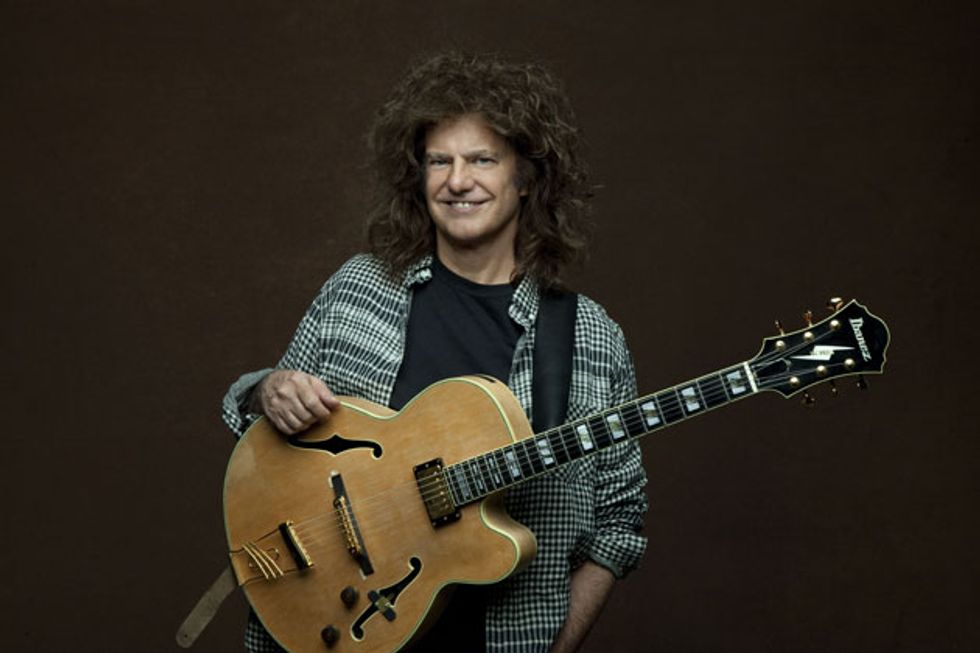
It wouldnāt be an overstatement to consider Pat Metheny one of the most successful jazz musicians of the modern age. His fluid, singing style has influenced countless guitarists, and his ability to compose deep, folk-based melodies has solidified his reputation as a first-rate composer. In this lesson weāre going to look at some of Methenyās signature moves.
āLetās begin with some of Methenyās pattern-based ideas (āEx. 1ā). These are crucial to copping his approach, especially during his albums from the 1980s. This lick moves by so fast that the harmony almost doesnāt matter. Itās the target note, in this case E, that you should focus on.
āāEx. 2 āis a simple four-note figure that ascends chromatically. This gives us an easy entry to a notable technique: an āunpreparedā hammer-on. (Fans of Greg Howe might call this a āhammer-on from nowhere.ā) Weāre quite accustomed to picking a note and then hammering on for a new note, but have you tried hammering on without picking a note on that string before? Thatās a common technique Metheny employs, especially at faster tempos. Saves a lot of extra picking!
āThis example (āEx. 3ā) uses a shape that lies under the fingers quite well. As before, the last note in each four-note group is a āhammer-on from nowhere.ā
Ex. 4 illustrates some of the most idiomatic figures in Methenyās bag of tricks. The basic motif is a major 7 chord without a 5th. For each figure, Metheny typically makes sure the first and last note of the group make sense harmonically, but whatās in between functions as transitional material designed to generate momentum and melodic color.
āRegardless of the style of a given track, it doesnāt take long to realize that deep down, Metheny is a jazz guitarist, through and through. Bebop language is critical to his playing. You wonāt catch verbatim Charlie Parker licksābut the spirit is there. Itās evidenced by the horn-style articulation and the idea of playing changes, navigating typical jazz harmony in a way that balances spelling things out clearly and a healthy amount of ambiguity. Notice the appearance of an idea like Ex. 1 in the middle ofā Ex. 5ā.
Even in his earliest work, Metheny managed to artfully combine elements of modal jazz, folk, bebop, and Brazilian music to create a fresh and unique sound. This example shows a variety of signature techniques, including his legato-based approach that includes generous amounts of pull-offs and slides. Triadic-based ideasālike at the end of measure two (a descending root-position F triad) and measure four (a descending root-position C triad)āare crucial to grasping Methenyās sound, regardless of era.
Who can play American music of any style without a nod to the blues? Ex. 6 shows Methenyās flair for conjuring liquid blues lines that any guitarist could do well to digest.
Methenyās rhythm playing really deserves its own lesson, or even its own book! Ex. 7 combines some trademark voicings that use open strings and 6/8 time, a favorite meter for his wild, folksy strums. The chord progression used here is a C# minor blues.
In jam situations, Metheny will pull out the standard jazz and funk vamps we all know and love. Ex. 8 is a modal tune that follows a four-bar vamp on each of the following chords: Fm7āDb7āDm7āFm7. Overall, the playing is quite inside, but the approach is filled with triadic pairsāthe idea that two triads can suffice to explore the basic sound of a mode or scale. In the Fm opening, there a strong emphasis on chord tones, but thereās a Gm triad (GāBbāD) superimposition, as well. The Db7 section reflects a triad pairing of Db and Eb, which imparts a Db7#11 type sound, embellished with a touch of bebop chromaticism. While the Dm7 material is purely Dorian, triads (rather than scale work) feature prominently here: C, Am, Dm, and Em.
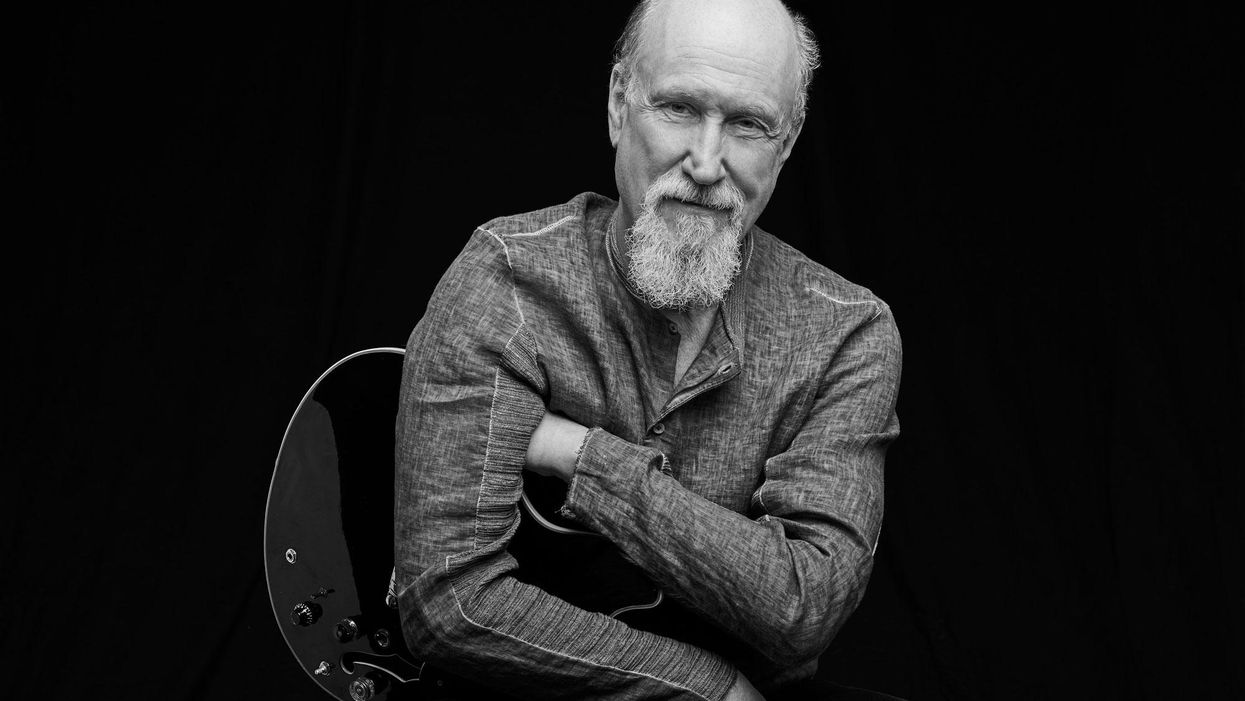
John Doe and Billy Zoom keep things spare and powerful, with two basses and a single guitarāand 47 years of shared musical historyābetween them, as founding members of this historic American band.
There are plenty of mighty American rock bands, but relatively few have had as profound an impact on the international musical landscape as X. Along with other select members of punkās original Class of 1977, including Patti Smith, Richard Hell, and Talking Heads, the Los Angeles-based outfit proved that rock ānā roll could be stripped to its bones and still be as literate and allusive as the best work of the songwriters who emerged during the previous decade and were swept up in the corporate-rock tidal wave that punk rebelled against. Xās first three albumsāLos Angles, Wild Gift, and Under the Big Black Sun-were a beautiful and provocative foundation, and rocked like Mt. Rushmore.
Last year, X released a new album, Smoke & Fiction, and, after declaring it would be their last, embarked on what was billed as a goodbye tour, seemingly putting a bow on 47 years of their creative journey. But when PG caught up with X at Memphisās Minglewood Hall in late fall, vocalist and bassist John Doe let us in on a secret: They are going to continue playing select dates and the occasional mini-tour, and will be part of the Sick New World festival in Las Vegas in April 12.
Not-so-secret is that they still rock like Mt. Rushmore, and that the work of all four of the foundersābassist, singer, and songwriter Doe, vocalist and songwriter Exene Cervenka, guitarist Billy Zoom, and drummer D.J. Bonebreakāremains inspired.
Onstage at Minglewood Hall, Doe talked a bit about his lead role in the film-festival-award-winning 2022 remake of the film noir classic D.O.A. But most important, he and Zoom let us in on their minimalist sonic secrets.Brought to you by DāAddario.
Gretsch A Sketch

Since Xās earliest days, Billy Zoom has played Gretsches. In the beginning, it was a Silver Jet, but in recent years heās preferred the hollowbody G6122T-59 Vintage Select Chet Atkins Country Gentleman. This example roars a little more thanks to the Kent Armstrong P-90 in the neck and a Seymour Duncan DeArmond-style pickup in the bridge. Zoom, who is an electronics wiz, also did some custom wiring and has locking tuners on the guitar.
More DeArmond

Zoomās sole effect is this vintage DeArmond 602 volume pedal. It helps him reign in the feedback that occasionally comes soaring in, since he stations himself right in front of his amp during shows.
It's a Zoom!

Zoomās experience with electronics began as a kid, when he began building items from the famed Heath Kit series and made his own CB radio. And since heās a guitarist, building amps seemed inevitable. This 1x12 was crafted at the request of G&L Guitars, but never came to market. It is switchable between 10 and 30 watts and sports a single Celestion Vintage 30.
Tube Time!

The tube array includes two EL84, 12AX7s in the preamp stage, and a single 12AT7. The rightmost input is for a reverb/tremolo footswitch.
Set the Controls for the Heart of the Big Black Sun

Besides 3-band EQ, reverb, and tremolo, Zoomās custom wiring allows for a mid-boost that pumps up to 14 dB. Not content with 11, it starts there and goes to 20.
Baby Blue

This amp is also a Zoom creation, with just a tone and volume control (the latter with a low boost). It also relies on 12AX7s and EL84s.
Big Bottom

Here is John Doeās rig in full: Ampeg and Fender basses, with his simple stack between them. The red head atop his cabs is a rare bird: an Amber Light Walter Woods from the 1970s. These amps are legendary among bass players for their full tone, and especially good for upright bass and eccentric instruments like Doeās scroll-head Ampeg. āI think they were the first small, solid-state bass amps ever,ā Doe offers. They have channels designated for electric and upright basses (Doe says he uses the upright channel, for a mid-dier tone), plus volume, treble, bass, and master volume controls. One of the switches puts the signal out of phase, but heās not sure what the others do. Then, thereās a Genzler cab with two 12" speakers and four horns, and an Ampeg 4x10.
Scared Scroll

Hereās the headstock of that Ampeg scroll bass, an artifact of the ā60s with a microphone pickup. Doe seems to have a bit of a love/hate relationship with this instrument, which has open tuners and through-body f-style holes on its right and left sides. āThe interesting thing,ā he says, āis that you cannot have any treble on the pickup. If you do, it sounds like shit. With a pick, you can sort of get away with it.ā So he mostly rolls off all the treble to shake the earth.
Jazz Bass II

This is the second Fender Jazz Bass that Doe has owned. He bought his first from a friend in Baltimore for $150, and used it to write and record most of Xās early albums. That one no longer leaves home. But this touring instrument came from the Guitar Castle in Salem, Oregon, and was painted to recreate the vintage vibe of Doeās historic bass.
A dual-channel tube preamp and overdrive pedal inspired by the Top Boost channel of vintage VOX amps.
ROY is designed to deliver sweet, ringing cleans and the "shattered" upper-mid breakup tones without sounding harsh or brittle. It is built around a 12AX7 tube that operates internally at 260VDC, providing natural tube compression and a slightly "spongy" amp-like response.
ROY features two identical channels, each with separate gain and volume controls. This design allows you to switch from clean to overdrive with the press of a footswitch while maintaining control over the volume level. It's like having two separate preamps dialed in for clean and overdrive tones.
Much like the old amplifier, ROY includes a classic dual-band tone stack. This unique EQ features interactive Treble and Bass controls that inversely affect the Mids. Both channels share the EQ section.
Another notable feature of this circuit is the Tone Cut control: a master treble roll-off after the EQ. You can shape your tone using the EQ and then adjust the Tone Cut to reduce harshness in the top end while keeping your core sound.
ROY works well with other pedals and can serve as a clean tube platform at the end of your signal chain. Itās a simple and effective way to add a vintage British voice to any amp or direct rig setup.
ROY offers external channel switching and the option to turn the pedal on/off via a 3.5mm jack. The preamp comes with a wall-mount power supply and a country-specific plug.
Street price is 299 USD. It is available at select retailers and can also be purchased directly from the Tubesteader online store at www.tubesteader.com.
The compact offspring of the Roland SDE-3000 rack unit is simple, flexible, and capable of a few cool new tricks of its own.
Tonalities bridge analog and digital characteristics. Cool polyrhythmic textures and easy-to-access, more-common echo subdivisions. Useful panning and stereo-routing options.
Interactivity among controls can yield some chaos and difficult-to-duplicate sounds.
$219
Boss SDE-3 Dual Digital Delay
boss.info
Though my affection for analog echo dwarfs my sentiments for digital delay, I donāt get doctrinaire about it. If the sound works, Iāll use it. Boss digital delays have been instructive in this way to me before: I used a Boss DD-5 in a A/B amp rig with an Echoplex for a long time, blending the slur and stretch of the reverse echo with the hazy, wobbly tape delay. It was delicious, deep, and complex. And the DD-5 still lives here just in case I get the urge to revisit that place.
Tinkering with theSDE-3 Dual Digital Delay suggested a similar, possibly enduring appeal. As an evolution of the Roland SDE-3000rack unit from the 1980s, itās a texture machine, bubbling with subtle-to-odd triangle LFO modulations and enhanced dual-delay patterns that make tone mazes from dopey-simple melodies. And with the capacity to use it with two amps in stereo or in panning capacity, it can be much more dimensional. But while the SDE-3 will become indispensable to some for its most complex echo textures, its basic voice possesses warmth that lends personality in pedestrian applications too.
Tapping Into the Source
Some interest in the original SDE-3000 is in its association with Eddie Van Halen, who ran two of them in a wet-dry-wet configuration, using different delay rates and modulation to thicken and lend dimension to solos. But while EVHās de facto endorsement prompted reissues of the effect as far back as the ā90s, part of the appeal was down to the 3000ās intrinsic elegance and simplicity.
In fact, the original rack unitās features donāt differ much from what you would find on modern, inexpensive stompbox echoes. But the SDE-3000ās simplicity and reliable predictability made it conducive to fast workflow in the studio. Critically, it also avoided the lo-fi and sterility shortcomings that plagued some lesser rivalsāan attribute designer Yoshi Ikegami chalks up to analog components elsewhere in the circuit and a fortuitous clock imprecision that lends organic essence to the repeats.
Evolved Echo Animal
Though the SDE-3 traces a line back to the SDE-3000 in sound and function, it is a very evolved riff on a theme. I donāt have an original SDE-3000 on hand for comparison, but itās easy to hear how the SDE-3 bridges a gap between analog haze and more clinical, surgical digital sounds in the way that made the original famous. Thanks to the hi-cut control, the SDE-3ās voice can be shaped to enhance the angular aspect of the echoes, or blunt sharp edges. Thereās also a lot of leeway to toy with varied EQ settings without sacrificing the ample definition in the repeats. That also means you can take advantage of the polyrhythmic effects that are arguably its greatest asset.
āThereās a lot of leeway to toy with varied EQ settings without sacrificing the ample definition in the repeats.ā
The SDE-3ās offset control, which generates these polyrhythmic echoes, is its heart. The most practical and familiar echos, like quarter, eighth, and dotted-eighth patterns, are easy to access in the second half of the offset knobs range. In the first half of the knobās throw, however, the offset delays often clang about at less-regular intervals, producing complex polyrhythms that are also cool multipliers of the modulation and EQ effects. For example, when emphasizing top end in repeats, using aggressive effects mixes and pitch-wobble modulation generates eerie ghost notes that swim through and around patterns, adding rhythmic interest and texture without derailing the drive behind a groove. Even at modest settings, these are great alternatives to more staid, regular subdivision patterns. Many of the coolest sounds tend toward the foggy reverb spectrum. Removing high end, piling on feedback, and adding the woozy, drunken drift from modulation creates fascinating backdrops for slow, sparse chord melodies. Faster modulations throb and swirl like old BBC Radiophonic Workshop sci-fi sound designs.
By themselves, the modulations have their own broad appeal. Chorus tones are rarely the archetypal Roland Jazz Chorus or CE typeātending to be a bit darker and mistier. But they do a nice job suggesting that texture without lapsing into caricature. There are also really cool rotary-speaker-like textures and vibrato sounds that offer alternatives to go-to industry standards.
The Verdict
The SDE-3ās many available sounds and textures would be appealing at $219āeven without the stereo and panning connectivity options, a useful hold function, and expression pedal control that opens up additional options. The panning capabilities, in particular, sparked all kinds of thoughts about studio applications. Mastering the SDE-3 takes just a little studyācertain polyrhythms can be dramatically reshaped by the interactivity of other controls and you need to take care to achieve identical results twice. But this is a pedal that, by virtue of its relative simplicity and richness and breadth of sounds, exceeds the utility of some similarly priced rivalsĀ, all while opening up possibilities well outside the simple echo realm
Reader: T. Moody
Hometown: Myrtle Beach, South Carolina
Guitar: The Green Snake
Reader T. Moody turned this Yamaha Pacifica body into a reptilian rocker.
With a few clicks on Reverb, a reptile-inspired shred machine was born.
With this guitar, I wanted to create a shadowbox-type vibe by adding something you could see inside. I have always loved the Yamaha Pacifica guitars because of the open pickup cavity and the light weight, so I purchased this body off Reverb (I think I am addicted to that website). I also wanted a color that was vivid and bold. The seller had already painted it neon yellow, so when I read in the description, āYou can see this body from space,ā I immediately clicked the Buy It Now button. I also purchased the neck and pickups off of Reverb.
I have always loved the reverse headstock, simply because nothing says 1987 (the best year in the history of the world) like a reverse headstock. The pickups are both Seymour Duncanāan SH-1N in the neck position and TB-4 in the bridge, both in a very cool lime green color. Right when these pickups got listed, the Buy It Now button once again lit up like the Fourth of July. I am a loyal disciple of Sperzel locking tuners and think Bob Sperzel was a pure genius, so I knew those were going on this project even before I started on it. I also knew that I wanted a Vega-Trem; those units are absolutely amazing.
When the body arrived, I thought it would be cool to do some kind of burst around the yellow so I went with a neon green. It turned out better than I imagined. Next up was the shaping and cutting of the pickguard. I had this crocodile-type, faux-leather material that I glued on the pickguard and then shaped to my liking. I wanted just a single volume control and no tone knob, because, like King Edward (Van Halen) once said, āYour volume is your tone.ā

T. Moody
I then shaped and glued the faux-leather material in the cavity. The tuning knobs, volume knob, pickguard, screws, and selector switch were also painted in the lemon-lime paint scheme. I put everything together, installed the pickups, strung it up, set it up, plugged it in, and I was blown away. I think this is the best-playing and -sounding guitar I have ever tried.
The only thing missing was the center piece and strap. The latter was easy because DiMarzio makes their ClipLock in neon green. The center piece was more difficult because originally, I was thinking that some kind of gator-style decoration would be cool. In the end, I went with a green snake, because crocodiles aināt too flexibleāand theyāre way too big to fit in a pickup cavity!

The Green Snakeās back is just as striking as the front.