Macy Gray, Lisa Loeb and Nita Strauss to be honored at the
2019 She Rocks Awards
The Women’s International Music Network presents 7th annual event celebrating
women in music on January 25, 2019 at the House of Blues Anaheim
The Women’s International Music Network (the WiMN) reveals Macy Gray, Lisa Loeb, and Nita Strauss as the first announced honorees at the upcoming 2019 She Rocks Awards. Recognizing women who stand out as role models in the music industry, the 7th annual live awards event will take place on Friday January 25, 2019, at 7:30 p.m. at the House of Blues in Anaheim, CA during the NAMM Show.
GRAMMY® Award winner Macy Gray is a singer, songwriter, producer and actress who started her career in 1999 with the hit song “I Try,” and has since gone on to sell more than 25 million albums globally. In September 2018, she brought her unmistakable rasp and soulful style to fans around the world with her critically well-received, tenth full-length album, RUBY. Her appearance in Training Day alongside Academy® Award winner Denzel Washington, has become an iconic hallmark.
Platinum-selling, GRAMMY® Award-winning artist Lisa Loeb is a singer-songwriter, producer, touring artist, author and philanthropist who started her career with the Number 1 hit song “Stay (I Missed You)” from the film Reality Bites, and was the first pop musician to have a Number 1 single while not signed to a recording contract. She also designs Lisa Loeb Eyewear, writes children's books, and supports non-profit causes. Lisa’s latest release, Lullaby Girl, is available exclusively from Amazon.
Currently on tour with Alice Cooper, acclaimed guitarist Nita Strauss has shared the stage with diverse artists including Jermaine Jackson and celebrated tribute band The Iron Maidens. Her skill and exuberant stage presence have earned her a stellar reputation and endorsements including Ibanez Guitars (she's the first female Ibanez signature artist with her own model), Marshall Amplification, DiMarzio pickups, and more. Nita's debut solo album, Controlled Chaos, launches on November 16, 2018.
More 2019 She Rocks Awards honorees will be announced soon.
Laura B. Whitmore, founder of the WiMN and co-producer of the She Rocks Awards, shares, “We are excited to honor these unique and super-talented women who are also true champions for women in music. We look forward to welcoming Macy, Lisa and Nita as our newest honorees.”
The She Rocks Awards pays tribute to women who display leadership and stand out within the music and audio industry, and is a premier event during the NAMM Show, bringing together industry professionals, music icons, artists, fans and the media. Past honorees of the She Rocks Awards include Melissa Etheridge, Pat Benatar, The B-52s, Colbie Caillat, Sheila E, Chaka Khan, Ronnie Spector, Orianthi, The Bangles, and many more, plus a collection of role models from all walks of the music and audio industries.
The 2019 She Rocks Awards will take place on Friday, January 25, 2019 at the House of Blues Anaheim at 7:30 p.m. This high-energy evening includes live music, awards and speeches, celebrity appearances, a fabulous silent auction, amazing gift bags and so much more! Tickets are now on sale, available in four tiers that include dinner and more. This event is open to the public; a NAMM Show badge is not required to attend the She Rocks Awards. Find out more and purchase tickets at sherocksawards.com.
The 2019 She Rocks Awards is sponsored by Gretsch, Sennheiser, PRS Guitars, Marshall Amplification, Seymour Duncan, Martin Guitar, Reverb.com, Roland, Rat Sound Systems, D’Angelico Guitars, Zildjian, Fishman, Guitar Center, Berklee Online, Gator Cases, Sabian, PreSonus, M.A.C Cosmetics, Paul Mitchell, The Music People, SoundGirls, On-Stage Stands, NAMM, 108 Rock Star Guitars, Future Publications, Guitar World, Guitar Player, Bass Player, Electronic Musician, Musicradar, Parademagazine, Guitar Girl Magazine, KVR Audio, Music-News.com, and more. For information regarding She Rocks Awards sponsorship opportunities, please contact info@thewimn.com.
Pedalboards tell stories, and this year's submissions prove it! From the minimalist who ditched the road case and went back to a One Spot on the floor, to the collector building a “Starboard” entirely from famous guitarists’ gear, to the neurosurgery videographer crafting soundscapes for the nervous system—these rigs reflect real lives and real gigs. Bass players with bamboo builds, experimentalists with dual boards, and portable warriors powering entire rigs from USB banks all made the cut. Here are seven boards with stories to tell.
New Wave Happy Place
Reader: Stephen Jackson
I’m a pretty ordinary guitar player, but I’ve loaded up on ten pedals that make me sound halfway decent. For me, my happy-place sonics are from the diffuse new wave genre of the late 1970s to mid-1980s. I just can’t get enough.
I prefer keyboard-dominated new wave that’s generally kind to enthusiastic but ordinary guitarists. I like it nice and dark—the Cure, Siouxsie and the Banshees, or the Cocteau Twins—or more pop-ish with some grit, like the Psychedelic Furs. I also love what I call “skinny guitar rock new wave”—earlier Talking Heads or Elvis Costello.
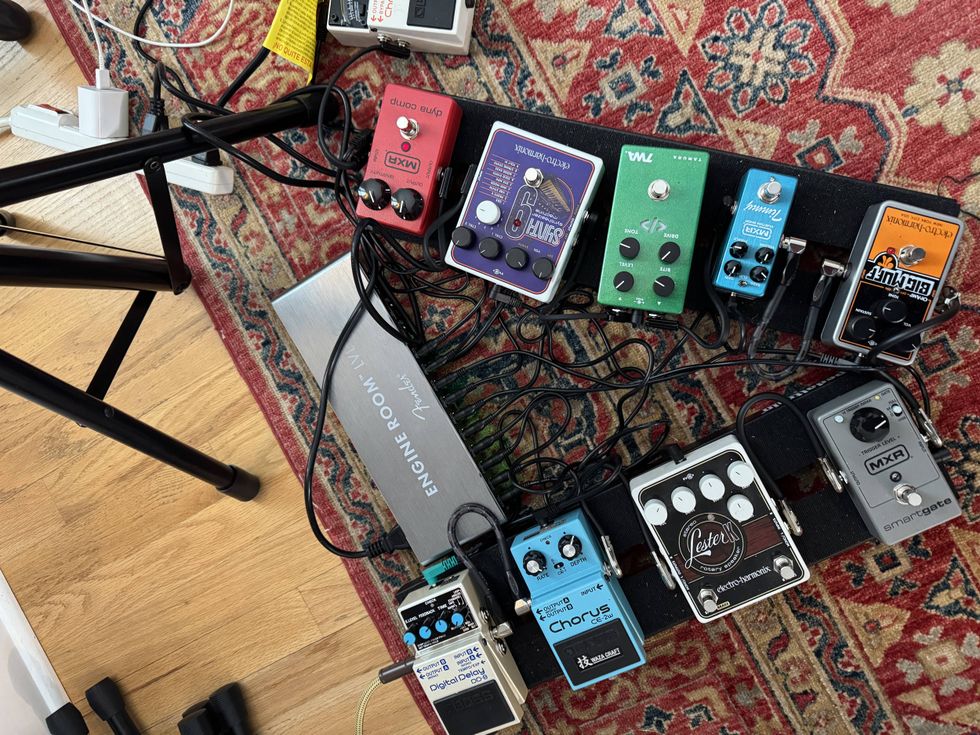
My pedals are powered by a Fender Engine Room LVL12, which is great for cutting down amp hum. Yes, there are battery packs that power pedals and may even help reduce cord hum, but they make me nervous—I forget to charge my phone or my vacuum stick, let alone a battery pack.
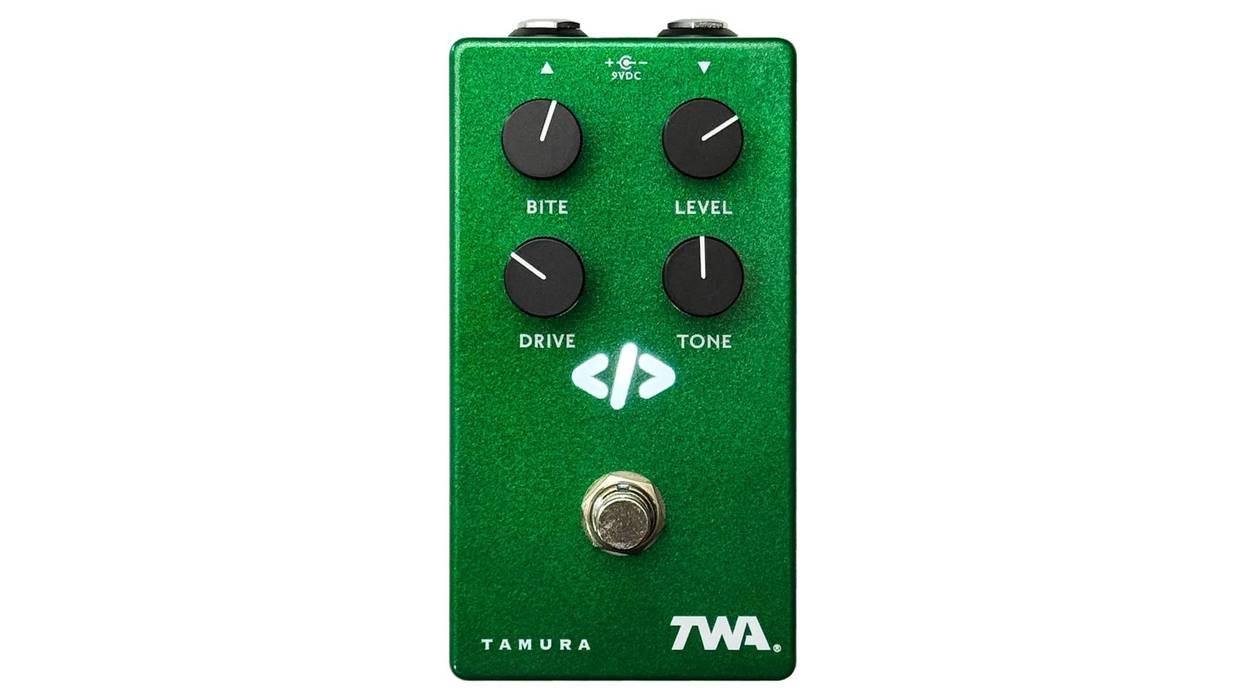
The first port-of-call from guitar to amp on my rig is a Boss TU-3 Chromatic Tuner. Next is an always-on MXR Dyna Comp compressor. Following that is a new wave synth staple, an Electro-Harmonix Synth9. Then the overdrive pedals: a newly-released entry in the Tube Screamer lineage, the TWA SC-01 Source Code, which is commonly on and dialed up relatively mellow; a kicked-up MXR Timmy; and a seething and spitting Electro-Harmonix Op Amp Big Muff Pi. My skinny rock songs get the SC-01 treatment or a Timmy on occasion. Oddly enough, the Big Muff is at home when turned down to backing some electronica—Berlin, for instance—as well as noisy new wave.
Next up is an MXR Smart Gate. Before I added that—and the Fender Engine Room—my Fender Jazz Bass had an annoying hum. Not anymore.
Finally, there are three stomps that, along with the Synth9, get my sound to the electronica and pop new wave happy place: an Electro-Harmonix Lester K stereo rotary speaker pedal, a Boss CE-2W Waza Craft Chorus, and a Boss DD-8 Digital Delay. My advice: never fear a chorus pedal.
Portable Power
Reader: Adam Thomas
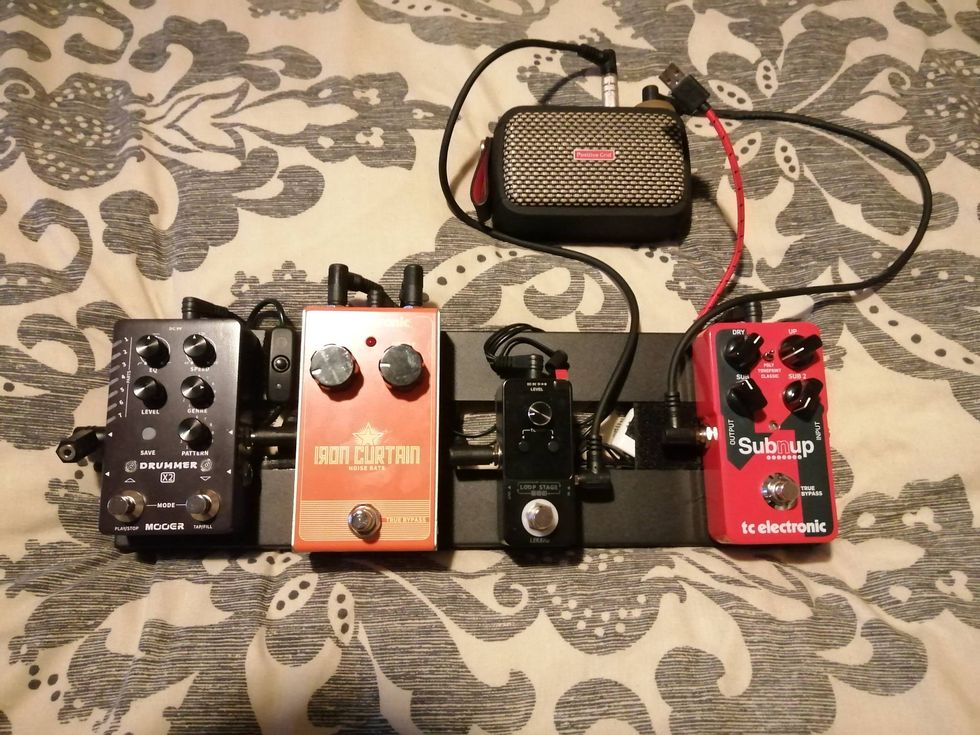
The board itself has a Li’l-moXie power supply hiding underneath. The red USB cable plugs into any USB power bank and powers the whole rig. The guitar output plugs straight into the [TC Electronic] Sub ’N’ Up [Octaver] pedal for the creation of bass lines and general low-frequency ambience. From there the signal travels to the Spark GO to be given a thorough going-over before it heads into the Lekato Looper. The second layer of the loop probably needs a true bypass from the Sub ’N’ Up and a different preset on the GO—no problem if you have the Spark Control X.
Next I send the signal into the [TC Electronic] Iron Curtain noise gate to get rid of any little imperfections created by the looper, and off we go to the Mooer Drummer X2 to provide some rhythmic accompaniment. I send the final output to a SubZero 15" portable PA (battery powered) via a stereo splitter line, giving me more options than you can shake a stick at for the entertainment of your fellow man, no matter where you may find them.
Experimental Lab
Reader: Kurt Nolen
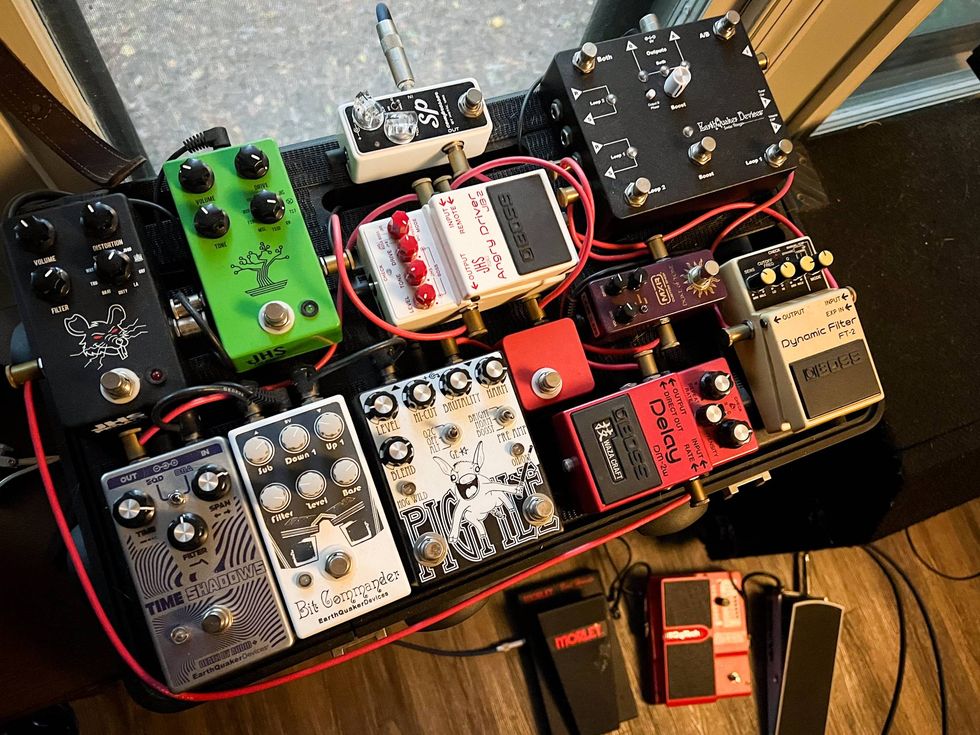
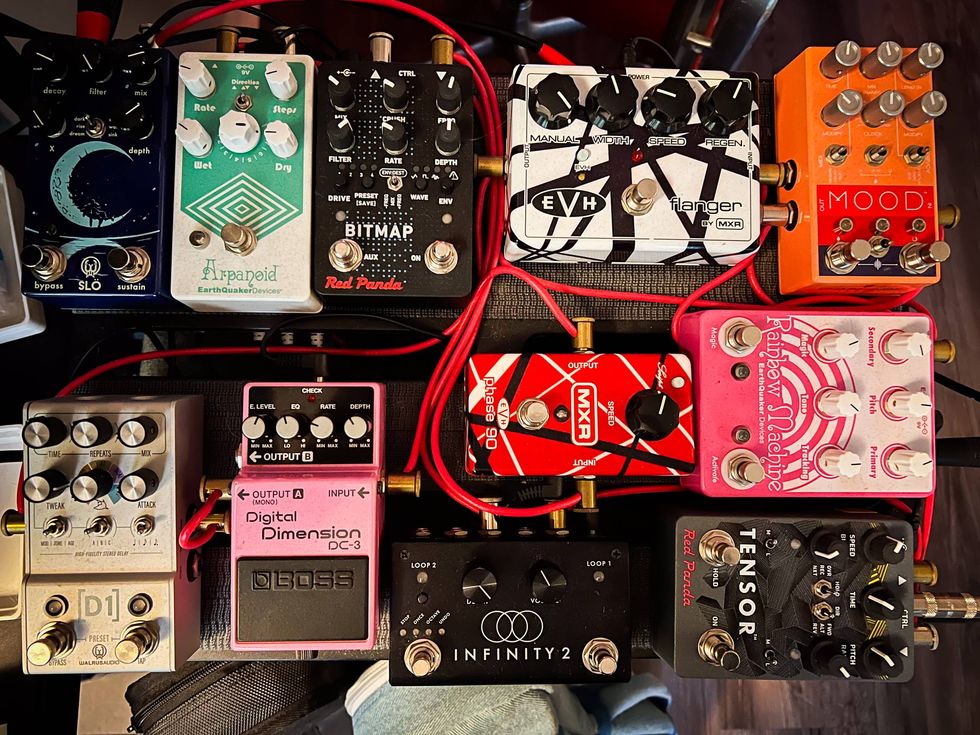
I’m the Medical Photographer/Videographer for the University of North Carolina School of Medicine Department of Neurosurgery, and frequently need to produce educational/academic or communications-related videos. Sometimes this material can use more narrative styles of music, but frequently it needs textural soundscapes that reference the subject matter in the video and drive viewer interest without being distracting. Want to evoke the sound of your globus pallidus? What does your nervous system sound like? What would high-intensity, focused ultrasound treatment sound like if you could hear it? This rig does it. I’m also an experimental composer and noise artist in my free time and needed something that could serve that purpose—or for sitting in with my friend’s Oingo Boingo cover band.
Board #1 (front of amp): guitar into Ernie Ball VPJR, DigiTech Whammy 4, Morley Bad Horsie, Xotic SP Compressor, Boss FT-2 Dynamic Filter, EarthQuaker Devices Swiss Things—loop 1 out to MXR Duke of Tone, Electrofoods Ultd Pigpile fuzz, EarthQuaker Devices Bit Commander, EarthQuaker Devices Time Shadows V1, Boss JB-2 (with JHS Red Remote), JHS Bonsai, JHS PackRat, Boss DM-2W to loop 1 return.
Board #2 (amp FX loop or loop 2 on EQD Swiss Things if running direct): FX out to EarthQuaker Devices Rainbow Machine, MXR EVH117 Flanger, MXR EVH Phase 90, Boss DC-3, Walrus Mako D1 Delay V2, Red Panda Bitmap, EarthQuaker Devices Arpanoid, Chase Bliss Audio MOOD, Red Panda Tensor, Pigtronix Infinity 2, Walrus Audio Slö Multi Texture Reverb to FX return (or Swiss Things loop 2 return if direct).
Legendary Pedals
Reader: Paul Martin
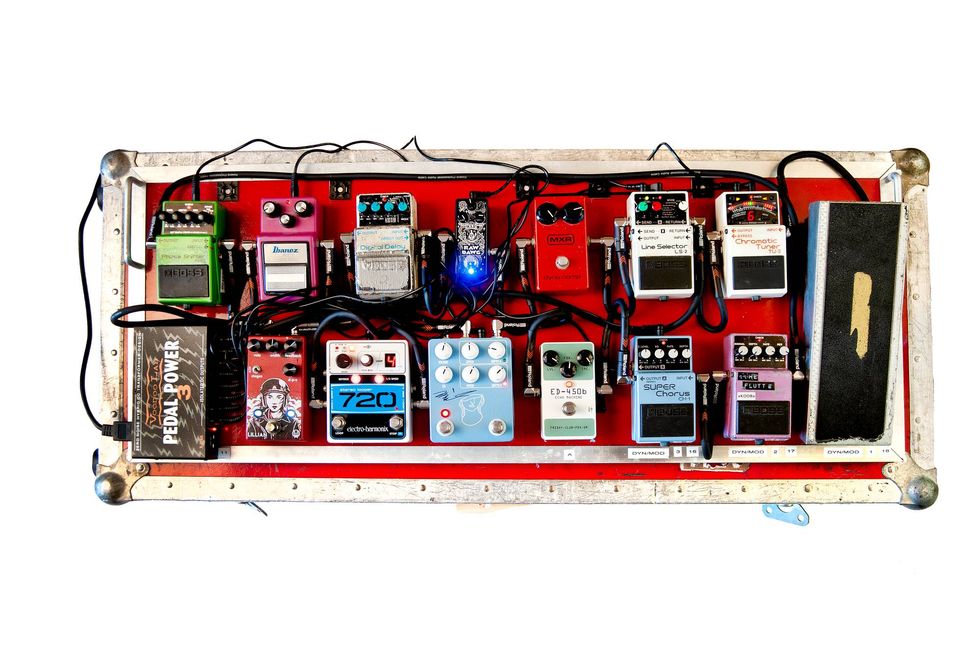
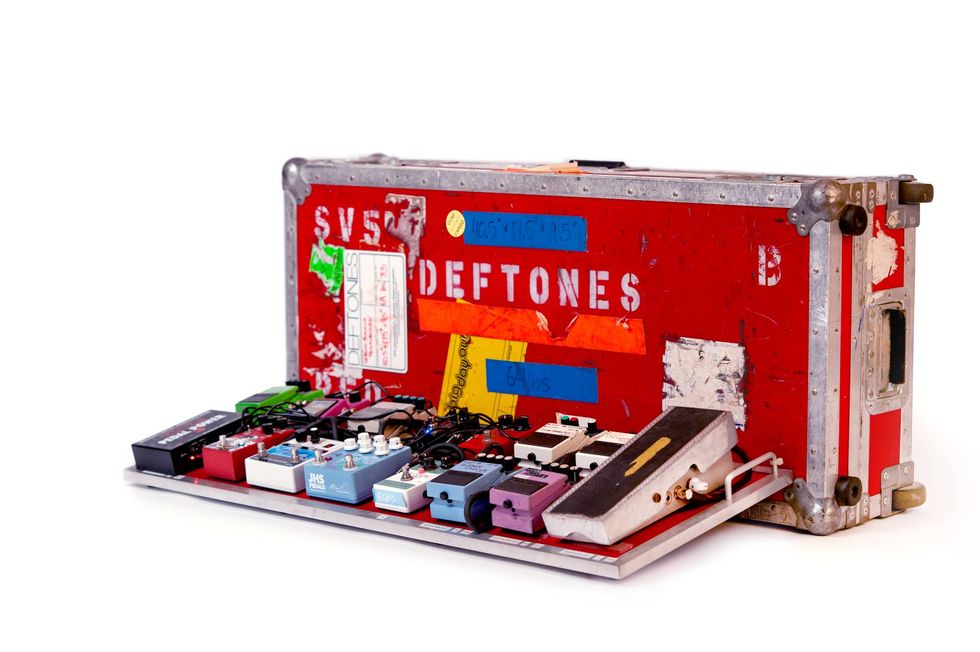
This is my “Starboard.” I call it that because it’s made up of pedals previously owned by famous guitarists. I mostly bought them from artist sales on Reverb, with a couple from Techno Empire and Pedal Pawn in the U.K. I was randomly collecting artist-owned pedals for a while, but when I bought [Deftones bassist] Sergio Vega’s pedalboard I decided to put a board together. The line selector switches between the top row for soloing and bottom row for clean. The board itself was owned by Sergio.
Top row: Boss PH-3 Phase Shifter, owned by Andy Taylor (Duran Duran and the Power Station); 1980s Ibanez AD9 Analog Delay, owned by Mitch Holder, a go-to session guitarist for Frank Sinatra, Barbara Streisand, and Lionel Richie; Boss DD-2, owned by Kiko Loureiro (Megadeth); signed MXR EG74 Eric Gales Raw Dawg Overdrive (limited to 250); vintage MXR MX-102 Dyna Comp, owned by producer and musician Dennis Herring; Boss LS-2 Line Selector, owned by Evanescence; Boss TU-3 Chromatic Tuner, owned and signed by Tommy Emmanuel.
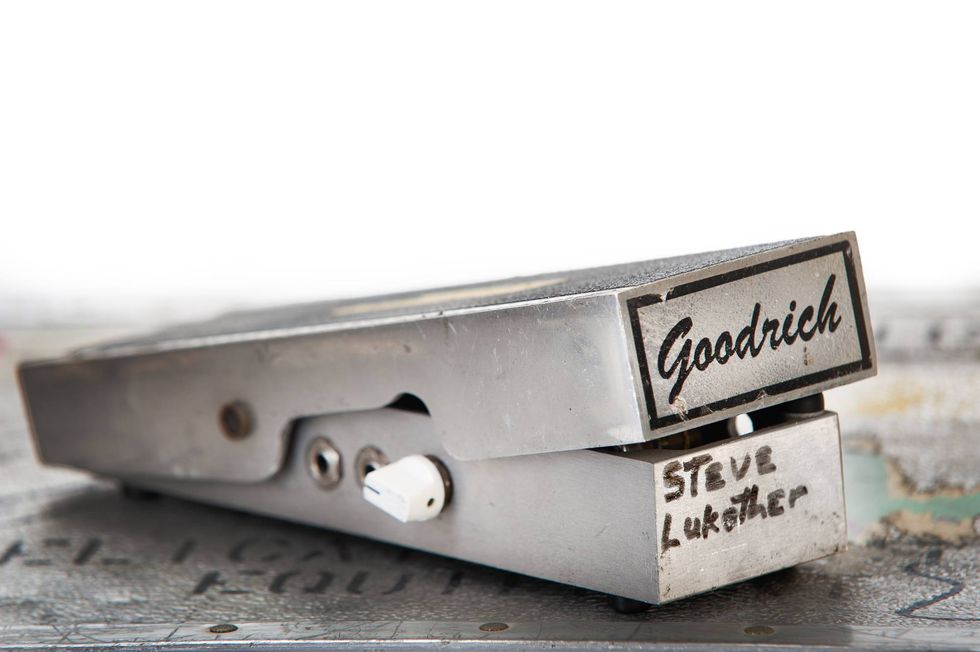
Bottom row: Walrus Audio Lillian Analog Phaser; Electro-Harmonix 720 Stereo Looper, owned by Malcolm Cecil, who invented the TONTO analog synthesizer and was responsible for the sounds on Stevie Wonder’s first three albums; JHS Artificial Blonde Madison Cunningham Signature Vibrato, signed by Madison when she was in Dublin supporting John Mayer; Friday Club ED-450b Echo Machine, owned by Isaac Brock (Modest Mouse); Boss CH-1 SUPER Chorus, owned by Daryl Stuermer (Genesis and Phil Collins); Boss HF-2 Hi Band Flanger, owned by Tad Kubler (the Hold Steady); and Goodrich Model 122 Volume Pedal, owned by Steve Lukather (Toto). From soloing on Stevie Nicks’ “Stand Back” to virtually all of Michael Jackson’s Thriller, it doesn’t get much cooler than that.
Bamboo Bass Rig
Reader: Dino von Wintersdorff
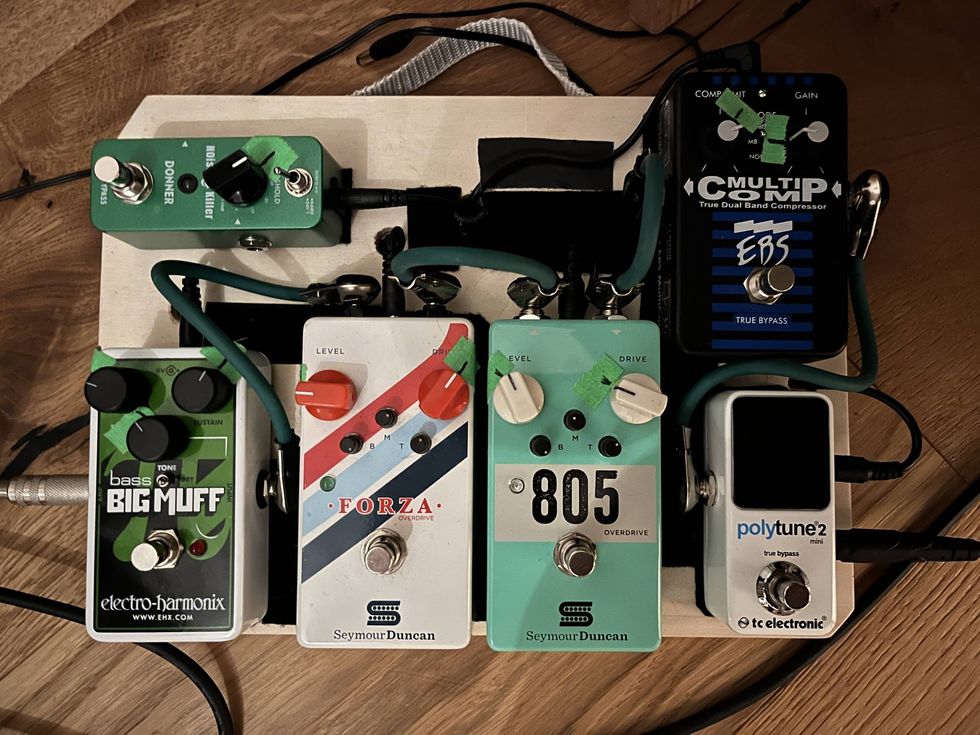
My bass pedalboard: Starting with a TC Electronic PolyTune 2 tuner, the signal goes into a Seymour Duncan 805 Overdrive, then a Seymour Duncan Forza Overdrive, an Electro-Harmonix Bass Big Muff, and finally a Donner Noise Killer. [An EBS MultiComp sits top right as well.] All on a board made out of bamboo and plywood, giving a fresh vibe on the stage!
First I got the Seymour Duncan Forza to have some nice controllable overdrive for the bass—the 3-band EQ helps get a nice tone. Then I found the clean signal was too boring and I added the SD 805 to have an always-on slight crunch and tone shape, and I love it! Sometimes the Muff and Forza are on at the same time, but the 805 isn't. So switching back to only 805 mode can be wild—there are times onstage that I would hit not only those three pedals, but also the tuner, instantly killing my signal!
No Board Required
Reader: Sam Paige
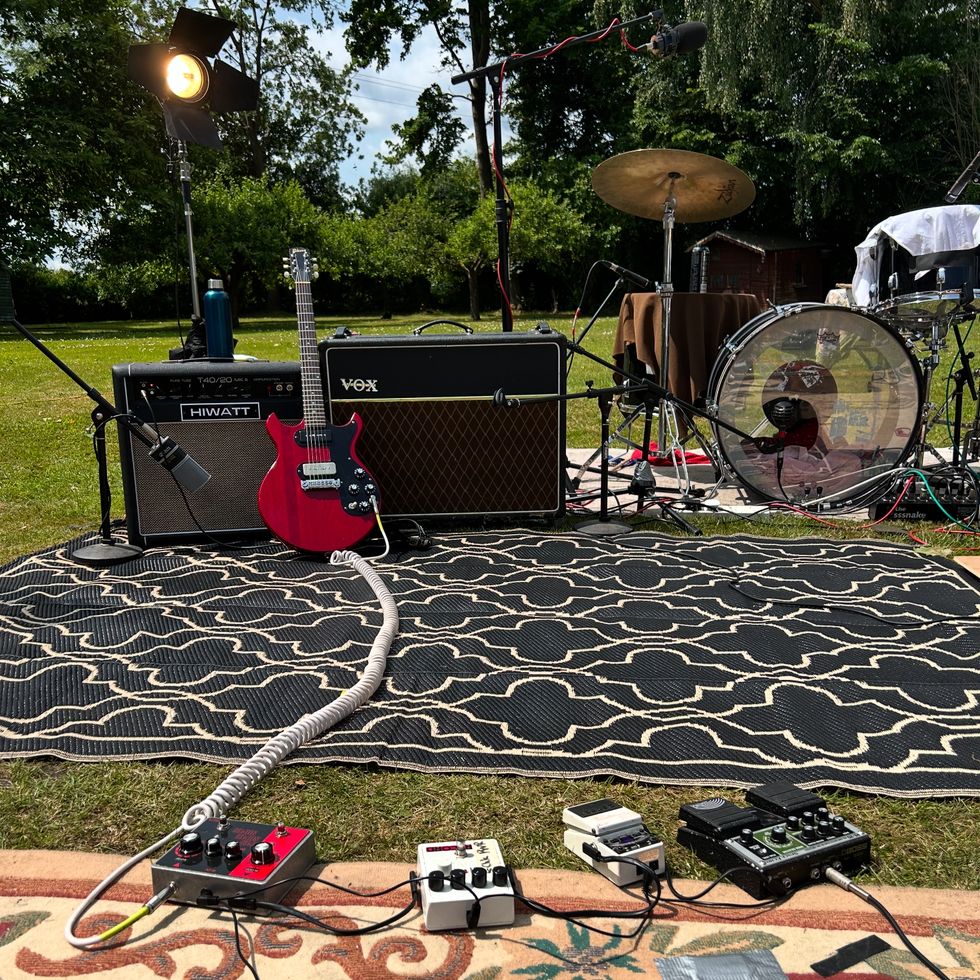
So obviously, yeah, there’s no board. It’s on the floor. In the 20-plus years I’ve been playing—starting with a few daisy-chained pedals to a fully-loaded [Pedaltrain] Novo 24 and nearly doing my back in taking the case offstage—I’ve got back to the pick-and-mix life of a [Truetone] 1 Spot and whatever I fancy.
Recently a band I fronted for six years or so fell apart, and as one door closed another opened. Starting in a new project, this was the first few weeks of bringing some old pedals and the 1 Spot to a new adventure and finding a new footing again.
Chain: Defects Super Super Super, something of a clone of the rare Death By Audio Super Fuzz War. Fuzz on one side, then boost. Inside there are dip switches for each side to shape EQ, add gain, add mids—usual setup is “full Fuzz War” with added mids, and currently a full-range boost on the other side. Second, the Electro-Harmonix Mel9, a sort of impulse buy based on seeing one of my favorite guitarists, Mr. John Dwyer, use it. It’s janky, has trouble with certain power supplies, and seems to have no built-in compression. So your effect out is either too quiet, just right, or blows your head off. I love it. It hasn’t left a setup since I bought it. Next, the Boss TU-2—god knows how old it was when it got to me (I rarely buy new), but I’ve had it for at least a good 15 years. A bit hard to see in the direct sunlight, but at least it won’t break. And a Boss RE-20 [Space Echo]—the more I use it, the more I’ve grown to love it—the perfect amount of bounce for echo effects. It’s forever inspiring and reliable. I keep thinking of trading in for one of the newer models, either to downsize or expand, but I can’t relegate this pedal to the shelf, or the draft listings on Reverb or eBay.
Double Trouble
Reader: Randall Brown
I spent years as an “only use the amp’s drive channel” guy, then started looking at EHX pedals out of nostalgia for a long-lost Muff Fuzz. Over the last 15 years or so, I’ve collected this batch of circuit friends with the idea of building wide tonal flexibility. I’m influenced equally by classic riff lords like Black Sabbath, contemporary psychedelic outfits like Osees and King Gizzard, and the ultra-modern trips of St. Vincent.
One of my favorite recent discoveries is a parallel mix of the EHX Cock Fight and the Fender Waylon Jennings Phaser—a slow-modulated buzz that really straddles the synth/buzz-guitar fence. I still pay the most attention to the magic that Electro-Harmonix puts out. In my drive to build the mega-board I have now, I started with the Freeze first. I also keep an eye out for additions to what I call the “fake bored keyboardist” section. The Freeze, Canyon, Key9, and Mel9 are the cornerstones of that. There are some days when I think I should go back to a single overdrive or go straight into the amp. But all the sounds are just too much fun!
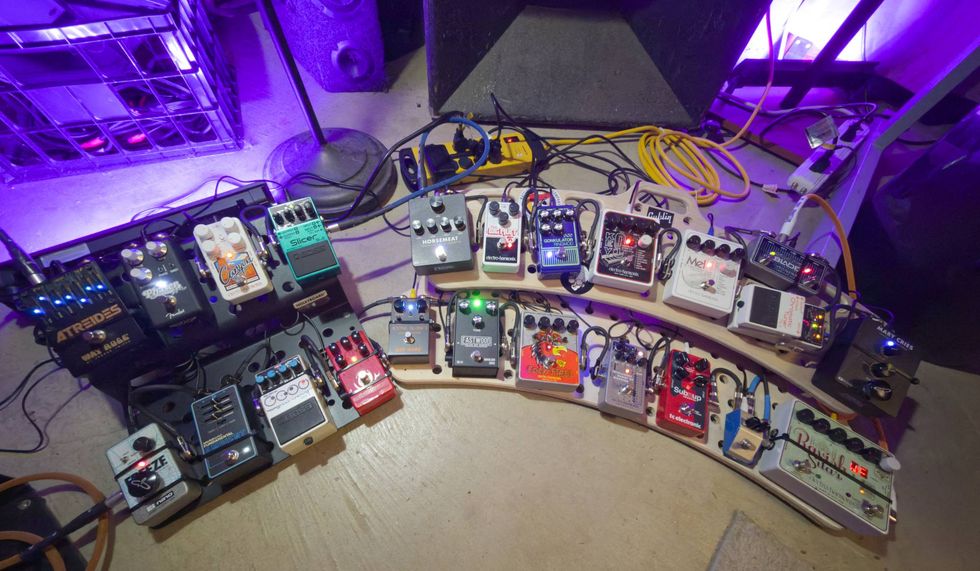
My guitar goes into a PRS Mary Cries compressor, then a Boss TU-2, then into an Electro-Harmonix Switchblade Plus. From the Switchblade, two signal chains go to two different amplifiers.
Roland JC-120 signal chain: Electro-Harmonix Ravish Sitar, Tonebutcher WeeWah auto wah, TC Electronic Sub ’N’ Up, Electro-Harmonix Intelligent Harmony Machine, Electro-Harmonix Cock Fight, Eastwood BB-01 Manalishi Drive, Way Huge Stone Burner, Catalinbread Bicycle Delay, Boss DD-2 Digital Delay, Walrus Audio Fundamental Series Ambient, Electro-Harmonix Freeze.
Fender Hot Rod Deluxe signal chain: Electro-Harmonix Mel9, Electro-Harmonix Key9, DOD Gonkulator, Electro-Harmonix Nano Big Muff Pi, PRS Horsemeat Transparent Overdrive, Boss SL-2 Slicer, Electro-Harmonix Canyon, Fender Waylon Jennings Phaser, Way Huge Atreides Analog Weirding Module.
Improvising over one chord for long stretches of time can be a musician's best friend or worst nightmare. With no harmonic variation, we are left to generate interest through our lines, phrasing, and creativity. When I started learning to improvise, a minor 7 chord and a Dorian mode were the only sounds that I wanted to hear at the time. I found it tremendously helpful to have the harmony stay in one spot while I mined for new ideas to play. Playing over a static chord was crucial in developing my sense of time and phrasing.
The following is the first improvisational device I ever came across. I want to say I got it from a Frank Gambale book. The idea is that there are three minor pentatonic scales "hiding" in any given major scale. If we're in the key of C (C–D–E–F–G–A–B) we can pluck out the D, E, and A minor pentatonic scales. If we frame them over a Dm7 chord, they give us different five-note combinations of the D Dorian mode. In short, we are building minor pentatonic scales off the 2, 3, and 6 of the C major scale.
Viewing this through the lens of D minor (a sibling of C major and the tonal center for this lesson), D minor pentatonic gives us the 1–b3–4–5–b7, E minor pentatonic gives us 2–4–5–6–1, and A minor pentatonic gives us 5–b7–1–2–4. This means you can use your favorite pentatonic licks in three different locations and there are three different sounds we can tap into from the same structure.
If you smashed all of them together, you would get the D Dorian scale (D–E–F–G–A–B–C) with notes in common between the D, E, and A minor pentatonic scales. Ex. 1 uses all three scales, so you can hear the different colors each one creates over the chord.
Ex. 1
Ex. 2 is how I improvise with them, usually weaving in and out using different positional shapes.
Ex. 2
The next idea is one I stole from a guitarist who often came into a music store I worked at. On the surface, it's very easy: Just take two triads (in our example it will be Dm and C) and ping-pong between them. The D minor triad (D–F–A) gives us 1–b3–5, which is very much rooted in the chord, and the C major triad (C–E–G) gives us the b7–9–4, which is much floatier. Also, if you smash these two triads together, you get 1–2–b3–4–5–b7, which is a minor pentatonic scale with an added 2 (or 9). Eric Johnson uses this sound all the time. Ex. 3 is the lick I stole years ago.
Ex. 3
Ex. 4 is how I would improvise with this concept. Many different fingerings work with these, so experiment until you find a layout that's comfortable for your own playing.
Ex. 4
If two triads work, why not seven? This next approach will take all the triads in the key of C (C–Dm–Em–F–G–Am–Bdim) and use them over a Dm7 chord (Ex. 5). Each triad highlights different three-note combinations from the Dorian scale, and all of them sound different. Triads are clear structures that sound strong to our ears, and they can generate nice linear interest when played over one chord. Once again, all of this is 100% inside the scale. Ex. 5 is how each triad sounds over the track, and Ex. 6 is my attempt to improvise with them.
Ex. 5
Ex. 6
If we could find all these possibilities with triads, it's logical to make the structure a little bigger and take a similar approach with 7 chords, or in this case, arpeggios. Naturally, all the diatonic chords will work, but I'll limit this next idea to just Dm7, Fmaj7, Am7, and Cmaj7. I love this approach because as you move further away from the Dm7 shape, each new structure takes out a chord tone and replaces it with an extension. I notice that I usually come up with different lines when I'm thinking about different chord shapes, and this approach is a decent way to facilitate that. Ex. 7 is a good way to get these under your fingers. Just ascend one shape, shift into the next shape on the highest string, then descend and shift to the next on the lowest string.
Ex. 7
Ex. 8 is my improvisation using all four shapes and sounds, but I lean pretty heavily on the Am7.
Ex. 8
This last concept has kept me busy on the fretboard for the last five years or so. Check it out: You can take any idea that works over Dm7 and move the other diatonic chords. The result is six variations of your original lick. In Ex. 9 I play a line that is 4–1–b3–5 over Dm7 and then walk it through the other chords in the key. These notes are still in the key of C, but it sounds drastically different from playing a scale.
Ex. 9
In Ex. 10, I try to think about the shapes from the previous example, but I break up the note order in a random but fun way. The ending line is random but felt good, so I left it in.
Ex. 10
While all these concepts have been presented over a minor chord, you can just as easily apply them to any chord quality, and they work just as well in harmonic or melodic minor. Rewarding sounds are available right inside the harmony, and I am still discovering new ideas through these concepts after many years.
Though the above ideas won't necessarily be appropriate for every style or situation, they will work in quite a few. Developing any approach to the point that it becomes a natural extension of your playing takes considerable work and patience, so just enjoy the process, experiment, and let your ear guide you to the sounds you like. Even over just one chord, there is always something new to find.
Few effects delivered as much aura and musically transformative power per buck as Electro-Harmonix’s Sovtek Big Muffs from the mid ’90s. Mine set me back probably $50. But man, I might as well have stolen Excalibur from the clutches of King Arthur.
Up to that moment, my piggyback Fender Tremolux, Tube Screamer, and Rickenbacker was perfect for thrashing out ’60s Kinks riffs. But with the Big Muff in the mix, my little rig became a monster—a wrecking ball capable of the potency I savored in Black Sabbath and Dinosaur Jr. From that moment on, my amplifier would be intolerable to the public outside the confines of a rented jam space. I suspect I went to bed that night pondering, like Robert Oppenheimer, tales of Prometheus and the Bhagavad Gita. The Big Muff had unleashed a horrible new power.
“The Fade Font ’94 possesses all the signature qualities of a Big Muff—sustain, mass, and megatonnage.”
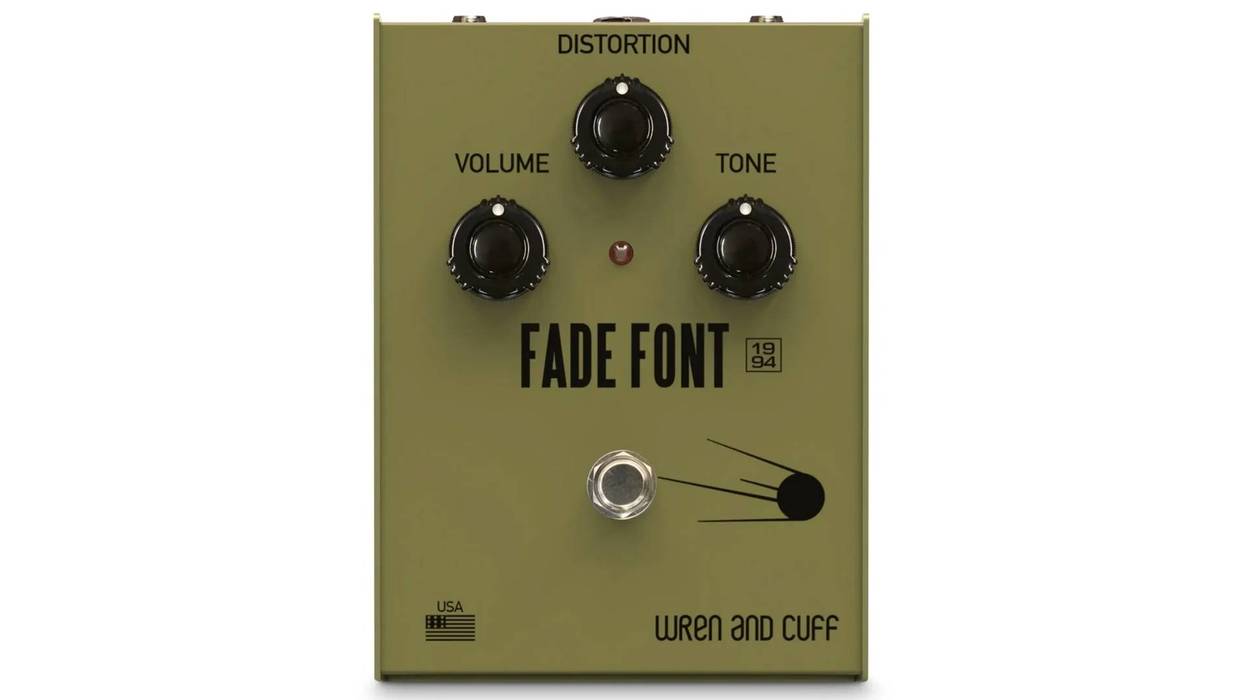
Today the Big Muff’s might is legendary, and thanks to a couple of decades of cloning and reissues its power has proliferated among players. But Big Muffs sing many songs. Like their human creators, they are full of quirks, and Wren and Cuff’s Matt Holl and protégé Ray Rosas study these oddities and irregularities fastidiously. The newest product of Holl’s obsession is the Fade Font ’94—a beautiful homage to a ’90s “Tall Font” Sovtek Big Muff in Holl’s sizable collection built with unusual components that shifted its personality to brasher ends. The Fade Font ’94 possesses all the signature qualities of a Big Muff—sustain, mass, and megatonnage. But it’s also nastier and illuminated at the edges by a ripping high-mid ferocity that counterbalances the creaminess that is the signature of most ’90s Big Muffs.
Built to Bruise
The charms of the Fade Font ’94’s olive drab, steel-slab design will no doubt elude some. But as someone who keeps their Sovtek Big Muff on a sort of informal mantle in my studio, I was genuinely thrilled to see how Wren and Cuff reproduced the original’s enclosure with such exactitude and quality. The dimensions are, save for very minor deviations, identical. At a few paces, you’d never suspect you were looking at anything other than an original Sovtek. The difference in quality, however, between Wren and Cuff’s unit and an original Sovtek is easy to see and feel. There’s a proper footswitch. The knobs (near-perfect replicas of the originals) turn with a smooth secure sense absent in Sovteks. And on the inside, the relatively simple circuit is executed masterfully on a through-hole circuit board. I also suspect the paint on the Wren and Cuff won’t flake off within weeks, and I won’t miss the Sovtek’s plastic jacks. So, yes, on the quality and craft side of the equation, Wren and Cuff deliver.
But it’s the sound that puts the Fade Font ’94 over the top. And Matt Holl was right to be excited by the sonic signature of the Muff that inspired this one. The primary design difference in that Big Muff is its use of 150k pots rather than the 100k pots most Muffs use. Holl found several component values elsewhere in the circuit that didn’t match Big Muff design norms. The sonic sum is what you hear here, and in Muff terms it’s something special.
Side by side, five Big Muff circuits can sound equally great for five different reasons. But the Tall Font conveys a sense of balance and playing to strengths—like a top-notch analog desk mix of a record, or a great mastering job. And it makes the Fade Font ’94 sound quite like listening to a Big Muff greatest hits record. It’s plenty bassy, just like a Sovtek should be. But the airy lower-midrange seems to siphon away excess low-end energy that might make a bass trap and convert it to low-mid purr. The high-mid, too, is very activated and detailed without flirting with brick-wall midrange. The top end is full of air, while the low-mid purr becomes a growl. It’s just really balanced across its gain structure and feels exceptionally alive as a result.
It’s got range, too. The tone control is a good friend when probing other voices within the brawny core output. At minimum high-pass levels (and lower gain levels) the Fade Font ’94 has some of the warmly stressed and fractured essence of an overdriven Tweed Deluxe. At more piercing tones and modest gain you can brew many shades of ’60s psych-punk. And when it comes to just doing things a Sovtek Big Muff does—doom, desert, dark psych, or just Gilmour’s smoothest, silkiest flights—the Fade Font ’94 does it all with aplomb and poise.
The Verdict
If you played the Fade Font ’94 without the benefit of side-by-side comparison with other ’90s or ’90s-style Big Muffs you might be hard-pressed to recognize the differences. If you have the ability to do so, though, it becomes hard to un-hear the shift in accent that makes it sound so much more sonorous, well-rounded, and at times, extra aggressive.
Obviously, there are practical downsides to the Fade Font ’94’s lovingly, exactingly executed big-enclosure format. Any player with more than a few additional pedals will struggle to accommodate the big footprint without scaling up to a bigger pedalboard. On the other hand, the Fade Font’s flexibility gives you justification to pare back your fuzz collection. Maybe, like I did over the course of this test, you’ll succumb to the Fade Font ’94’s brutish charms so completely that you’ll find everything but a delay pedal superfluous. For such minimalists, well-heeled maximalists with roadies, pedal aesthetes, or studio rats more concerned with delicious sounds than pedalboard space, the Fade Font ’94’s size won’t get in the way of putting it to use.
Reflecting on my $50 Big Muff purchase back in the ’90s—and the many times I put it back together with a cheap Radio Shack soldering kit and gaffer’s tape—it’s hard to imagine that such a close relative could be elevated to this level of luxury. But once again, Wren and Cuff has shaped magnificence from merely modest perfection. And any player who loves the Big Muff owes it to themselves to experience this intriguing, engaging variation on the theme.
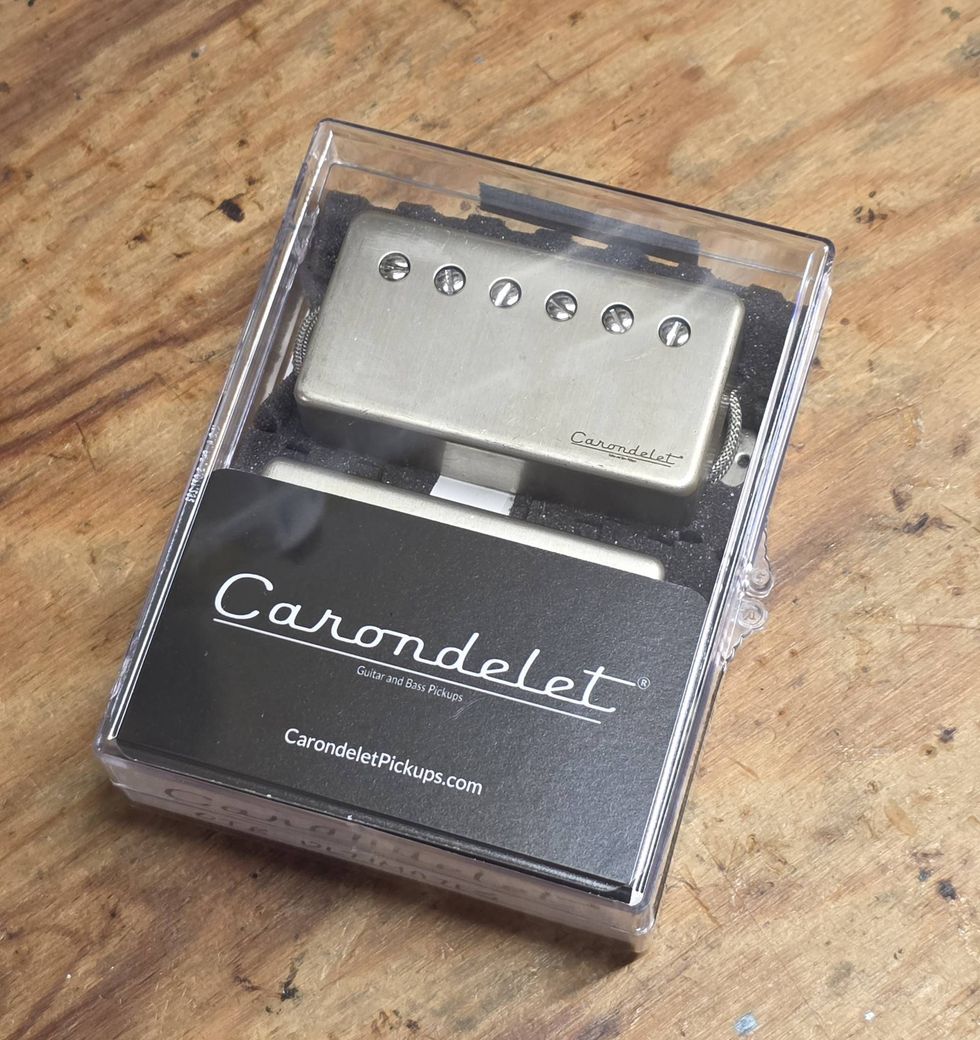
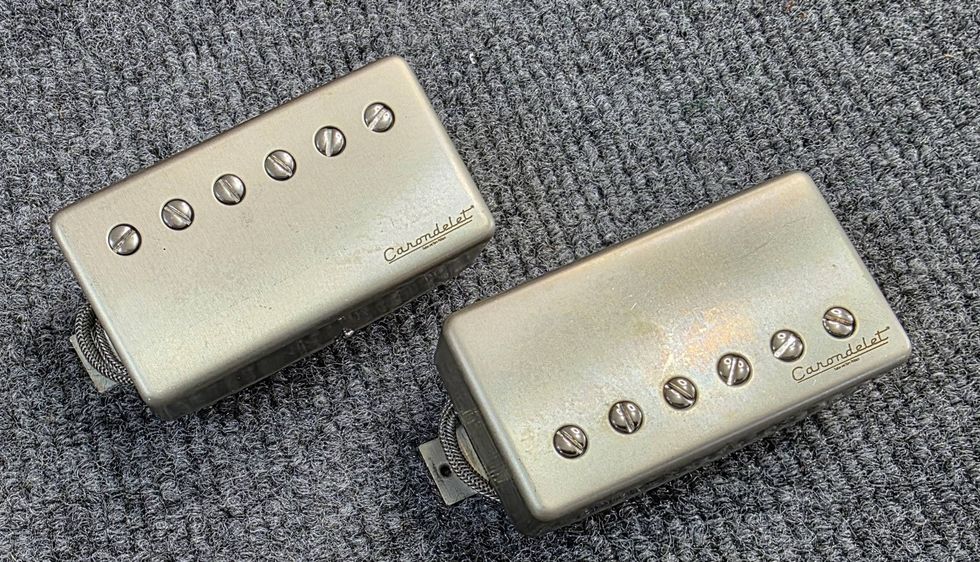
Carondelet Pickups has introduced their newest vintage-style humbuckers: the company’s OTB Ultimates provide a sound and feel that are stunningly close to great examples of original 1957-61 Gibson “Patent Applied For”-sticker humbuckers.
Louisiana-based Carondelet -- pronounced “kuh-RON-da-let” -- teamed up with artist Owen Barry in developing the OTB with the specific goal of “cracking the code” of vintage Gibson PAF humbuckers, but at a fraction of the cost of actual vintage PAFs.
The bridge position Carondelet OTB Ultimate reads 8.2k DCR and the neck position 7.0k DCR. Both positions feature rough-cast Alnico V magnets; historically accurate coil wire, plastics and metallurgy; two-conductor braided shield leads; and are unpotted like original PAFs.
Carondelet OTB Ultimates come with permanent and period-correct American-made raw German nickel silver covers. The “standard” version featuring modern covers with etched Carondelet logo carry a street price of $249 each and $498 per set. The “grail” version features no-logo vintage correct covers created from a 3D scan of an actual 1959 Gibson PAF, and carry a street price of $279 each and $558 per set.
The OTB Bridge position pickup is available in either Gibson-spacing or Fender-spacing, while the Neck position is available in a single vintage Gibson-spacing format.
The OTB in the product name is based on the initials of Owen Timothy Barry, a Nashville-based session and touring player whose resume includes The Chicks, Jackson Browne, Celine Dion, Jennifer Lopez, Gwen Stefani and Tal Wilkenfeld, among many others. Carondelet’s owner Jeff Richard (REE-shard, Cajun French) hand-winds all Carondelet pickups one at a time in his workshop in Baton Rouge. Barry and Richard met at the Amigo Nasvillle guitar show in 2025 and R&D on the OTB Ultimates began shortly thereafter, involving multiple trips between Tennessee and Louisiana and well over 50 pickup prototypes that directly contributed to the final recipe, Richard said.
“Even the simplest guitar pickup has so many variables which forge overall tone and feel,” Richard said. “In the case of a vintage PAF, however, you’re trying to recreate pickups wound 70 years ago by primitive machines, using inconsistent to outright changing techniques, components and materials, in a process overseen by common factory workers who aren’t around today to field how-to questions.”
Said Barry: “In order to create my perfect PAF set with Jeff, I had to fully understand the original recipe. It was an incredibly intensive deep dive, but I knew we had to try and test every variable. This would be the only way to find what created the original PAF magic.”
Carondelet OTB Ultimates are available direct via CarondeletPickups.com; and select vintage/boutique dealers including Carter’s Vintage Guitars in Nashville (cartervintage.com) and LA Vintage Gear in Los Angeles (lavintagegear.com).
Few players have been more instrumental in shaping the sound of modern metalcore than Converge’s Kurt Ballou. But to hear the producer and guitarist tell it, the 6-string was originally a consolation prize, not a calling. “My buddy Rob and I had this pact to start a band together, but we both wanted to play bass because we were both really into Rush and Iron Maiden at the time,” he says, calling in from his God City recording studio in Salem, Massachusetts. “And those bands have fantastic guitar playing, but they also have these bass heroes in Geddy Lee and Steve Harris, respectively. So, we decided that whoever could save up money for a bass first got to be the bass player, and the other one had to play guitar. I obviously lost.”
It’s a good thing the chips fell where they did. Since Converge formed in 1990, Ballou’s chugging-yet-sinuous brand of guitar brutalism has proved to be the perfect foil for vocalist Jacob Bannon’s throat-rending forays into emotional catharsis. It’s a sound that has evolved exponentially since the band’s early days, though never lacking ferocity. “The music that I was making was about trying to find a voice that was true to me and to what my influences were, but wasn’t parroting something that I was a fan of,” Ballou says of the band’s earlier work. “You start out by emulating, and you either emulate poorly and come up with something original, or you just find your own voice and get to something that’s original. I think that’s what we got to eventually, but it took a while.”
A decade into their career, Converge had already solidly established themselves in the extreme music world. But with release of the album Jane Doein 2001—the band’s first to feature the almost supernaturally kinetic rhythm section of drummer Ben Koller and bassist Nate Newton—Converge demonstrated their ability to challenge, and sometimes even transcend, genre tropes with a deft balance of fury and finesse. Their new album, the bleakly titled Love Is Not Enough, is their first in nearly a decade (Bloodmoon: I, a 2021 collaboration with doom metallist Chelsea Wolfe and Stephen Brodsky of Cave In, notwithstanding). “Converge is basically our side hustle,” explains Ballou, who spends most of his time producing and mixing other artists. “So, it’s not like we’re beholden to an 18-month album cycle. But there was definitely a feeling that like, ‘Oh yeah, it's been too long.’”
Ballou with his God City Instruments Craftsman, onstage at Furnace Fest.
Photo by Ben Pike
Love Is Not Enough was well worth the wait. Songs like the album-opening title track are relentless blasts of aggression, replete with riffs and half-time breakdowns sure to incite circle pits the world over, while brooding, delay-and-reverb-drenched midtempo numbers like “Gilded Cage” continue to expand and refine Converge’s palette. Throughout the album, a compositional discipline reigns that never allows the listener’s attention to drift. “It’s a good idea in anything creative to leave people wanting more rather than giving them too much, and if you try to limit how many ideas are in one song, you can increase the impact that that song has by keeping it tight and memorable,” Ballou says. “It’s like when you listen to newer Metallica. I actually think there's a lot of cool shit on St. Anger, but they just beat every idea into the ground. Instead of doing something four times, they do it 32. And if they’re like, ‘Well, part A sounds good going into part B, but part A also sounds good going into part C, and part C sounds good going back to A, but part C also sounds good going to B, then they do it every possible way in the song. These are all cool ideas, but I think it’s better to just find the best ones, tighten up your arrangements, and give people the bestversion of the thing rather than every version of the thing.”
Converge’s economical arrangements are certainly integral to what gives their songs an instantly recognizable contour, but the bespoke alternate tunings that the band have explored since Jane Doe are perhaps what distinguishes them most. “There were only a few songs in the first 10 years of Converge that had any alternate tunings because I was always really against them,” Ballou says. “Every time I tried drop D, I felt like what I was coming up with was really generic and basic. It took a while before I cracked the code to making something that felt like me.” Ballou credits Neil Young’s soundtrack to the 1995 Jim Jarmusch film Dead Man with finally opening his ears to the possibilities of alternate tunings. “It was atmospheric, vibe-y stuff that really spoke to me,” he says. “There was also a guy named Alex Dunham, who was in the bands Hoover and then Regulator Watts and Abilene, who had a similar vibe but also played slide. And so, I started experimenting with slides. But then you realize, like, ‘Oh, I don’t want this major third here. Let me get that out of there.’ And so, you start changing the guitar’s tuning to get the chord shapes you want. Eventually, I just stopped using the slide but stayed with those open tunings.” Ballou also cites other heavy bands like Cave In, Melvins, and Neurosis with providing him with inspiration, as well as indie rock legends (and alternate tuning icons) Sonic Youth.
Bannon and Ballou at Furnace Fest in Birmingham, Alabama, October 5, 2025.
Photo by Ben Pike
“You start out by emulating, and you either emulate poorly and come up with something original, or you just find your own voice and get to something that’s original.”
“I feel like if you really boil it down, Converge is sort of like Sonic Youth meets Slayer meets New York hardcore,” Ballou says. “And I actually have a tuning I call ‘Open Slayer.’ It’s C–F#–C–F#–C–F#, which is a take on Sonic Youth’s C–F–C–F–C–F.” Ballou’s favorite tuning, however, is one that he and the band refer to as “Wacky Tuning.” And while the internet will tell you that it’s C–G–C–F–G#–C, the guitarist will neither confirm nor deny this. “For whatever reason, I’ve put my foot down,” he says, smiling. “I’m not going to say what it is. It’s a challenge for people to figure it out. But we’ve used it almost half the time on every record since Jane Doe.”
For the recording of Love Is Not Enough, Ballou auditioned many of the amps in his studio’s collection, only to return to his stalwarts. “It's funny, when I have a record where there’s a little more time in the budget to experiment, like we have with Converge, I will tend to set up more amps and do shootouts,” Ballou says. “And a lot of times I’m just like, ‘Oh yeah, the shit I use all the time I’m using all the time for a reason—this is the best shit that I have!’ There are a few amps that really are the best at everything.”
He continues, “On this record, for the main rhythm guitars, the left side is this uncommon amp from Belarus made by Sparrows Sons. There’s a handful of them that are out there. I own two, and they don’t sound the same as each other. My purple one has a very “home brew” kind of vibe. And it’s just really great sounding. I don’t know what kind of circuit it’s based on. And then the right side is a 100-watt HMW, which stands for ‘Heavy Metal Warfare,’ by Dean Costello Audio. Both amps ran through Marshall 1960 cabinets that have a mix of Celestion Classic Lead 80s and Amperian speakers, miked with Shure Unidyne SM57s and Soyuz 1973s.”
Instead of relying exclusively on his amplifiers’ preamp sections to produce crushing gain levels, Ballou prefers to hit the amp’s front end with a pedal. It’s a practice he adopted early on in Converge’s career, when he primarily employed a ’70s-era Traynor YRM-1 45-watt head, which he still owns and used for many of the clean and semi-clean sounds on Love Is Not Enough. “There’s something about starving the low end and tightening things up with a pedal that I still like,” he says. “The Traynor is somewhere between a Fender Twin and a Marshall JMP kind of circuit, so it wasn’t designed to go ‘chug, chug, chug.’ I was forcing it to do that against its will by hitting the front end with a Boss OS-2 [Overdrive/Distortion], which has a really good midrange push to it.”
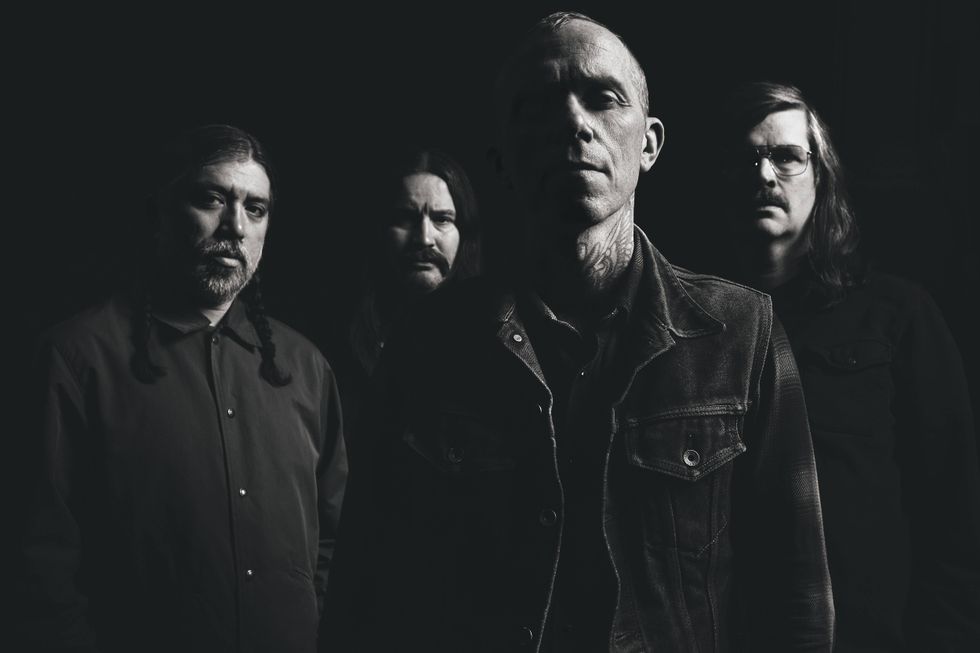
Converge, 2025 (l–r): bassist Nate Newton, drummer Ben Koller, singer Jacob Bannon, Ballou
Photo by Jason Zucco
When pressed to unpack the concept of “starving the low end” a little more thoroughly, Ballou, who has a degree in aerospace engineering, is more than happy to expound. “In any negative-feedback-based op-amp overdrive, there’s always this sort of shunt to ground that happens in the negative feedback circuit in order to get gain. And basically, you have to high pass that—meaning cutting the lows—because low end tends to overdrive before high end, and you can end up with a signal where the low end is distorted but the highs are clean,” he explains. “So, to get that searing tone with high end and mids compressed and overdriven, you have to starve the bottom end going into the overdrive circuit. To do that, a lot of pedals—like, say, the Boss Metal Zone—have a bunch of EQ stages working under the hood that precondition the signal before the drive section by cutting lows, and then post-condition after the drive section to add it back in. So, you’re starving the bottom end going into it to tighten it up and make it more responsive, and then you’re boosting the bottom end at the output to restore what you’ve lost. The same theory applies when you’re hitting the front of an amp.”
Ballou eventually graduated from the OS-2 to using a Boss GE-7 graphic equalizer pedal “set to a frowny-face EQ with the output gain jacked up,” and now favors the Onslaught, a pedal that he designed for his own God City Instruments brand of stompboxes, guitars, and basses. Although he also used a Wild Customs electric, a pine T-style partscaster with Lindy Fralin pickups, and a First Act Sheena with EMGs, the bulk of the guitar parts on Love Is Not Enough were in fact tracked using GCI guitars that Ballou designed himself.
“My father’s a machinist and owns a machine shop and has CNC mills and stuff, so making shit was always just sort of normal to me,” Ballou says. “There was a summer where the studio was slow and my dad’s shop was slow as well, and I went down the rabbit hole and built about 30 guitars. I was making the bodies that I had designed on the CNC machines, and having Warmoth make the necks with a custom headstock.”
The guitarist would assemble and set up the instruments himself, a process that he found less satisfying than dialing in the design and specifications of the instruments. “I am definitely better at the design aspect of it than I am at the craftsman aspect,” he says. “Now I’ve got a relationship with this fantastic factory in South Korea that’s doing the building for me, but I still do all the quality control of each instrument myself when they get here.”
“I feel like if you really boil it down, Converge is sort of like Sonic Youth meets Slayer meets New York hardcore.”
Kurt Ballou’s Gear
Guitars
God City Instruments Craftsman
God City Instruments Constructivist
God City Instruments Deconstructivist baritone
Amps
Studio:
Dean Costello Audio 100-Watt HMW
Sparrows Son
Traynor YRM-1
Marshall 1960 4x12 cabinets with Celestion and Amperian speakers
Live:
Line 6 Helix into Quilter Labs Tone Block 202 heads
Picks, Strings, & Cables
D’Addario Duralin Standard Light/Medium Gauge (.70mm) picks
D’Addario NYXL (.011–.056) and NYXL Players Choice (.013–.064) custom set for baritone strings
D’Addario cables
While his production runs often sell out—as of this writing, there are no guitars available for sale on the God City Instruments website—one thing that never fails to bedevil Ballou (as surely it must his peers) is the mercurial and unpredictable taste of the guitar-buying community. “I am always amazed at the things that people are particular and not particular about,” he admits. “And people are very, very particular about colorways. Sometimes, I order guitars in a color where I’m like, ‘Yeah, whatever, it’s white,’ and, boom, they sell out. Then sometimes I order a colorway, and I just think like, ‘Oh my God, this color looks fucking awesome!’ And then it’s slow to sell.”
He continues. “I love doing it, but I get really scared because none of this is done through pre-order. So it’s all out of pocket to me. Twice a year, I have to wire half my life savings halfway around the world to get a batch of guitars. And then when they come in, I’m just crossing my fingers that they’ll sell!”







![Rig Rundown: Russian Circles’ Mike Sullivan [2025]](https://www.premierguitar.com/media-library/youtube.jpg?id=62303631&width=1245&height=700&quality=70&coordinates=0%2C0%2C0%2C0)

 Carondelet Introduces OTB Ultimates Vintage-Style PAF Pickups