
One of the great paradoxes of guitar sonics is that reverb, an effect invented to give electronic and recorded sound more natural ambience, can also make the instrument feel otherworldly. It’s reverb that transforms guitar and amp into waves crashing off the Malibu cliffs, and reverb that makes the Stones’ “Gimme Shelter” sound like the darkest of moonless city nights.
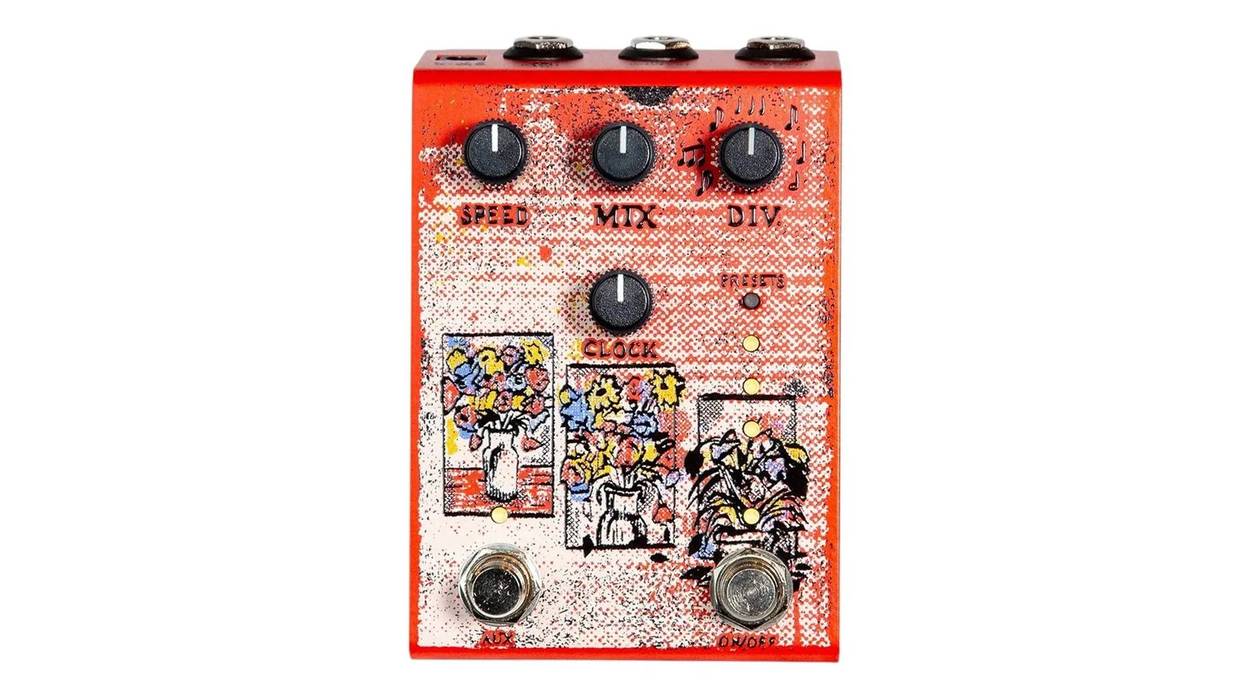
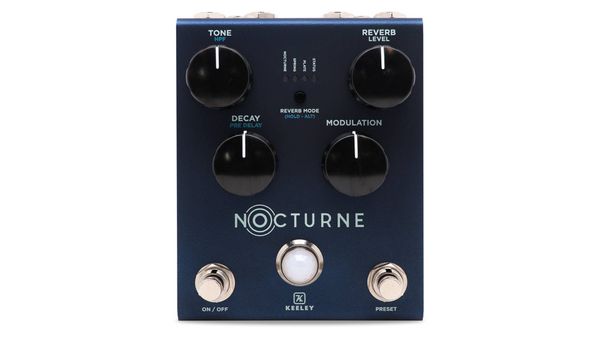
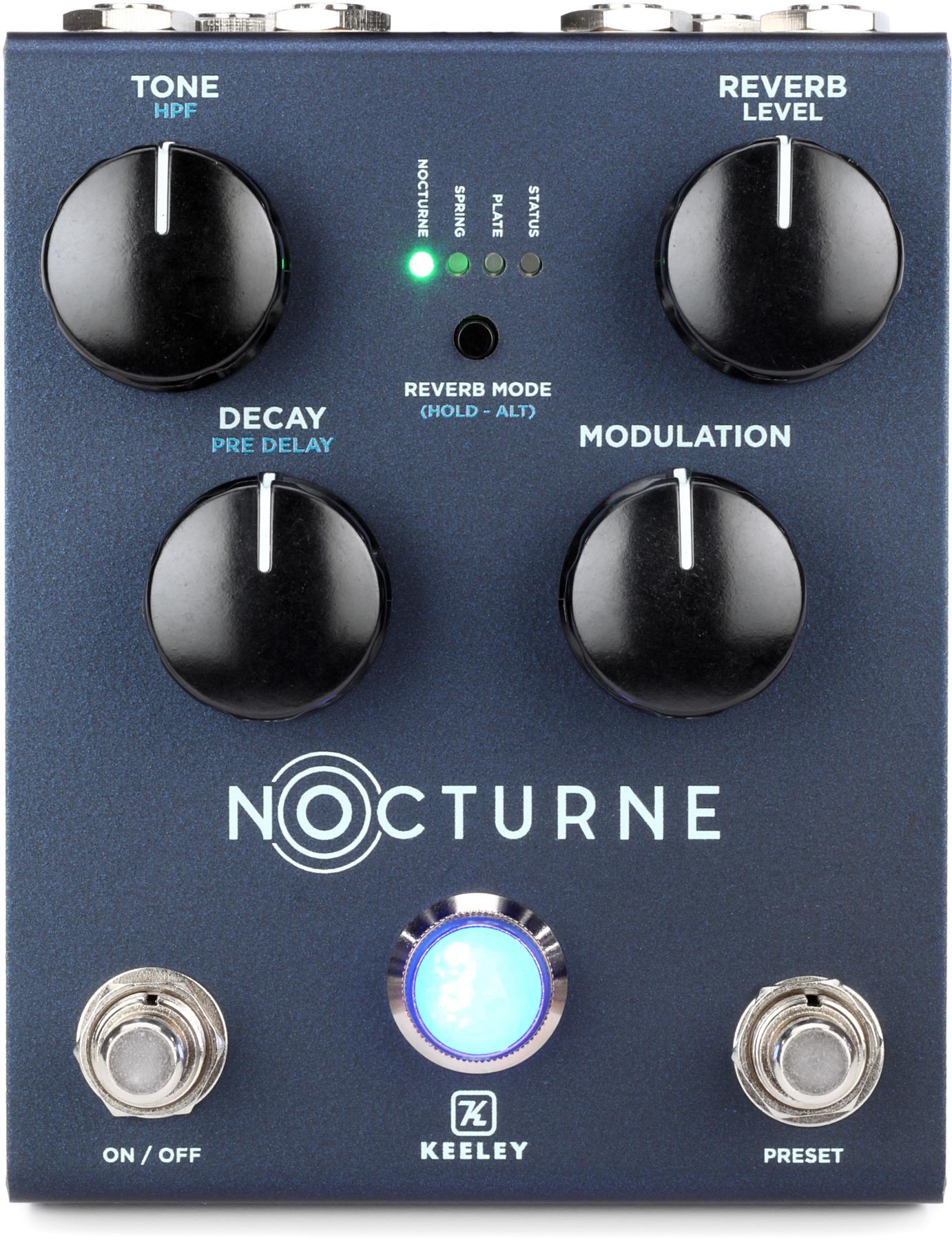
That midnight tone is among those that lives in Keeley Electronics’ Andy Timmons signature Nocturne, a versatile stereo pedal perfectly at home exploring reverb’s dual potential to recreate natural atmosphere or sounds that seem beyond physical dimensions.
Exploring the Atmosphere
Inspired by the Keeley Andy Timmons Halo delay/reverb, the Nocturne focuses on reverb exclusively, offering three flavors: nocturne, spring, and plate. While the latter two are the most conventional, they can be dialed in to break free from the constraints of their mechanical counterparts. All three modes give you control over tone, reverb level, decay, and modulation. But the pedal also has alternate functions that enable the tone and decay knobs to control a high-pass filter (which tailors the low end) and pre-delay (a powerful and often overlooked parameter that shifts the space between transient notes and the onset of the reverb).
Spring and plate do the most basic versions of their job well, but they happily go beyond the norm. In spring mode, the modulation control governs the mechanical “boing” overtones in the reflections, which range from realistic to totally over the top. Though I preferred the more subtle settings, which enabled me to capture the essence of gentle slap heard in my old Fenders and Ampegs, it was also easy to move between big and clangy or smaller and subtly ambient.
“It made me slow down, allow the notes to hang, and listen—and even led to new music for a documentary soundtrack I’d been struggling with.”
For most conventional guitar-tone tasks, the plate mode would be my go-to. It’s especially effective for high-gain sounds, where you can dial in the sense of a big amp in the studio. I used the Nocturne both in front of a solid-state amp and in the effects loop of a modified Bassman 10, which has Fender-style and pentode preamp channels and EL34 power tubes. The pentode channel can be set to preserve more low end than a typical guitar preamp, so the high-pass filter was especially useful there. More important, though, was the Nocturne’s high headroom, which meant it could live in the effects loop, on the receiving end of preamp and other drive sources, without complaint—even when powered by a basic 9-volt supply (18-volt is optional).
Dark Reflections
While both spring and plate are effective day-to-day tools, it’s the eponymous nocturne mode that opens up the pedal’s creative potential, delivering lush, modulated sounds with distinct echoes blended into long decays. I often got lost in the swirl of shimmering sustain while playing simple thirds and drones. It made me slow down, allow the notes to hang, and listen—and even led to new music for a documentary soundtrack I’d been struggling with. Things got more interesting when I grabbed an EBow, where the sustain and feedback-like harmonics let me create a sonic bed with far more texture than many synths, and far more expression than a sample.
As these experiences suggest, I often found myself playing to the effect in Nocturne, letting it serve as a guide, and treating it as an extension of my guitar and amp. Using the assignable expression input to change parameters while playing only enhances the sense of interactivity here. It’s that responsiveness to player input—and the fact that so many big sounds don’t completely obscure dynamics—that make the nocturne mode so effective as a creative tool.
The Verdict
While there are plenty of creative and powerful spatial effects on the market, the Nocturne is one of the few I know that works like it was designed for the guitarist without dumbing things down. It’s easy to get started and the basic sounds are satisfying, but it also invites you to go deeper. Preset capability (you can create up to 72 with MIDI) means that in a performance setting you can switch easily between completely space-altering effects and more earthly ambiance. The high fidelity and headroom make it a powerful studio tool.
Though it takes time to master some functions (it took a few tries to get the expression pedal assignments right) the layout remains super intuitive. That essential simplicity makes Nocturne equally suited to pedalboard minimalists and MIDI-based rigs. But whichever camp you’re in, you might want to leave a note for family and friends when you plug in, because you’re likely to get lost in space.



![Rig Rundown: The Black Crowes’ Rich Robinson [2026]](https://www.premierguitar.com/media-library/youtube.jpg?id=66952027&width=1245&height=700&quality=70&coordinates=0%2C0%2C0%2C0)