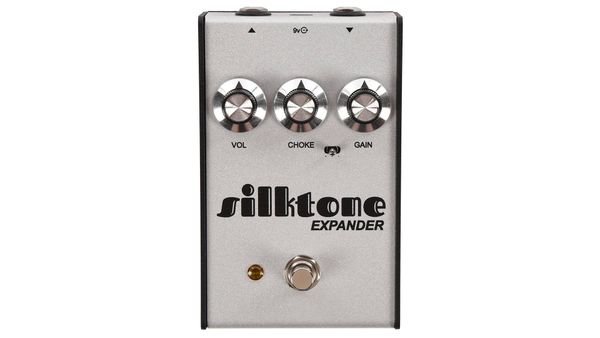

Spending quality time with the Silktone Expander is like getting lost in a garden maze in late spring. You might not always know where you are, but the sensory overload is so rich and intoxicating that you’ll forget you were trying to get anywhere specific in the first place. Using the Expander, a player encounters full, resonant boost, overdrive, and distortion tones that can sound great in the most straightforward applications. But there are also unusual gain flavors in abundance, ranging from exploding-5-watt-antique-amp textures, thrilling uncommon fuzz fare, and ghostly, smoky, fiery, in-between sounds that defy easy categorization but can drive a mixer, arranger, or songwriter’s inspiration to white-hot levels.
Getting the most out of the Expander’s, well, expansive tone vocabulary requires you to be realistic and honest about your relationship to strictly analog methods. There are no presets here. And while the Expander can cover textures you might otherwise assign to three or four gain devices with their own dedicated footswitches, you do all that here with a single footswitch, three knobs, and a toggle. So, tapping into the breadth of the Expander’s capabilities in performance takes confidence, and a creative mindset that allows for happy accidents. If your composing and performance style is more “roll-with-it” than surgical and uncompromising, the Silktone Expander opens doors that reveal unexpected surprises.
A Chameleon, An Individual
One of the trickiest things about reviewing the Expander and boiling it down to its essence is how hard it is to find equivalent sounds as a base for comparison. The germanium heart of the pedal is inspired by a Dallas Rangemaster, and some overdriven and fuzzy facets of its personality sound and behave like a germanium Fuzz Face. At other times it responded like my Jext Telez Selmer Buzz Tone clone running at 3 volts. Some of the Expander’s warm, fizzy drive tones also evoke console preamp-style pedals like the Hudson Broadcast. But on the flip side, I’d plug the Expander in alongside a favorite clean boost, sparkly overdrive, or preamp, and end up totally preferring its balance of clarity, detail, and energy.
If you find a combination this pedal sounds lousy with, let us know! We’re still looking.
How did Silktone craft a pedal that’s so many pedals in one? There are clues to Silktone founder Charles Henry’s intent. In addition to the Rangemaster influence, Henry gravitated toward the Shin-Ei FY-2 and FY-6 as well as the Roland Bee Baa—all fuzzes that speak through bold, often radical voices. Certainly, tones of that ilk live here. But there is much in the Expander that reflects the mindset of an amp builder—and Henry is a very creative one. In lay terms, the Expander’s circuit works like this: A JFET transistor that emphasizes rich, consonant, 2nd order harmonics makes up the first power stage. The second stage is Henry's riff on the germanium Rangemaster circuit. That is almost certainly the origin of many of the Expander’s hazier, fuzzier, but also more dynamically responsive tendencies. A JFET at the output stage effectively emulates the saturation that occurs in a real tube amplifier's first stage—probably a reason the Expander sounds great at low amp volumes. There’s nothing terribly complex going on here. But in practice you hear a balance more typical of a great amp: Warm when clean, full of overtone character when run at its limits, and responsive across a wide dynamic range and EQ spectrum.
Equal Opportunity Expander
Though I tried, I really couldn’t find an amp and guitar pairing that wasn’t enhanced by the Expander. A Jaguar running through a hot, 15-watt EL84 amp at attenuated levels? Magic! An SG driving a Fender Reverb tank and a 50-watt Bassman? Double, extra-thrilling, super-loud magic! A Rickenbacker and Champ? That combo sounded ten times as big and fat, all at a volume that any soundman or engineer could love. I could go on. I threw Danelectros and Eko 12 strings at this pedal. Mixed it with other gain sources as divergent as Harmonic Percolators, Selmer Buzz Tone clones, Tube Screamers, Boss DS-1s and Vox Tone Benders. In every case the Expander was not just agreeable and accommodating but had real enhancements to lend. If you find a combination this pedal sounds lousy with, let us know! We’re still looking.
The Verdict
For all its understated, elegant design, the Silktone Expander is packed with sounds that not only bring a lifeless amp to life, but do so in ways distinctive enough to jump-start a stalled recording project or rescue a song from the doldrums. The straight-ahead, all-analog design means that presets aren’t coming to save you in a pinch. You’ll need to get crafty, be resourceful, and practice using the Expander. But it is incredibly forgiving, a willing co-pilot, and full of alternative tone treasures—particularly for players willing to explore and improvise. While $269 might seem a lot for a pedal this simple, the quality is tip-top, and it certainly makes several of my gain devices feel superfluous. If you have downsizing to do, the Silktone Expander, despite its name, is a beautiful solution that leaves you no less rich in tone options.

![Rig Rundown: The Black Crowes’ Rich Robinson [2026]](https://www.premierguitar.com/media-library/youtube.jpg?id=66952027&width=1245&height=700&quality=70&coordinates=0%2C0%2C0%2C0)