
Among the many fuzz pedals to carry the Tone Bender name, the MkII might be the one that rips the most. And though not as common as the Vox Tone Benders that American psych-punk fans wrestled with for decades—which were generally Mk1.5 or MkIII versions—it might have been the Tone Bender version that people experienced the most thanks to Jimmy Page. As Page superfans and fuzzspotters outed the MkII as the sound of Led Zeppelin, it came to embody what a Tone Bender should be. Consequently, a lot of builders jumped on the bandwagon.
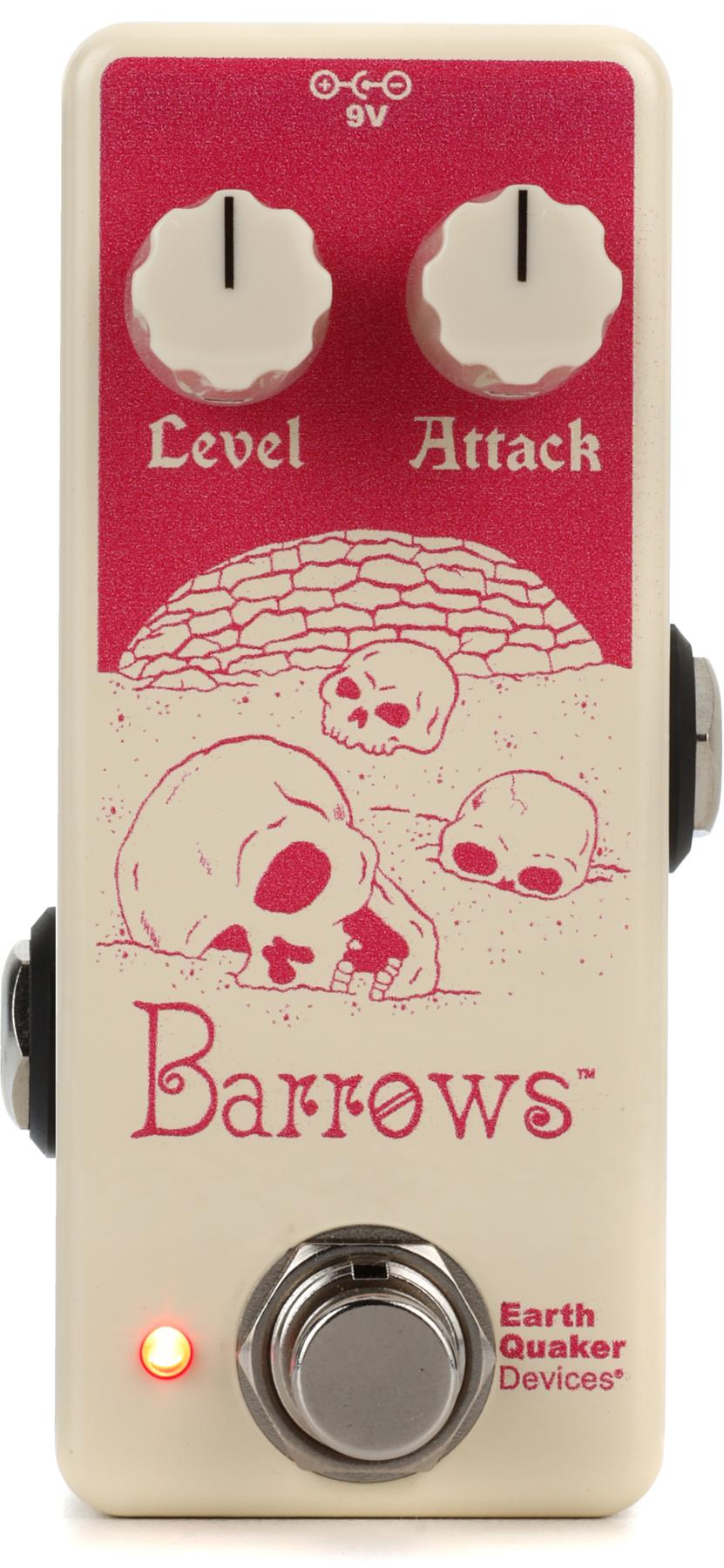
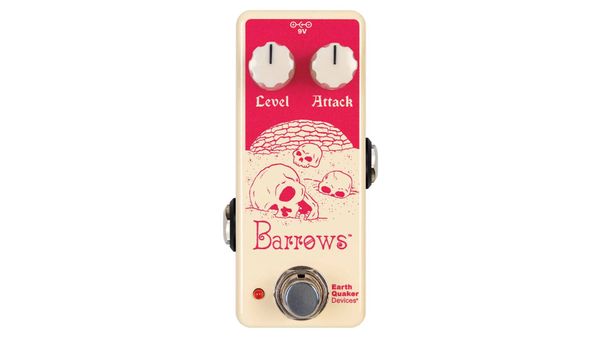
There is a practical, musical upside to the MkII that transcends the Jimmy Page associations. Some desert, doom, and stoner rockers, for instance, love its ability to sound huge and evil while occupying less mix space than a Big Muff. And while not as sweetly sensitive to input dynamics as the Fuzz Face (or the very Fuzz Face-like Tone Bender Mk1.5 and first-generation Vox Tone Bender), its germanium transistor topology makes it responsive to guitar-volume attenuation. EarthQuaker’s new take on the MkII, the Barrows, shares all these attributes. And between its very convenient size and refinements that make it less noisy, Barrows represents a ceratin sonic, functional, and practical ideal of what a vintage-style germanium fuzz can and should be in 2025.
Savage, Sassy, and Sweet
Doctrinaire thinking around germanium fuzz usually states that it sounds good only at maximum volume and gain levels and that any variation must come from the fingers and guitar controls. The Barrows reveals the cracks in this view. While the Barrows is positively searing at wide-open settings, and most receptive to input dynamics at these levels, it shines at many different gain and level settings. There are heaps of cool, smoky, more subdued fuzz sounds lurking in the middle third of the gain range that can be useful for simultaneously creating mystery and generating menace and mass in a recording situation without blowing the room apart with volume. The Barrows is not as touch-sensitive here, but guitar-volume adjustments can create dark, compelling fuzz voices that are equally interesting with a 50-watt amp and a 2x12 cabinet or a practice amp.
MkII Tone Bender-style circuits have always been regarded as second-best to the germanium Fuzz Face when it comes to gnarly-to-clean range. That dictum remains mostly true in the Barrows, at least as far as clean tones go. But if the Barrows can’t quite equal a Fuzz Face’s capacity for airy clean sounds at reduced guitar volume, its near-clean sounds still have abundant clear, bell-like resonance and detail that will suffice for most. The Barrows’ dynamic range is most evident in its touch sensitivity. You can generate many beautiful, spooky, and smoldering gain shades just by varying picking intensity. It’s especially impressive if you ditch your pick and use your fingers to generate these tone variations. And if you want to go super old-school and string up your guitar with flatwounds, the Barrows reveals many beautiful, round, and vocal fuzz colors. More than once, I was moved to think that if Sinatra was a psych-punk he would have adored the atmospheric, verge-of-exploding moods Barrows can produce in these environs.
“If Sinatra was a psych-punk he might have adored the atmospheric, verge-of-exploding moods Barrows can produce.”
The Verdict
For a fuzz nut, the Barrows—for its small size and big sound—might as well be candy. Players that use fuzz more infrequently, though, will dig its simplicity, small dimensions, and the fuzzy classicism exuded by its punchy, straight-ahead voice. The pedal is intrinsically limited by the same factors that limit any germanium fuzz with 1960s lineage. And by the standards of modern gain devices that can be tuned in small increments to match very specific distortion needs, the Barrows can, at times, seem unruly and one dimensional. But if you’re willing to use guitar volume and tone and touch dynamics to re-shape the fuzz, you’ll uncover many less aggro tones ranging to light drive and near-clean sounds—applications made even more rewarding thanks to a low noise floor. Best of all, the petite Barrows comes with an equally petite price tag of $129. For germanium-fuzz newbies, that makes a plunge into the unknown a lot more palatable. But even seasoned fuzz and Tone Bender users are bound to be impressed by the quality and flexible vintage voice Barrows delivers for the money. PG