5x GRAMMY® Award-nominated guitar legend Joe Bonamassa and Sixthman, the leader in festivals and music cruises for more than 25 years, have announced a second northern edition of their world-famous blues-rock celebration, Keeping the Blues Alive at Sea Alaska II, sailing September 14-21, 2027, from Seattle, WA to Juneau, Skagway, Glacier Bay, and Victoria, BC, aboard the beautiful Norwegian Jade. Fans are urged to sign up for the presale now at www.bluesaliveatseaalaska.com to secure a cabin on this highly anticipated Alaska return.
The InterFax Harmonic Percolator HP-1 circuit revealed its magic to me over a long period of time. Like just about everyone, I’ve never played an original. And when I finally encountered a reproduction at a recording session, it was the wrong pedal at the wrong time. I walked away from it vaguely disappointed and moved onto other things. Luckily for me, though, I came to be a colleague of Premier Guitar editor Joe Gore. Joe’s simple guidance for navigating the Harmonic Percolator lit the way to loving the circuit.
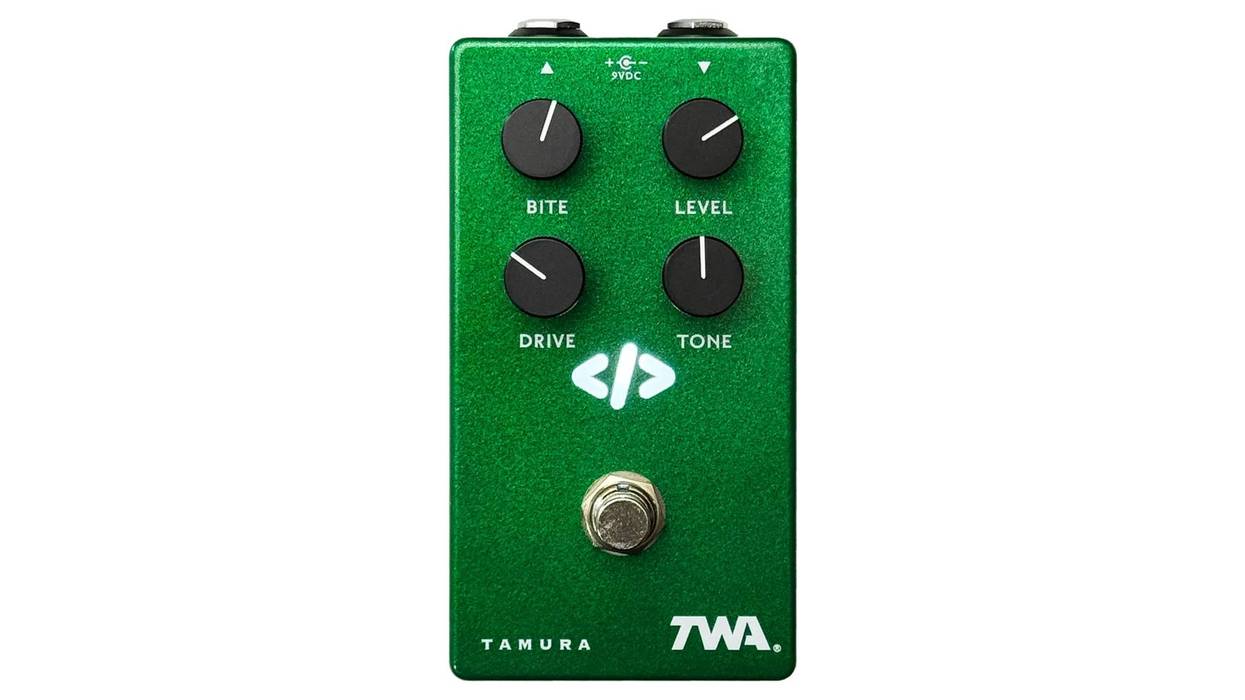
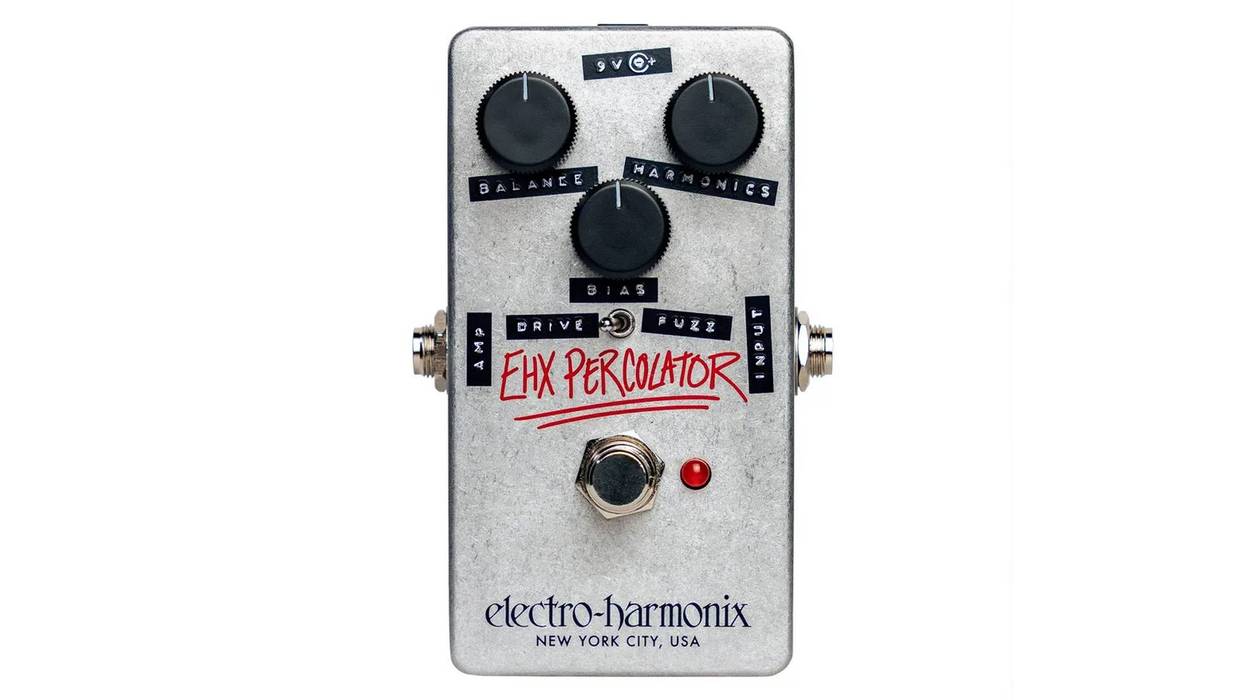
I mention this journey because I think a lot of readers experience a crooked path to grasping the Harmonic Percolator. And one thing the new Electro-Harmonic EHX Percolator does well—apart from kicking up a glorious racket—is make the HP-1 a little more accessible. Interestingly, it accomplishes this by adding another layer of options in the form of a hard-clipping fuzz mode and a bias control.
Bubbling Over
The original HP-1’s mysteries live as much in its fundamental voice as in the interplay between a guitar and its controls, which number just two. The drive and distortion that the pedal generates aren’t really the creamy, hot-tube-saturation sort. And though the harmonics and overtones it produces are indeed lively, the basic voice has a dry, husky edge. Even the compression it imparts can be unusual, in that it seems to strip less oxygen from the signal. The EHX Percolator captures these fundamental, and sometimes alchemical, aspects of the HP-1’s voice.
The EHX’s controls can be less than intuitive. The balance and harmonics knobs—the only ones on an original HP-1—are effectively a master volume and an input gain control (which functions more or less like a guitar volume knob). There is no dedicated gain or tone control. This makes the bias control on the EHX Percolator an extra-cool addition—it alters the distinctive distortion flavor in ways an original HP-1 cannot, and in a manner that a tone or gain control never would. Situating the bias control at noon makes the EHX Percolator sound a lot like a basic HP-1, and a few degrees to either side of noon gives you interesting variations on that core tone. Turning the knob further counterclockwise, however, adds an almost tweed Deluxe-like saturation that can fracture in cool, chaotic ways. At more extreme clockwise reaches, the bias control kicks up busted-speaker scuzz dust and gnarly, tattered voltage-starved effects that verge on fuzzy.
The Hidden Hand And that leads us to another bonus feature the EHX Percolator offers—the drive/fuzz switch. The drive mode lifts the clipping section. Curiously, though, the drive mode often sounds closer to the HP-1 voice than the fuzz side. At bias settings that align with the original HP-1 voice, the clipping doesn’t add much to the pedal’s personality. In fact, I’d argue that it has a flattening effect that strips away the drive mode’s most alluring complexities. Introducing unusual bias settings brings the fuzz more alive, though. And that angular huskiness at the Percolator’s core can, at many bias settings, lend focus to cracked and deviant fuzz tones. These, in turn, can sound fantastic when fed to another sweeter gain source.
The Verdict The EHX Percolator, like its inspiration, is an idiosyncratic thing. But for $99, it’s a crazy-inexpensive and super-cool way to extract yourself from a distortion tone rut. It’s exceptionally responsive to guitar volume and tone input as well as picking dynamics, which stretches its vocabulary even further. For the right player it can be a transformative addition to a stale old gain chain.
A lot of players spin magic and craft signature tones from a cocked wah. (For those that don’t know, the cocked wah sound is that honking, mid-rangey, filtered tone that you get when you park a wah pedal at a specific angle and leave it there to do its dirty work.) Frank Zappa did it. Mick Ronson did it. So did Michael Schenker. And for the last decade, Matt Pike of High on Fire and Sleep—a man whose entire tone philosophy seems to be “louder, and also weirder”—used various versions of Daredevil’s Atomic Cocked circuit to do that job.
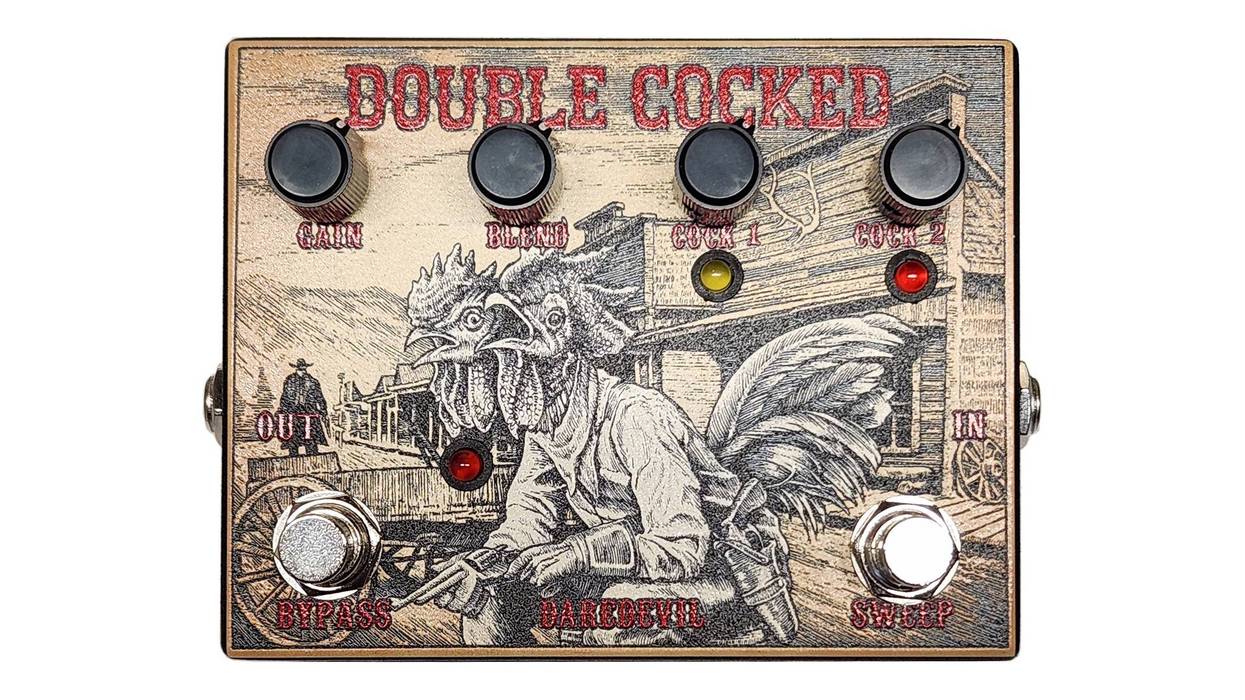
Tucked onto Pike’s board, which is otherwise anchored around crushing sustain and volume that could reasonably be classified as a structural hazard, the new Double Cocked does specialized work. But it’s impressively powerful by itself. The Double Cocked evolved out of Daredevil’s Atomic Cocked, but the functional mission is the same. It’s essentially a wah filter with two fixed, foot-switchable filters. Each filter sweeps a wah-like frequency range and can be set anywhere along that curve. So, you get two cocked-wah personalities, living in one pedal, ready to alternate between traditional rhythm and lead voices—or much less conventional combinations—all without crouching down to twist a knob mid-riff or searching through the sweep of a wah.
Food for Filters
Were the Double Cocked simply two filters, the pedal would be tons of fun. But here, the filters feed into a gain stage that adds dirt and a genuinely useful boost for solos. A FET boost follower does additional post-filter heavy lifting, which makes the Double Cocked plenty powerful without any assist from fuzz, distortion, or a giant stack. A blend knob at the center lets you dial in exactly how much filtered wah signal gets folded into that boosted output, which can be anything from a subtle EQ nudge to what Daredevil describes (quite accurately) as fully saturated Ronson, Schenker, or Slayer-adjacent territory. It may sound simple, but the Double Cocked adds real character and range. You can use it to add subtle peakiness to a solo, or to sound like you’re actively trying to injure your amplifier.
“You can use it to add subtle peakiness to a solo, or to sound like you’re actively trying to injure your amplifier.”
In the most practical terms, the thing that separates a fixed-filter from a regular wah is control. There’s no rocking, potentially floppy pedal to manage. Nor is there the risk of your foot drifting off the sweet spot mid-song. You dial in your voicing once, then just stomp to engage. For riff-heavy, drop-tuned, high-gain playing—Matt Pike’s whole world, basically—that’s a real advantage. But it’s an asset in traditional verse-solo rock environments, too. You can set up a rhythm/verse tone with a unique, musical mid-forward texture that cuts, and have instant access to a second flavor for solos—no scrambling required. As you can imagine, the possible filter combinations and contrasts can be much stranger, too. Incidentally, each unit is signed, numbered, and dated by Pike himself—a nice touch that transforms the pedal into a piece of memorabilia with a very practical purpose.
The Verdict
Though you have to be open to the possibilities of filter sounds to hear the potential of the Double Cocked, it can be full of surprises. It doesn’t exactly chase maximum versatility. And it’s definitely a tool built for a very specific job, and a musician with very particular tastes. But it does that job with real character, and impressive, unexpected musical range. This pedal could live and prosper in musical environments well outside those associated with Matt Pike’s heaviness. But if your tastes, and your rig, are optimized for sludge, doom, or stoner-rock realms—or even just old-school hard rock with a mean streak—this pedal will feel like it was built with you in mind. Because, frankly, it was.
Ashdown has announced that the company’s products will be exclusively available across the USA through Guitar Center and Musician’s Friend. The new distribution arrangement marks a watershed for the British company as it aims to build a larger following in America.
I’m always thrilled to see a tweed Fender amp come across my bench. During the tweed era, Fender was producing some of their most dynamic amplifiers, which are still heavily sought after today. Most of the time, I have the pleasure of working on the more common tweed Champs and Deluxes. This month, I was lucky to have a rarer 1958 tweed Bandmaster on the bench for a full restoration.
The Bandmaster was introduced in 1953 as the 5C7. This was during the “wide panel” cabinet era, which quickly shifted to the narrow panel cabinets a few years later. The wide panel 5C7 housed one 15" speaker, while the 5E7 narrow panel Bandmaster housed a total of three 10" speakers. The amp pumps out roughly 25-30 watts of power, and with a ton of natural distortion through the trio of speakers, this amp is one of the more unique of the Fender tweeds.
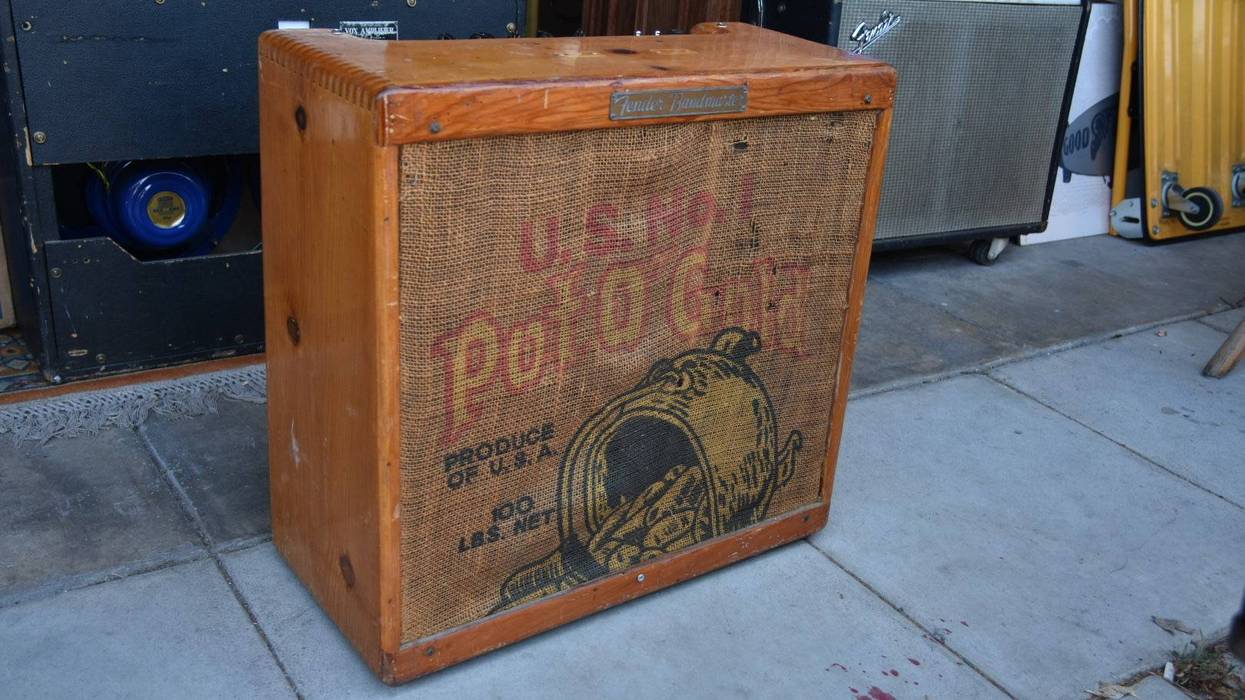
The Bandmaster was brought into the shop by a father who wanted to restore the amp for his daughter to use. Aesthetically, this amp is one of a kind. The cabinet had been previously stripped of its tweed, and now sports a beautiful exposed wood finish. The grill cloth had been replaced with an old burlap “Pot O Gold” potato sack, which gives the amp some very unique character.
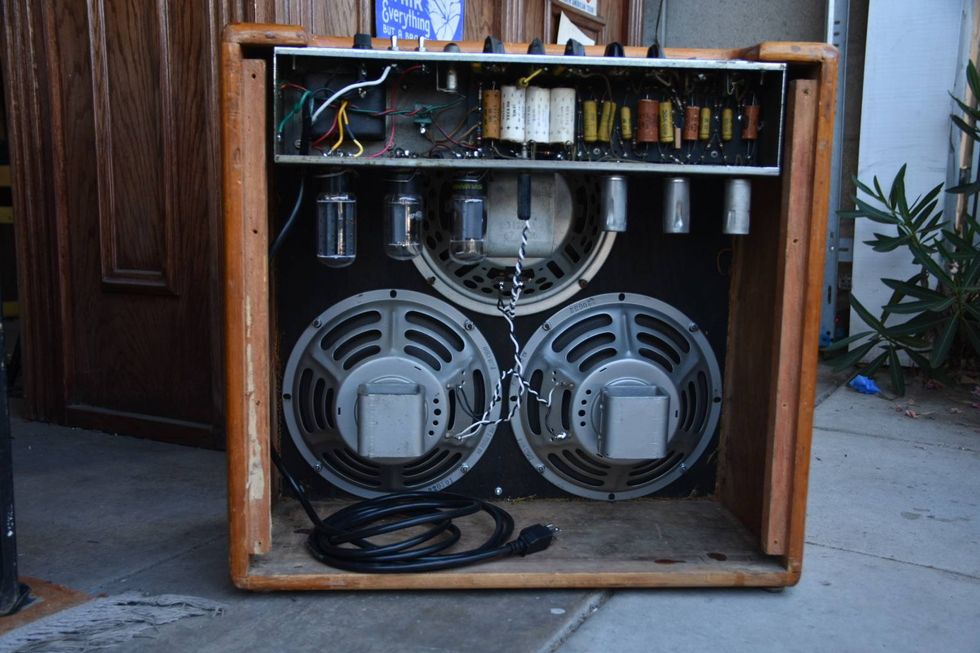
The circuitry in this amp had been mostly untouched. Exposure to the elements left the chassis very dirty, with many broken wires and cracked solder joints. I knew that I would be replacing all of the electrolytic capacitors, which is necessary for an amp of this age. With tweed amps, I like to install the new capacitors inside the old cardboard covers to preserve the original aesthetics. There is nothing like removing the back panel of a tweed amp and seeing those ’50s-era colors and textures.
“This Bandmaster simply oozes soul, and zaps life into the guitar.”
With this amp, it was very important for me to clean out the chassis. So much dust and debris was covering the circuitry and tube sockets, which could certainly cause some safety or overheating issues. With the large electrolytics out of the way, I was able to really get in there and remove as much dirt as possible. This is where the air compressor and shop vac come in handy! Once the chassis was clean, I went through and re-soldered every connection. The fresh, shiny solder joints will help the amp function more reliably than with the dull, cracking joints.
After this first round of work, I installed a grounded 3-prong power cable. The amp was now safe to actually turn on and test. Immediately, I noticed the power and standby switches were sticking and needed to be replaced. I installed new toggle switches and the amp fired right up. Once I confirmed that everything was working properly, I let the amp run for a while to listen for any noise issues. Miraculously, I did not hear any pops, crackles, or hum, which means the restoration is almost complete!
The final circuit check comes down to the coupling capacitors. In this amp, we have beautiful yellow Astron capacitors with green writing. All of these capacitors are original, and in order to leave them all in, I need to make sure they’re still healthy. Some of these capacitors are part of the tone stack, which shapes the guitar signal by blocking or passing specific frequencies. The other coupling capacitors pass the guitar signal from one gain stage to the other. Often these capacitors connect to the plates of the preamp tubes, where signal from one stage has just been amplified. There is a high DC voltage applied to the plates of the preamp tubes, which is necessary to power the tube. We don’t, however, want that high voltage to travel through the coupling capacitor and into the rest of the signal path.
I go through the schematic and check any coupling capacitor that connects to a high voltage point. I confirm the high DC voltage on one side of the cap with my multimeter, and then check the DC voltage on the other side. The goal is to see close to 0 VDC, but sometimes the capacitors will break down and begin to leak the DC voltage into that signal path. If I see more than 1 or 2 volts on the other side of that cap, I may opt to replace it. Sometimes that leaked voltage will cause noise or scratchy controls. In the case of the potato sack amp, I was able to leave all of those yellow Astrons original.
This amp sounded so sweet. I had never played through a tweed Bandmaster before, so this was a treat for me. There was so much natural growl and lively touch response, but without being too loud. There’s no surprise that this amp was favored by guitar players such as Joe Walsh and Pete Townsend. This Bandmaster simply oozes soul, and zaps life into the guitar.