
I love to learn about the history of an instrument when I am tasked with creating something new. Many people are unaware that I make over 45 different types of stringed instruments. When I say that, I’m quick to add that although I make six or more styles of steel-string or classical guitars, these do not count toward that number of 45.
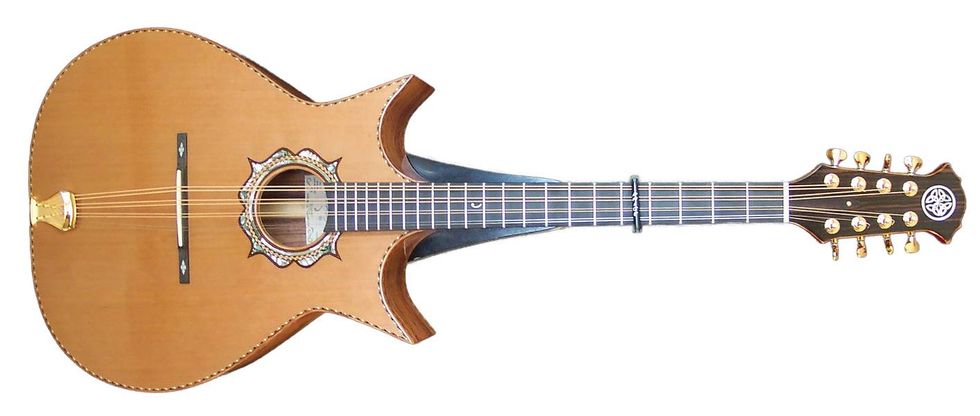
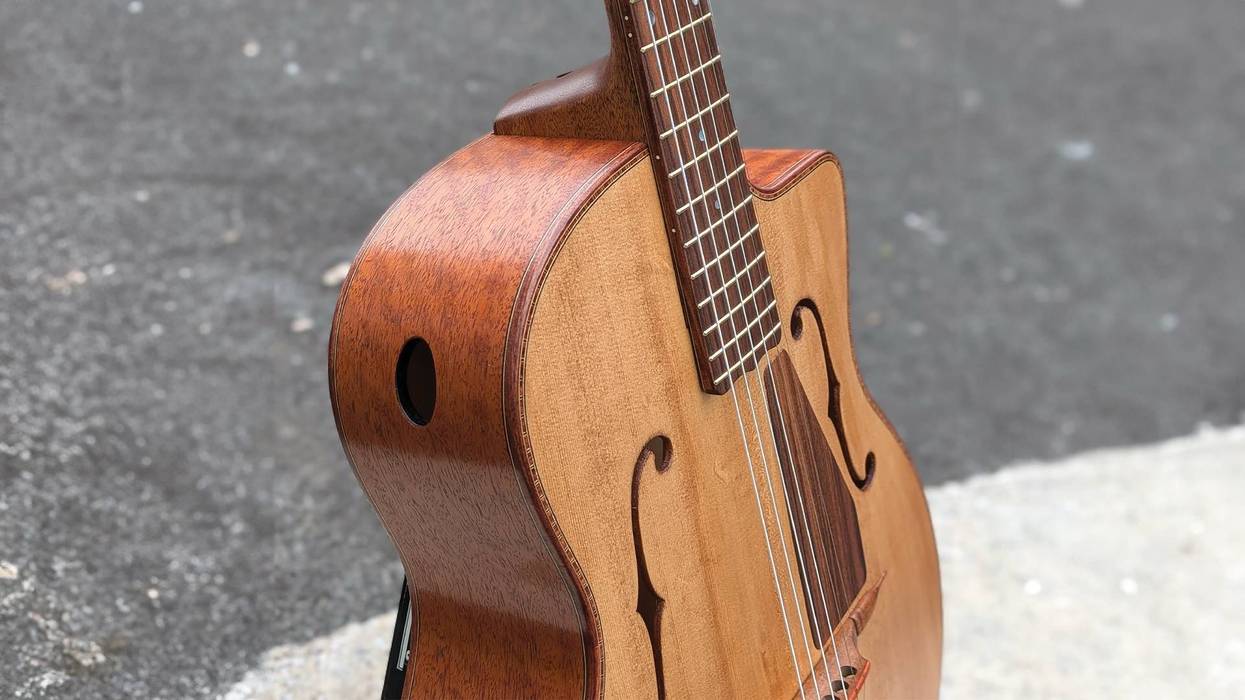
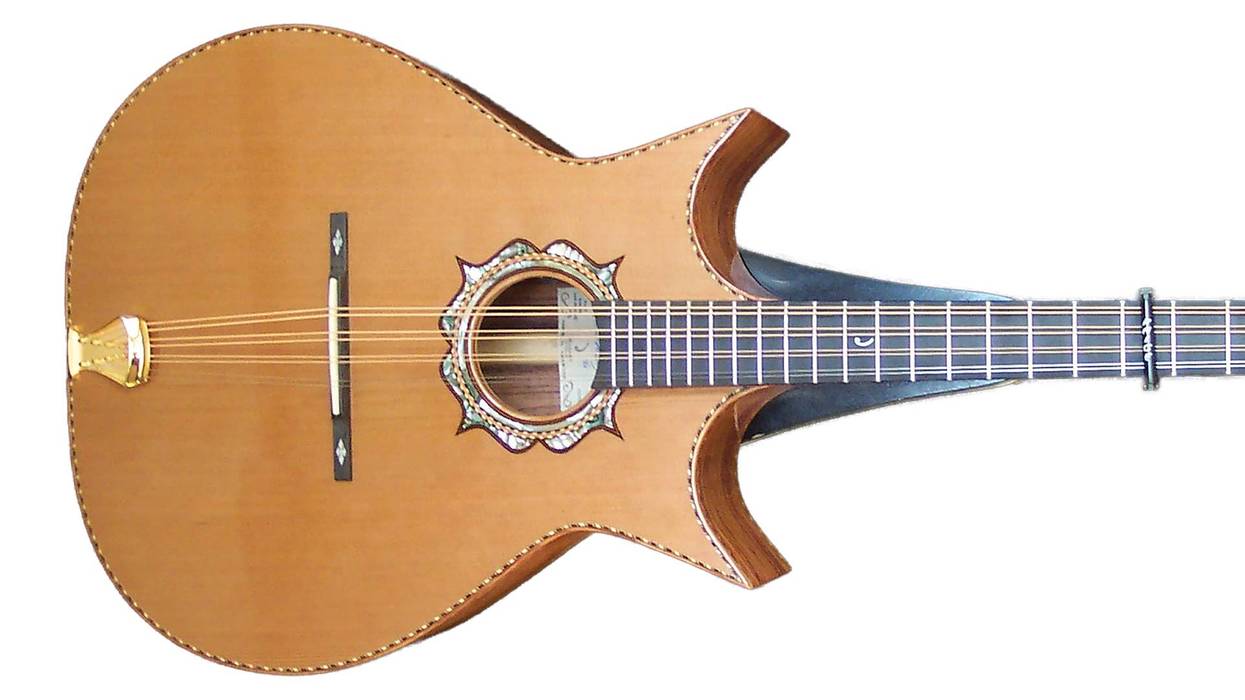
The Irish bouzouki, like this one built by Manuel Delgado, is descended from Greek roots, via a trip to a luthier in Kent, England.
When I research instruments, I am often taken down a historic trail that will tell me about the culture of the instrument. One such instrument led me to learn about the connection between Irish and Mexican culture. Not only do these cultures share the Catholic faith, they both faced colonialism and fought for cultural resilience. There was also a large immigration of Irish people who went to Mexico, especially in the years after the Irish Potato Famine. During the 1846-1848 war between Mexico and the United States, many Irish defected to join the Mexican army, viewing it as a Catholic versus Protestant war. Together, they formed the Battalion of St. Patrick (Batallón de San Patricio).
With that history in mind, I thought I would share my history of building the Irish bouzouki, an instrument I was introduced to by a client who wanted one custom-made. I named the model the “Jeannine,” after my Irish-American mother-in-law. (Did I mention my wife is of Irish descent? Mooneyham … Pretty darn Irish.) Most know the Irish bouzouki in its teardrop form. To give an idea of the size of the instrument, think mandolin, then an octave-mandolin, then a cittern, and then the Irish bouzouki.
However, the instrument did not evolve from the mandolin family. It was the Greek bouzouki that gave rise to the Irish bouzouki. In the 1960s, the Greek trichordo was introduced to the Irish. Originally with a bowl back shape and three courses, it took a different form when a local Irish folk musician changed the bottom course strings to two individual strings and then later brought the instrument to a well-known luthier in Kent, England. There, it received a custom-made four-course, three-piece, partially staved back, giving birth to the Irish bouzouki and its new shape.
The Irish bouzouki has a distinct sound, and once you hear the instrument isolated from other instruments, you can pick it out much more easily in traditional folk, Celtic, or English music. Its distinct clear, bright sound is often described as “jangly,” but for anyone unfamiliar, I describe it more as a bassy drone blended with a mandolin-style tone.
When I was asked to custom-build a bouzouki, I wanted to do something unique and decided to make two models, each slightly different from the other, and very different from the teardrop style most commonly known. I built both with a double Florentine cutaway, Palo Escrito sides and back, Honduran mahogany necks, African ebony fingerboards, and Spanish cedar tops. On one of the models, I wanted to blend visuals that would capture both cultures using lush green inlays and abalone shell around the rosette, while blending in the bright colors in the center of the rosette and on the purfling.
Visual design aside, the tone and sound I was building for was a warmer, softer attack with the mids being highlighted, so it would be neither bass- nor treble-dominant. The bracing style and wood combinations created a rich tone with a unique warmth, and I know my clients were happy with the end result. It is difficult saying goodbye to a new instrument, but the bouzouki was one I especially wish I had more time with, because I enjoyed playing it for the short time I had with it.
Hopefully I will get around to building one of these again, but one of the challenges of building in the old-world technique (as opposed to having others make the instruments for you and just slapping your name on it for the credit) is that there isn’t much time outside of the orders for extra builds.
So for now, somewhere in the world live two custom Delgado “Jeannine” Irish bouzouki models that blend my Mexican heritage with my wife’s Irish heritage and carry my mother-in-law’s name. My “Irexican” (Irish/Mexican) daughter’s wish for you is, “May your pockets be heavy and your heart be light.”