

If you were to classify personality types according to how they go about purchasing bass gear, there are essentially two main personas at opposite ends of the spectrum—the scientist and the artist. The scientist analyzes an instrument’s materials and how they react with each other. When assessing overall quality, the scientist also takes other factors into consideration, such as the builder, an instrument’s vintage, and the design. On the other side of the spectrum, we have the artist. These folks seek an instrument that allows them to align their musical chakras and use their instruments as a means of expression.
Most of us fall somewhere between the two, and we oftentimes play an instrument that caters to one personality more than the other. But on rare occasions, we’ll find an instrument that excites the inner scientist and unlocks unlimited creativity from the artist. Jens Ritter’s recent creation with the R8 Singlecut just happens to be one of those occasions.
A Singlecut Above the Rest
Ritter’s “what if?” approach to bass building
has earned him a reputation for producing
instruments that combine unique designs
with supreme quality. And it doesn’t take
long to realize that the R8 Singlecut is an
instrument of the highest craftsmanship.
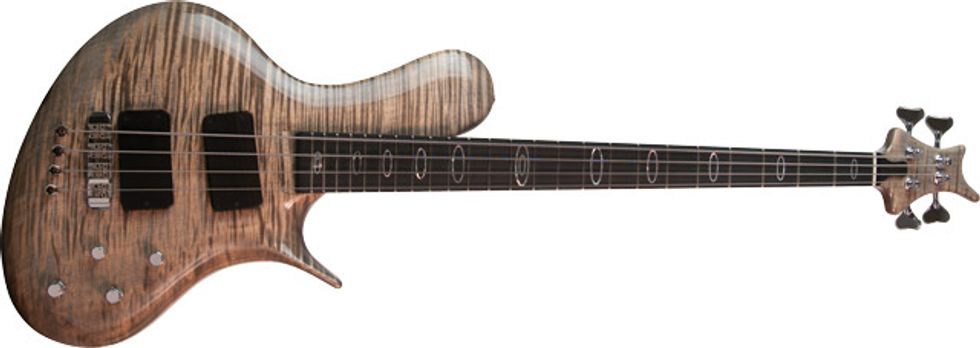
Many single-cut instruments use neckthrough construction, but Ritter chose a bolt-on neck for his R8, believing this improves the midrange presence and provides a more responsive string attack. Supported by ten stout screws, the 3-piece bolt-on neck is constructed of quartersawn maple and topped with a dark ebony fretboard that’s appointed with oval-shaped pearl inlays.
To achieve maximum vibration and eliminate glue lines, Ritter carved the body on our review model from one piece of flamed maple. The R8 sports his new high-gloss finish called captain silver—a stunning color that enhances the depth and definition of the flame with a smoky, striped look.
Ritter’s 3D bridge, a system he designed to optimize the transfer of string vibrations, is made of heavy brass and offers conventional adjustments, as well as the means to shift the string spacing. The ball end of each string is supported by a separate B1 string attachment. Ritter says these individual saddles allow the strings to vibrate independently of each other and this enhances tonal clarity throughout the bass.
The R8’s Ritter-designed pair of Master Bar pickups are switchable triplebuckers—each consisting of two active coils and one passive coil—and are dressed with ebony covers. Though Ritter’s accompanying C3-S EQ system may appear to be a conventional 18V preamp at first glance, it has some twists that expand the R8’s tonal palette. The master volume has a push-pull potentiometer for switching between active and passive modes, and below the master volume is a stacked bass and mid EQ. The other dual potentiometer allows one to cut or boost the treble on top, and the ring below it operates as a tone control while in passive mode. Aside from the blend knob, further tonal transformations can be achieved by pulling up on the top knobs of the dual potentiometers. This puts the humbuckers into a “humfree” single-coil configuration.
It’s Pretty, But How Does It Play?
Once my initial oohs and aahs about the R8’s
looks and features settled, I hung the Bavarian
beauty with a strap. Within seconds of standing
with the R8, I could feel Ritter’s ingenuity at
work. The shape of the bass balanced perfectly,
whether it was played at an angle or horizontally,
and there were no signs pointing to possible
shoulder or back fatigue. Not knowing
how the small lower horn would allow the bass
to balance in a seated position, I set the R8 on
my thigh and it maintained its position, even
while shifted at a slight angle.
From a performance perspective, the Ritter R8 played even better than it looks. Unplugged, the bass delivered notes quickly, with a deep resonance that could be felt throughout its neck and body. I found no dead spots on the neck and the bass conveyed consistency and punch from the lowest notes on the 4th string to the highest notes on the 1st string. Speaking of the neck, the glossy finish offered fast, smooth transitions up and down the fretboard, without any stickiness. As someone who prefers satin-finished necks, I have to say this is one of the best high-gloss necks I have ever played.
Plugged in, the R8 shined. Played through a Phil Jones D-600 head, a pair of Glockenklang Space Deluxe 112 cabinets, and Analysis Plus cables, the pickups were silent—accurately replicating the characteristics of the R8’s acoustic tone. When I plucked the strings in passive mode, the bass was very responsive to my touch as I moved my right hand from the end of the fretboard to the bridge. And while most basses will certainly change their tonal character with such movement, the R8 did so to a much greater degree.
Soloing each pickup, the R8 offered the sounds indicative of each pickup’s placement, but with more clarity. The bridge pickup brought the snarl, but added a woody snap and a brighter top end. The neck pickup sounded round and warm on its own, with a subtle low-mid bump. And combining the two created a balanced, articulate tone that would invite channeling your voice through the instrument. Although the single-coil mode made for a less aggressive sound and offered potentially practical tones, I found the R8’s humbucker mode to be the most pleasing to my ears.
In active mode, the nicely voiced EQ enhanced the tonal traits of the maple and ebony woods. The bass provided the notes with a warmer foundation, the mid added some major punch, and the treble brought presence with very smooth highs.
Such GR8 Heights
Pleased with the R8 Singlecut in a quiet
environment, I decided it was time to take
it to the stage. And the bass went through
the most rigorous of field tests, as I played
it at a variety of gigs through a number of
different amp and cabinet configurations.
Though each rig added its own character to the R8’s sound, there was one major constant that stood out at each venue—the Ritter R8 Singlecut was designed to make music. With the slightest change in touch, I could go from supportive bass lines that sat clearly and comfortably in the mix, to authoritative fills and solos that broke through an ensemble. Every note was present across the fretboard, chords came out full and balanced, and harmonics emerged with a bell-like sparkle.
There were many pleasing moments with the Ritter on stage, but three occasions really stood out for me that demonstrated the R8’s quality and versatility. While playing Michael Jackson’s “P.Y.T.” during a cover-band gig, I was able to create a stabbing and satisfying snarl when soloing the bridge pickup and boosting the mid EQ—saving me from having to haul a keyboard to the gig in order to replicate the original synth-bass parts. And when it came time to attempt Louis Johnson’s slap fills in the middle section, I quickly rolled the blend knob closer to the middle, backed off the mids, and boosted the bass and treble. There was an instant and dramatic change in color, almost recreating Johnson’s signature Stingray sound.
Ratings
Pros:
Articulate, responsive tone. Superior construction. One of the best 4-strings in its class.
Cons:
Expensive.
Tones:

Playability:
Build:

Value:


Street:
$9,500
Ritter
ritter-instruments.com
Boosting the mid and treble with the blend knob turned forward and fully favoring the neck pickup, the R8 Singlecut excelled during a Tower of Power set with a horn band. The 16th-notes came out tight and punchy, and added a percussive pop to ghost notes—essential for trying to cop Rocco Prestia’s legendary lines.
I also used the R8 while performing with a jazz trio. And even though it didn’t replace the sound of an upright, the bloom of each note conveyed fretless-like warmth. Its sonic sensitivity delivered varying vibratos with ease, offering ballads a beautiful bass voice.
For Your Consideration
Because Jens Ritter builds all of his basses by
hand, the Ritter R8 is available with a seemingly
unlimited number of options. A standard
R8 Singlecut is priced at about $5,000,
but the R8 reviewed here can be yours for
$9,500. Yes, this R8 Singlecut commands
a hefty price tag, but consider something:
Many professional musicians who depend
on supreme playability and tone will invest
serious money on their instrument, potentially
into the five-figure range. And after
this review, I can say with confidence that
the Ritter R8 Singlecut may be worth every
dollar when you consider what you get.
The Verdict
The R8 Singlecut bass is an extraordinary
handmade instrument and is an ideal choice
for the professional bassist or one who is
willing to spend top dollar for the ultimate
in tone and craftsmanship. Many who have
experienced Ritter’s basses consider them to be
works of art. But complementary as that may
be, it does not do his work justice, for the
Ritter R8 Singlecut goes far beyond being just
another pretty face. Intelligently engineered,
this bass possesses a voice and playability that
provides a bassist the ultimate gift—uninhibited
freedom of musical expression.



![Rig Rundown: AFI [2025]](https://www.premierguitar.com/media-library/youtube.jpg?id=62064741&width=1245&height=700&quality=70&coordinates=0%2C0%2C0%2C0)