
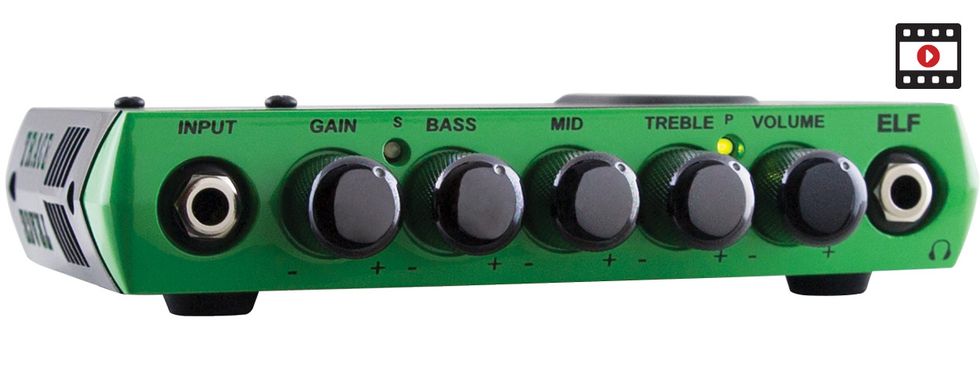
Clip 1 - Amp settings: gain at 2 o’clock, bass at 4 o’clock, mid at 10 o’clock, treble at 12 o’clock, volume at 2 o’clock.
Clip 2 - Amp settings: All controls at noon.
Clip 3 - Amp settings: gain at 5 o’clock, bass at 2 o’clock, mid at 12 o’clock, treble at 2 o’clock, volume at 2 o’clock.
If you haven’t noticed, there’s a revolution afoot—with the world getting smaller in so many facets of our lives, from circuits to cars to tiny houses. Music gear is not immune, yet for us bassists, we’ve forever been taught that bigger means better. So it seems a little counter-intuitive for us to want something smaller, since our entire existence revolves around being “big”—be it big tone, moving big air, or playing the big strings on our instruments.
Enter the ELF from Trace Elliot, one of the biggest little amps I have ever seen. Beyond its incredibly small footprint and the initial wow factor, the amp could be one of those gotta-have type products for a myriad of reasons. I say could be, because to get past the initial sideshow attraction aspect of it, it has to sound good, too.
ELF Not on a Shelf
When I opened the ELF’s included carry bag, I was greeted by a straight-ahead-looking design with Trace Elliot’s familiar green adorning the solid-feeling enclosure. Given its size and that it’s lighter than a Carnegie Deli Rueben sandwich at just a hair over 1 1/2 pounds—yes, 1 1/2 pounds—it had better be rugged, since us musician types will likely be shoving it into a gig bag or backpack (or even a pocket). While our test unit did feel solid overall in its construction, the plastic housing where the IEC power cord connects felt a bit loose, which could pose a problem after prolonged use.
The front panel is about as no-nonsense as can be. There are two 1/4" jacks (one for input and one for headphones) that surround the five dials governing the gain, volume, and 3-band EQ. I was happy that Trace Elliot went with “normal-sized” controls rather than the mini variety—a move that will make on-the-fly adjustments in the real world easier. Finally, the ELF houses two small LEDs on opposite ends of the EQ section: one a signal indicator and the other to let you know the amp is powered on.
The back panel is as simple as the front. There’s a rocker power-switch next to the AC power inlet, a 1/4" speaker-out rated at 4 ohms, and a XLR DI (post-EQ) with a neighboring ground-lift switch. No nonsense, indeed.
The ELF That Roared
To check out the ELF’s prowess, I paired it with an Eden D410XLT and plugged in an active Fender Deluxe PJ loaded with Nordstrand pickups. Because this little amp was built with on-the-go portability in mind, I also spent some quality time with it employing a pair of Audio Technica ATH-M50x headphones.
Starting with the cab to gauge the ELF’s live feel, I dialed all five controls to the straight-up 12 o’clock position. The tone was very much what I expected from a Trace Elliott amp: a little mid-heavy with some bite. This isn’t the most ideal tone for me, so I moved the bass control (centered at 80 Hz) up to about 2 o’clock and rolled back the mids a bit. Then we were cooking with gas. This little adjustment made the amp more transparent and allowed me to hear the voice of my bass. When I dialed in a little more treble by setting its respective knob to 2 o’clock, I found a sweet spot that appealed to my slap and fingerstyle articulation.
Ratings
Pros:
Delightfully compact and powerful, with solid tone.
Cons:
Grab a pedal if you’re going for overdriven tone. Some players will long for more features (like a mute switch).
Tones:

Ease of Use:

Build/Design:
Value:
Street:
$299
Trace Elliot ELF
traceelliot.com
So, you’re probably asking yourself now if the ELF really has enough juice to effectively push a cab. In a word: absolutely. Rated at 200 watts (into 4 ohms) and 130 watts (into 8 ohms), the ELF can shake some floorboards. When I pushed both the gain and volume dials to 3 o’clock, the amp held its own and showed me it could easily take on rehearsals, an intimate gig, or even a club gig, depending on the venue. And let’s not forget that the ELF offers one of the easiest load-ins imaginable.
Whereas the amp shined very brightly in its primary function—to amplify a bass—I felt it fell a little short in the overdrive department, which is a promoted feature. When I dimed the gain and slowly brought up the volume, there wasn’t a ton of overdrive to speak of. Yes, there was some breakup to the tone, but I’d personally opt for a favorite OD pedal and just let the ELF do what it does best: serve as a simple, straightforward, compact bass amp.
When I plugged in the headphones, the tone got even better, because I could better hear the true representation of the amp and the EQ. Again, I found my sweet spot by setting the EQ with a slight mid scoop, which delivered the most authentic, uncolored bass tone. I personally love the 1/4" headphone out, but, in this iPhone age, many will likely have to pony up for an 1/8" to 1/4" adapter. All said, when you also consider the post-EQ DI, you’ve got a wonderfully convenient practice-to-rehearsal-to-gig amp with the ELF—literally at your fingertips.
The Verdict
If you told me years ago I could own a bass amp that weighs less than a book, I would have called you loony. It’s exciting to see technology push forward like this, and the fact that the ELF sounds good certainly helps its case. Its overdrive isn’t the greatest, but with the amp coming in at 300 bucks, you can afford to buy yourself a pedal or two. One more time: The ELF weighs just a hair over 1 1/2 pounds. This fact alone will likely make it a staple in many a player’s gig bag. If your ego can handle having such a diminutive amp onstage, then go out and give the ELF a look and listen. And guess what? You don’t have to wait until Christmas.
Watch the Review Demo:


![Rig Rundown: AFI [2025]](https://www.premierguitar.com/media-library/youtube.jpg?id=62064741&width=1245&height=700&quality=70&coordinates=0%2C0%2C0%2C0)