
Certain individuals’ inclinations to tinker led to many of the guitar designs that are still boutique-built and factory-manufactured today. One of those folks was country guitarist Chet Atkins, whose working relationship with Gretsch (and later Gibson) resulted in some wonderfully innovative guitars, many of which continue to be built.
While the Gretsch 6120 Chet Atkins—debuted in 1954—was his first signature model and remains the most well-known, Chet’s influence on guitars extends much further. He pondered, he collaborated, and oftentimes, he just plain got to work. Chet’s workbench has been on display at the Country Music Hall of Fame. When a floating DeArmond pickup on an L-10 wasn’t enough, he added two P-90 pickups and controls to a 1947 Gibson L-7 archtop, and later heavily modified and electrified his Excel built by archtop artisan John D’Angelico. Les Paul was a dear friend, with whom he performed and recorded (if you haven’t heard the 1976 album Chester & Lester, now’s the time). During his Gretsch-endorsed years, he was at least partially responsible for offerings like the short-lived 6121 (a Round-Up/Duo-Jet-ish solidbody version of the 6120), and hit his signature-model stride with his designs for the thinner-bodied 6122 Country Gentleman and 6119 Tennessean. These latter two replaced the cows, cactus, humptops, and branded trimmings with subtler specs like neo-classical thumbnail inlays, inlaid f-holes, and a metal model-name/serial-number plate on the peghead. Chet was partial to a metal nut, loved Bigsbys, and replaced the tone control on his favorite 1959 Country Gentleman with a built-in phase shifter.
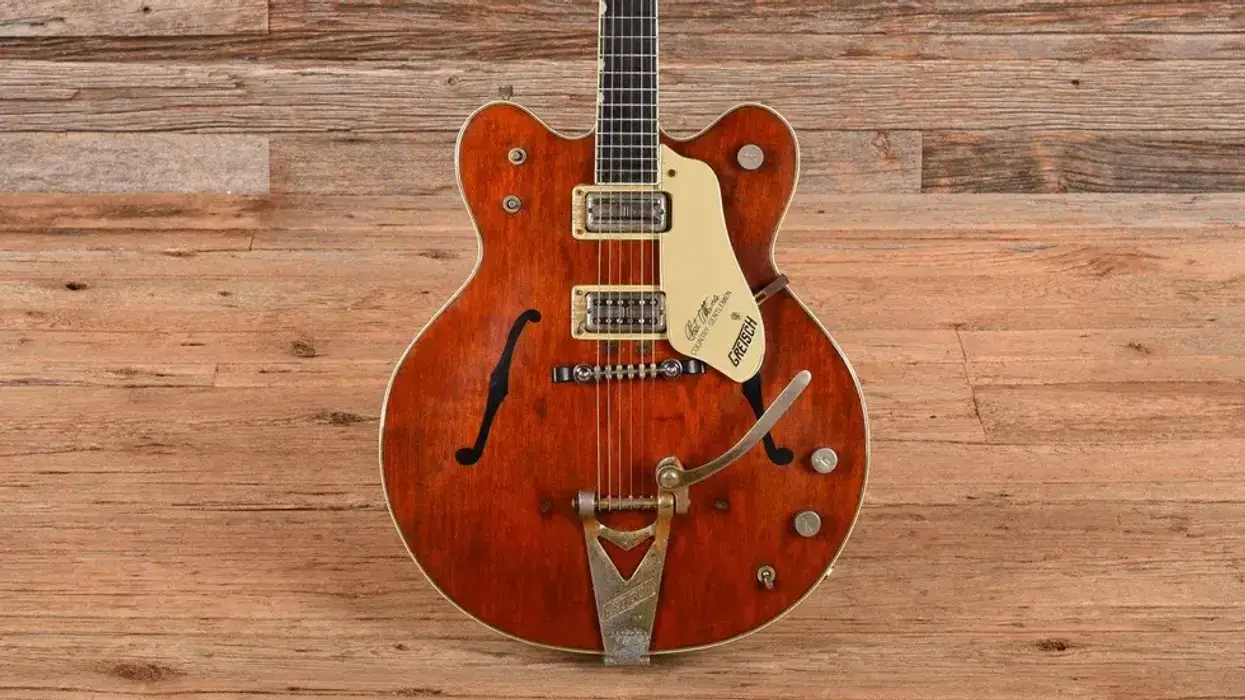
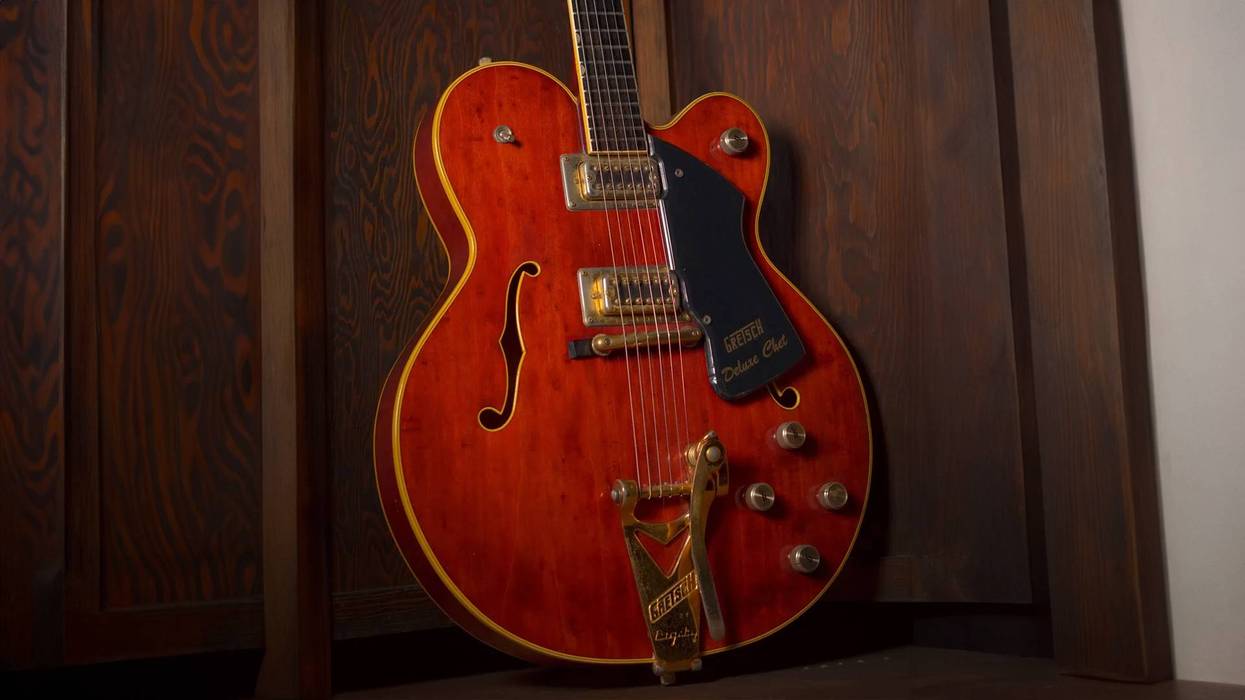
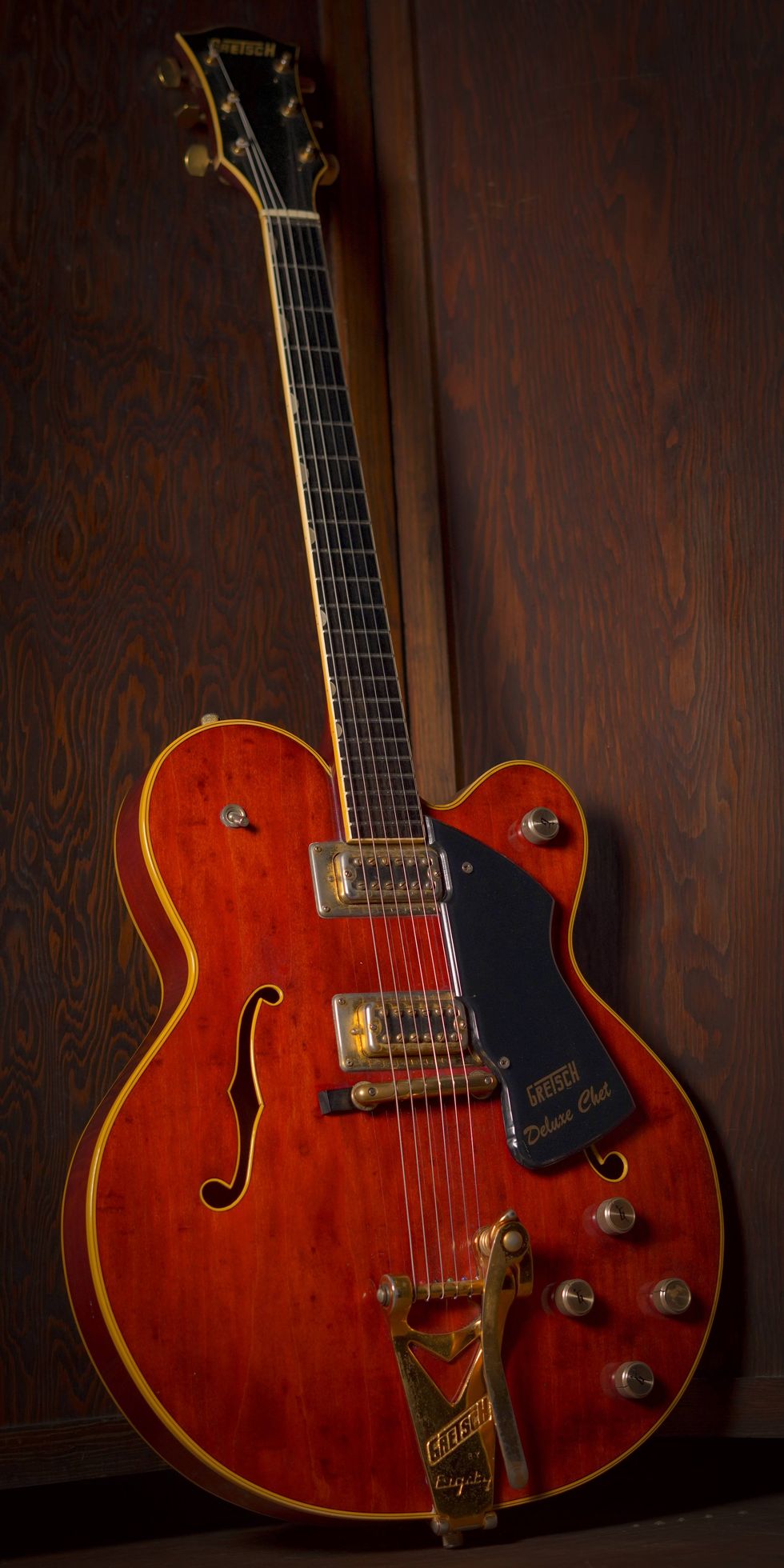
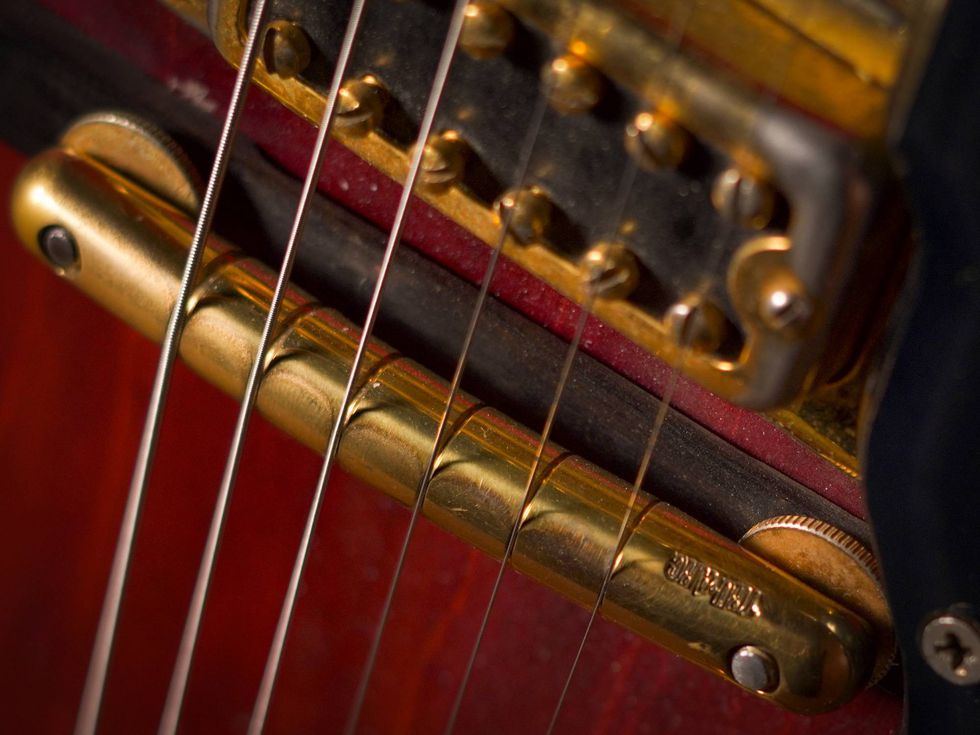
He continued his relationship with Gretsch until 1980, 13 years after the brand was sold to the Baldwin Piano Company. Aesthetically, the 1972 Gretsch 7680 Deluxe Chet featured in these photos is clearly the evolution of models like the 6120 and 6122 Country Gentleman. The body is 17" wide and 2.5" deep, with a single rounded cutaway, two bound f-holes, and Autumn Red finish. The 3-piece maple neck, with bound ebony fingerboard, has neo-classical thumbnail inlays, zero fret, and a triangular truss-rod cover on the back of the body for truss-rod adjustment at the neck heel (a Baldwin-era “innovation”). The two black-top Filter’Tron humbuckers have two volume controls, two tone controls, master volume control, and a 3-way pickup selector switch. Accounting for the Rocker Bar bridge and Gretsch-branded Bigsby tailpiece, one might assume that Chet transitioned to working with Gibson not only because they had moved to Nashville, but also because, like a lot of 1970s guitars, the ones Gretsch was making had quirks to them that may not have suited a gentleman like Chet.
We acquired this Deluxe Chet from our friend George Bradfute, a stalwart Nashville producer/multi-instrumentalist/luthier extraordinaire and one of the few people we know who collects and uses Baldwin-era, Atkins-designed, later-’70s Gretsch Super Axes. As an added bonus, the ones in his collection have electronics that actually still work! Chet tinkered and innovated, but the 9V battery in the Super Axe may have drawn the figurative line in the Gretsch sand.
Chet Atkins called Nashville home and spent as much time working on Music Row as he did on the road. While you may have heard of CMA Fest, during Chet’s era it was known as Fan Fair—a days long event that was indeed fan-focused and an annual opportunity to collect as many autographs as your country-music-loving heart desired. There are few glimmers of the 20th century Nashville I remember, but one longstanding annual event remains: the CAAS (Chet Atkins Appreciation Society) Convention every July at the Sheraton Music City Hotel and Convention Center.
The Chet Society boasts “over 1,000 worldwide members” on their website, and their 2026 four-day convention schedule included up to 12 hours of live music per day on two stages, as well as workshops like “Basic and Intermediate Thumbpicking” and “B-Bender Techniques.” Day three’s evening schedule included John Knowles and Tommy Emmanuel, both of whom were Chet’s friends and collaborators. The convention can feel like a mini NAMM show, featuring booths with vendors like Gretsch and, up until his recent passing, Kirk Sand, the builder who collaborated with Chet on thin-bodied nylon-string guitars. We mean this in the kindest possible way when we say the whole thing feels kinda culty. Over the years, many guitar players have experienced the overwhelming desire to learn Chet’s picking techniques, or at least take a stab at Merle Travis’ “Cannonball Run.” When we worked at a Nashville guitar shop on Broadway in the early 2000s, our colleague coined the term “peach-cutting” to privately announce that CAAS attendees were filling the store with Chet pickin’, since the festival coincided with the ripening of the South’s most delicious fruit.
These days, a large historic home on Music Row briefly owned by Chet has been dubbed “the Chester” on Airbnb; it sleeps 12 at a cost of about $3,500 for the four nights of the CAAS Convention next year. If you get a wild hair to see both the new and old Nashville, I highly recommend stepping back in time at the Chet convention. You can fly solo with your Chet Atkins model of choice, or bring 11 friends—each with an electric archtop—and stay on Music Row at the Chester!