
You’ll sometimes see Jim Burns referred to as Britain’s Leo Fender, though the moniker itself tells you who history has favored more. Both were inventive guitar designers. Both used burgeoning tech and techniques to create bold instruments in the early rock ’n’ roll boom. Each worked with musicians to meet the needs of evolving playing styles and made some idiosyncratic choices along the way.
What’s funny is that, due to Leo’s enormous business success, his idiosyncrasies became the template for much of what followed in the guitar industry. Burns’ did not.
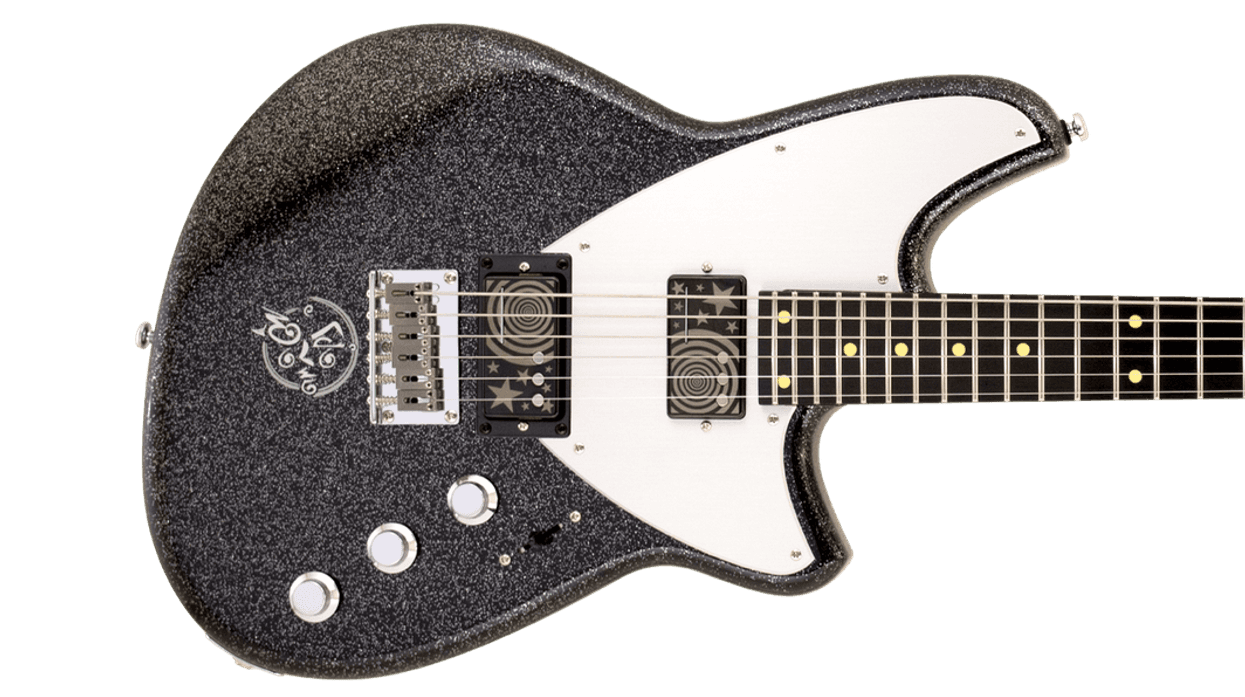
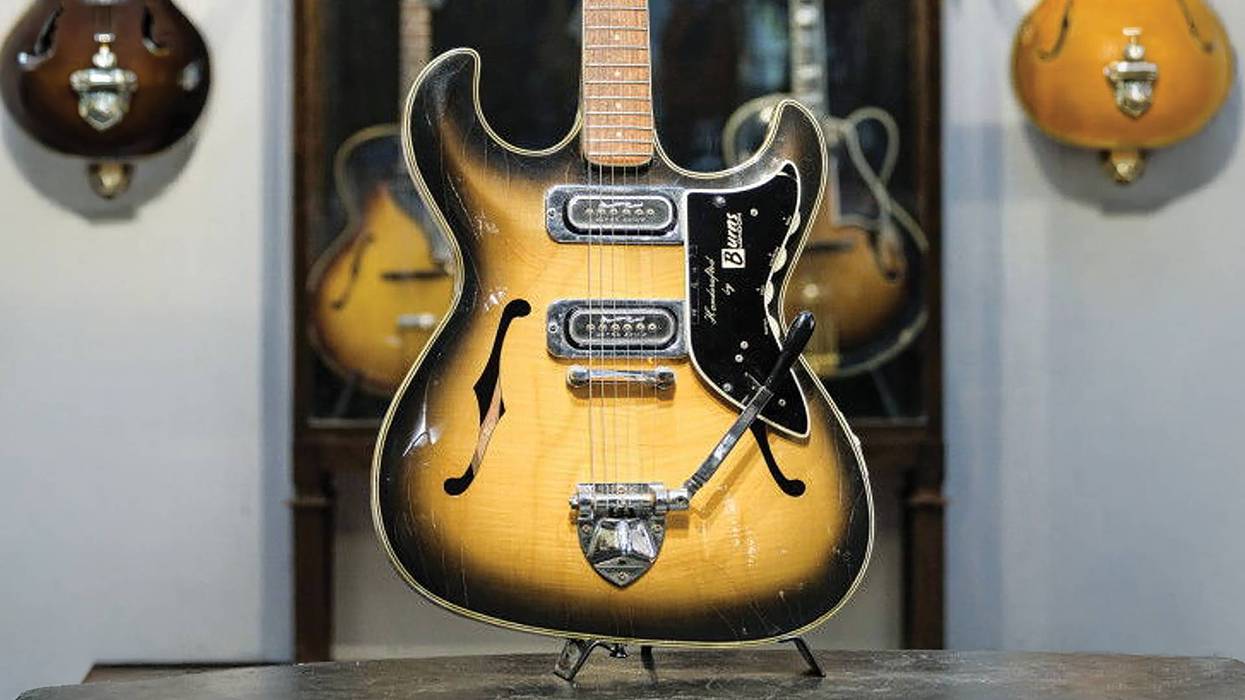
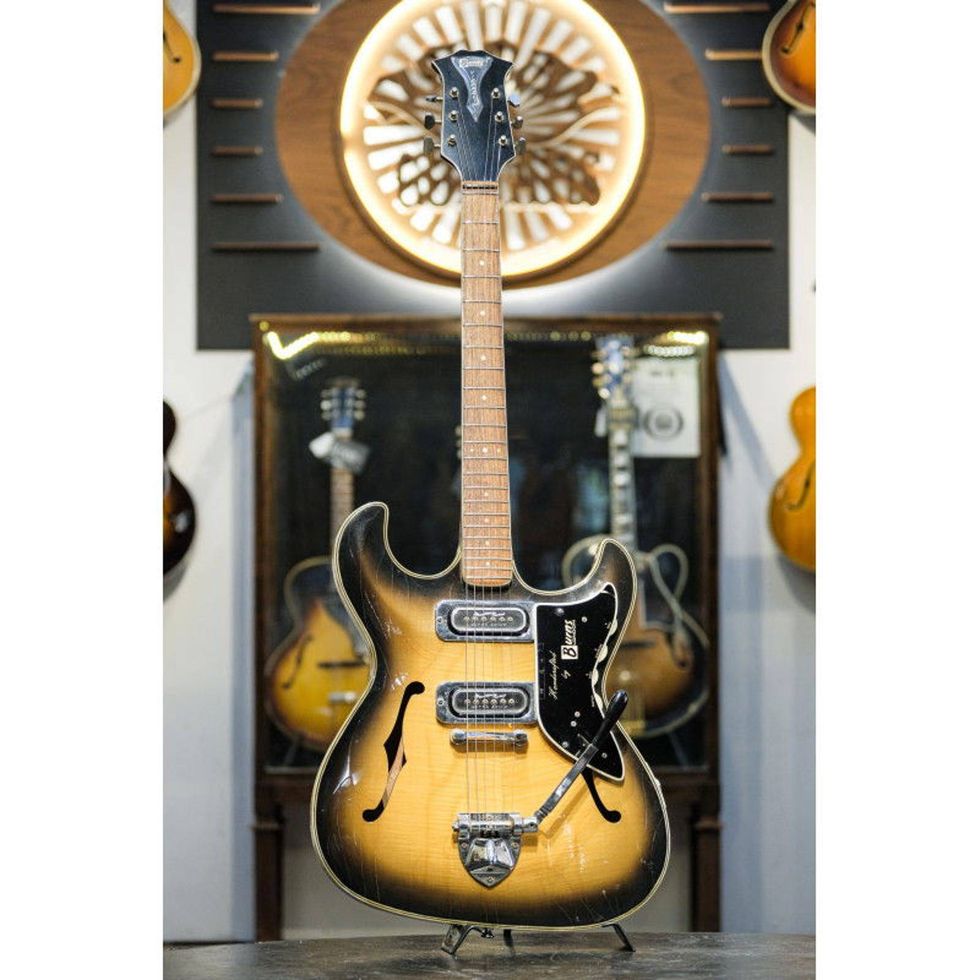
Take the Stratocaster’s original control layout: one volume, tone 1 (neck pickup), and tone 2 (middle pickup only upon release, only later adding the bridge pickup). That is, objectively, pretty bizarre. Time and familiarity have made it less so. By comparison, look at this 1964 Burns Vibra Slim, the featured pick for this edition of Vintage Vault. Its idiosyncrasies were strange from the start, and time has only made them more so.
See those control wheels peeking out from under the raised pickguard, closer to what you might encounter on early electrified archtops? Here, they’re fairly hard to reach, given the width of the guard. And the controls themselves are not in a traditional layout. When looking from a player’s position, left-to-right reads tone A, presence B, tone B, volume. Huh?
“If this had caught on, maybe we’d be calling Leo Fender the American Jim Burns.”
It’s best to think of this tone circuit in combination with the Ultra Sonic pickups. The Vibra Slim originally featured two, with the one at the neck being a kind of stacked humbucker, and at the bridge, a straightforward single-coil. So, you set the 3-way switch to the neck (left), bridge (right), or both (center) positions, then set tone A to taste. Presence control blends in extra body from the stacked humbucker’s second coil. And tone B fine-tunes the mix. If this had caught on, maybe we’d be calling Leo Fender the American Jim Burns. But, as you know, it did not. The Vibra Slim was actually one of the last of the original designs Jim Burns made for his namesake company, before Baldwin bought it and started implementing changes.
The Vibra Slim was first available in September 1964, and would be gone by ’68 (a shorter run than LBJ’s). Between the guitar’s birth and demise, Baldwin would even strip away some of what made it unique and lovable. Back upon release in ’64, it was advertised for £140.70 (what would be £3,700 today, adjusting for U.K. inflation today). That’s nearing $5,000 for Americans, with current exchange rates. It was a premium handcrafted guitar, near the top of Burns’ prices.
Similar to its TR-2 predecessor, though lighter thanks to laminated plywood construction, it had a 15 3/4"-wide semi-hollow body (rather than a carved top). And it had a very nicely offset waist that predated the Fender Starcaster by about a dozen years.
Sadly, soon after Baldwin’s purchase in 1965, branding shifts began. Ultra Sonic pickups changed to Bar-O-Matiks. Then, a major overhaul: The original set neck became a bolt-on. The pickguard and control layout changed completely, and steps toward standardization were made. Thumbwheels became standard knobs on the body, and the still-angular horns of the Burns years were softened a little. By 1968, the Vibra Slim was out of Baldwin’s catalogs altogether.
Because players and collectors alike are less familiar with Burns in general and Vibra Slims in particular, you can find these wonderful, handcrafted instruments for very reasonable vintage prices today. While asking prices can vary greatly, the final sold prices are more along the lines of what folks now pay for off-era Fenders or Gibsons, and lawsuit-era MIJ copies of the classics.
This particular Vibra Slim, for sale now through Reverb seller Oscar Guitars, based in Stockholm, Sweden, has an asking price of €1,771 ($2,147). In truly excellent condition, we’ve seen these go for around as high as $3,000 on Reverb, and as low as $1,000 with some heavier wear-and-tear or mods.
It’s interesting that, while one side of the vintage market is pushing up prices for lesser-ran Fender and Gibson models, or even off-brand copies, there’s so little interest in these premium guitars that were built with plenty of their own flair. If you dare to be different, keep your eye out for a Burns Vibra Slim like this.
Sources: Tony Bacon’s “A Brief History of Burns,” Vintage Guitars’ “Baldwin Guitars and Amplifiers” and “Beat Portraits: Burns Volume 7"; Reverb listings and sales data.