
What makes “vintage,” vintage? Is it just a matter of time? Or does an instrument need some extra, sui generis quality to become a true marker of an era in our minds?
Photos courtesy of Joel’s Vintage Guitars.
There’s no hard or fast cutoff for “vintage” like the 100 years required for something to be a true “antique,” but a range of 30 years for clothing or other types of collectibles generally separates what’s vintage from that which is merely used. By that benchmark, the first PRS McCarty—released over 30 years ago, in 1994—is now a vintage guitar.
Keep in mind: In 1994, at the launch of Paul Reed Smith’s McCarty, the original Les Paul Bursts (built 1958–1960) were about as old to the McCarty as the McCarty is to us right now. The vintage guitar market was then, as it were, already heating up, with Bursts going for anywhere between $20,000 and $100,000. Today, first-year McCartys still trade in the four-digit thousands, while price tags for Bursts and other “properly” vintage electrics have grown dramatically.
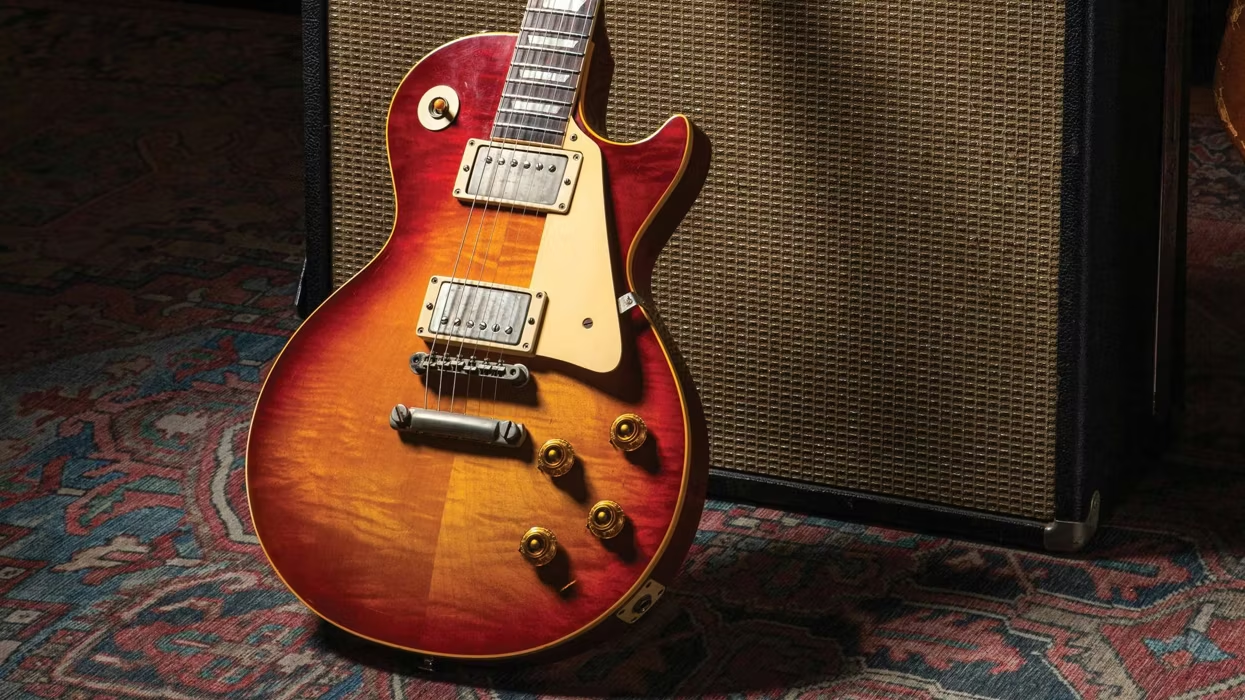
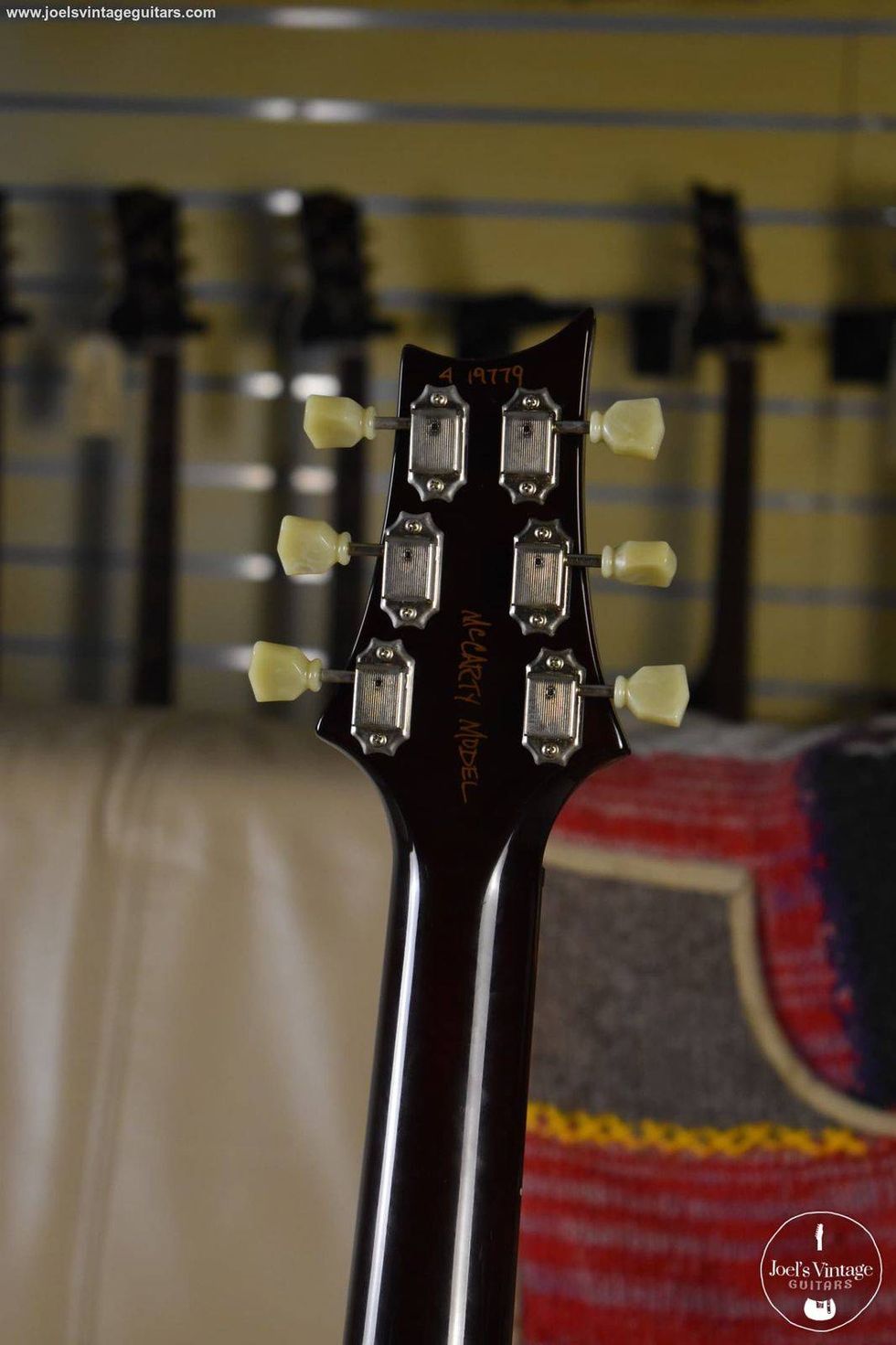
And so we ask, does this particular first-year McCarty that we’ve selected for this edition of Vintage Vault—serial #17 out of the 100 built in 1994—truly belong in the vault?
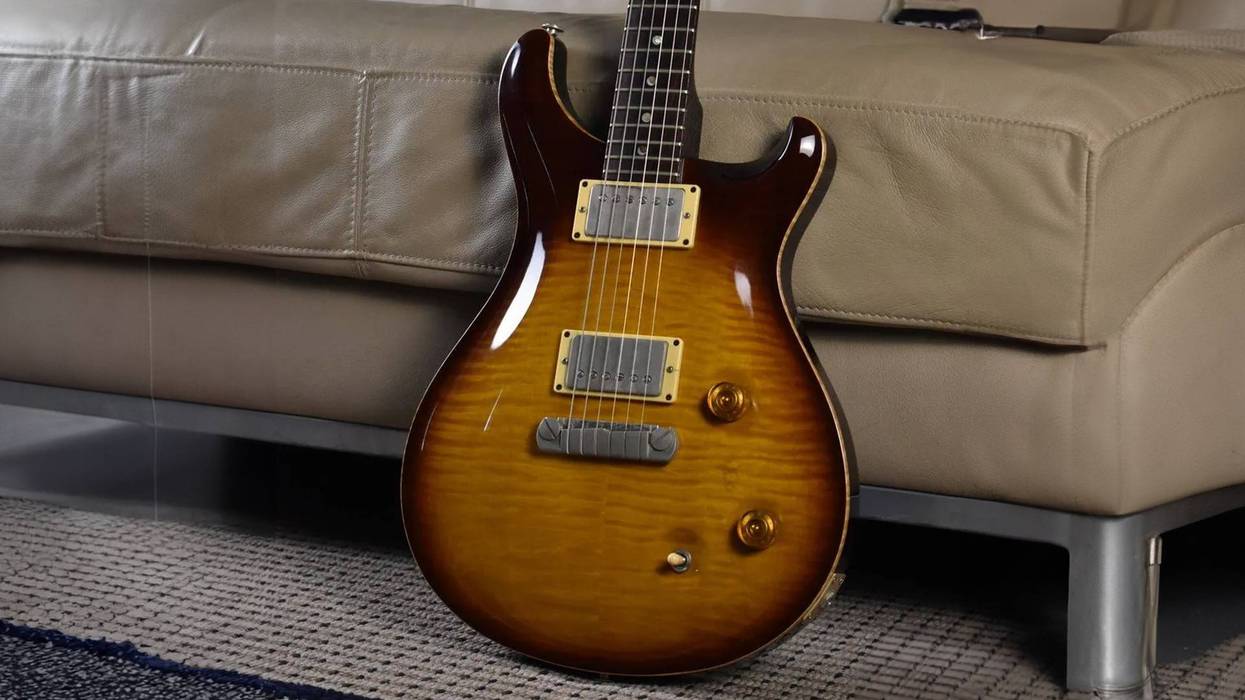
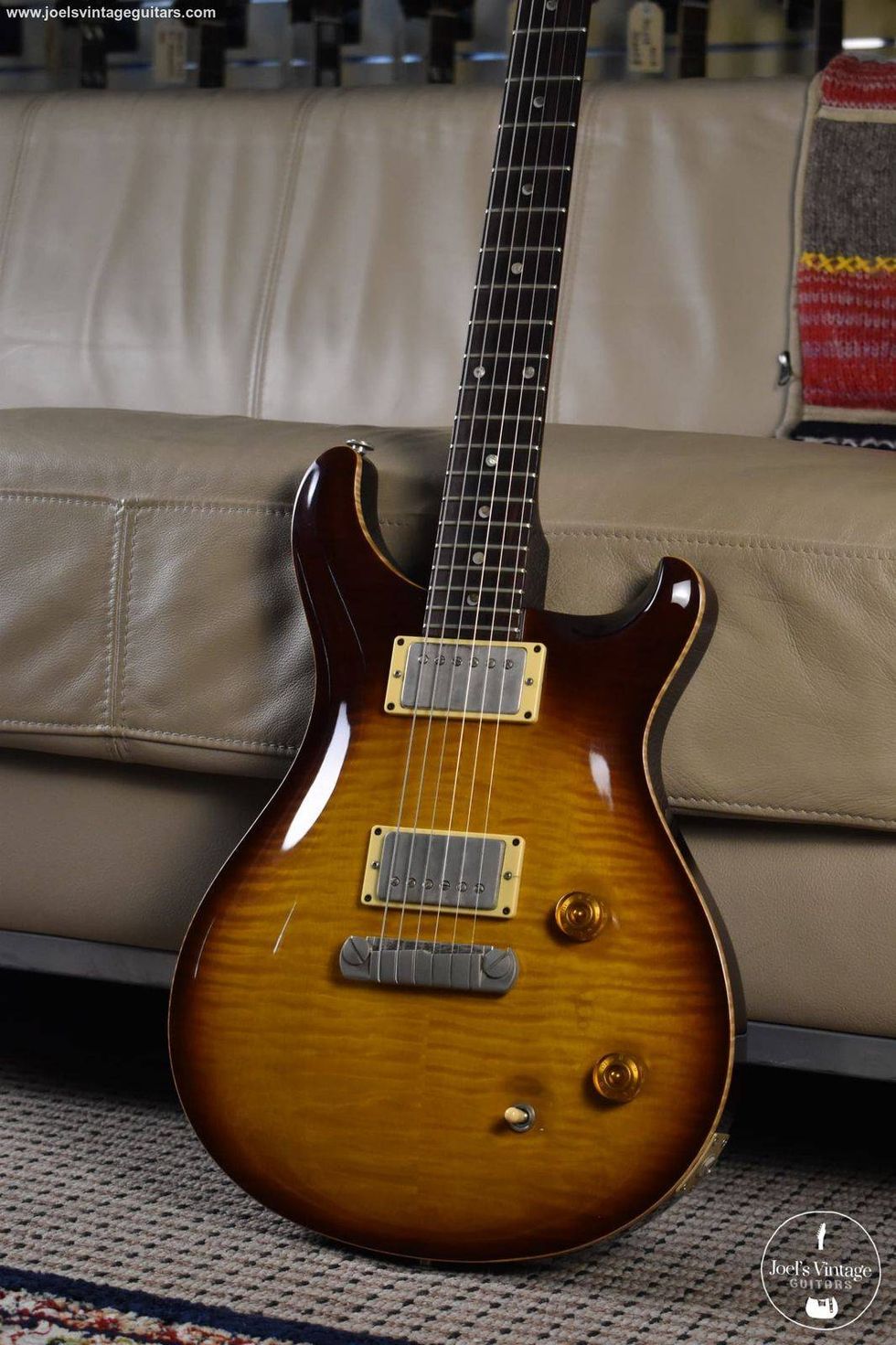
Up for sale now for about $8,500 via Reverb seller Joel's Vintage Guitars (no relation to this writer), this McCarty bears two autographs: Paul Reed Smith’s as part of the inlay headstock logo design, and Ted McCarty’s own on the guitar’s backplate.
While most of us here probably know the name, for those who don’t: Ted McCarty was the president of Gibson during the generally agreed “Golden Era” of the company, when classic guitars like the Les Paul, SG, and ES-335—and classic components like the Tune-O-Matic bridge and PAF humbucker—were born. He retired from Gibson in 1966.
Many years later, Paul Reed Smith himself kept seeing McCarty’s name on Gibson patents while diving into records at the U.S. Patent Office. While Smith knew McCarty’s work, at the time he didn’t know the name, nor did he realize just how instrumental McCarty was to Gibson’s most well known guitars and specs. But on patent after patent, listed as the inventor, his name kept popping up: “Ted McCarty, Kalamazoo, Michigan.”
Smith reached out to McCarty in 1986 and asked him to be a consultant for the fledgling PRS company. Paul wanted to know everything about how the most prized Gibsons were made during McCarty’s reign: “What kind of glue did he glue the frets in with?” Paul remembers asking. “How did they glue the tops on? How did they glue the necks in? How did they level the fingerboards? How did they dry the fingerboards, the necks?”
McCarty was not only forthcoming with his answers, but was thrilled to share his life’s work. “Nobody has asked me these questions in 30 years,” he told Smith, in Smith’s retelling. And did you catch that, reader? “In 30 years,” he said. Just about the length of time it takes for the next generation, in this case Paul Reed Smith’s, to reconsider what is old and unwanted versus what is vintage and desirable. Paul decided McCarty’s work was so valuable that he built a guitar model as tribute.
Photos courtesy of Joel’s Vintage Guitars.
The McCarty was offered as a vintage-style guitar, compared to PRS’ more modern-flavored Custom 24. In fact, its original inspiration came from guitarist David Grissom, who asked Smith to make a guitar that sounded like Duane Allman’s from At Fillmore East (which, as history would have it, was a ’59 Burst and a ’57 Goldtop).
This ’94 McCarty nods to a Les Paul in many ways: It has a two-piece carved maple top with a tobacco burst finish over a mahogany body. It has a mahogany neck, rosewood fingerboard, 22 frets, two humbuckers, a wrap-around tailpiece … So far, so Les Paul.
But there are obvious differences, too, with the double-cutaway body being the most obvious. Runners-up are the single volume and single tone knobs. And the more subtle is the scale length: The McCarty’s is 25", in between Gibson’s standard 24.75" and Fender’s standard 25.5".
At over $8,000, if this McCarty sells it will be the most expensive first-year McCarty to sell on Reverb, though that’s plenty reasonable when compared to prices asked for vintage Gibsons and Fenders. (The most expensive ’94 McCarty sold on Reverb to date went for $4,400, paid four years ago for a higher serial number.)
Perhaps there’s a ceiling on what guitarists are willing to pay for a vintage PRS. Adjusted for inflation, the $8,500 price tag is just slightly above what its brand-new price would’ve been in 1994 dollars. But with the McCarty connection—and through him the connection to lineage of golden-era Gibson—perhaps we’re just at the start of a new vintage boom. Could buying an original McCarty for $8,000 today be as big of a steal as buying a burst LP for eight grand in the ’80s? Only time will tell.
Sources: PRS’ The Unforgotten Man: Ted McCarty and His Impact on Paul Reed Smith, Reverb’s Former Gibson Chief Ted McCarty on Tonewoods and the Problems of 'Top-Heavy' Management, Reverb listings and Price Guide sales data