

Line 6 has evolved considerably since the release of their first product—the AxSys 212 amplifier—in 1996. Even though the AxSys proved popular, it was the POD that really launched their name into the stratosphere. It wasn’t the first amp emulator, but none quite had the massive impact on the industry like that little red bean did.
The company has exploded in the past decade, capturing the attention of countless musicians and recording enthusiasts with their updated POD models, Vetta amplifiers, and Variax modeling guitars. Recently, they teamed up with noted luthier James Tyler to build several new guitars with Variax circuitry but new body styles, neck shapes, and pickup compliments. The JTV-59 is among these new models.
Varia-tions of Tone
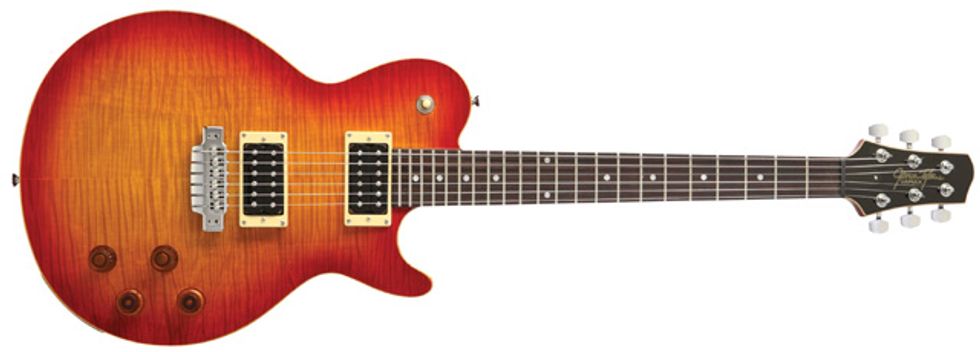
Line 6’s versatile Variax has always had the same attractive, well-balanced body since its introduction. This James Tyler design, however takes obvious inspiration from Gibson’s 1959 Les Paul Standard. The body is comprised of a three-piece mahogany back with a two-piece carved flame maple top, along with a 24 9/16” scale mahogany set neck capped with a rosewood fingerboard. The entire guitar weighed in at just a hair shy of eight pounds, and is very well balanced.
A high standard for build quality is evident everywhere on the guitar. Fretwork was spot on, with smooth and perfectly rounded edges. The neck heel is sculpted and highly contoured, though there’s plenty hold on for deep bends beyond the 12th fret.
The Variax was originally designed to model a multitude of famous guitars, so traditional magnetic pickups weren’t used on the original models. But in response to demands from players, Line 6 and James Tyler decided to add them into the new Variax models, so players can switch between magnetic pickups and the Variax’s emulated models. On the JTV-59, two PAF-style humbuckers are controlled with a traditional three-way switching system and volume and tone knobs. The other two knobs on the body are for activating the Variax’s modeling circuits and controlling the model and tuning models. Also, when in Variax mode, the 3-way, volume and tone knobs are also encoders that control parameters in the modeled guitar. There’s also a custom-designed Tyler stop tail bridge and saddle combo, which houses an L.R. Baggs Radiance Hex piezo pickup system for the Variax modeling circuits.
The original Variax guitars gave players a ton of flavors to work with, but the models in the JTV-59 and the sounds of the magnetic pickups could keep the most obsessive tone collector probing the possibilities of these guitars for hours on end.
On the side of the body you’ll find a ¼” jack for plugging in a ¼” cable and sending the magnetics and models into an amp, and a specially-designed RJ-45 jack for connecting to compatible Line 6 hardware, such as POD and Variax Workbench. The ¼” is also a TRS cable for hooking up to the optional direct box that is also an A/B switch so you can send your electric models to your amp and your acoustic guitar models directly to the sound board.
One of the coolest features on the new Tyler Variax models is Line 6’s free Workbench software, which you can use to virtually design your own guitar from the ground up—including the body wood and shape, pickups and pickup placement, and pretty much any other factor that ultimately affects a guitar’s tone. Once you’re satisfied with your custom model, you can save it in either of the two custom slots in the JTV-59, and it can be accessed up by a simple turn of the guitar’s MODEL control. You can also change and save every model in all 10 model positions.
The JTV-59 contains the entire up-to-date compliment of Line 6’s guitar emulations. There are a total of 28 emulated instruments, ranging from golden-era Gibson and Fender electrics and acoustics, to Rickenbackers, Gretschs, and Martins. There’s even some specialty instruments including a Coral Sitar, Gibson Mastertone Banjo, and a 1928 National Tricone resonator. The Variax circuits are powered by a removable lithium ion battery, which holds a maximum charge of 12 hours of play time.
In addition to the JTV-59’s impressive array of instruments, the guitar also has 11 alternate tuning options that can be used with any of the selected instruments via the Alternate Tuning knob on the body’s top. Want to apply a baritone tuning to the banjo model? An open D tuning to one of the Gretsch models for some down home Delta blues slide work? With a simple flick of the tuning knob, this is entirely possible. You can even make your own custom tunings and replace any of the tuning banks—except for the Standard tuning one—with your own custom tunings on the fly without hooking up to a computer.
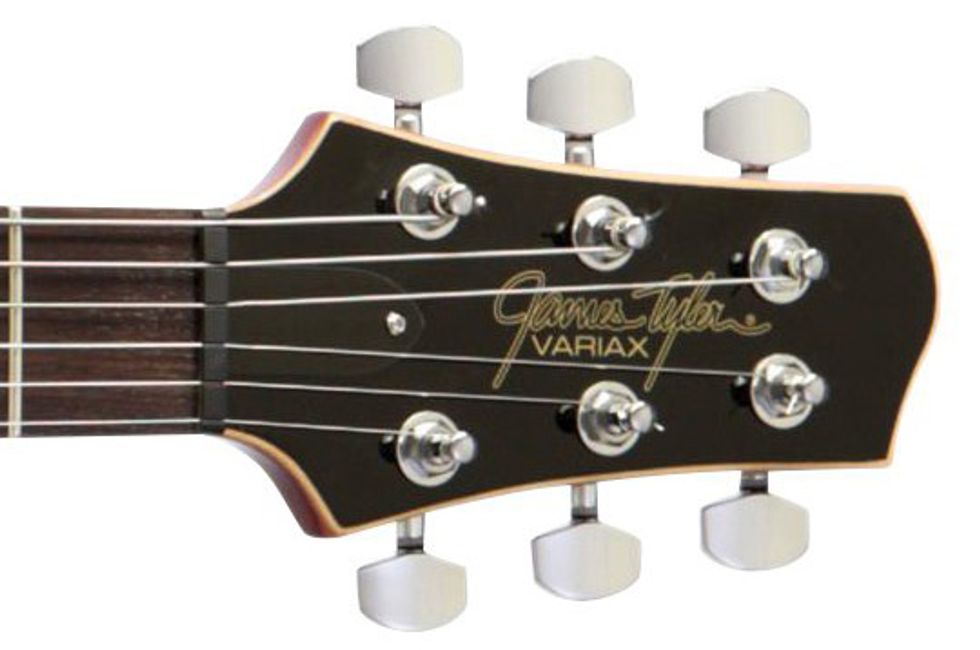
To say that the JTV-59 covers a lot of musical and tonal ground would be a vast understatement. The original Variax guitars gave players a ton of flavor to work with, but the models in the JTV-59 and the sounds of the magnetic pickups could keep the most obsessive tone collector probing the possibilities of these guitars for hours on end.
I wanted to hear if the guitar’s standard pickups had enough kick and clarity I’d expect from of a good set of low output humbuckers, and they performed admirably. Through a 50-watt 1981 Marshall JCM800, the bridge pickup exhibited a capacity for the tight lows and crisp highs that the original PAFs are known for, though I experienced some muddiness in the midrange when chording.
An attempt at the Guns n’ Roses classic “My Michelle”—which brilliantly moves around fluid, arpeggiated clean movements, Joe Perry-inspired single note riffs, and fast, chorded choruses—had the bridge pickup kicking out just the right amount of juicy mids for the leads. But for the song’s faster riffage I had to drop the guitar’s volume knob slightly to pull the pickup’s midrange clarity back in.
Clean tones using the Marshall’s low input and the guitar’s neck pickup were surprisingly detailed, allowing me to hear a tinge of sparkle come from the amp that I can honestly say I’ve never heard from it before. Cranking the gain back up with the neck pickup let loose a dynamic, fluid lead tone that was a blast—especially given that the guitar’s nicely sculpted neck offered no resistance to my quick, legato lines and fills.
I had a great time playing with the emulated models. It’s a blast. But there is one major aspect of playability that even the best emulation can’t account for and that’s the feel of a given instrument. A guitarist becomes accustomed to, say, the feel of a Tele neck correlating with traditional Tele tones. Likewise, the extremely resonant nature of, say, a large-bodied Gibson J-200 acoustic vibrating against our bodies as we belt out open chords dictates how you play those chords. In the case of the JTV-59—even with its fantastic neck and resonant body—there’s still some disconnect with how the guitar sounds and how it feels. The 1970 Martin D12-28 12-string, for instance, may have had surprising clarity, but the feel that I naturally associate with that sound wasn’t there. It’s a physical difference that won’t be apparent to a listener—live or on a recording—but it takes some getting used to as a player.
The electric emulations are also impressive, but the feel of the guitar is closer to those being emulated. Some of the greatest guitars in history are modeled here, including a 1958 Gibson Les Paul Standard, 1959 Fender Stratocaster, 1968 Rickenbacker 360, and a slew of other well-known axes. Some are very convincing tone-wise, like the 1953 Gibson Super 400 model. The tone was huge and snappy on the highs with the Twin, inducing thoughts of Scotty Moore ripping it up with The King. I was also particularly impressed with the snappy response of the ’68 Fender Tele Thinline model, which exhibited an airy sustain and woody response that those treasured instruments are known for. Others fell a bit flat, like the 1959 Gretsch 6120, which sounded a little too wooly in the lows and muddled in the highs.
The Verdict
With the help of James Tyler, Line 6’s new JTV-59 marks a true evolution of the Variax family that offers even more versatility for the price. While some really great guitars are available for the same 1500 bucks you’ll spend for the JTV-59, you’d be hard pressed to find the sheer amount of sounds that this one has on tap. The exceptional build quality and fantastic playability definitely help justify the expense too.
Purists will be inclined to write the JTV-59 off as a gimmicky toy. But nothing could be further from the truth. The amount of just plain fun that I had with the JTV-59 was undeniable. And there’s so many great sounds available for adding that little something extra to your tunes, that it could become an indispensable tool in pro and project studios alike. If you’re a guitarist whose sense of adventure remains intact, the JTV-59 could pay sonic dividends on your investment for a lifetime.
Buy if...
an all-in-one guitar that can cover a cosmos of tonal ground sounds practical and fun.
Skip if...
you’re a purist that’s happy with one guitar with one or two tones.
Rating...


| Street $1499 - Line 6 - line6.com |