

Revoicing flat-top steel-string guitars is something I’ve practiced for decades. In the early days, once I discovered what scalloping was and how it affected tone, I began reaching inside instruments and carving braces in hopes of improving their sound. The problem was that I had no real idea what I was doing, no sense of targets, and certainly no clear understanding of purpose. Fortunately, I didn’t attempt this on many guitars, and never on anything of real value.
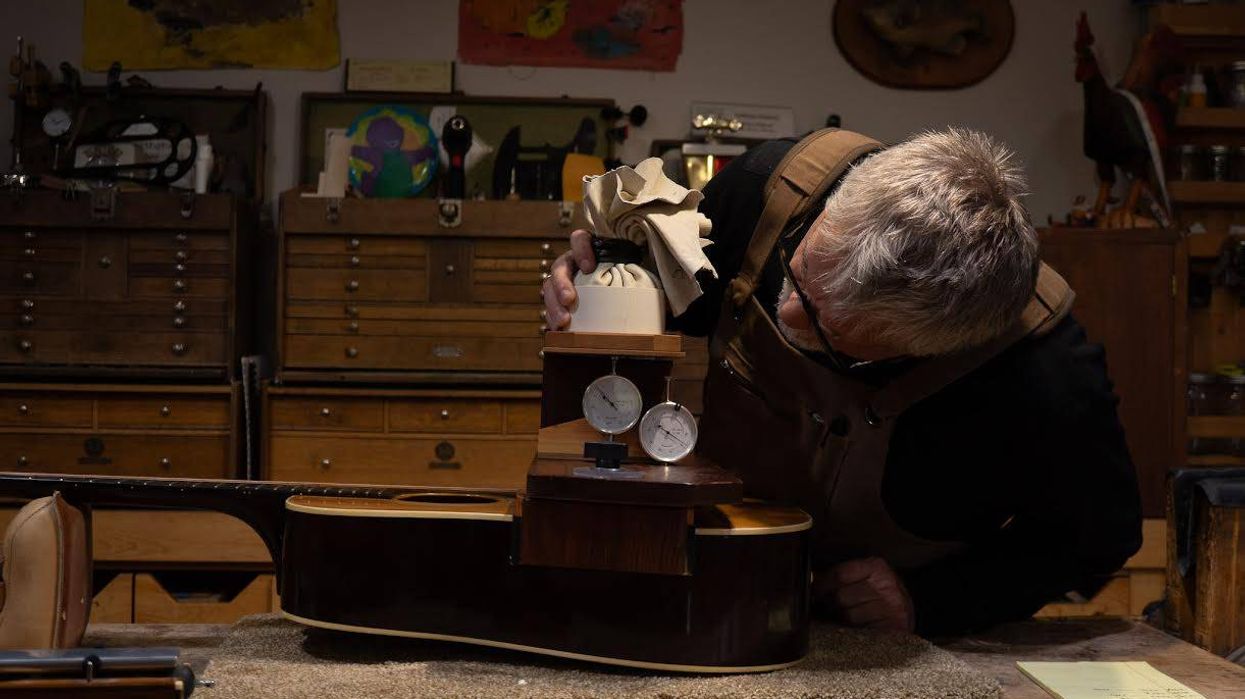
As time went on and I began building my own instruments, I developed the ability to tune tops through scalloping or tapering braces. This gave me valuable insight into what to look for when approaching revoicing later in my career. The process became more disciplined; it included setting air resonance, balancing top and back frequencies, and measuring deflections.
But the question remains: Should we even be revoicing guitars at all?
In the violin world, revoicing is standard practice. Instruments are designed to be disassembled and worked on, and re-graduating tops is one of the most common procedures performed on vintage violins, violas, and cellos. These repairs are done routinely, even on valuable vintage instruments, and often multiple times across their lifespans. This tradition also extends to historical pitch change, such as the move from A=340 Hz to A=440 Hz, where instruments had to be physically altered to remain functional. Violin makers are trained from the very beginning to understand instrument revoicing and the practice is widely accepted.
“For those with the training and experience, revoicing can transform a lifeless guitar into something inspiring and enjoyable to play.”
Flat-top steel-strings are different. We now have guitars, pre-war Martins in particular, that are considered the Stradivari of the flat-top world. These instruments already sound extraordinary, and carving on their braces would not only be unnecessary, but destructive. Still, not all guitars share this level of excellence even within vintage Martin examples. Over the years I’ve encountered many instruments that simply missed the mark, where the relationships between air, top, and back resonances were poorly balanced.
Take, for example, a Guild D-40 from the 1980s that recently came into my shop. Guilds of that era were well-built, sometimes even overbuilt. This particular guitar measured an air resonance of 101 Hz, a top resonance of 200 Hz, and a back resonance of 207 Hz. The problem was obvious: The top was so tight at 200 Hz it had restricted musicality, and its frequency nearly sat on top of the back, only separated by 7 Hz. Worse, the air resonance, at 101 Hz, was far too high for a large-body guitar, which typically falls around 95 Hz or lower.
This guitar was crying out for a revoice. My plan was simple: reshape and scallop the accessible braces on the top, drop the top resonance into the 170 Hz range, and allow the air resonance to settle near 95 Hz. Step by step, I carved, restrung, measured, and repeated until the targets were met. The top gradually dropped: first to 190 Hz, then 180 Hz, and finally 173 Hz. The air resonance followed, landing at 95 Hz. The results were dramatic. The instrument opened up, resonances began to couple, and its musicality increased significantly.
Of course, there are caveats. Any revoicing work voids a warranty, and on a new instrument that can be a serious consideration. In this case, the Guild was decades old, had changed hands multiple times, and carried no warranty concerns. More importantly, the guitar was so overbuilt that there was little danger in loosening the top.
So, what are the ethics of revoicing? Should you attempt it? The answer is clear: Unless you thoroughly understand resonance, frequency targets, deflection values, and how they interact, you should not. For those with the training and experience, however, revoicing can transform a lifeless guitar into something inspiring and enjoyable to play.
In restoration, the golden rule is to enter and exit an instrument without leaving a trace. But sometimes, as with this Guild, the only way forward is to make meaningful change. Done carefully, with respect for the instrument and for the physics of sound, revoicing is not only ethical; it can be a gift to both the guitar and its player.