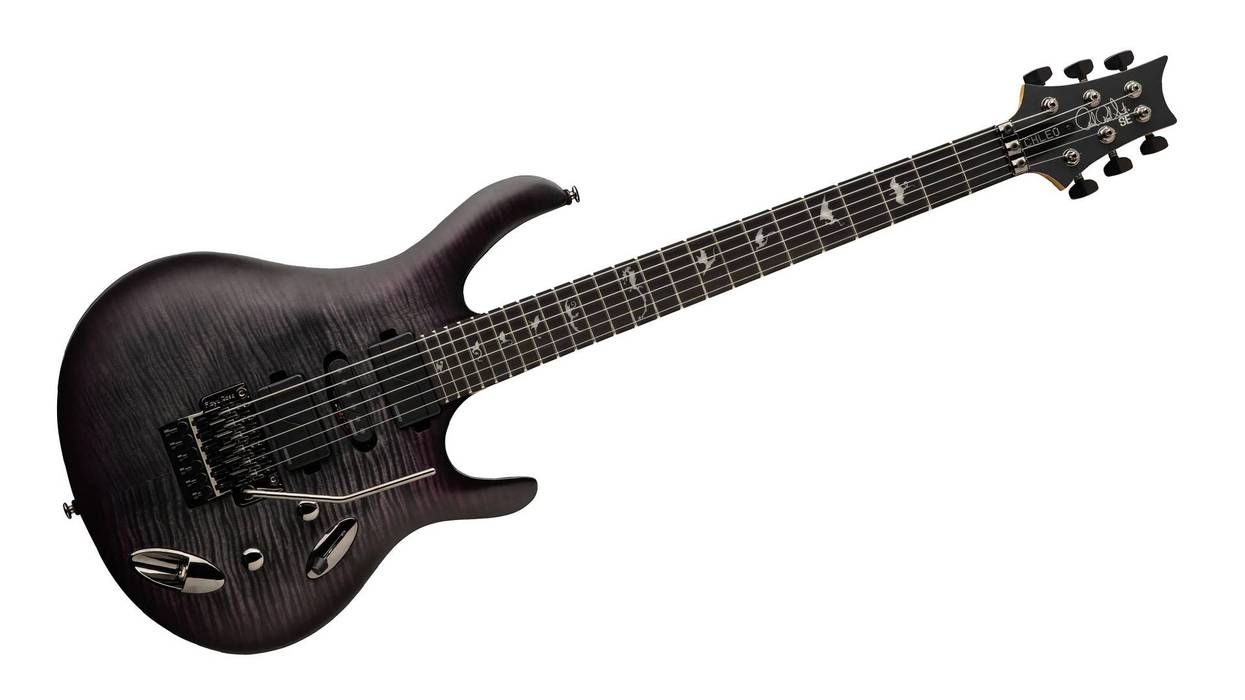

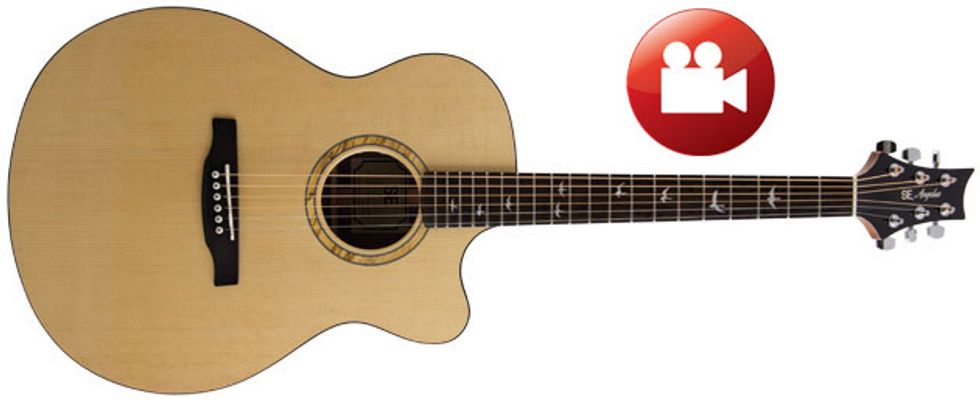

In both electric and acoustic incarnations, Paul Reed Smith’s SE guitars have typically been wickedly good combinations of price and performance. The electric SE line is even home to some very nice artist signature instruments. But the A15AL Alex Lifeson Thinline, an SE version of the Rush guitarist’s signature Private Stock Angelus acoustic, is the first signature SE acoustic. It’s pretty, fast playing, and comfortable. And while it’s not as loud or powerful as many flattops its size, it’s responsive and an excellent platform for fast, nimble-fingered fretboard expressions.
A Winning Player
About 10 years ago, Paul Reed Smith had an “a-ha” moment. He had tried a century-old nylon-string made by Antonio de Torres. Floored by the guitar’s volume and bass response, the famously curious and design-minded Smith wondered what nylon-string construction methods he could borrow to make better steel-strings.
Smith combined aspects of the Torres fan bracing array and steel-string X-bracing. The bracing pattern became one of the foundations of PRS’s steel-string flat top design—from the high-end models made in the company’s custom shop in its Maryland factory to the affordable SE line—including the Alex Lifeson model.
The first thing you’ll probably notice about the Lifeson, however, is not the sonic subtleties of hybrid bracing, but how well it plays. The neck has a deep, substantial but comfortable C shape, and a relatively narrow nut, 1 21/32", gives it the streamlined feel of an electric guitar that makes thumb-fretted chord shapes easy. The generous string spacing at the saddle, 2 3/16", offsets the narrow spacing at the nut to some degree and keeps things from feeling too cramped.
The action on our test guitar was just about perfect—low enough to make barre chords feel effortless and facilitate high-velocity soloing and even whole-step bends. Players accustomed to traditional steel-string guitars might even find the Lifeson Thinline a little too easy to play. But as fast and low as the action felt, the guitar never buzzed. This set up was very well done.
The neck’s comfort is echoed in the body’s sleek and slim design. The lower bout is 15 1/2” inches wide, a half inch wider than Martin’s OM, and at its deepest, the body is 3 7/8" thick, compared to 4 1/8" on an OM or 4 7/8" on a Martin dreadnought. It feels great to cradle the guitar, especially in a seated position.
Luxurious Detailing
Design and execution are, predictably, excellent. PRS fans will appreciate the signature Bird in Flight fretboard inlays. Other details, like the wooden rosette and tortoise binding, heel cap, and end strip, lend extra elegance. The wood selection—a solid Sitka spruce top, mahogany neck, and laminated dao back and sides, complement each other beautifully.
Ratings
Pros:
Smartly designed and well built. Insanely playable. Perfect set up.
Cons:
Not the best value for a guitar with laminated back and sides. Bass and treble response could be better.
Tones:

Playability:

Build/Design:

Value:

Street:
$799
Paul Reed Smith SE A15AL Alex Lifeson
prsguitars.com
Fretwork is every bit as clean as what you’d see on a US-made PRS. The slotting on the bone nut and saddle are super precise. The poly finish, while uniformly applied, does feel a little extreme in its glossiness. It’s perhaps the only outward indicator of the Lifeson’s more-affordable origins.
Slimmer Means Thinner
The Lifeson Thinline’s svelte shape does mean a few sacrifices on the sonic side of the equation—at least if you favor burly, bassy dreadnought-style tones. The midrange tones are rich and shimmering, but the bass response could be stronger.
Then again, if you take a stab at the arpeggios that open Rush’s “Closer to the Heart” (originally played on a 12-string), you can hear how the guitar’s tone profile would work for a player with aims akin to Lifeson’s. Clarity and note separation are excellent. I could certainly hear the payoff from PRS’s hybrid bracing while playing the instrumental section that opens “The Trees” (originally played on a nylon-string). The notes cascaded together beautifully and the guitar is very responsive to fret-hand nuance. And while the string spacing at the nut isn’t ideal for complex chord shapes, the wider spacing at the saddle makes fingerpicking easy.
Plugged into a Fender Acoustasonic with the amp’s tone controls set flat, the Lifeson isn’t exactly dazzling. The midrange feels pronounced at the expense of low-end presence and high-end detail. As such, the Lifeson probably isn’t balanced enough across the frequency spectrum for solo performance. On the other hand, it’s easy to imagine this guitar being a perfect fit for a rock band situation—nestling just right between bass and kick drum, and vocals and lead guitar.
The Verdict
PRS’s SE A15AL Alex Lifeson Thinline is a stylish and immaculately executed guitar, boasting top-notch playability. It might not have the most inspiring voice, acoustically or amplified, but it sounds good and feels great in rock and ensemble contexts. And its performance potential in this role is likely very much what the guitar’s namesake had intended and something his acolytes will appreciate.
Watch the Review Demo: