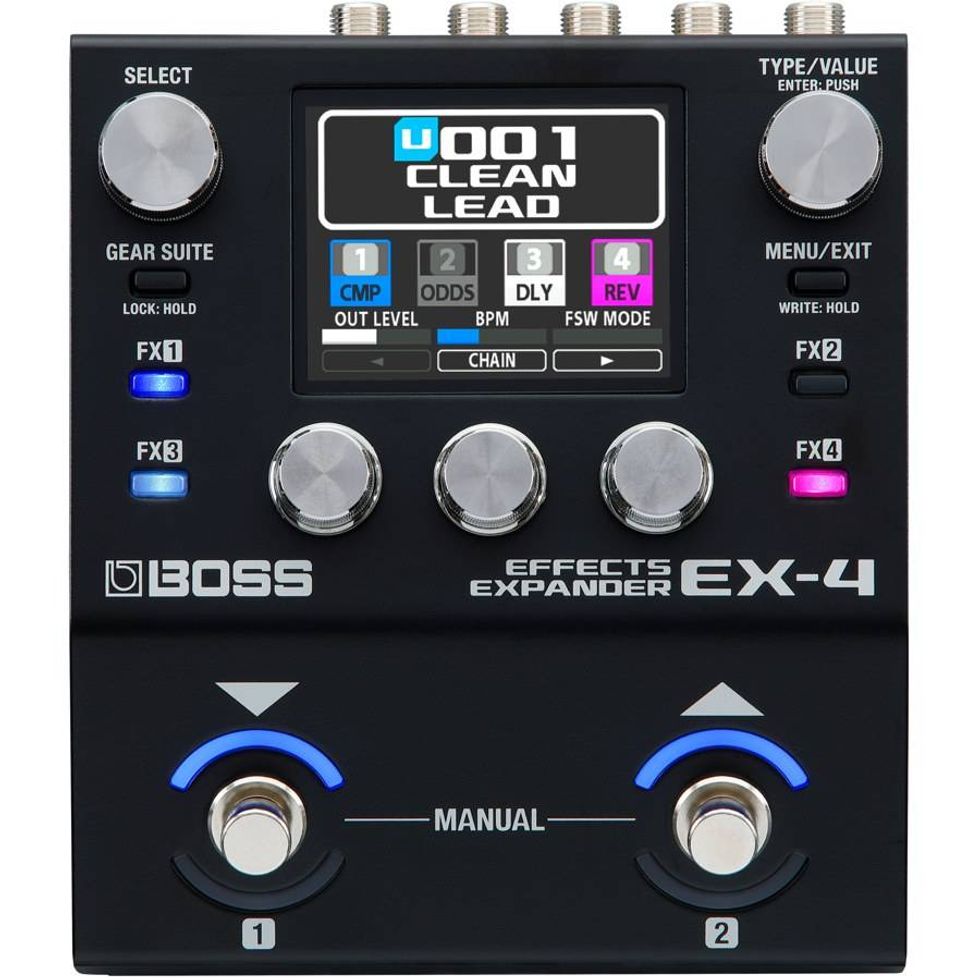
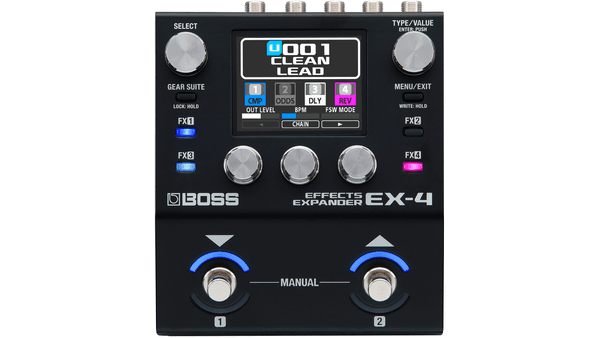

In a world inhabited by do-it-all profiler/modelers and zen-simple single-effect stompboxes, where does the humble digital multi-effect fit in? Well, they can still represent a very virtuous goldilocks kind of situation by doing a lot without overwhelming the user. But in terms of fitting into a very modern signal chain, it helps if they can play nice with modelers, amps, and vintage-style stompboxes alike—functioning as a central processing station, outboard loop router, as well as a source of extra effects color. When you can do all that in a compact footprint, you can really earn your keep. BOSS’s new EX-4 Effects Expander impresses for being able to do a bit of all of that.
The Old Switcheroo
The EX-4’s footprint, at 4.63" wide, is just slightly wider than their current 200 series of stomps, including the wide SY-200 Synth and OD-200 Hybrid Drive. Spatially, it represents a middle-ground between BOSS’ classic compact pedals and the company’s significantly wider 500 series. The more compact size means the EX-4 forgoes some functionality compared to, say, the MS-3 three-loop pedalboard switcher and multi-effects unit that the EX-4 seems to take many cues from. Next to the MS-3, there are fewer send/return options (the EX-4 has one rather than three) and the amount of available effects blocks is reduced from six to four. Like the MS-3, the EX-4 aims to combine the functions of switching command station and effects arsenal, so in addition to the 120 available effects in four effect blocks, there are several “utility” blocks that help you manage routing from the interface.
Utility blocks can occupy any position in the effects chain, and that’s a significant bonus. On the hardware side, there are four back-panel ¼" jacks for mono and stereo input/output. Two jacks also function as send and return for integrating standalone stomps into the EX-4’s internal chain. Effects loop users will also appreciate this: By adjusting the EX-4’s hardware settings and inserting a send/return utility block within the EX-4’s block chain, you can use the four-cable method to also integrate your amp’s FX loop. This allows you to send front-end-friendly effects like overdrive, distortion, and compression directly to the front input of your amp, while assigning time-domain effects like reverb and delay to the amp’s FX loop—all from within the EX-4’s architecture. Talk about potential.
Tough and Practical Tech
Still, let’s talk about the EX-4’s power within its own borders. Like the 200 series, the EX-4 is road-worthy and practical for stage use. An extremely vivid 2.4" full-color LCD screen enables you to discern various effect types and blocks via smart color-coding in the LCD. It makes ID on the fly, and on dark stages, much easier. The front panel also features three indented rotary parameter knobs that enable accurate parameter adjustments, as well as four color-coded buttons for turning a given effect within a block on and off or initiating edit mode for that effect.
The two large rotary dials handle navigation, menu selection, and various effects views, and while you can use the upper right dial to scroll through presets, the EX-4’s two dual-function footswitches have you covered there too. And without even availing yourself of the EX-4’s connectivity for up to two external controllers, the onboard footswitches can be assigned to tasks like real-time effect parameter control (hello, instant whammy effects!), tap tempo, external loop switching, delay hold, and more.
“For my money, though, these EQ and compression tools are the functional heart of the EX-4 because, in a backline or fly-rig situation, they can mean the difference between a pro tone and one that’s just so-so.”
Sounding Board
Okay, so the EX-4’s architecture is smart. But how are the sounds? The overdrive and distortion block alone contains 35 digital emulations, including BOSS staples like BD-2 and OD-1 overdrives, Metal Zone and DS-1 distortions, and a clutch of nod-and-a-wink saturation staples with names like “T-Scream,” “Centa,” “Guv,” and “Dist+,” plus a handful of fuzz blocks that emulate Fuzz Face and Big Muff voices. Many will argue the verdict is out on whether digital models capture the true warmth and texture of analog drive, distortion, and, especially, fuzz. But these models are surprisingly accurate, and when manipulated via the global EQ functionality, you can precisely carve smoother or more-aggressive versions of the voice you’re after—sometimes to ends that are more practical and surprising than a simple fuzz. Modulation options abound too. Standouts include a spatial stereo chorus, an awesome 12-stage phaser, a classic Uni-Vibe chorus/vibrato model, and a sick pitch-tracking ring modulator. Even Boss’ cool Slicer rhythm effect has a home here.
With six compressor types—including BOSS’ own CS-3, Dyna-Comp and Dan Armstrong Orange Squeezer pedal-style simulations, and outboard-style limiter models including a Urei 1178 sim—the EX-4 has a strong dynamic control section that, in my view, is a major selling point. The same goes for the 4-band parametric and 10-band graphic EQ. EQ and capable dynamics are tools many players leave off their board entirely because their effects can be subtle. For my money, though, these EQ and compression tools are the functional heart of the EX-4 because, in a backline or fly-rig situation, they can mean the difference between a pro tone and one that’s just so-so. They also extend the potential of the effects that are already built in here. And they are also an asset when you’re working in the context of your home studio, where the EX-4 can feel almost as capable as a small mixing desk.
The Verdict
There are a lot of ways to make the BOSS EX-4 invaluable—and a lot of different players that can find use for its considerable power. It can be a killer backup or substitute board for fly dates. It can be the secret weapon in a cover band that needs to span The Police and Jack White. Perhaps you’ll pair it with your favorite analog overdrive and delay stomps, or your main modeler in a hybrid solution that out-sources dynamic compressors, room sounds, volume control, envelope filters, mods, and EQ tools to the EX-4.
But while the EX-4 is a utility knife of sorts, there are also avenues of creative exploration here. Maybe you're unwilling or unable to dedicate valuable space on your working board to more exotic effects. The EX-4 can create those opportunities for you without demanding extra acreage. Whether you’re a guitarist, bassist, or keyboard player, the EX-4 is a deep and versatile device that may do more than simply expand your arsenal of usable effects. Its excellent sense of flow and powerful EQ and dynamics tools may also expand your studio and production smarts and instincts, as well.