A native of the Pacific Northwest, Jordan grew up traveling the country as the son of theater technical directors and speech instructors. His exposure to the performing arts early on helped foster his love for music and attention to detail, and upon receiving his first guitar at age 15, he became hooked. Jordan brings a considerable background of gear knowledge and tech experience to Premier Guitar, and has contributed an extensive amount of articles, artist interviews and Rig Rundown videos since late 2008. He lives in the Iowa City area, where he also works to bring music education initiatives to both local and regional communities.
“When in doubt, don’t.” It’s a pearl of wisdom that offends risk takers and guides more than a few tortoises to the finish line ahead of the rabbits. But in the tone-chasing world this dictum carries extra weight, because depending on your aims, anything you situate between guitar and amplifier can subtract as much as it adds. Indeed, a little restraint can go a long way toward sweetening a sound.
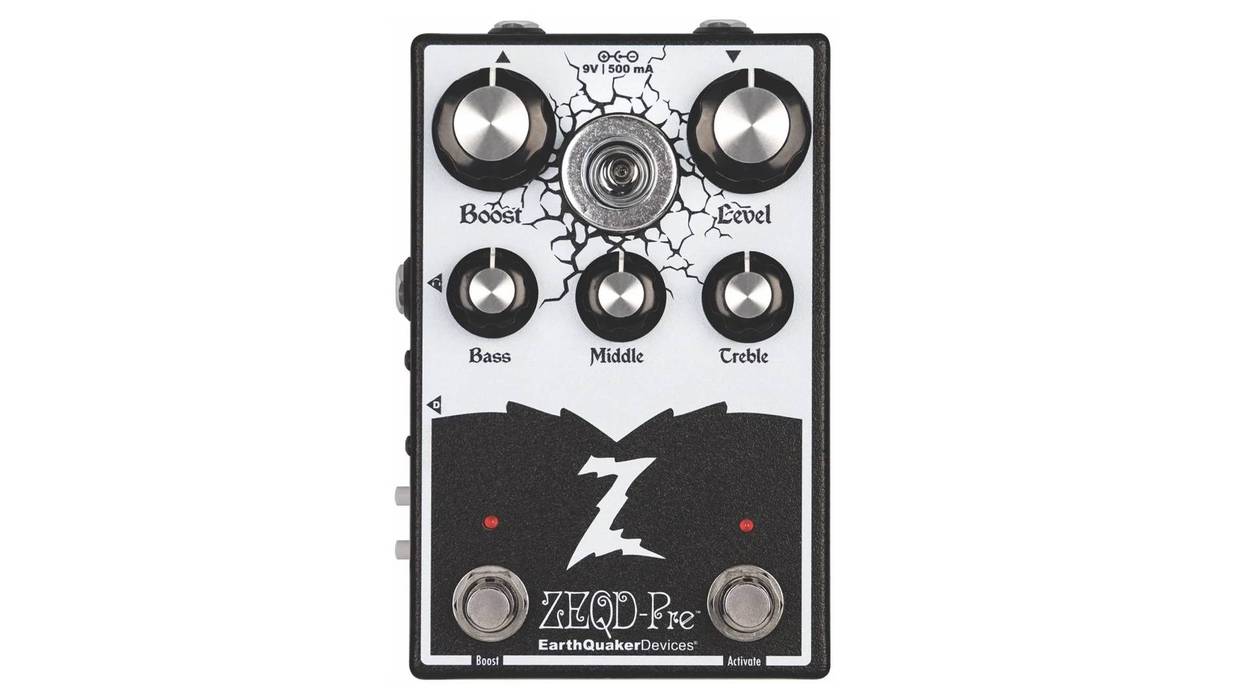
And restraint is one of the things that makes the ZEQD-Pre, a preamp co-designed by EarthQuaker and Mike Zaite (aka Dr. Z), such an elegant piece of kit. The things they didn’t add make it easier to use. The streamlined design also makes the ZEQD-Pre feel truly additive. It can lend body and excitement to big tube amps that sound flat at low volume. And as an analog addition to digital signal chains, it adds real life and a tactile dimension to flat, drab, or spiky DAW and modeler tones.
Feel Free With The Help Of A Pre
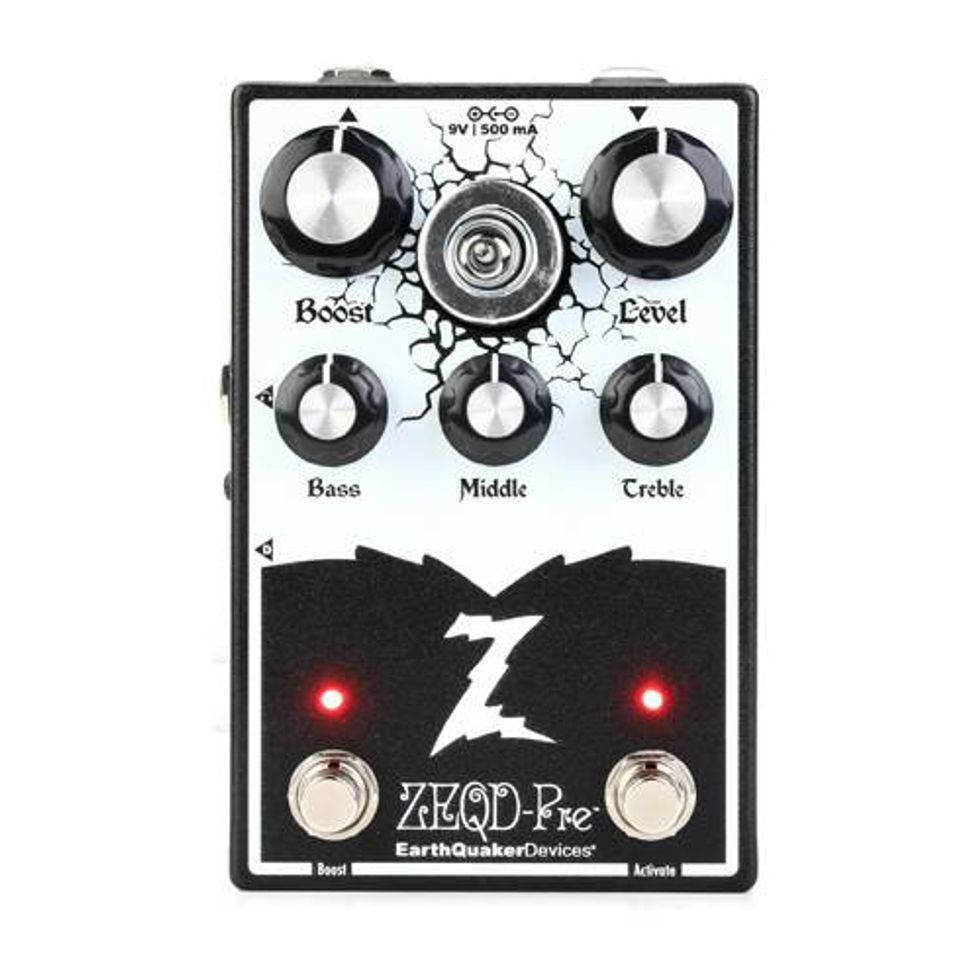
Though the ZEQD-Pre is a beautifully integrated whole, it’s effectively made up of two sections. There’s a passive EQ that can do a lot on its own to recast or fine tune the sound of a tube amp or modeler. It also features a boost. Switching on the boost disengages the EQ. But both sections use the level control as an output volume control.
In my first experiments with the ZEQD-Pre, I situated it in front of a 50-watt Fender Bassman and 2x12 cabinet. And though I suspect more potential customers will be interested in the EarthQuaker’s potential in digital environments, it can transform conventional tube amplifiers. I rarely get to turn my Bassman up much past 2 in my house. But the ZEQD-Pre’s EQ section made those modest volumes sound much fuller. The boost is not a high-gain affair, but it adds weight and excites overtones that might otherwise lay dormant at low volume. At higher amp volumes it can add a just-right nudge into the dirty zone that almost always sounds silky rather than harsh.
EarthQuaker Devices ZEQD-Pre Preamp Demo
“It is zingy, responsive, and does much to take away the uncanny valley sense of lifelessness you can feel when interacting with a modeler.”
Use of the EF86 in a preamp is not common—at least relative to the ubiquitous 12AX7. But Dr. Z’s choice of the EF86 for the boost is an inspired one. It is zingy, responsive, and does much to take away the uncanny valley sense of lifelessness you can feel when interacting with a modeler. Those that know the EF86 by its too-hot-to-tame reputation needn’t fear that it will be a handful though. The ZEQD-Pre boost voice is balanced and lively in all the right ways, and these attributes are especially apparent when the pedal is paired with a digital end destination.
When testing the ZEQD-Pre in this capacity—by running a cable from the headphone output straight into the Hi-Z input of my Universal Apollo Twin—I did not make it easy on the EarthQuaker. My main instruments are Jaguars and Jazzmasters, and the relatively thin and trebly output from both of them rarely flatters modeled and DI sounds. But I really liked the tones that I tracked with just the ZEQD-Pre and the DAW—especially without a modeled amp in the mix. The EQ adds body and tone-shaping versatility, and the boost lends real character and color, inhabiting a sweet space that is neither Fender Princeton nor Vox AC15, but which possess some of the smooth richness of the former and the sparkle of the latter. I enjoyed the sound of the ZEQD-Pre direct into the Apollo so much that it ceased to feel like a compromise between amp and modeler. Instead, it felt like something unique—an amp with its own very appealing flavor that I would use for its sonic virtues as much as its convenience.
The Verdict
Though I’ll opt for a tube amp in almost any situation where there is a choice, I’ve warmed to some of our faux-amp friends in the digital domain. That said, I think I would choose the ZEQD-Pre and my pedals over almost any modeler. In direct-to-DAW situations, the ZEQD-Pre is warm, alive, and sounds, well, a lot like a real amp. It also feels like it was designed by people that know how a tube amp should feel under the fingers and in a room.
The ZEQD-Pre makes distortion and fuzz units sound like their real selves. And even without a simulated power amp, the cab sim makes rigs sound great through flat response monitors. The ZEQD is nearly $400, and for most of us, that’s a hefty enough sum to give pause. But the U.S.-made ZEQD-Pre is designed by gifted builders that have poked around the innards of amps and stompboxes for years and built classics in their respective fields. So, you can rest assured that the bars this pedal needed to clear in sonic and quality terms are high ones. I was pleasantly surprised and impressed—to the point where $399 seemed a very reasonable price to pay. And if you’re a tube amp loyalist navigating the worlds of backline-free gigging and digital recording, you may end up similarly smitten.
When Japanese engineer Susumu Tamura designed the Maxon OD808 overdrive, he could hardly have known that it and its export twin, the Ibanez TS808 Tube Screamer, would become perhaps the most influential and, probably, imitated pedals in stomp box history. In fact, upon its introduction in 1979, the Tube Screamer, whose smooth sound is characterized by a bass roll off, midrange bump, and slight high-end attenuation, was not an instant success. But as the pedal was adopted by players as disparate as Stevie Ray Vaughan and Kirk Hammett, it gradually became a ubiquitous presence on pedalboards of all persuasions.
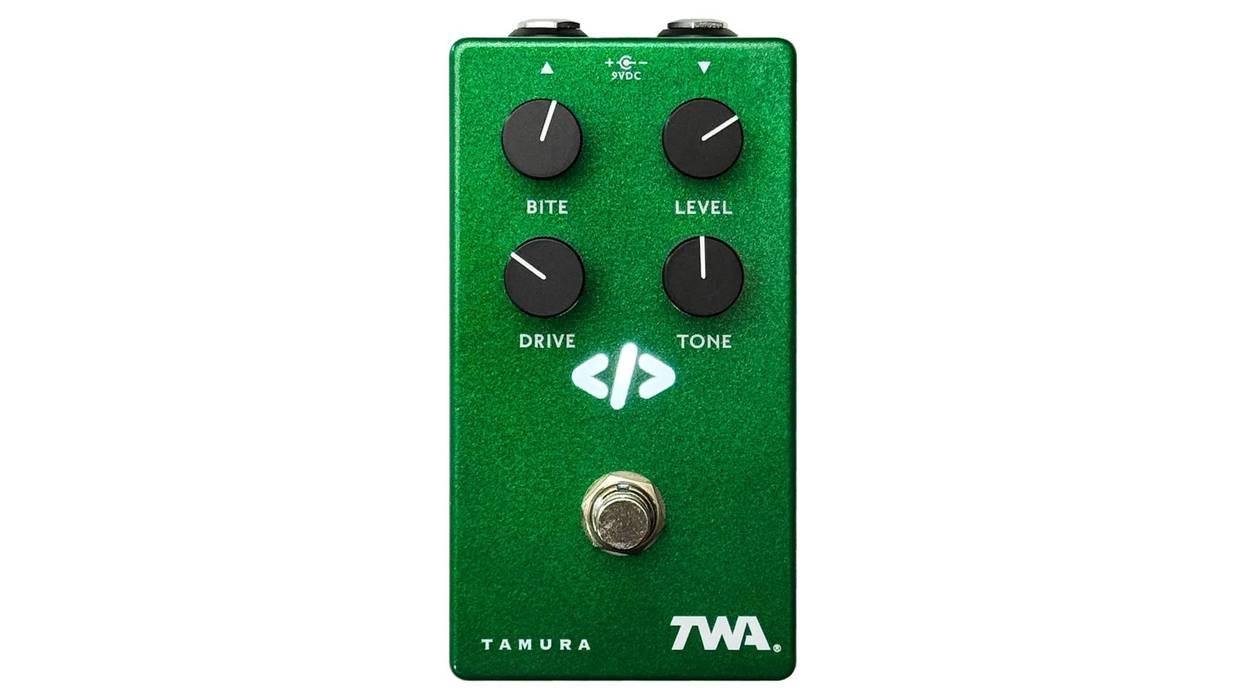
Tumura, a guitarist himself, spent several of the intervening decades working on wireless designs. In recent years, however, he began modifying Tube Screamers for Japanese guitar stores. But now in his seventies, he found the pace—almost 1,000 pedals annually—exhausting. Why not, he thought, just make a pedal that incorporated all his refinements? Enter the TWA SC-01 Source Code, which is exactly that. Handmade in the U.S., the SC-01 features improvements on the TS design, including 18V operation via an internal regulator, a +6 dB boost, anop amp that claims toinject “complex harmonics and an amp-like feel,” and, most importantly, a “Bite” control that can mix in asymmetrical, tube-like clipping to the symmetrical clipping-based sound of the original.
Source in Session
Using a Stratocaster and Fender Princeton Reverb as my test platform—a made-for-Tube Screamer rig if there ever was one—I first determined whether the Source Code could speak traditional Tube Screamer by A/B-ing it with a recent Ibanez TS-9 reissue. It does, producing tones indistinguishable from the traditional circuit when the bite control is at zero. That said, if your take on Tube Screamers has always been, “if it could only just…,” you’ll find that the bite knob opens up a whole new world. Goosing it adds the extra measure of sizzle, zing, and teeth that more common iterations of the design always lacked. And adjusting the balance of the drive and bite controls dials in an enhanced and expanded range of overdrive tones that truly transcend the original TS.
The Verdict
Whether you deploy Susumu Tamura’s latest refinement of the TS circuit to hit the input of an amp that’s already breaking up or as your primary source of overdrive, you won’t be disappointed. It offers all the essence of the original, but it’s the extra oomph and range that impresses.
The tweedDeluxe circuit sets the gold standard in tone for many of us. And for good reason. It’s simple and responsive, with a warm, compressed, midrange-forward voice that’s perfect for jazz and country lines at low to moderate volumes—and a distinctive, saturated gnarliness in the upper reaches of its output that’s hard to beat for rock. If that’s the sound you hear in your head, many would say a vintage model is still the one to have.
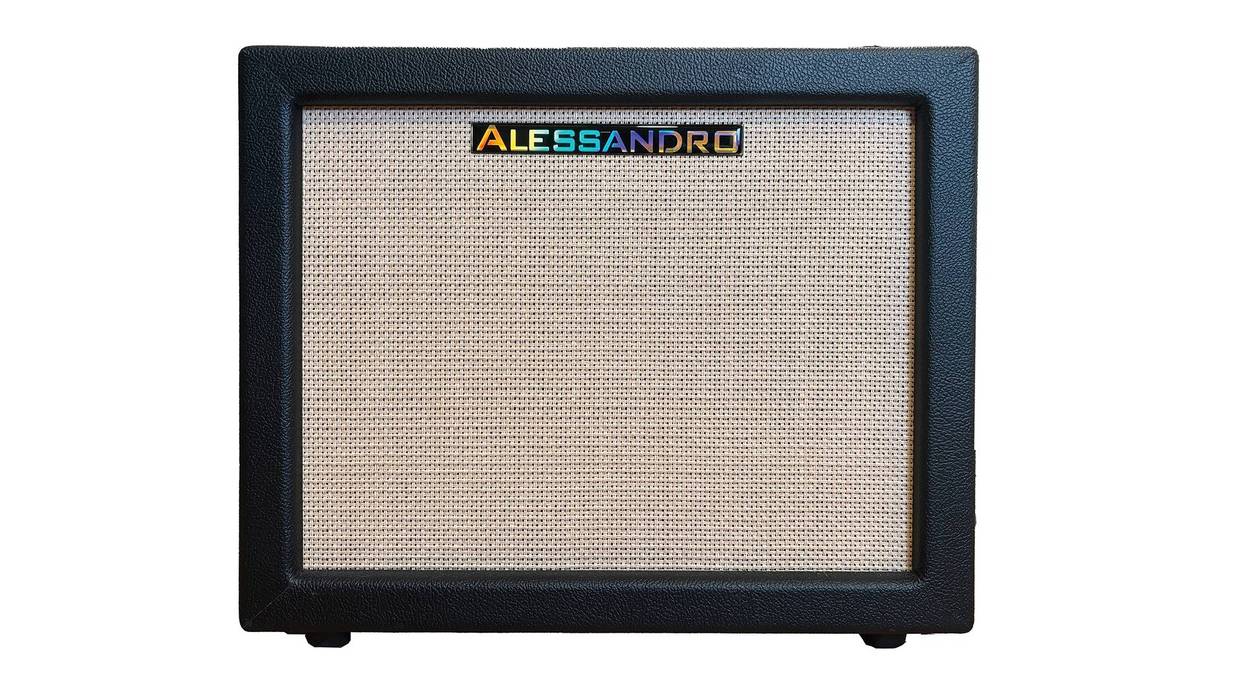
If anyone could top that with a true “tweed killer,” I’d put my money on George Alessandro. That’s not just because his clientele reads like a Mount Rushmore of guitar tone—David Gilmour, Derek Trucks, and Warren Haynes are just a few who’ve cited Alessandro in current gear lists in PG. It’s the combination of his deep firsthand knowledge of the history of guitar amp circuits and his tireless quest to source the finest components that not only land him those rock-star devotees, but easily place his name among mythical amp wizards like Alexander Dumble and Ken Fisher, and make him the guy for the job.
I’ve had the good fortune to play one of Alessandro’s 5E3 copies, and it was so familiar, it felt like what I imagine one of those amps must have sounded like fresh out of the factory in the late ’50s. With his new combo, The Dane, he’s used that circuit as a jumping off point—with a nod toward Dumble as well—and optimized it for a modern pedal-using player. Not only does the 14-watt The Dane deliver the same sonic hallmarks as the 5E3, it offers more headroom and an even wider range of touch-sensitive response.
Do the Evolution
Despite all the tweed Deluxe talk, the Dane is no clone. Instead, it’s inspired by the 5E3 circuit and a Dumble Tweedle Dee—that legendary amp builder’s own tweed Deluxe mod—that landed on Alessandro’s bench for service. From there, Alessandro evolved the design, creating a unique preamp circuit, which uses a pair of ECC83MG/12AX7s. On the user end, the most recognizable change might be the inclusion of a 3-band EQ. Alessandro paired his preamp with a ’50s-style output section that employs a pair of 6V6s. Together, and in conjunction with Alessandro’s signature Eminence GA-SC59, they evoke a vintage vibe, achieving the tube compression and harmonic complexity tweed Deluxe players know well, but with more clean volume.
As a tweed Deluxe player who also loves pedals, I’ve often found myself a little bit conflicted. There’s a weird imaginary line I feel like I cross every time I plug a fuzz—or even worse, a digital pedal—into my 1949 5A3. But if I want to use my prized amp on as many gigs as I do, it’s a necessity. With The Dane, not only is there no conflict, it actually feels more welcoming to pedals. That’s not just about headroom, though that certainly helps—the 3-band EQ really goes the distance when it comes to shaping your sound.
Much like the dynamic interplay between the tone and volume controls on a vintage Deluxe, each of The Dane’s EQ controls seems to shape the whole of the sound. I found this to be especially helpful with dialing in dirt tones. Over the course of a few sessions with The Dane, I plugged in a wide range of gritty pedals, including a Klon KTR, Analog Man King of Tone, EHX Ripped Speaker (there’s some comedy here in using a fuzz that’s supposed to sound a little broken), and an Analog Man Sun Fuzz. In each, I found that I was able to shape their tones with the EQ more than I would ever expect from other amps. And that goes for using those to push The Dane into overdrive as well, which, as ruthlessly delightful as it is to do on a tweed Deluxe, is not especially sculpt-able. With the KTR adding some gain and heading into cranked volume territory, the mid control alone added a heft to my Creston JM-style that felt resolutely heavy and thick—much more so than I would expect from JM-style pickups. And at more polite volumes, I could use the pedal alone to get my overdrive, while still preserving the character and voice of the amp.
Full Control at Your Fingertips
While reviewing The Dane, there’s a quote that kept coming back to me from when I interviewed Alessandro a few years ago: “If I can make it a limitless journey, then I did my job right.” With The Dane, he’s managed to take the tweed Deluxe sound and remove the limits.
I think there are a lot of ways Alessandro gets there, and one of those is through his next-level component sourcing. With the fervor of a hi-fi aficionado, Alessandro has most of his components custom built, with quality control that goes well beyond the consumer-grade level.
The result is that The Dane, like every Alessandro amp I’ve played, responds like a performance sports car: It runs silently, has an ultra wide dynamic range, a broad frequency range, and is fast and articulate, all of which keeps control in the player’s hands. That might be daunting if you’re used to an amp that heavily colors your phrasing by limiting the window of control (though pedals can help with that). But if you want to keep that window wide open, The Dane will get you there.
What, exactly, does that mean? The response, dynamics, and EQ keep the controls in your hands. Playing intensity and attack have more noticeable results. Sustain is there when you need it. In short, The Dane is a thrill to play.
The Verdict
As a devoted tweed Deluxe user, I’m genuinely taken by The Dane. Alessandro has preserved the character of the original while opening it up with more dynamic range, control, and possibility. But it goes beyond that, because The Dane isn’t just a 5E3-style amp—it’s a solution. Whether you’re playing clean articulate lines (I didn’t have an archtop handy, but I can assure you this amp would be the perfect transparent companion for jazz hits) or cranking with abandon, The Dane has the harmonic range and firepower for the gig. Its 14 watts are not only bold and powerful, this combo maintains its composure through its entire output, making it fully usable at all levels. At $3,000, The Dane, handmade by one of the ultimate legends of amp building, is an unrivaled feat.
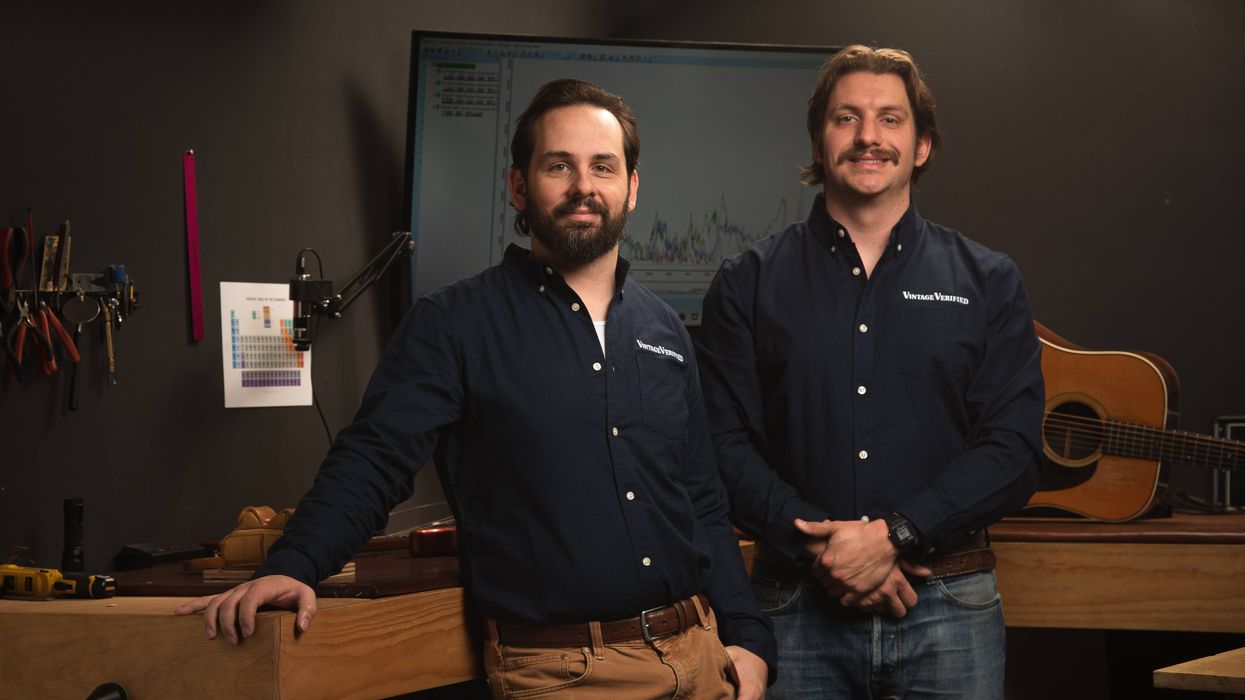
Vintage Verified founders Jon Roncolato (left) and Zach Ziemer
We don’t often talk about Renaissance high art and ’50s rock ’n’ roll guitars in the same breath, unless we’re forming a new rockabilly-prog band called Hot-Rod Maximus. (You’re welcome.) But in the modern world of art and guitar collecting, items reputed to be the work of either Leonardo Da Vinci or Leo Fender are subject to much the same scrutiny from experts in the field, are known for fetching vast prices from discriminating buyers, and, given the millions of dollars potentially involved in even a single sale, are likewise expected to stand up to the most rigorous high-tech scientific analysis, as well. Right?
Well, almost. While the worlds of high art, medicine, astronomy, police forensics, and environmentalism have all taken that last cue to heart by making data-driven determinations with the latest tools of chemical analysis, the vintage guitar market—and its many rightfully respected authorities—has generally proven resistant to sharing the process of authentication with the likes of spectrometers, microscopes, and 3D imaging, tools that have long proven their worth in identifying the material composition of everything from planets to polyps to paint thinners. Black lights on the backs of headstocks have typically been about the latest “tech" in the room.
Until now. In a story that feels ripped from The Da Vinci Code or Cold Case Files, two remarkably down-to-earth—if undeniably intrepid—guitar-shop guys from Nashville, Jon Roncolato and Zach Ziemer, have quietly upended the vintage-guitar market in a matter of months. Fueled by rotating batches of fresh-ground coffee, an abundance of nerve, and a stomach for study, they’ve tapped some of the most advanced and expensive analytical machines available to capture, catalog, and compare hundreds of thousands of data points from countless vintage and modern instruments—their lacquers, pigments, pots, pegs, pickups, and parts—building the largest dataset for guitar-component and finish comparison in existence.
In the process, they’ve issued a gentle nudge to dealers, appraisers, and collectors—and yes, they’ve even shifted the status of some long-held vintage “treasures.” Although they no longer appraise or sell instruments themselves, they’ve still managed to ruffle a few feathers and attract more than a few legal threats. At the same time, they’ve leveraged their diligence and strong reputations to assemble a trusted advisory team made up of some of the most respected minds in guitars, art, and hard science: icons like repair guru Joe Glaser, cultural-heritage scientist Dr. Tom Tague (who authenticated Da Vinci’s “lost masterpiece” Salvator Mundi), Music City session legend Tom Bukovac, pickup mastermind Ron Ellis, and analytical chemist Dr. Gene Hall, among others.
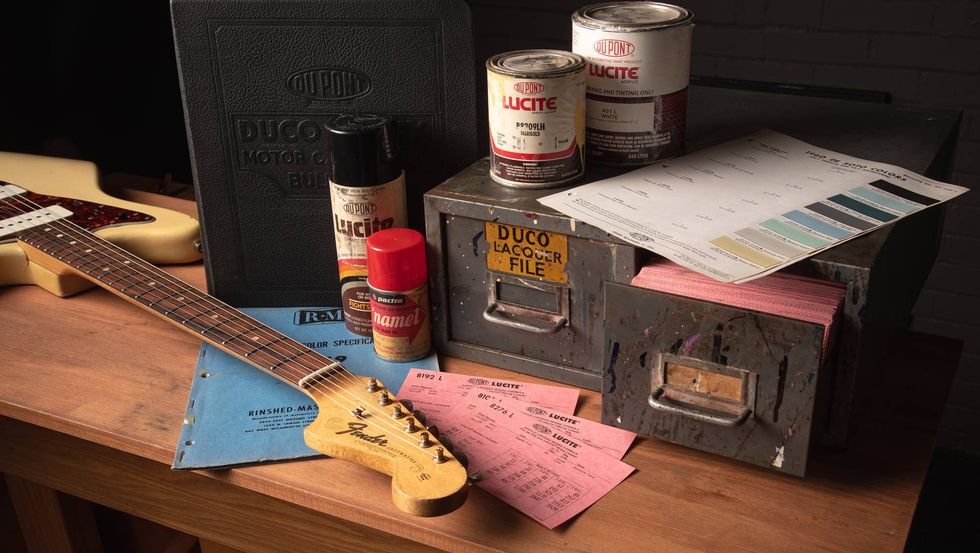
Vintage Duco reference/research materials
Jon and Zach are guarded about the technology, as you might expect. They don’t post selfies, they don’t have a podcast, and they won’t be starting one. As Ziemer puts it, they’d much rather “keep our heads down and keep hammering away” with laser-based spectrometers, plumb the deepest secrets of Fullerton red Strats, and compare the chemical makeup of Duco paints (ironically, both Pollock and Fender’s mutual go-to.) In their scrupulously clean Nashville HQ—which will expand to offices in L.A. and N.Y.C. in 2026—they seem pretty resigned to their current controversial status, and remain motivated primarily by going after, y'know, the truth.
Okay, that and a good cup of coffee.
What was the genesis of this idea to apply these types of cultural heritage sciences to vintage guitars? Is the problem with inaccuracies, refinishes, and forgeries really that widespread?
Jon Roncolato: We met while I was the GM at Carter Vintage Guitars in Nashville. We initially hired Zach as part of the inspection team. It’s difficult to find people who have logged enough time examining vintage instruments to truly know what they’re looking at, but Zach had spent a couple years at Glaser Instruments—the go-to shop for repairs on high-dollar pieces.
When Zach became Head of Authentication, we began seeing questionable instruments come through with six-figure price tags that other experts had already signed off on. When you have a six-figure instrument and multiple experts all saying different things, you’ve got a problem. That’s when we realized there had to be a better way to do this—something grounded in science, not speculation.
Zach Ziemer: Everybody misses now and again. Most dealers are trying their absolute hardest with their experience, eye, and gut to tell an original from a fake or a refin. There’s simply some things you just can’t know unless you look at them with the kinds of tools that we’re bringing to the table. And it shouldn’t be that controversial: after all, literally every other collectible industry has a third party unassociated service like ours. The most obvious one is PSA with collectible sports cards. PSA is a little different than it used to be, but everybody still sees a sports card and a PSA box and if it says, “PSA 9,” for instance, you know you’re probably in good shape.
“In the art world, scientific validation has long been standard practice—pigment analysis, canvas fiber studies, dimensional scans. Sometimes it changes the story. That’s not an attack on tradition. It’s the pursuit of truth.” —George Gruhn, Gruhn Guitars
Jon Roncolato: In the art world, if you don’t have both iron-clad provenance and scientific analysis, it’s not possible to certify a piece as unequivocally “by the hand” of a given artist. Art dealers are very specific about their language, and there’s a whole hierarchy of degrees of certainty that directly correlate to the price of the piece. In the world of dealing guitars, though, even if you’re not 100% sure, you have to absolutely stake all your credibility on a guitar, even if there’s some doubt. You're not going to sell a $250,000 custom color Fender if you come out and say, “Well, I think it's a custom color. It looks good to me.” So that's just been the structure of the industry. Being in the underbelly of the whole thing, as we were, we realized what a big problem this was.
There must have been a ridiculous learning curve. You guys are guitar dudes, not scientists. Takes a bit of brass to bite off something like that, no?
Jon Roncolato: We have a framed quote in the kitchen from Wilbur Wright: "There are two ways of learning to ride a fractious horse: one is to get on him and learn by actual practice how each motion and trick may be best met. The other is to sit on a fence and watch the beast awhile, and then retire to the house." We chose the former.
That said, we spent the first year and a half offering no services at all—just studying the science. That included week-long training seminars where everyone but us had a doctorate attached to their name, and consulting with the top experts in the cultural heritage field.
We also didn’t get here alone. We caught a major break by connecting with Dr. Tom Tague and Dr. Gene Hall, two of the world’s leading experts in analytical chemistry. They took us under their wing and gave us a crash course in PhD-level material analysis.
Zach Ziemer: I can't even express how difficult it was to make heads or tails of any of this at first. Jon and I were not chemists, and a lot of what we do now is largely analytical chemistry. So the learning curve on that was incredibly steep. We always joked that we were smart enough to have the idea, but dumb enough to think we could do it. And while this process exists in other industries, the finished instrument industry is totally unique. The instruments are so modular, and you have finishes, plastics, hardware, pickups, and so you have to have an answer for all that information.
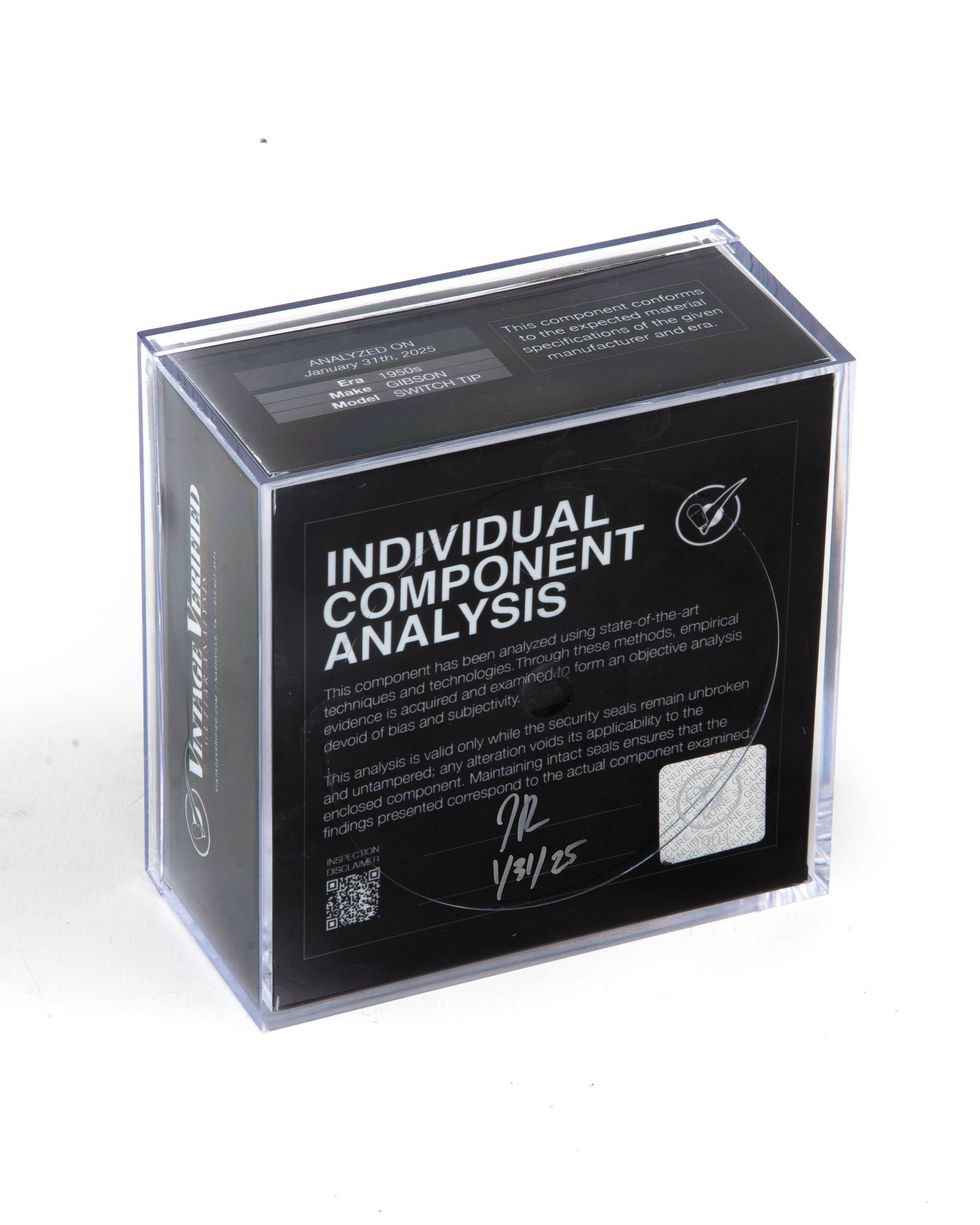
Jon Roncolato: That’s right. The process is designed to have an answer for anything and everything on the instrument. The headstock decals, the finish, the hardware, the fret wire, the fingerboard inlays—we have a data-driven answer for everything. That was really critical, because we didn't want to give incomplete information. Another absolutely critical principle for us was that anything we put in one of these reports has to be defensible in court. If we get subpoenaed to go to court, which inevitably we will, we need to know that Zach or I can show up and we can defend this and prove this. Our other guiding principle is that we remain completely independent, and not touch the buying and selling of the instruments.
“Vintage Verified is doing what we couldn’t do 20 years ago. They’re bringing in real tools—from forensics, from art conversation, from aerospace—and applying them to guitars. And it’s not about replacing experience. It’s about supporting it.” —Joe Glaser, Glaser Guitars
The workshop
Fair enough. So, what’s the most difficult or highly sensitive area of your analysis?
Jon Roncolato: Finish is easily the most complicated part of what we do, an absolute maze of information, and it’s also where you see the biggest value swings. Traditionally, if a guitar’s been refinished, the rule of thumb is that it cuts the value in half. Nowadays, it probably cuts the value by 40%. But if you start talking about custom colors, like a Fender Sonic Blue Strat, or the Fullerton red we have in our lab right now, this Strat here is probably a $250,000 Strat, assuming the finish is original. If the finish is, in fact, not legitimate, then potentially you’re looking at a $20,000 Strat.
And to determine this, you don’t just need that guitar’s own fingerprint, if you will, but you need to be able to conduct comparative analysis against a bulwark of trustworthy data. Where does that come from?
Jon Roncolato: We’ve been very fortunate to have guys like Joe Glaser and George Gruhn in our corner, who put their own cred on the line to help us scan and analyze literally thousands of vintage guitars, plus Dr. Gene Hall, whose work decoding Jackson Pollock paintings means he has the largest collection and database of period-correct Duco, Ditzler, R-M, Sherwin Williams, etc. paints on the planet, the same paints Fender used in their golden era. That’s just the tip of the iceberg. We now have millions of data points across several different machines, a good $500,000 worth of spectrometers alone. We spent eight hours a day, all day, every day, collecting data as much as we possibly could.
So is it very much a one-to-one comparison? “This finish’s chemical composition is true to the year this guitar purports to be, so we’re good”? Or is it more complex than that?
Zach Ziemer: A little of both. Sure, the data that I just grabbed matches the aggregate of the given model/era pretty well, so therefore we can say with a high degree of certainty that it’s a period-correct material. But what really blew the doors open for us was when we got past that level, and started to have a fundamental understanding of these lacquer formulations, how various formulations over time were degrading, and how the different components in a lacquer formulation—plasticizers, pigments, etc.—all interact and evolve. How did those components morph over time?
If the government set regulations, what was the regulation attached to? If you look at a spectrum of a given lacquer, you’ll have hundreds of chemical compounds. A ton of information in there. What we had to do was figure out which chemical compounds were going to be chief identifiers of who was using what, and when. Building out this timeline for the major manufacturers was the bulk of our work, just as much as developing an understanding of the complexity of the materials. In other words, the data is only valuable if you understand the materials that are producing the data.
You’ve encountered some backlash, and even dealers who later became supporters initially had their lawyers on the phone. What’s your message to dealers, appraisers, collectors, working players, and the business as a whole?
Jon Roncolato: We knew there would be a significant amount of skepticism and backlash early on, just as there always is around a new service or technology. It’s like the wagon wheel salesman in the age of the automobile. Zach and I think they’ll come around eventually. One positive aspect of our service is that it allows buyers who would otherwise not feel comfortable spending large amounts of money on a piece to now buy with confidence. For years, many people at the top of the market wouldn’t buy custom color Fenders, wouldn’t buy Flying Vs. Because they were largely under the impression that many of them are refins or counterfeit pieces. So, already we’ve seen that many of these people who previously were not buying custom colors, bursts, or whatever, are now joining that market again because they have the trust that these are authentic.
Zach Ziemer: Our mission is to make sure that the data and the information we provide is absolutely correct. That’s our lane. We're not the guitar police. We are not policing transactions, and we do not appraise or assign any type of valuation, monetary or otherwise, to any instrument, ever. We’re hoping that we can help dealers begin to understand that this is designed to be an asset. It’s designed to help you protect yourself. And look, as soon as we print out a report, and I hand it to you, you can throw it in the garbage if you want. But it’s an option for you. Ultimately, it’s something that we believe helps give people the confidence to buy and sell high-value instruments, and know exactly what they’re getting.
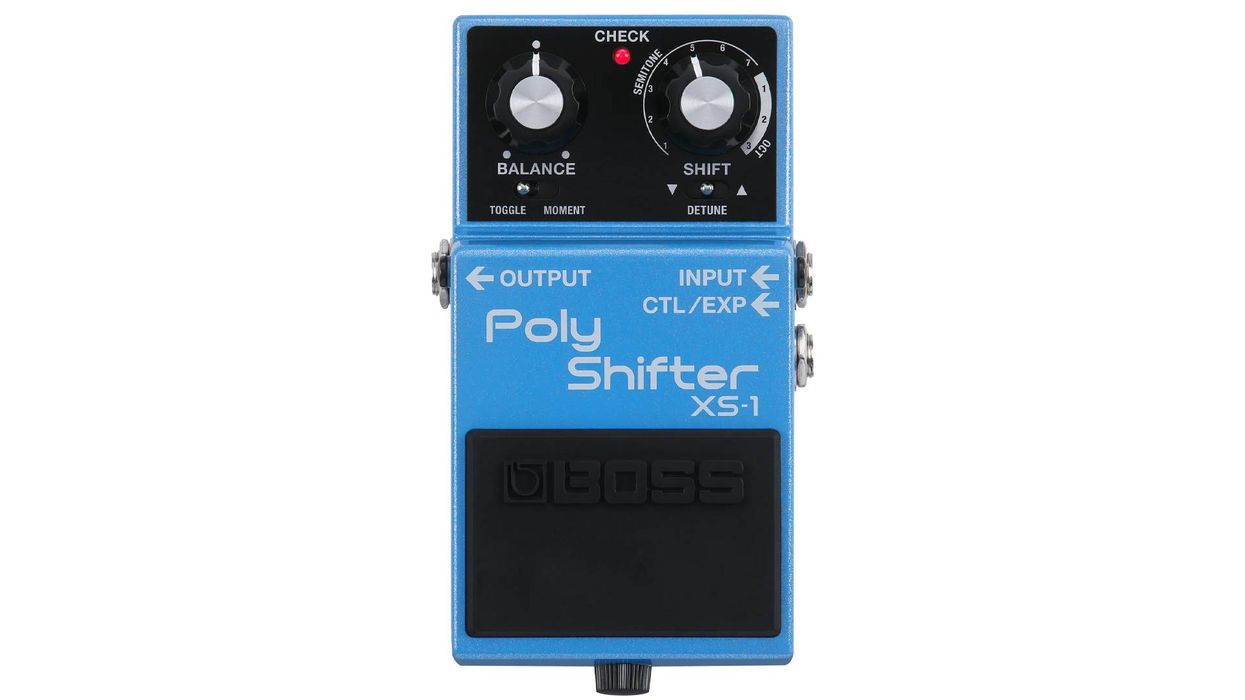
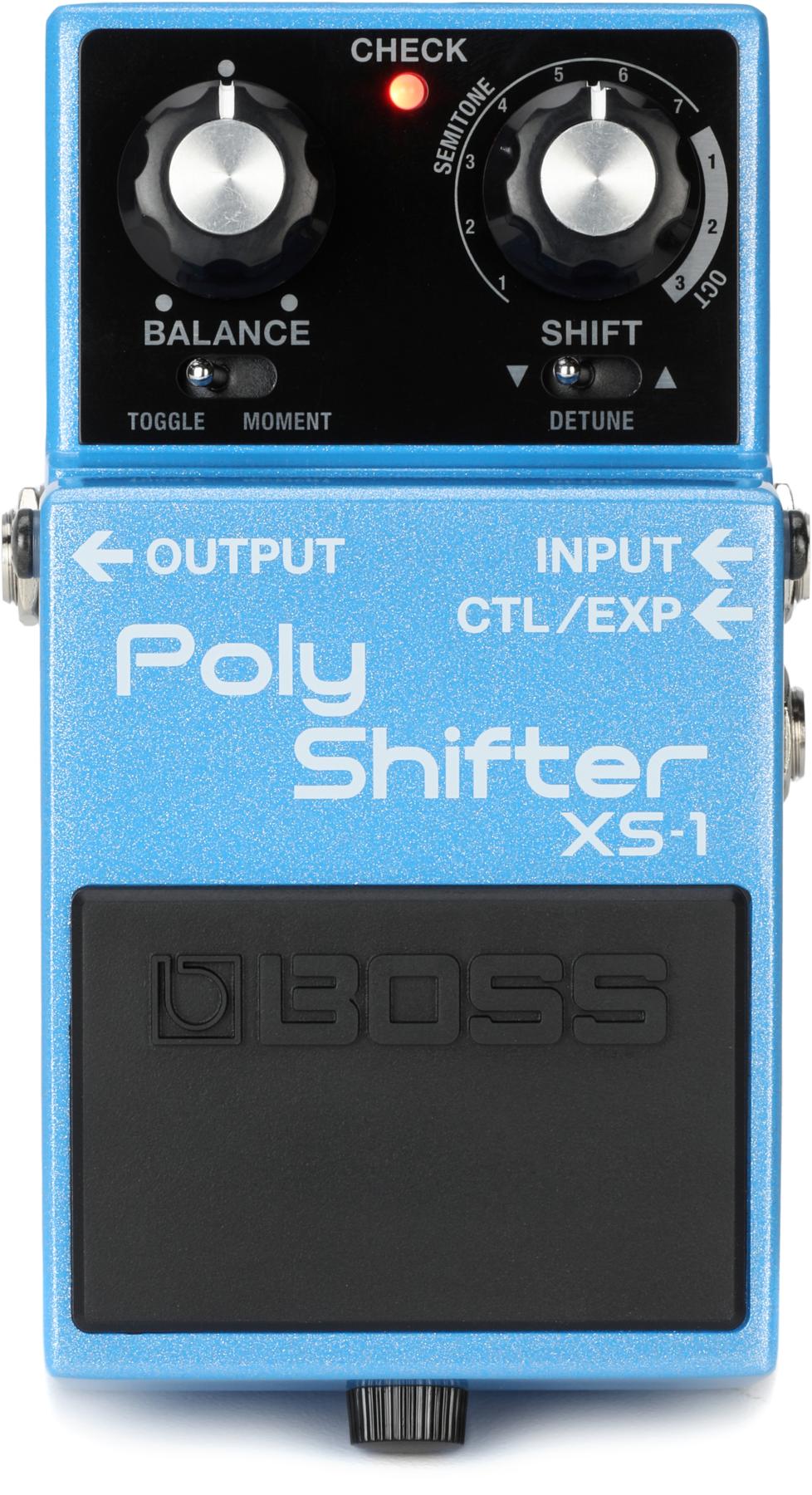
Any effect can color a guitar’s personality and language. But Boss’ new XS-1 Poly Shifter literally stretches the instrument’s vocal range. With the ability to shift input by +/-3 octaves or semitones, it can turn your guitar into a bass, a synth, or a baritone, or function as a capo. It also seamlessly generates harmonies for single note leads and keeps up with quick picking without any apparent latency. Furthermore, the pedal is capable of stranger fare that stokes many out-of-the-box ideas. But if you’re a guitarist that plays more than one role in your band—or musical life in general—the XS-1 can be a utilitarian multitool, too. It’s a pedal that can live many lives.
- YouTube
The XS-1, which was released alongside its bigger, more intricate sibling, the XS-100, is an accessible route to exploring pitch shifting’s potential. Housed in a standard Boss enclosure, it doesn’t consume a lot of floor space like the XS-100 or DigiTech’s Whammy. And while it achieves this spatial economy in part by forgoing a built-in expression pedal (which could be a deal breaker for some potential customers) it’s still capable of +/- seven semitones and a +/- three-octave range that can be utilized in momentary or latching applications.
Slipping, Sliding, and Twitching
Though digital pitch shifters have always been capable of amazing things, early ones sounded very inorganic at times. High-octave sounds in particular could come across as artificial, like the yip of a robot chihuahua plagued by metal fleas. Some very creative players use these colors—as well as the most sonorous pitch shift tones—to great effect (Nels Cline and Johnny Greenwood’s alien tonalities come to mind). In other settings, though, these older pitch devices can be downright cringey.
“The pedal clearly represents several leaps forward from first-generation pitch shifters.”
The XS-1 belies digitalness in some octave-up situations. But the pedal clearly represents several leaps forward from first-generation pitch shifters. Tracking is excellent and shines in string bending situations. Semitone shifts can provide focused harmony or provocative dissonance depending on the wet/dry mix and which semitones clash or sing against the dry signal. At many settings the XS-1 feels alive and organic, too, with legato lines taking on many of the touch characteristics of a violin-family instrument. You get far less of a note-to-note “hiccup,” and glissandos take on a beautifully fluid feel—with or without a slide—letting the XS-1 deliver convincing pedal- and lap-steel-style textures when you add a single octave up. (Such applications sound especially convincing when you kick back on guitar tone and restrict your fretwork to the 3rd through 5th strings, which keeps digital artifacts at bay.)
Mixmaster Required
The most crucial XS-1 control is the mix. For the most convincing bass, baritone, and 12-string tones, you’ll want a fully wet signal. But composite sounds can be awesome, too. You can use the control’s excellent sensitivity and range to highlight or fine tune the prominence of a consonant harmony. But it’s sensitive enough to make blends with dissonant harmonies sound a lot more intentional and integrated. And many of these eerie, wonky, off-balance textures are extra effective when introduced in quick bursts via the momentary switch. (That switch can also deliver great flashes of drama with more consonant harmonies—like dropping in a 3rd or 5th above a resolving chord in a verse.)
You can get creative in other ways using dissonant blends. Droney open tunings can yield fields of overtones that sound extra fascinating with delay, reverb, or 12-string guitar… or all of them! Dialing in blends that really work takes some trial and error, and you’ll definitely hit a few awkward moments if you’re navigating by instinct alone. But those same experiments often uncover real gems—especially in the pitch-down modes, which tend to produce more mysteriously atmospheric textures than their pitch-up counterparts.
The Verdict
Boss’ most straightforward pitch shifter covers a lot of ground. If you play in a duo, trio, or small band, it can expand that collective’s stylistic and harmonic range. It’s small, at least relative to treadle-equipped pitch shifters, so if you’re not a pitch shift power user, you don’t sacrifice a lot of room for an effect you might only employ occasionally, and you can still use the expression pedal jack to hook up a pedal for dynamic pitch control. The $199 price puts it in line with competitors of similar size and feature sets, but the XS-1 is a great value compared to more elaborate, treadle-equipped pitch shifters. If you’re taking your first forays into pitch shifting, or know that you need only the most straightforward functions here, it will ably return the investment. And along the way, it might even unlock a whole cache of unexpected tonal discoveries.