
Preparing to record the Tedeschi Trucks Band’s sixth studio album, Derek Trucks and Susan Tedeschi thought it was time to try something different.
“We were ready to change it up,” says Trucks. “We’ve done a lot of records where the band rolled into the studio and followed the muse. We play 100 shows a year, and we know what we can do by just letting it rip, but we wanted to get some outside ears and try something new.”
The resulting album, Future Soul, is diverse and song-oriented, with all tracks under five minutes and covering a wide range of material, from the opening riff of the funk-driven “Crazy Cryin’” to the last notes of the beautiful, lilting album closer, “Ride On.” In between, they evoke Delaney & Bonnie, JJ Cale, and their own extensive catalog. “Be Kind to Me” sounds like a blues run through a Beatles filter, while “Devil Be Gone” is, amazingly, the first straight shuffle TTB has ever recorded.
That song features the couple trading guitar licks, before Tedeschi’s solo takes flight with stabbing single-note lines. It’s one of many moments where the guitars shine, and where the live solos will be far more extended, with the studio version evoking jams but focused on the song structures.
“It feels like a healthy growth and shift for the band,” says Trucks. “I’ve enjoyed listening to this record from top to bottom more than anything I’ve ever done. I find the tunes really compelling.”
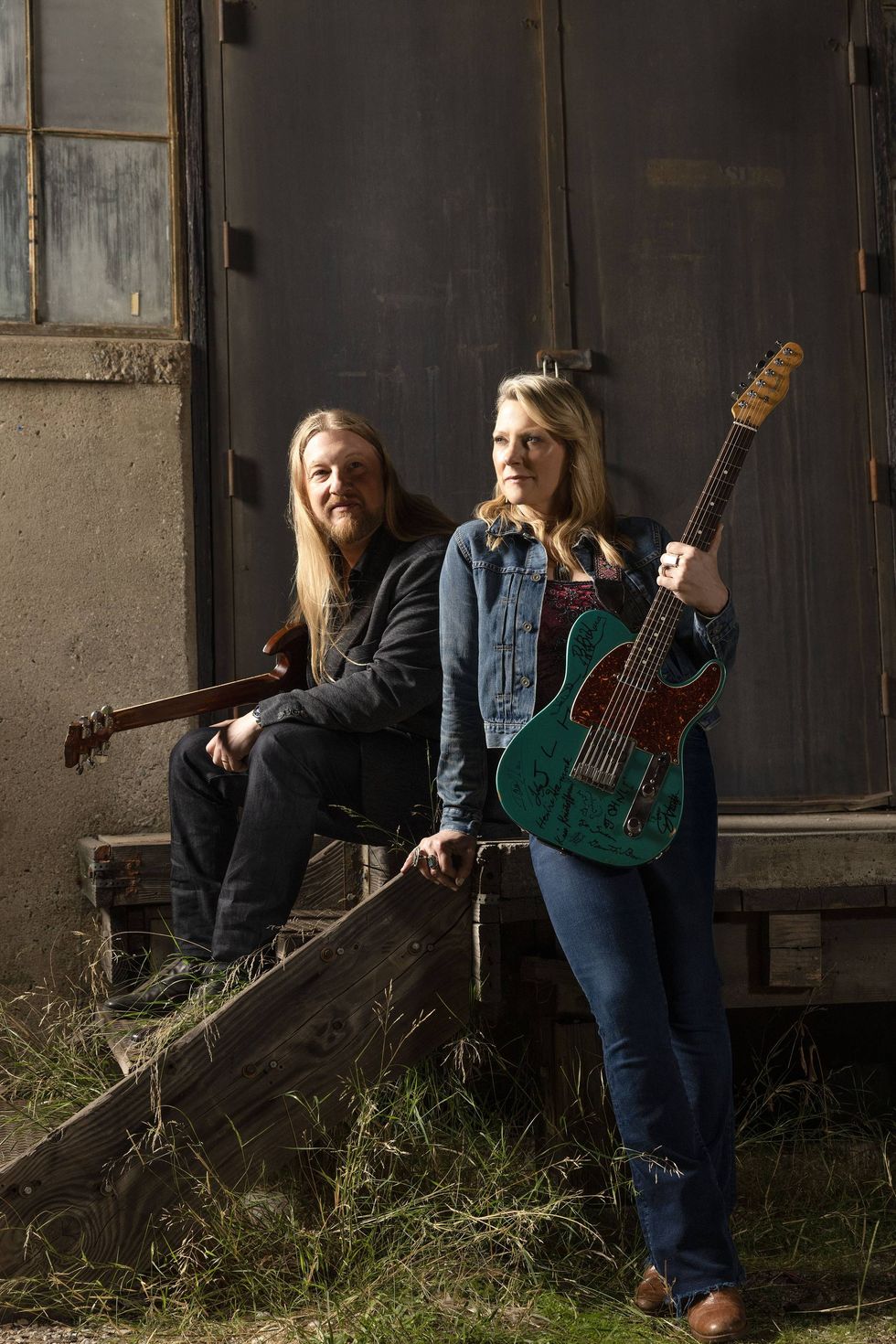
Trucks with Tedeschi, holding her original 1993 Fender Telecaster in Caribbean Mist, the guitar her signature Fender Susan Tedeschi Telecaster model is based on.
Photo by Chapman Baehler
Derek Trucks' Gear
Guitars
Trucks’ main guitar is a Gibson Custom Dickey Betts SG (Artist Proof #4) model, which he plays the vast majority of the time both onstage and on Future Soul. Other guitars on the album include:
- 1964 Gibson ES-335
- 1959 Gibson Flying V
- 1960 Gibson Les Paul Standard Sunburst
- 1945 Gibson “Banner” J-45
- Martin D-18
Amps
- Fender Vibroverb
- Supro S6422TR
- Silvertone 1484
- Leslie 16 speaker cabinet
Effects
- Interstellar Audio Machines Octonaut Hyperdrive
- Tycobrahe Octavia
- Fender ’63 Reverb
- Maestro Echoplex EP-4
Strings & Slide
- DR Pure Blues (.011-.046)
- DR Veritas (.012-.056, for acoustic)
- Dunlop Blues Bottle Slide
Trucks says that touring the world with Eric Clapton in 2007 in a band that also featured his friend Doyle Bramhall II, Steve Jordan, and Willie Weeks, helped give him “a whole new appreciation for the power of a great song.”
“Of course, a great melody was always important to me, because when you’re soloing, that’s what you’re thinking about,” he says. “But it’s realizing that there’s also a way to distill those elements down into something that’s meaningful and feels good to people, and I feel like we’ve done that here.”
Tedeschi and Trucks constructed Swamp Raga Recording studio in their Jacksonville backyard, and it’s where they’ve tracked all their recent work. They cut most of Future Soul there as well, but this time, rather than Derek producing the album alone, with his trusty wing man, Bobby Tis, engineering, they brought in Mike Elizondo to co-produce, and finished the album in sessions at his studio outside of Nashville.
“I wanted to hear a fresh take on our music, and maybe be a little more current-sounding,” says Trucks.
“I've enjoyed listening to this record from top to bottom more than anything I’ve ever done."
The Tedeschi Trucks Band’s previous studio effort, 2022’s I Am the Moon, was actually a four-album concept record, which retold the story of Layla from the woman’s perspective. Trucks regards the four releases as being a single album, and while he says he “loved doing a concept record,” he also notes that “people don't have attention spans the way they used to.”
“It’s a different world now, so you have to meet people where they are,” he says. “And then you get them out to shows and dole out the medicine in a different way. We can stretch out as much as we want onstage, but we wanted to really use the studio to craft the music in a different way. It made us remember the original reason that we built a studio in the first place—understanding that what you do in there is a different outlet than the stage, and it’s okay to approach it as such.”
Figuring out how to use the studio in this manner led them to work with Elizondo, whom Trucks met when Elizondo was playing bass with Bramhall. Together, they sought out different guitar sounds, experimenting with different instruments, amps, and even a few pedals—a notable departure for the famously minimalist guitarist, whose tonal manipulations usually reside strictly in his fingers.
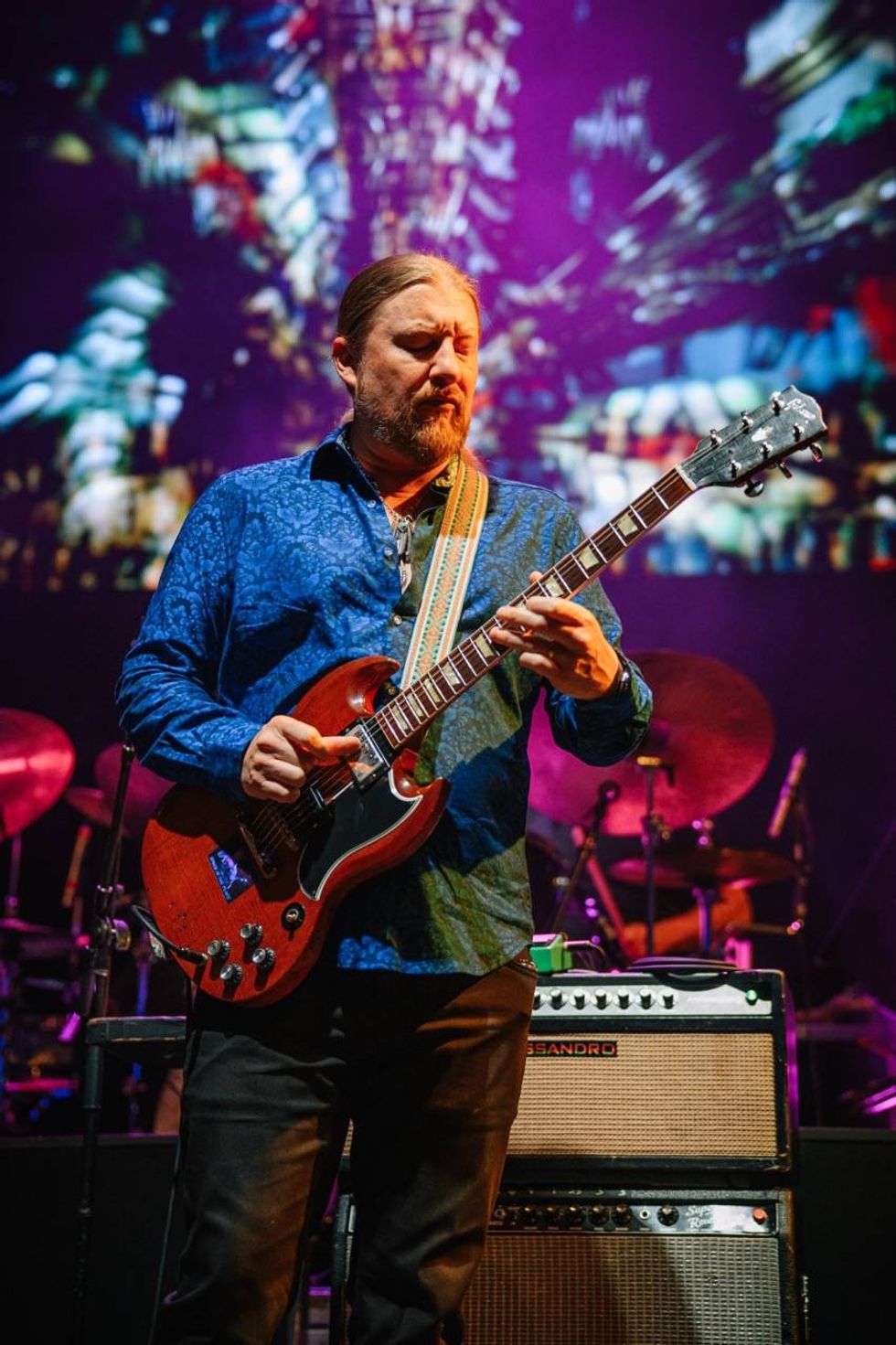
“We can stretch out as much as we want onstage,” Trucks says of the live TTB experience.
Photo by Bradley Strickland
Susan Tedeschi's Gear
Guitars
- 1993 Fender Telecaster
- 2011 Gibson Custom Shop “Beano” Les Paul
- 1960 Les Paul Standard Sunburst
- 1960 ES-335
- 1970 Fender Stratocaster
- Martin 00-17
Amps
- Fender Deluxe
- Supro 6498 VR
Effects
- Vox Wah
Strings & Picks
- D’Addario EXL115 XL Nickel Wound (.011-.049)
- D’Addario EJ16 Phosphor Bronze Acoustic Strings (.012-.053)
- Fender Classic Celluloid heavy picks
Trucks has had the core of his sound locked in since he was 12 years old, and though specifics have changed, the basic approach has not: a Gibson SG tuned to open E, straight into a tube amp played with his fingers. His most notable changeup comes on “Future Soul,” the album’s title track, which was written by singer Mike Mattison.
“When Mike brought that tune in, the laptop demo sounded grungy and mean as hell, and I wanted to replicate that feel,” Trucks says. “I wanted the solo to feel like a building that’s about to blow apart.”
To achieve that sound, he played a ’59 Gibson Flying V through a Tycobrahe Octavia pedal into a Fender Vibroverb.
“We were able to maintain the spirit of Mike’s demo, which reflects the song’s lyrics,” says Trucks. “It’s about being frustrated with the world we live in, and realizing that the way we think about music and art is not really the way most people think about it. It sometimes feels like the walls are collapsing and AI is coming for us all. The first thing that came to mind when I heard the song is that it’s a changing landscape, and we just hope that the thing that we do has a place in the future. I think it does, but it’s okay to be cranky about it.”
That, he explains, is what the line “I hope your future has soul” means to him. Mattison, who has been a key collaborator since he joined the Derek Trucks Band as its lead singer in 2002, wrote or co-wrote six of the songs on the new album, including the propulsive, catchy “I Got You,” on which both his acoustic guitar playing and humming are featured.
“I wanted the solo [on the title track] to feel like a building that’s about to blow apart.”
“Mike said he was hearing some two-guitar, Allman Brothers-style harmonies on the song. He was humming the guitar parts and I was like, ‘Let’s just keep it that way!’” Trucks recalls with a laugh. “There was something that felt a little more unique about it to me that way.”
Elsewhere on the album, Trucks played a 1964 ES-335 and a 1960 Les Paul, which his former boss Eric Clapton gifted him at the 2023 Jeff Beck tribute concert in London. “I’m scared to take that guitar on the road, so I play it in the studio when I can,” he says.
Trucks also used acoustic guitar to create layers, with some of them played by Mattison and some by Trucks himself, on a Martin D-18. “There are a few acoustic tunes, but on about half of the others it’s just hidden in there for propulsion,” he says. Elsewhere, guitars are sometimes mixed low enough to be almost subliminal, or function similar to an organ patch or string part.
Part of what motivated Trucks to focus on the themes explored in “Future Soul” was the frequency that friends—“really smart people”—were sending him links to photos and videos that he immediately was “sure were 100 percent bullshit.”
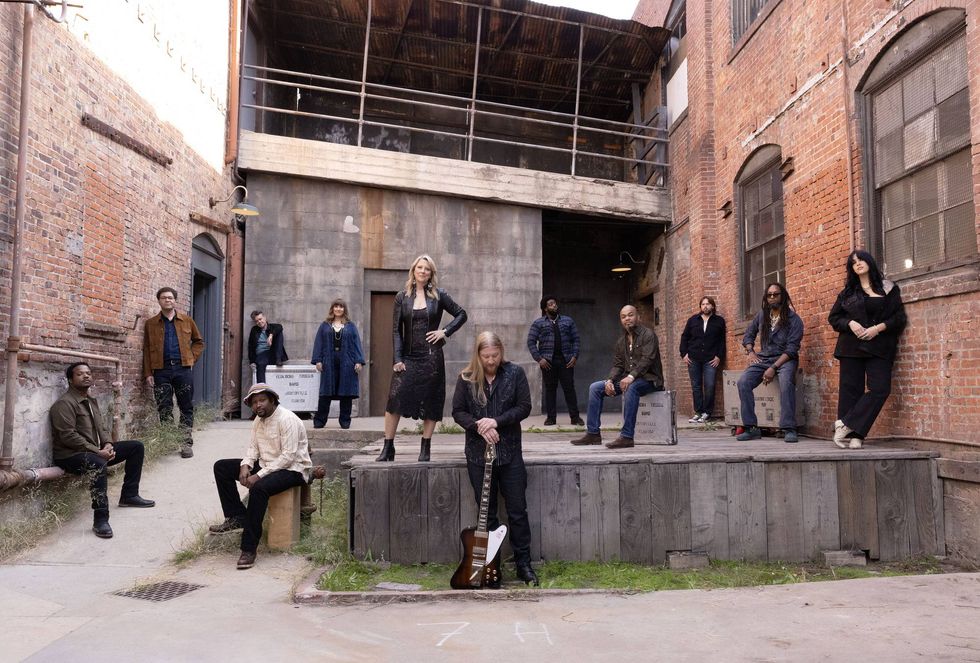
The 12-member-strong Tedeschi Trucks Band.
Photo by Chapman Baehler
It’s a confusing world, Trucks notes, which only makes live music played with an old-school approach more valuable to all of us. It’s an undeniably human, emotional experience to stand in front of Tedeschi as she belts out a tune backed by Trucks and his SG, with a 10-piece band pushing and pulling behind them.
“In our current world, I think the things that are true and honest become more valuable and more important to keep that way,” Trucks says. “I’ve been on a kick of listening to Mississippi John Hurt and Mississippi Fred McDowell, just old guys with a guitar, singing, and cut to acetate. Sometimes, we just need to get back to the basics to clear our heads and reset.”
In addition to “maybe sounding a little different,” Trucks says, he wanted Future Soul to have a different visual look. The cover was designed by artist Mark Sasso, who has created art for comic books like Iron Man, Spider Man, and X-Men, and worked with bands including Judas Priest and Mötley Crüe. The cover mimics a 1950s vision of the future, with Derek and Susan as superheroes striding through a city under attack.
“The idea was to create the look and feel of what people in the ’50s or ’60s thought the future would look like,” Trucks says. “The whole concept came into focus once we settled on the title Future Soul, and Mark just ran with it to create this image of the world burning and the band as characters in the Marvel Universe.”
“In our current world, I think the things that are true and honest become more valuable and more important to keep that way.”
When the cover was released beside the first single, “I Got You,” there was backlash from some fans. This surprised Trucks a bit, since he notes that the band has been issuing music for almost 20 years and probably “hasn’t heard from two people about the art on any of them.”
“We wanted to stir it up a little bit here,” he says. “I love doing what we do, but the whole idea of this record was to expand a little and bring people in. There’s something beautiful about people feeling like they have some ownership of you and your career, but the part that gets a little difficult is they can forget that there’s a human element, too.”
It’s a conundrum Trucks has been navigating since he first hit the road professionally at age nine. At every stage, some hardcore fans have grown attached to what he was doing and bristled when he changed.
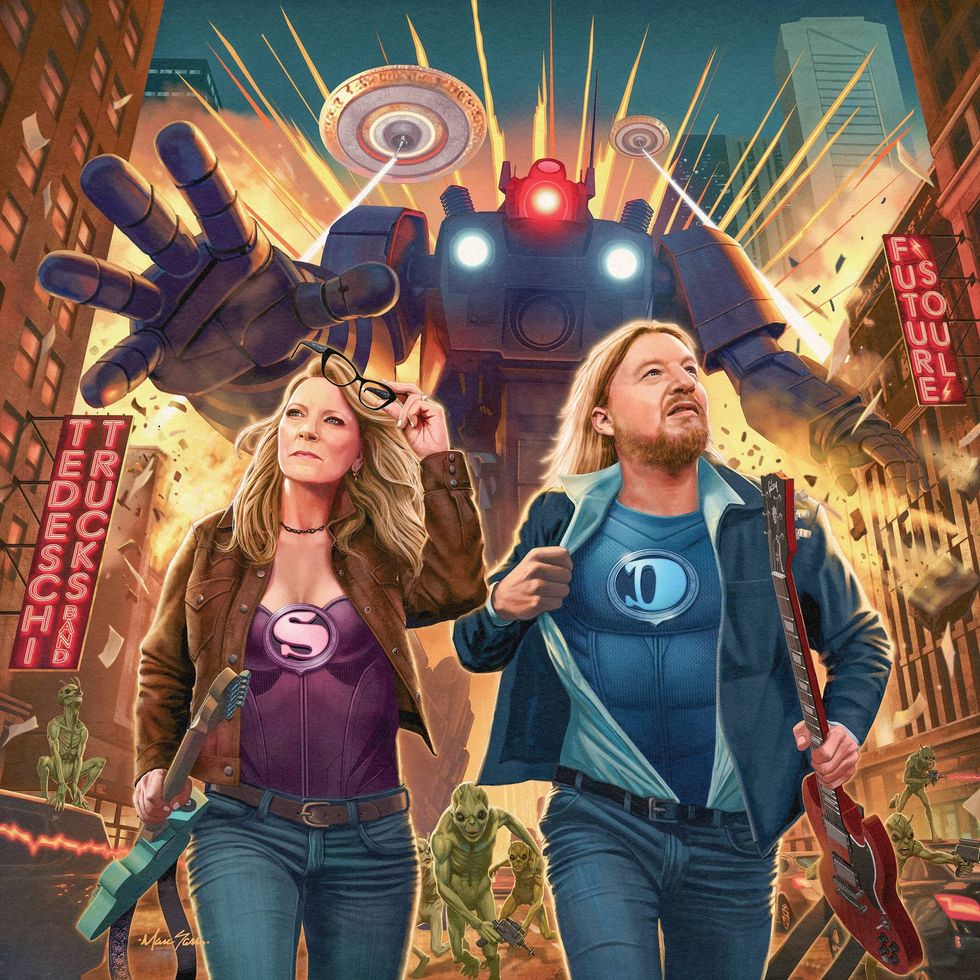
The album cover for Future Soul was designed by artist Mark Sasso, who has created art for comic books like Iron Man, Spider Man and X-Men.
“When I first started playing instrumental music and not playing ‘One Way Out’ every night as a child, there were people asking what I was doing and saying it was awful,” Trucks recalls. “I also remember the blowback when we first put Tedeschi Trucks Band together, and there were just awful things said about Susan.
“People called it a money grab, which proves that they’re not very good at math. When you go from a four-piece band to a 12-piece band playing the same venues, it’s anything but that! It can be shocking to realize how people perceive things, but those times are when you’re making some headway, doing something that’s valuable, and moving the needle.”
“The whole idea of this record was to expand a little and bring people in.”
The band experienced more blowback in 2023 when they opted to play New York’s Madison Square Garden and Boston’s TD Garden instead of multi-night runs in those cities at the Beacon Theatre and Orpheum Theatre, respectively. “How many people would turn down an opportunity to play a sold-out Garden?” Trucks asks rhetorically. “Playing those venues was like a mythical childhood dream.”
All of these experiences have led Trucks to double down on trusting his own instincts and to make decisions with Tedeschi, his wife and musical partner, keeping a clear vision of their goals.
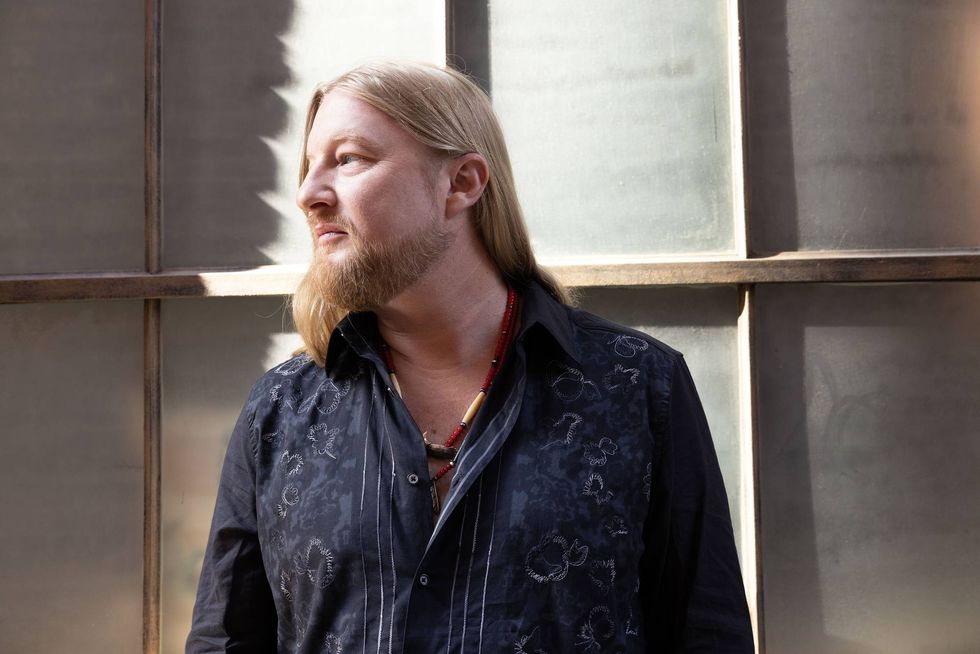
Photo by Chapman Baehler
“We’ve reached a point as a band where if we’re going to make a record, there’s got to be a compelling reason to do so,” he says. “You don’t want to make the same record over and over. I’ve never had the band down here and not enjoyed it, not learned a ton from it, and not come away feeling like it was beyond time well spent. But we’re not 20 years old anymore. I’ve been on the road for 35 years without more than a month off, other than the pandemic, and we run hard to keep a 12-piece band together.
“We’re on the road about 130 days a year,” he continues. “It’s a crazy life, and your time gets more and more valuable. Our son is 23, our daughter is 21, and we have a grandbaby on the way. Things start changing, and you lose friends, like Kofi [Burbridge, keyboardist], and realize in a very visceral way that we don’t have unlimited time. So, if we’re going to go in the studio and make a record, and spend a month or two where you’re neither off, nor on the road—because to be blunt, making an album is zero income and expensive as hell—it really has to be something that everybody believes in and you really mean.”
All that said, Trucks adds, “I think the more time that we spend out here in the studio, the more we’re realizing that it’s awfully fun to experiment. There are different ways to approach making records, and we try to make it count. I really feel like that’s what we did with Future Soul.”



![Rig Rundown: The Black Crowes’ Rich Robinson [2026]](https://www.premierguitar.com/media-library/youtube.jpg?id=66952027&width=1245&height=700&quality=70&coordinates=0%2C0%2C0%2C0)