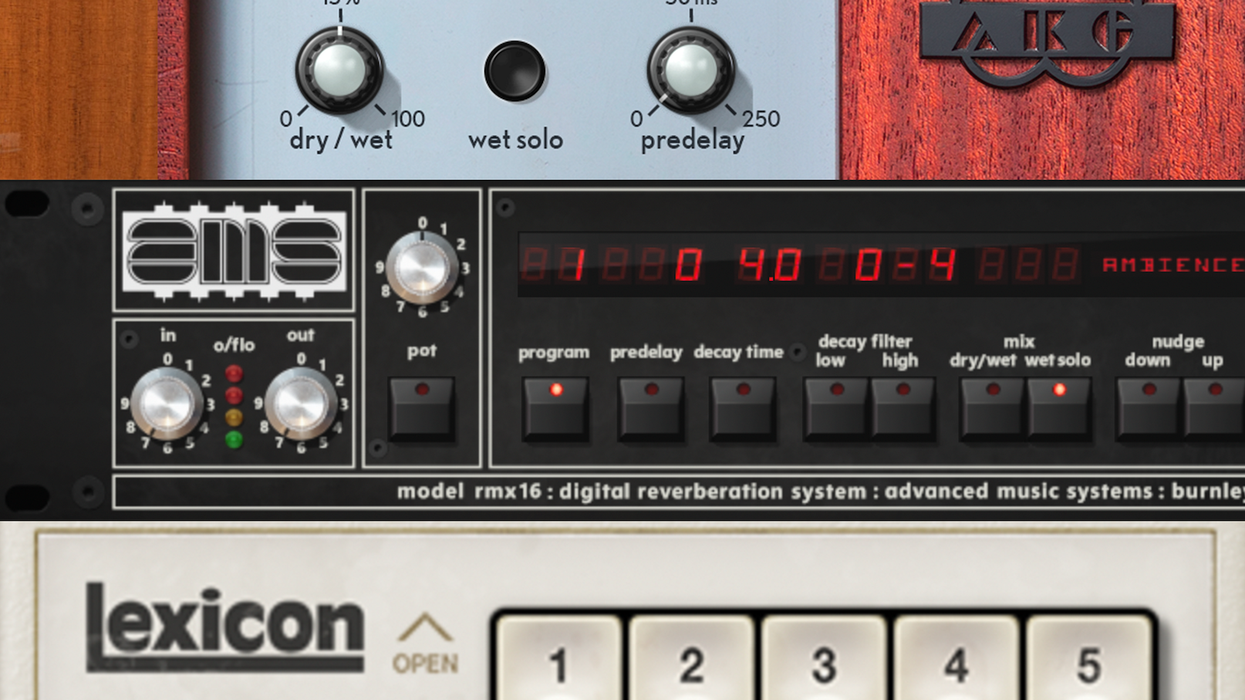


Welcome back to another Dojo. Tighten your belts, because this time we’re going back to literally ancient fundamentals, a tribute to the primordial physical spectre, the OG of all effects: reverb. I’m not talking about presets, brand/model names, or “this is what so-and-so uses.” (I’ve written about that already in my two-part article, “Reverb Therapy”). I’m talking about what reverb actually is, and how you can use its properties to make better recordings.
Reverb is something that we know intimately. It’s a physical property of life on this planet, but not so for outer space. Think about the luscious, reverb-drenched sounds of ion canons being fired toward other spacecraft in any sci-fi battle movie—that’s the “fi” part of sci-fi.
So, how does reverb occur on Earth? Well, we need a medium to carry sound, and the denser the better! For comparison, Earth’s atmosphere has roughly 100 million atoms per centimeter, while the atmosphere of outer space often contains only 1 to 10 particles per cubic meter. This is why in the vacuum (void) of outer space you don’t get reverberation. It’s just too sparse.
Back on Earth, at 68 degrees Fahrenheit, sound travels at approximately 1,126 ft. per second in air. But in water, it’s four times faster. I know what you’re thinking: “I was told there would be no math.” Worry not.
Sound is itself a pressure wave that requires particles to collide and transfer energy, passing vibration along in much the same way that water transfers rings of concentric waves when you drop a stone in a still pond. However, in air, those sound waves bounce off varying degrees of dense objects, intermingle, and further reflect at different times with decreasing levels of energy in four dimensions (length, width, height, and time) and create reverb. All physical spaces have reverb unless: A) you’re outdoors in an open field, or B) you’re in an anechoic chamber.
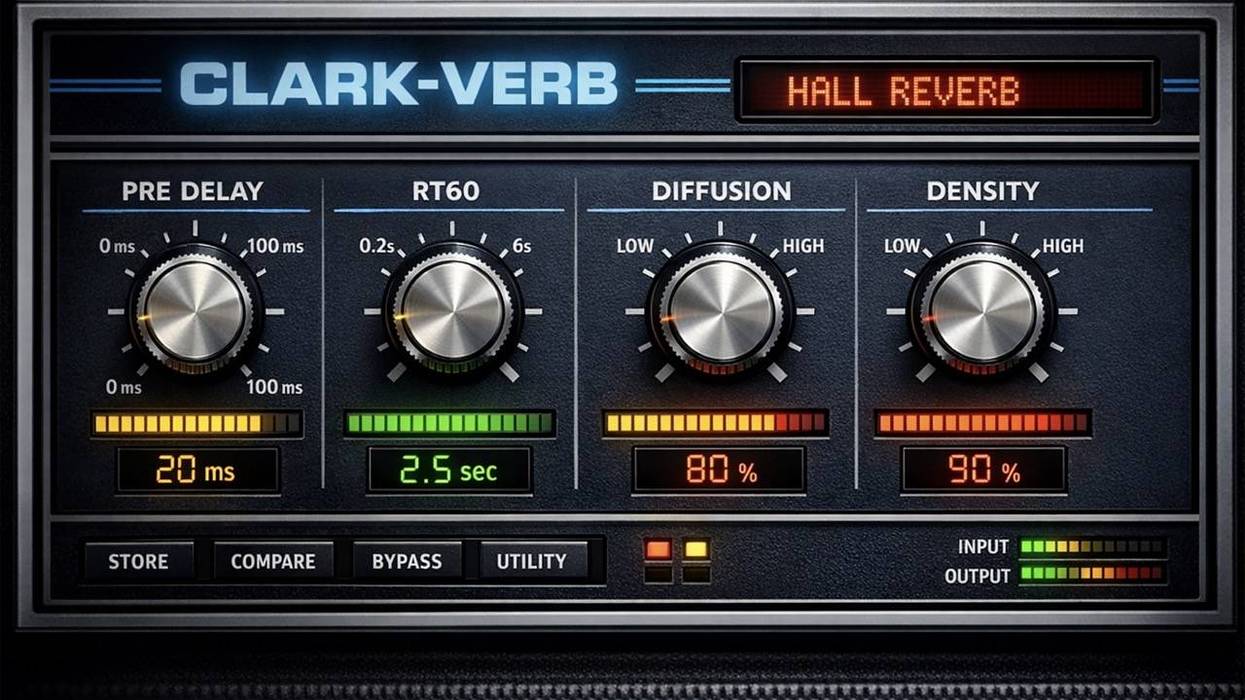
At its core, I define reverb (when using it as an effect) as a controlled explosion of sound reflections based on a static position. Once reverb begins, there are three main properties to focus on—RT60, density, and diffusion. Having a firm grasp on these three will help you make better use of your reverbs, regardless of whether they’re analog or digital.
Let’s break down the core parameters—not as knobs on a plugin, but as decisions you’re making whether you realize it or not.
RT60 is the big one. It tells you how long it takes for the reverb to decay by 60 dB (basically, how long it takes for the reverb to die out completely into relative silence). Put simply, RT60 = reverb time.
“At its core, I define reverb as a controlled explosion of sound reflections based on a static position.”
Diffusion and density are where things start to get interesting. They reveal the true timbral characteristics of the reverb. For example, a simple 2.5-second reverb time is not enough information for us to tell what kind of reverb it is. We just have the RT60, but the diffusion and density characteristics will let us know if it’s a plate, spring, hallway, stairwell, concert hall, digital version, or a hybrid of any of these. Obviously not all reverbs, particularly analog ones, offer an easy way to control these parameters. But digital reverbs can, with aplomb.
Let’s separate them cleanly first.
Diffusion refers to how quickly individual reflections lose their identity.
When a sound first hits a space, you don’t get a smooth wash—you get discrete echoes bouncing around. This includes the early reflections (pre verb). When the brain can no longer detect early reflections arriving individually, reverb starts (RT60). Diffusion controls how fast those echoes smear into a continuous field.
With low diffusion you can hear the hard surfaces of the “space.” The reflections feel grainy or even metallic. In extreme cases, you’ll hear little “pings” or fluttering artifacts. With high diffusion, the reflections blend together almost immediately. You don’t perceive individual echoes—you perceive a smooth tail. This is what most people think of as a “lush” or “silky” reverb.
Density is different. Density is about how many reflections exist within a given slice of time. Think of it as population.
Low density yields fewer reflections, so the space feels sparse. The tail feels thin, sometimes hollow. With high density, there are many reflections packed closely together. The tail feels thick, full, continuous.
So density is about how populated the reverberant field is over time.
Have fun playing with these parameters, and until next time, namaste.