
 | Download Example 1 Strat Clean - Bridge & Middle, vol. 7, tone 6. |
| Download Example 2 Strat Clean - Neck & Middle, vol. 8, tone 7. |
| Download Example 3 Strat Dirty - Bridge pup, vol. 9, tone 5 |
| Download Example 4 Tele Clean - Bridge pup, vol/tone rolled off slightly |
| Download Example 5 Tele/Orange Overdrive 2/Dirty - Bridge pup, volume/tone rolled off slightly. |
| Clips recorded through Vox AC30CC2 (unless otherwise noted) in Logic Pro on a MacBook Pro with Focusrite Saffire Pro 24, using Sennheiser e609 and Rode NT-1A mics. | |
We assume that even the functionally clueless can appreciate what a challenge that must have been, since in practice it means giving players the ability to bring home a new, US-made Fender for a price that is basically (once you’ve adjusted for inflation) a fraction of what a new American Fender electric used to cost, even during the heydey of American manufacturing—and at a time when so many foreign-made guitars have clearly demonstrated themselves as equals to their domestic rivals in quality, even exceeding many of them in value. To have an American-made Fender for the price of a foreign-made Fender in 2010 is some dream, and the fact that Fender appears to have pulled it off is, we think, a testament to the company’s determination to continue satisfying the demands of its customers even as those demands become more… well, challenging.
Finding the Line
Assessing the value these newcomers offer to working guitarists, however, turns out to be quite a challenge in itself. Fender has been very successful at its strategy of offering ever more variations on two of the most archetypal electrics in existence— namely the Telecaster and the Stratocaster— and there are nearly as many iterations of these storied instruments as there are kinds of players. The American Special series, like the Highway One and Classic Player series before it, isn’t out to offer an instrument so particular that it’s totally unlike anything already available in Fender’s lineup, so those looking at this new series will rightly wonder if they have anything new to offer, and if they justify replacing the trusted and well-worn Fender guitars already in their possession.
Quite a large number of players, though, have expressed a desire for an American-made guitar that doesn’t come at a premium price. And supplying that is something new for Fender, even if the instruments themselves aren’t a radical departure from previous offerings. At what point does the trade-off become reasonable? Street price for the American Special Series comes in right around $800, and Fender has numerous Mexican-made instruments at that price point—quite effectively blurring the line between USA-made and foreign-made instruments. So, the real question is: how important is the fact that they’re made in the United States? As we’ve said, props should be given to Fender for answering the call from players and addressing the desire for legendary American-made quality at a price that’s affordable. Indeed, the key ingredient in the American Special recipe is the “made in the U.S.A.” label, but that might turn out to be something of a shibboleth. Some players will only buy US-made guitars for ethical reasons, and want to feel that they’re supporting the American worker. Others purchase them based on the assumption that they’re of a higher quality simply because they’re made in the United States. For those to whom it means a lot, it means a lot, but for the price-conscious buyer looking for a workhorse Fender electric with which to pay the bills (or at least some of them), it’s less clear how important that will be. What is important is how they measure up in quality to their more expensive domestic brethren, and whether they’re on par with Fender’s top-of-the-line foreign-made models.
With the number of models Fender currently produces bearing the Strat and Tele namesakes, it’s best to compare the American Specials to those they have most in common with: the American Standard series and the Mexican-made Standard and Highway One lines.
Comparing Offerings
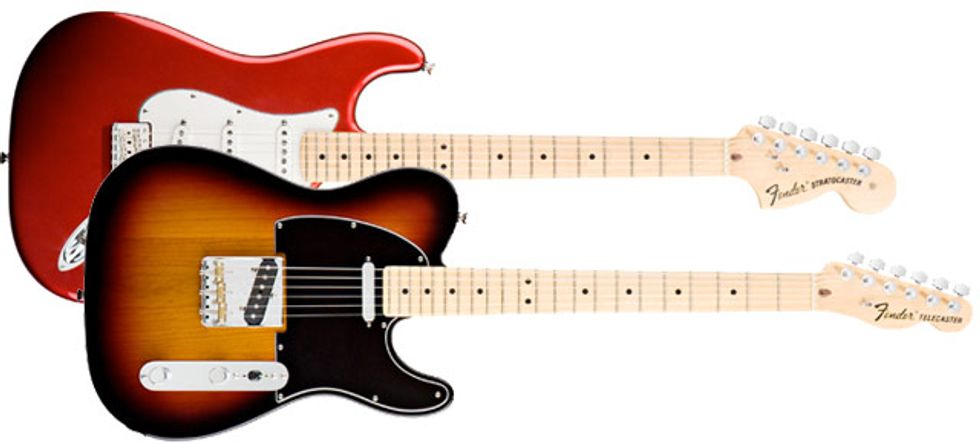
In relation to its south-of-the-border brethren, the American Special Strat and Tele both have some subtle yet apparent differences. There are 22 frets instead of the Standard’s 21, and the fret size is full jumbo, as opposed to the medium jumbo on the Standard. Like the Standard, the American Special features a standard truss rod and no micro-tilt adjustment. The neck is finished in a satin urethane and capped off with a large ‘70s-era Fender headstock, but it has a different feel compared to the satin urethane neck of the Mexican Standard. Part of that difference might be due to the extra 1 mm of width at the nut—this might seem like a trivial thing to note, but players used to the 42 mm spacing of other Fenders might wonder why the neck feels a little strange to them. In most every aspect of the neck, the American Special is closest to the Highway One line. Another important detail to point out is that, like the Highway One, the American Special offers only a maple fingerboard on the single-coil Strat (the American Special HSS Strat board is rosewood), whereas the Standard and American Standard models have a rosewood option.
Finish options for the American Specials are minimal compared to those offered for both the Standard and American Standard models, with only two available for each model, compared to the former’s five and the latter’s seven. The American Specials we received for review do indeed display high-quality gloss urethane finishes— as good as any Fenders we’ve seen. Like many players, this pair of reviewers leans toward nitrocellulose finishes, when they’re available, for the sonic qualities those guitars exhibit. In this regard, we think the Highway One models might have a leg up for many, but there’s no lack of guitarists who’d rather have a glossy finish.
Stratocaster
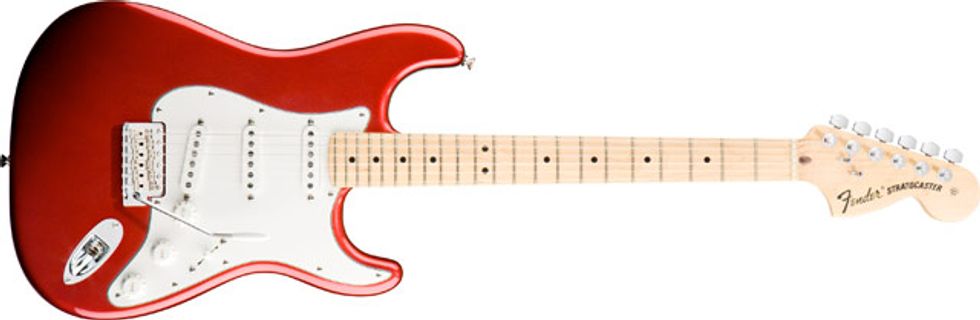
The Standard Stratocaster is equipped with a set of ceramic magnet-powered singlecoil pickups, but the American Special Strat ups the ante with Fender’s popular Texas Special pickups, and it shares Fender’s unique Greasebucket circuit with the Highway One line. The Greasebucket wiring allows the player to roll down the Tone control without adding any bass to the sound, a problem that is the bane of many a single-coil guitarist. It works as described—though it’s more effective on the Strat than the Tele, which does drift toward muddiness as you roll the knob down. Another major difference is the bridge: where the American Standard model utilizes a 2-point vibrato with bent steel saddles, the Special comes fitted with a vintage-style bridge that is similar to the one employed on the Standard.
Telecaster
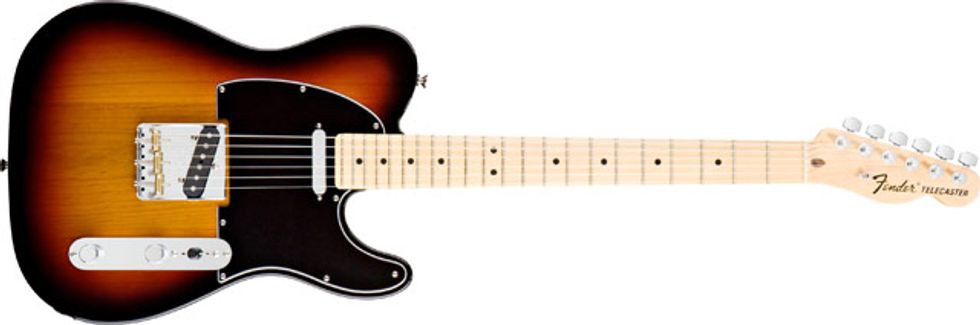
Obviously, the Telecaster is a very different beast from its Stratocaster cousin. The American Special model has a major element in common with its original ancestor, and that is the inclusion of a string-through vintage-style bridge with three brass saddles supporting the six strings. We’re big fans, and we applaud Fender for the decision. In comparison, the Standard Telecaster has a modern style bridge with individual saddles and a string-through body. While the added coupling from the string-through design helps with sustain, the brass saddles from the American Special Tele help it fit more in line with the vintage, bright and twangy sounds of yesteryear. Like the American Special Stratocaster (and the Highway One Tele), it features Fender’s Greasebucket wiring, an additional 1 mm at the nut, Jumbo frets, Texas Special pickups and an additional 22nd fret.
Playability and Tone
Any player with some real mileage on the odometer, who’s not a newcomer to Fender, will have developed some preferences where the Stratocaster and Telecaster are concerned, and it’s for certain that one of the trade-offs that makes the American Special series possible is a limited set of options. For players who find these guitars chock-full of their favorite features, they’re sure to be more satisfying than for those who gravitate toward different specs. In the interest of full disclosure, this pair of reviewers has to admit we find ourselves a little more in latter camp. We do tend to be more finicky about Strats than Teles—a disposition that is not uncommon. It may be simply the fact that the Tele is in many ways a much simpler instrument, while the Strat has always been, in the succinct words of one of our colleagues, “a delicate balancing act.” We tend to prefer rosewood boards on our Strats, but we like maple just fine on our Teles. Neither of us is crazy about the super-size frets, though we’re more agnostic when it comes to the larger headstocks and the differences between the 2-point and vintage-style tremolo systems.
Both American Specials did require significant setup work upon arrival, but both yielded gracefully to the undertaking. They are as accommodating and playable as any of their like, and the modern C-shaped neck is comfy and familiar. The fretwork is good, and the Texas Special pickups on both guitars obediently delivered the signature tones we were looking for when we plugged them into a Vox AC30CC2. The Strat has plenty of quack in the notched positions; the bridge pickup has just the right amount of cutting bite without the harsh brightness; and the neck pickup offered up a characteristic bluesy swagger. All three are balanced well with each other in terms of output, and they clean up nicely when you roll the Volume knob off. Our only reservation here is with the taper of the Strat’s volume pot, which leaves a little to be desired in terms of its evenness and usefulness for volume swells.
Like the Strat, the American Special Tele’s pickups are on the hot side, with plenty of sizzle. They too are well balanced, though they tend much more toward modern sounding even with the traditional bridge. The brass saddles do seem to provide all the snap and bite we like to hear in a Telecaster, and they didn’t frustrate our efforts to achieve a workable intonation. We didn’t like the sound of the bridge pickup with the Volume and Tone knob maxed (a go-to setting for both of us) as much as we wanted to, but we have to admit we’ve been fairly spoiled by the sound of the Mexican-made Road Worn ‘50s Telecaster we acquired last year. It has bona fide vintage tone and a degree of subtlety and tonal versatility that’s hard to compete with. Despite that, the American Special Telecaster does have what it takes to satisfy many, if not all, Tele afficionados.
The Final Mojo
We found the build quality, fit and finish of the American Special Stratocaster and Telecaster to be on a par with many of Fender’s top Mexican-made offerings, but we can’t say they’ve exceeded them. For the price, that means a good, solid value—provided buyers aren’t set on having a wider variety of options available to them. Those who do know exactly what they want in an über-reliable Fender axe would probably do well to consider the long-term benefits of stepping up to an American Standard, even if it means a little more money.
Buy if...
these specs make your heart go pitter-patter, and a “Made in the U.S.A.” label is essential.
Skip if...
you’re looking for a number-one Fender electric that’s just the way you want it.
Rating...


| Street $799 - Fender - fender.com |




![Rig Rundown: The Black Crowes’ Rich Robinson [2026]](https://www.premierguitar.com/media-library/youtube.jpg?id=66952027&width=1245&height=700&quality=70&coordinates=0%2C0%2C0%2C0)