After a devastating theft in 2021, the metal band’s guitarist rebuilt his tone empire around some life-changing loans.
Chicago post-metal band Russian Circles had to battle their way back to gear heaven. In 2021, the bulk of the band’s gear was stolen while on tour, leading to a years-long rebuild. As a result, many of the items you might’ve seen in guitarist Mike Sullivan’s Rig Rundown back in 2017 are long gone.
PG’s Chris Kies recently met up with Sullivan at the band’s Chicago practice space, where they’ve resided for nearly 20 years. Check out some highlights from Sullivan’s new, resurrected rig below.
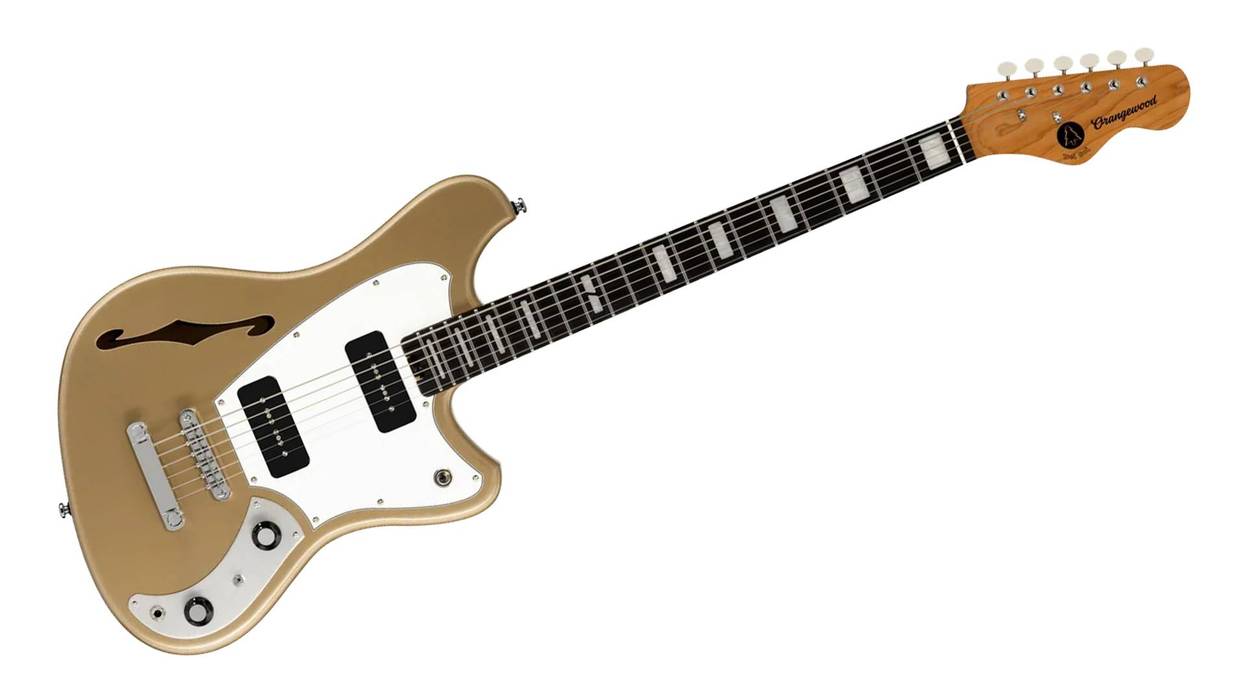
Sullivan has been favoring Dunable guitars of late, borrowing one from tourmate Chelsea Wolfe after his other guitar was nabbed. The green one is based on the Dunable Narwhal, with a more Gibson-like scale—comparable to Sullivan’s old Les Paul. This Narwhal has a mahogany body and neck, maple top, and a coil-tap function for the two humbuckers: a DiMarzio PAF 26th Anniversary and a DiMarzio Joe Duplantier Fortitude signature. Vibrating atop those pickups are D’Addario strings—a set of .011–.056, with the low E swapped for a .058. Sullivan uses a number of different down tunings, all with D-A-D-G-A-D as a starting point.
The white Dunable has a maple neck, a 25.5” scale, and is tuned lower, with a .062 for the low E string. It’s used for drop-A tunings, and has the same DiMarzio pickups.
Gettin’ Hi
Sullivan was turned onto Hiwatts after acquiring some on loan in the wake of the gear theft, and he hasn’t turned back since. The cabinets are loaded with Hiwatt Octapulse speakers.
Mike Sullivan’s Pedalboard
Sullivan runs two pedalboards. The first includes a Peterson tuner, Shure P9HW, Dunlop CBM95 Cry Baby Mini, DigiTech Drop and Whammy Ricochet, and MXR Phase 95.
The motherboard carries a Dunlop DVP3 volume pedal, a Friedman BE-OD Deluxe, Strymon Dig, TimeLine, and Flint, a T-Rex Image Looper, DigiTech JamMan Stereo, MXR CAE Boost/Line Driver, Foxrox Octron3, Electric Eye Cannibal Unicorn, Maxon Apex808, Fortin-Modded Ibanez Tube Screamer, and a Radial Shotgun Guitar Splitter and Buffer.
An all-analog flange and chorus with a lot of character.
Way back in the 2010s, before starting Mr. Black as his pedal-building outlet, when Jack DeVille was releasing effects under his own name, he created the Mod Zero. This multi-modulation unit covered flanging, chorus, rotary effects, and vibrato, and, with a limited run of 250 units, gained a reputation and is long sold out.
Although Mr. Black’s Mod.One is not that pedal, this all-original unit designed by DeVille follows a similar mission, and its reverential name is surely no accident. The Mod.One is a 100-percent-analog modulator that spans chorus, flange, and high-band flange with a unique control set designed for flexibility, sonic excitement, options and a lot of character.
Controls for the Curious
If you come to the Mod.One a little fuzzy on the differences between chorus and flange, here’s a brief explanation: Chorus is created using a slower set of delay times on a secondary, parallel signal. Flange uses shorter delay times, and high-band flange the shortest. On the Mod.One, a pair of knobs—one for lower limit and one for upper limit—allow users to set that range of delay times. The lower limit knob has a max delay of 31 mS and a minimum delay of 1.9 ms. The upper limit knob ranges from 1.9 ms to .5 ms. Within those ranges, you’ll find the difference between chorus and flanging, and the position of the two knobs, rather than a switch, determines which effect you’re using. Ultimately, I’m a firm believer that we should use our ears and not get hung up on definitions when listening to an effect. The Mod.One is a great example. Determining exact delay times and whether you’re chorusing or flanging is inexact but ultimately it doesn’t matter. What matters is what sounds good.
The lower limit/upper limit controls might frustrate purists that want to toggle between a clearly defined chorus and flange tone. But Mod.One’s controls, and its central premise, are all about sound sculpting and opening up creative options. And options abound: LFO speed, for example, reaches up to 20 seconds long when using the tap-tempo switch. Six waveform options also widen the sonic lane.
Let’s Get Exponential
The Mod.One is powerful in a literal sense. The active volume control provides plenty of juice, and is capable of really pushing whatever comes next in your chain. That lends a gooey vibe to everything that passes through the pedal. Whether you use that power to drive your amp or not, the combo of gain and all-analog circuitry give the Mod.One a warm, thick voice. This is not just another metallic-sounding flange device.
I found myself stomping on the Mod.One to add space and texture to rhythms, riffs, and leads that cover a lot of range. Sometimes, I was looking for subtlety—Andy Summers on “Walking on the Moon,” for example. For that, I kept the enhance knob, which determines the intensity of the effect, toward lower settings, and kept the speed on the slowest part of its range, which generates molasses-like movement. For more obvious results, I nudged the speed and enhance knobs. There’s a lot of play in each control, so it doesn’t take much to get things moving in a different direction. The enhance control can even self-oscillate at the top of its range, where more extreme sounds live.
Each of these controls interacts differently with alternate waveform settings, making the possibilities exponential. If there’s one complaint I have about the Mod.One—and I do think it’s just one—it’s that it’s hard to tell which waveform is selected. When experimenting by ear, that’s not the worst thing, but when searching for specific settings, it can be hard to tell if the single LED lights up in a sine, triangle, or other pattern. Eventually I got better at telling the difference, but I didn’t always nail it.
To get some ’70s pseudo-cosmiche tones for a recording project, I rocked the triangle, sine, and hypertriangle waveforms at varying levels of excess. And all three were useful for thickening up high-fretted chordage rather than just the crystalline kind of flange I tend to associate with Prince. I found true excess with the step wave selected and the enhance cranked to its fullest, and there are many experimental sounds to be heard in these wilder places. With so many variables at play, I know there is a lot to be discovered still, which makes the Mod.One compelling.
The Verdict
The Mod.One is a powerful flange and chorus with a strong, recognizable character and wide range. It’s not a do-it-all kind of modulator meant to compete with digital units. But this all-analog device can deliver texture to your sound at dosages that are easily controlled. The unique sculpting possibilities make it exciting and refreshing, and in my time with the pedal, I was impressed with how much I hadn’t yet discovered. It strikes a difficult balance between a quick learning curve and the kind of depth that’ll keep it in heavy rotation for a long time to come. It simply sounds excellent, too.
The similarities between Bad Cat’s light, compact, and versatile new Ocelot lunchbox head and its South American feline namesake make the amp’s moniker a truly apt one. A real ocelot is lean and agile, generally weighs around 20 pounds, and boasts incandescent eyes that glow when illuminated. It also packs a formidable bite quotient and can produce a loud, forceful roar or a softer, if no less menacing, close-range purr.
With its 2xEL84 power stage, and 3x12AX7 preamp, the all-tube, 20-watt Bad Cat Ocelot is similarly taut, lean, and light. The aluminum chassis features a dazzling front panel with orange stripes that glow when the amp is on. And plugged into either an 8- or 16-ohm cabinet, the Ocelot displays a talent for roaring British lead and crunch tones, as well as mellow-to-menacing, but cleaner California-style sounds.
It's also adaptable to almost every conceivable live, studio, and home environment, thanks to its internal speaker load, footswitchable 2-channel, dual-gain-mode versatility, the ability to shift from 20-watt to 1-watt operation with a single switch, and cabinet-simulated XLR and headphone outputs for recording and silent practice. Obviously, the Ocelot offers plentiful possibilities running straight into a speaker. But with software integration and editing capabilities via Two Notes software and their Torpedo DynIR multi-mic cabinet capture—which are deep and powerful tone-shaping tools on their own—the Ocelot shows just how wildly versatile a modern EL84 amp can be.
Prowling the Jam Jungle
I performed a 10-song live Hendrix set with the Ocelot, and while it was far from dimed, the amp hit every corner of the venue. The front-panel EQ with bass, middle and treble is responsive and varied enough to match what your ear wants and needs in most musical situations. The mid control has an especially nice range and moves readily between smooth American tones and British bark. In fact, the only problem with the EQ is not the EQ itself, but the fact that the cool, but very bright orange light on the front grille can make front panel adjustments hard to see.
Channel 1 is a clean machine. Add a dash of slapback delay in the Ocelot’s buffered effects loop, and rockabilly rave-ups and country double-stops on a Telecaster sound punchy and crisp. Choose the middle-bridge pickup combo on your Strat, hit a ninth chord or Curtis Mayfield-style third-based figures and you’ll conjure the spirits of Jimmy Nolen, Prince, Paul Jackson, Jr., and Nile Rodgers, all of which benefit from a whiff of very nice organic compression.
Bump Channel 2 into “hi” mode and you’ll wonder how 20 watts produces lead tones that loud and dynamic. It’s simply wicked.
Jazzbos and bluesmen will dig the Ocelot’s clean headroom, too. Neck and neck/middle position pickup configurations—along with a little guitar tone shaping—summon tones evocative of Otis Rush or Les Paul. Even surf and early garage enthusiasts can have a blast with Channel 1, which, via the included footswitch, can move between “lo” and “hi” gain mode—adding enough grit for Dave Davies, Link Wray, or Wayne Kramer speaker-tearing rages.
The Hum of the Forest
Channel 2, the higher-gain channel with dedicated gain control, is where many humbucker-oriented players will want to spend their time. And it’s here that the Ocelot pulls the Bad Cat formula into contemporary high-gain realms. Pickups as different as Gibson ’57 Classics, Seymour Duncan Hot Rails, and a brutal Duncan Nazgul set on a Schecter C-1 Standard are all capable of whiplash-inducing, djent-worthy wallop. Bump Channel 2 into “hi” mode and you’ll wonder how 20 watts produce lead tones that loud and dynamic. It’s simply wicked.
Interestingly, while the Ocelot/single-coil pairings come across as full-throated and dynamic (very much like Eric Johnson’s most singing tones) it was less sweet with noiseless single-coils. This is a subjective observation, but it’s worth investigating if you plan on matching noiseless units with the Ocelot.
Impulse Control
The Ocelot is Bad Cat’s first leap into the world of cabinet emulation and impulse responses. But this direct recording functionality is no afterthought. Bad Cat made solid choices here with the internal load box by working with Two Notes Audio Engineering to help design their cabinet emulations, and by using the company’s Torpedo software for remote editing.
In the interest of brevity, here’s what you absolutely need to know: Ocelot ships with six onboard cabinet emulations, selectable via a knob on the front panel. These are created with DynIR Virtual Cabinet Technology rather than as static impulse responses, and there are myriad options in the editing suite, including eight mic options for each cabinet, dual miking, variable mic axis, and up to 10,000 possible mic locations including front- and back-of-cabinet placings. All can be situated in a plethora of room and studio spaces. Ocelot can store up to 32 of these detailed DYNir Virtual Cabinets in internal memory. When connected to a computer (via the onboard USB-C port) you can use the cabinet manager in Torpedo to assign the IRs to Ocelot’s 6-way cab switch.
The Verdict
Given Bad Cat’s pedigree, the Ocelot’s top-shelf voicing is no surprise. But paired with Torpedo, it offers a standout, standalone direct recording solution that’s competitive with most offerings in that ever-evolving space. And where some power-scaling amps can introduce irritating quirks, the Ocelot’s 2-channel design makes tone crafting across many gain and power levels easy. The Ocelot's $1,200 price is modest for an amp that magnifies the character of pickups this accurately and sounds this velvety right out of the box. Its versatility might just make that price an outright bargain.
Though the business of cloning pedals is competitive (and endless fodder for frothing Reddit denizens), I appreciate when a pedal company offers a useful twist on an established formula.Warm Audio accomplishes this with the Throne of Tone. It is clearly inspired by theAnalog Man King of Tone. But it is also very obviously a nod to the Marshall Bluesbreaker, the pedal that Mike Piera used as a departure point for his KOT design. The Throne of Tone, though, might mark the point at which the snake bites its tail. It cross-pollinates the circuits in a dual overdrive that opens up many, many tone-coloring avenues and options.
Split Personality
Mike Piera ripped up a friend’s Bluesbreaker to build the first King of Tone. But by the time he rewired it, it was a different pedal altogether. To the extent that the KOT and Bluesbreaker sections are accurate in the Throne of Tone, the differences between the original Bluesbreaker and King of Tone are easy to hear. It’s hard to accurately assess the accuracy of the Throne of Tone’s two circuits without a real-deal King of Tone or Bluesbreaker at hand. But I’ve played through both as well as excellent clones, and in both sound and feel, both Throne of Tone circuits are in the ballpark and better.
In very general terms, that means the “king” side is a bit less aggressive, darker, and more dynamically responsive to changes in pick intensity—especially when you want to go from gnarly to truly clean. The “blues” side is a bit more dynamite, revved up, and lively in the midrange. It’s more immediate and a bit harder to keep on a leash for dynamic purposes. But the Throne of Tone is a great multiplier—and mixer—of these qualities, because you can experience each basic voice through the lens of high gain and low gain settings, a boost, an overdrive or a distortion. Additionally, output from each side can be modified with a presence control which appears on neither pedal in its original form. Add up the possible tone permutations and, well, you’ll probably be less occupied with the accuracy of the circuits, and more excited about harnessing the copious killer tones here.
Pick A Door
Of the three modes, the boost is the most user friendly and easy to apply to a base tone that just needs heft and body. It’s also great for demonstrating the basic duality in the king and blues voices—which align along a Marshall/Fender divide. The blues, or Marshall-like side feels considerably more compressed as a boost, but it positively rings in the high-mid zone. If you want a guitar to be boss in a mix it dishes the goods. But it’s agreeable too, and flattered PAFs, Telecaster single-coils, Wide-Range humbuckers, and a Rickenbacker 12-string—lending all of them an infectious, excited edge. Matched with an EL84 amp it can feel a touch redundant, but with 6L6 amps it shines. The king, or more Fendery side, sounds comparatively scooped. It feels much less hyperactive, and it excels in the clean, low-gain range, but it also gets squishy when you dig in.
These same qualities are very apparent in the overdrive mode. Each voice sounds more compressed than the boost mode. But the higher reaches of the gain controls yield treasure. Here again, the blues side was explosive—sounding at many settings like Malcolm and Angus Young after consuming a bag of firecrackers. Angry but fun. The king’s OD side, at high gain range, sounds much more like a mid- to late-’60s Bassman at high volume: crunchy, but softer around the edges. Each of these voices can be nudged into more savage extremes by the high-gain toggle, which depending on your amp and guitar, can be surprisingly airy to downright sizzly.
The distortion mode kicks the high-midrange in the pants, but retains much of the overdrive mode’s basic coloration. It’s an especially cool match for 6L6 amps—especially on the king side. But the way the distortion modes remain responsive to dynamic input like volume and touch variation is impressive. Distortions can often sound quite binary—either raging or gobbling up midrange oxygen. Both distortions in the Throne of Tone give you gray area to work with that can range down to chiming clean tones.
The Verdict
The original King of Tone and Bluesbreaker pedals are revered for good reason. And if Warm Audio’s take on the two circuits represents even 80 percent of those pedals’ prime tonality, you’ll still hear and feel what makes them special. As a whole, the Throne of Tone is adaptive and versatile. The kind of pedal that could save your hide and solve problems in a studio. But it could work the same magic in a live situation, especially one with a backline surprise in store. In performance, the vertically oriented mini toggles, which are situated perilously close to the bypass switches, could be a liability. I accidentally switched the gain and mode switches with my toe more than once. That’s a shame, because they make experimentation so much easier than when DIP switches are in the mix. It’s hardly a dealbreaker, though. For $229, the Throne of Tone offers a very big bucketful of tone options that can span civilized and rabid.
Attack—essentially the rate and intensity with which a note rises in volume from its point of creation—is one of the coolest musical expressions you can mess with. If you play an instrument from the violin family it’s a fundamental part of your vocabulary. It’s used frequently in synthesis to conjure spooky, low-gravity atmospherics, and it’s an essential tool for taking the front end off some psychotic Moog sound that might otherwise explode like a foghorn six inches from your ear.
Guitar players know the potential of this effect well too. Volume swells can drastically recast a guitar line—evokingreverse tape,pedal steel, and deep space. But doing it well is not easy. Even on guitars like theStratocaster that lend themselves to volume swells by design, it takes technique, practice, and usually a very flexible pinky finger to make it work right. Electro-Harmonix’s Swello, which has origins in the attack filter section of the POG2, can do a lot of that work for you. But it’s capable of more than simple swells, with the ability to generate envelope filter- and wah-like sounds, big synth-style pads that are ripe forlooping, and much stranger fare.
Swing in Smoothly
Though they can be mellowing, soft attack and volume swell effects aren’t always subtle. For many players that prize precise, immediate attack, they are anathema. Swello—especially in the sans-filter “green” mode—is great at backgrounding the effect and making it more subliminal. At the lowest attack levels, you can use Swello in a capacity similar to a compressor to soften picking irregularities. At slightly higher but still subtle settings, it imparts a beautiful legato quality to melodic lines—especially enchanting in understated or deeply ambient delay and reverb contexts. At much slower attack rates, it evokes lush pedal steel tones and remarkably natural volume pedal or cello-like effects. There’s a lot of range to explore in the attack control alone.
"Swello ’s capable of more than simple swells, with the ability to generate envelope filter- and wah-like sounds, big synth-style pads that are ripe for looping, and much stranger fare."
While the Swello’s control set is minimal, players without experience in synthesis or in using filters and envelopes with guitar may find them less than intuitive. This isn’t a shortcoming of the EHX design—it’s simply inherent to the complex interplay between filter and attack effects. If you start twisting knobs casually and with no particular intent you can end up with filter and attack combinations that make a guitar sound 30 feet underwater—if not altogether absent. So, it pays to move slowly though these controls, observe the sensitivities in their interactions and pay attention to how very small, incremental changes—as well as where you play on the fretboard—can alter the response and output. Though getting to your destination can be tricky and require patience, there are many surprises to find along the way.
Overtone Organizer
As a player that uses volume swells as both an expressive tool and crutch, I loved Swello’s very natural volume pedal and cello-like effects. But I also own a POG2 and treasure that pedal’s capacity to add -2-octave content to an upswelling tone. That can be a preposterously big sound with reverb (the low synth parts in Vangelis’ Blade Runner opening sequence and the Golden Gate Bridge foghorn at the distance of a couple miles are a couple handy points of reference). And there’s plenty of it here when you get a deep resonant peak, slow attack, and filter modulation working in sync, and hang out on the low strings.
As with the POG2, boosting the high frequencies can make the pedal sound less organic—and at times even a bit cloying. Some settings also introduce digital artifacts, most noticeable in the quackier, mid-forward envelope filter-style tones. These sounds can be fun, but they’re not the Swello’s strong suit (and may disappoint players that demand vintage Mu-Tron authenticity from envelope filters). That said, there are plenty of ways to use high-frequency emphasis for pleasant coloration and to shape the attack, and at many such settings the output is largely free of digital aftertaste.
The Verdict
Swello, as the name suggests, specializes in very cello-like volume swells that sound organic, and enable you to keep your fingers on the strings and your feet away from expression pedals. At less than $150, it’s a great value for the slow-attack effects alone. However, players who explore its compression-like dynamics and the vast, unconventional tones found at atypical filter frequency and modulation settings will discover that the Swello is far more than it appears—truly greater than the sum of its parts.