The country legend’s bandmates bring a range of low- to high-end gear to Nashville’s Basement East.
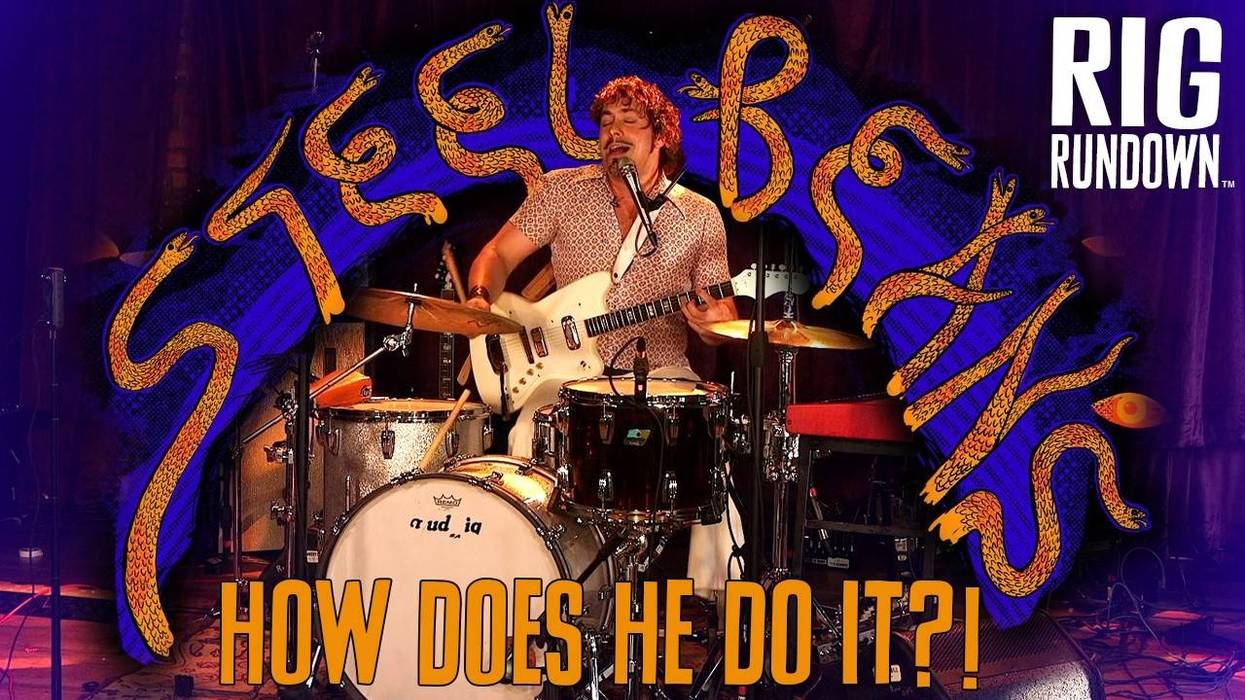
Ahead of Lucinda Williams’ fundraiser show on December 15 at Nashville’s Basement East, PG’s John Bohlinger spent some time with guitarists Marc Ford and Doug Pettibone, and bassist David Sutton, at the venue for this special holiday Rig Rundown. Tune in for all the goods, and check out the highlights below!
Pettibone plucked this off the wall of a guitar shop in Philly to demo an amp and ended up walking out with it. Its Seymour Duncan pickups are coil-split, and Pettibone gets some good, old-timey Gretsch tones out of it. Plus, after having a load of gear stolen on tour a while back, Pettibone prefers to bring out less precious instruments.
Tok-ibson
Pettibone snagged this Japan-made ES-335 knockoff, built by Tokai, while touring Australia earlier this year.
A Jewel of a Pedal Steel
Pettibone’s main pedal steel is this 1999 Emmons, which he ordered brand-new when he was playing with Jewel.
Fender Friends
Pettibone runs the Emmons pedal steel through a ’64 Fender Twin Reverb, with a ’70s JBL 15" speaker. A Strymon El Capistan adds delay, if desired. His 6-strings run into a ’68 Fender Deluxe Reverb, loaded with a Celestion Greenback speaker.
Doug Pettibone’s Pedalboard
Pettibone runs a Sarno Earth Drive, Durham Electronics Crazy Horse, Keeley-modded Boss BD-2, Boss TR-2, Mad Professor Silver Spring Reverb, and a Catalinbread Belle Epoch. A Strymon Zuma powers them.
Thou Shalt Not Covet
After “coveting” it for a long while, Ford borrowed this humbucker-equipped 6-string from Bill Asher, and after a bit of time with it, decided that he couldn’t give it back—even though he has an Asher signature model.
Nashing of Teeth
Ford was on the hunt for a Telecaster with a maple neck, and snagged this Nash T-style just a few weeks before this Rundown.
Hurtling Through Space
This custom Satellite amp has two 10" speakers and pumps out roughly 20 to 25 watts.
Marc Ford’s Pedalboard
On his board, Ford runs a D’Addario tuner, BMF Effects Marc F’n Ford and Ge Spot, Analog Man Sun Face, Satellite Fogcutter, White Amp Emulator, and Jonny Two Bags, a Catalinbread Belle Epoch Deluxe, MXR Phase 45, and Analog Man ARDX20.
Ghost of Christmas Past
There’s a lot of history in this picture. The P-bass on the right was a gift that Sutton received on Christmas morning when he was 16. The body is the only original part left, and he strings it with La Bella flatwounds. On the left is an old Kay/Kraftsman bass, which he plays with old roundwounds strings. Sutton has owned the Ampeg SVT and cab, at rear, since he was 18.
David Sutton’s Pedalboard
At his feet, Sutton runs a TC Electronic PolyTune, Radial Loopbone Master Loop Controller, Boss TR-2, SansAmp Bass Driver DI, and ACT Entertainment Panic Button, all powered by a Voodoo Lab Pedal Power 2 Plus.
The Blondie co-founder talks early Stratocasters, fingerpicking punk riffs, CBGBs-era New York, and the cultural truth of electric guitars.
Chris Stein of Blondie joins the Axe Lords for a deep conversation about tone, technique, and the guitars that shaped Blondie’s sound from their early years at CBGBs to today. The Rock & Roll Hall of Famer also explains why he dislikes relic guitars, how he came to his very un-punk fingerpicking picking technique and reveals that some of the band’s most iconic “synth” sounds were actually produced by guitars. A thoughtful, opinionated, and unrelentingly wise-cracking look at creativity by a punk and new wave legend who Dave says is basically his best friend. Make sure to stick around through the end of the episode for a deep dive into the design and build of Cindy’s D&D guitar.
PG brings you a hands-on look at some of the gear that the late Skynyrd guitarist used to change rock history.
While our Rundown team was in Chicago in November, they spent some time at Chicago Music Exchange with CEO Andrew Yonke and vintage inventory and purchasing manager Daniel Escauriza. In 2023, they were contacted by Gary’s daughter Mary Rossington to help manage the gear that belonged to her late father, the legendary Lynyrd Skynyrd guitarist Gary Rossington. With the help of friends and crowd-sourced knowledge, Yonke and Escauriza embarked on a months-long saga to learn about Rossington’s guitars and amps.
PG’s John Bohlinger met up with Yonke and Escauriza inside CME’s Vault to learn about the adventure, and to get up close and personal with some of Rossington’s most treasured pieces of kit. Check out some of the highlights below, and after the photos, we have an exclusive interview with Mary Rossington, so keep scrolling!
Rossington’s iconic Gibson SGs, some of which he owned from high school, were among the most prized and recognizable instruments in his arsenal. They’re gathered together on display now at CME.
Bernice’s Twin
This is the first prototype of Gibson Custom Shop’s Gary Rossington '59 Les Paul Standard, a replica of his infamous 1959 LP named “Bernice,” dated to the early 2000s.
Southern Sounds
When word got out that Rossington’s rig had resurfaced, Yonke fielded calls from dozens of guitarists wondering one thing: Were his Peavey Maces going to be going on the market? These old Mississippi Marshalls were a cornerstone of Rossington’s tone.
A Bit of British
This Hiwatt Custom 100 and non-master-volume 1959 Marshall Super Lead head were also key components of Rossington’s sound.
We spoke with Gary’s daughter, Mary Rossington, about her father’s legacy, the importance of honoring his influential impact through the Collection, and how Chicago Music Exchange became the ambassadors to this awesome musical history.
Did Gary ever speak about what he’d want done with his instruments after he was gone?
Rossington: Gary never spoke about what his wishes were as far as his collection. These were his tools he used and was as humble a man as there ever was. I don’t think he really even grasped how truly special he was and how impactful his contribution to the music was (and always will be). He was just doing what he loved and knew how to do it.
Gary was known for valuing guitars as tools rather than trophies. How did that philosophy shape your decisions when evaluating how to preserve his gear? I know Rickey Medlocke made the suggestion/introduction, but when did CME seem like the right fit for your vision? Rossington: Two weeks after dad’s passing we asked Rickey following the CMT tribute what on earth were we to do now? He directed us to Andrew Yonke and the CME family having every faith they would be the one to guide us in the next steps. Upon speaking with Andrew, which honestly is a blur for us due to the timing, we went about setting up the first meeting for Andrew and Daniel to come down to Atlanta and go through the collection with us. We had no idea where we wanted to go with anything but knew we needed help in every way.
We instantly fell in love with their passion and energy for the project. We just stood in the doorway and watched as they meticulously and carefully opened each and every case and examined each guitar. At times we didn’t have a clue as to what they were saying, and at one point after about two pots of coffee, they paused and said ‘Ok, we're really trying to be cool but this is blowing us away!’
Mom and dad had sat down a few years prior and wrote a little note for each one describing where each guitar came from and the story behind it. Their enthusiasm for what we could potentially do with all these instruments and their knowledge made us feel so comforted and we trusted them. All dad ever wanted to do was keep the music alive for his brothers that passed and we feel the need to do the same for him.
We want to share his legacy with the world and that starts with the instruments that made the music come alive. They had met dad over the years and respected him as not only an artist but as the amazing man he was—that was all we needed to know to this was the right fit. Andrew never made mention of money or selling anything, so we knew he was in this to assist in preserving his legacy and it was not about a payday for him.
What part of the process brought you the most comfort?
Rossington: We knew very little about dad’s collection, but it was very apparent they knew exactly what they were talking about. We prayed on it and knew this was God putting us with exactly who we were meant to be paired with. Their dedication, knowledge, and enthusiasm to preserve the pieces and further dad’s legacy meant the world to us. Many people would’ve only been interested in selling the collection and that’s never been a concern with Andrew, Daniel, and CME.
Allowing other players to use these instruments is a powerful gesture. How did you arrive at that decision?
Rossington: We again just want to keep his music and legacy alive and by allowing others artists to touch a piece of history while furthering his name and contribution to music that has shaped and inspired generations. I'll never forget how excited dad was when he got to hold Duane's guitar and we want that for other musicians as well.
Was there one guitar that symbolized Gary to you more than any other? Why?
Rossington: Of course Bernice was the standout guitar and dad thought it was the coolest thing ever that the Rock & Roll Hall of Fame would want to not only house the piece, but that it was displayed right next to Duane's. It blew his mind!
All of his Les Pauls were so special and the SGs were the sound of “Freebird.” Every time we hear the guitars played it resonates in our hearts and souls.
Were there any specific guitars that Gary insisted should continue to be played? Why?
Rossington: Dad never really discussed his instruments with us. When he was home it was all about the family and he kept most of that knowledge to himself.
You’ve mentioned hoping younger musicians feel inspired when they hold or hear these guitars. What do you hope they learn about Gary from this collection? Is there a message Gary tried to pass down to the next generation that CME is helping carry forward?
Rossington: Our hope is that through the continued exposure of his collection and hearing the guitars onstage that those experiences will inspire others to explore not only what an amazing musician and songwriter he was, but what a humble and beautiful man he was. He would have given the shirt off his back to anyone in need. He would’ve said to always work hard and never give up no matter what life may throw your way.
He tried every day of his life to honor and further the music the guys wrote together when they were so young. Those songs were written from the heart and performed with such accuracy and dedication that they will stand the test of time.
Do you envision the CME vault becoming a long-term home, or is it the beginning of a larger legacy project—documentaries, books, exhibitions?
Rossington: For now we are so very pleased that his collection survived the early days in the Hell House in Florida and everything that happened, and they are protected, secure, and in loving hands. We have hopes in the future for documentaries and are exploring the possibility of an exhibition in the future.
We would love to see a portion of his collection travel the world so more people could enjoy them and feel that they were a piece of this amazing history, too. It will come down to logistics and safety ensuring that the instruments remain in their current condition so there’s peace of mind for everyone.
PG contributor Tom Butwin demos the new Fishman Fluence Acoustic multivoice pickups, breaking down the nondestructive design, dual-voice control, and three distinct models built for everything from solo fingerstyle to full-band stages.
Fishman
FLUENCE ACOUSTIC: ROCK ICON
All eras of rock have leveraged the driving sound of an acoustic guitar for depth and counterpoint. The Rock Icon delivers punch and clarity, with a killer second voice that sits above the mix.
Voice 1: Solos and clean picking. Dynamic and forward.
Voice 2: Vintage-inspired, riff-centric voicing. This is the acoustic tone that created legends.
When all eyes are on you, the Spotlight is there to help you shine. Its two voices provide warmth and articulation, making it well-suited for the solo artist or small ensemble.
Voice 1: Sweet and mellow, perfect for vocal accompaniment and more intimate arrangements.
Voice 2: Articulate and clear for solos or breaks, whether picking or playing fingerstyle.
The Nashville Legend’s two voices provide you with ultimate versatility, ideal for flatpicking or fingerstyle whether performing on stages big or small.
Voice 1: Forward, clear, and articulate. A natural, well-balanced tone.
Voice 2: Up-front, percussive, round, and clear. Great for cutting through the mix.
The Aqueous Chorus is our take on the best of both worlds — vintage bucket brigade character andmodern watery tones” says Chris Van Tassel. Chris continues, “We wanted a chorus that didn’t just soundgood, but felt good to play. With added controls for EQ and gain makeup, it gives players a huge palette ofsounds from subtle vibe textures to full-on rotating speaker effects, vintage and modern chorus soundsthanks to its tilt EQ.”
Aqueous Chorus Features:
Vintage to modern chorus tones with Tilt EQ shaping (wet signal only)
Preamp section for gain makeup and added feel not typically found in modulation pedals
Mix control blends chorus and vibe modes, with vibe-only in the last 1/4 rotation
Depth and Speed controls for subtle movement to extreme modulation
Rotary-style sounds and lush modulation effects are available with creative settings
Built with rugged construction and vintage-inspired looks Specifications:
9VDC Negative Tip Power (no internal battery option)
28mA Current Draw
The Aqueous Chorus will be available November 6th, 2025 via select dealers for $229.99
J Rockett Audio Designs
Aqueous Chorus
With the Aqueous, J. Rockett applies its penchant for pedals that blend modern functionality with vintage charm to the world of chorus effects. Its stylish, handbuilt design provides a diverse palette of both classic and contemporary shimmers, with a 5-control layout for effortless tweakability. The Aqueous bridges the gap between vintage BBD-style effects and modern textures, featuring controls for Speed and Depth, along with a Tilt EQ that adjusts the overall tonal balance. A built-in Preamp sets the level, making it highly popular among Sweetwater guitarists by maintaining signal strength and adding a unique character to the overall tone. Designed for balance and accuracy, the Aqueous is a versatile chorus at home on any pedalboard.