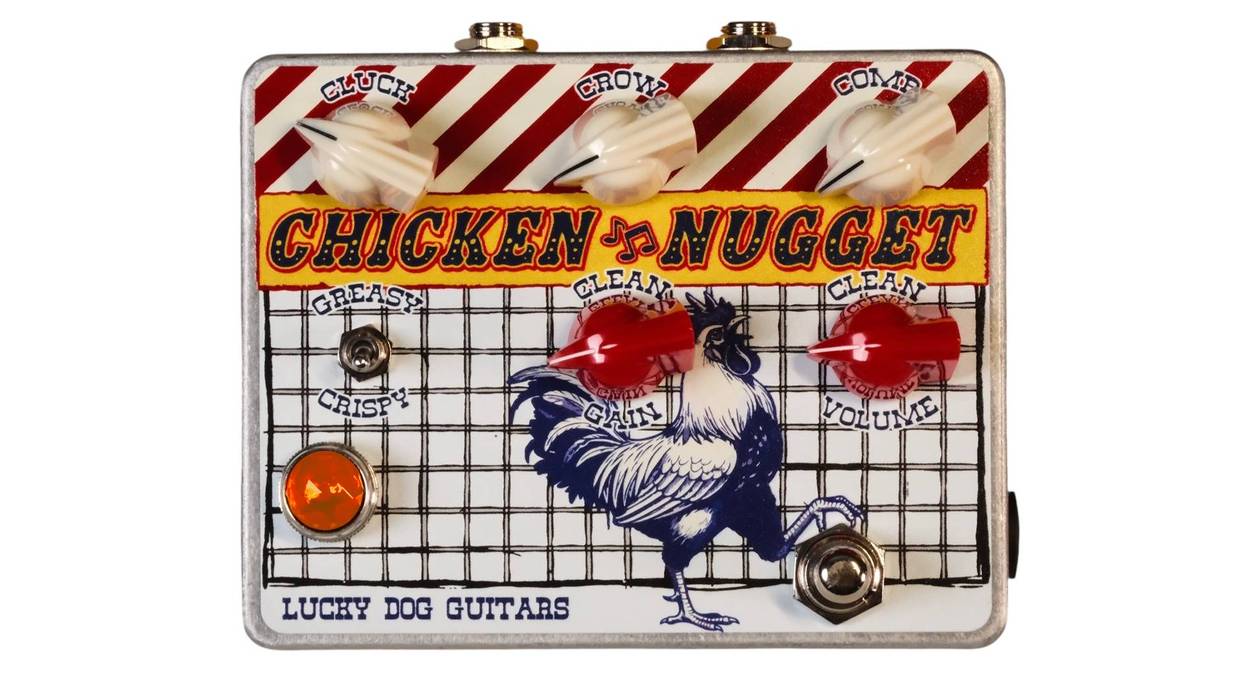
Adding to the company’s line of boutique effects, Lucky Dog Guitars has introduced the Chicken Nugget compressor, capable of delivering old school guitar compression made famous by country players throughout the decades, but with modern updates. The Chicken Nugget combines classic dynamic compressor sound and feel with an added sparkly clean tone in a separate, parallel channel. The two channels are completely independent and have their own dedicated volume knobs for maximum flexibility as you blend them together. Both channels offer plenty of output above unity gain, so both can be used as volume boosters.
The Chicken Nugget’s eye-grabbing graphics are augmented by a large retro-style jewel pilot light (in a “fried chicken” color) and playful descriptions for the control set. The compression channel offers three knobs and a two-position toggle switch for tone shaping. The “Cluck” knob controls the amount of compression; “Crow” varies the compression release time; and “Comp” adjusts the output volume level of the compressor channel.
The compression channel’s two-position toggle adds EQ flexibility: its “Greasy” and “Crispy” settings can tailor the effect to your guitar’s pickups. Use the “Greasy” setting with bright single coils for classic compression twang. Use the “Crispy” low-cut setting for tightening up a humbucker by eliminating muddy low-end frequencies.
The pedal’s clean channel offers two control knobs. “Gain” adds body and juice to your clean signal, while “Volume” controls the clear, uncolored signal parallel that can be added to the compressed signal.
Other features include:
Soft switch controlled mechanical true bypass – if the pedal loses power it immediately goes into true bypass so you don’t lose your signal
9-volt operation using standard external power source – no battery compartment
Retro-cool graphics and “chicken head” knobs, color coded for ease of use: cream for the compression channel and red for the clean channel
The Lucky Dog Chicken Nugget carries a $189 street price and is available through luckydogguitars.com
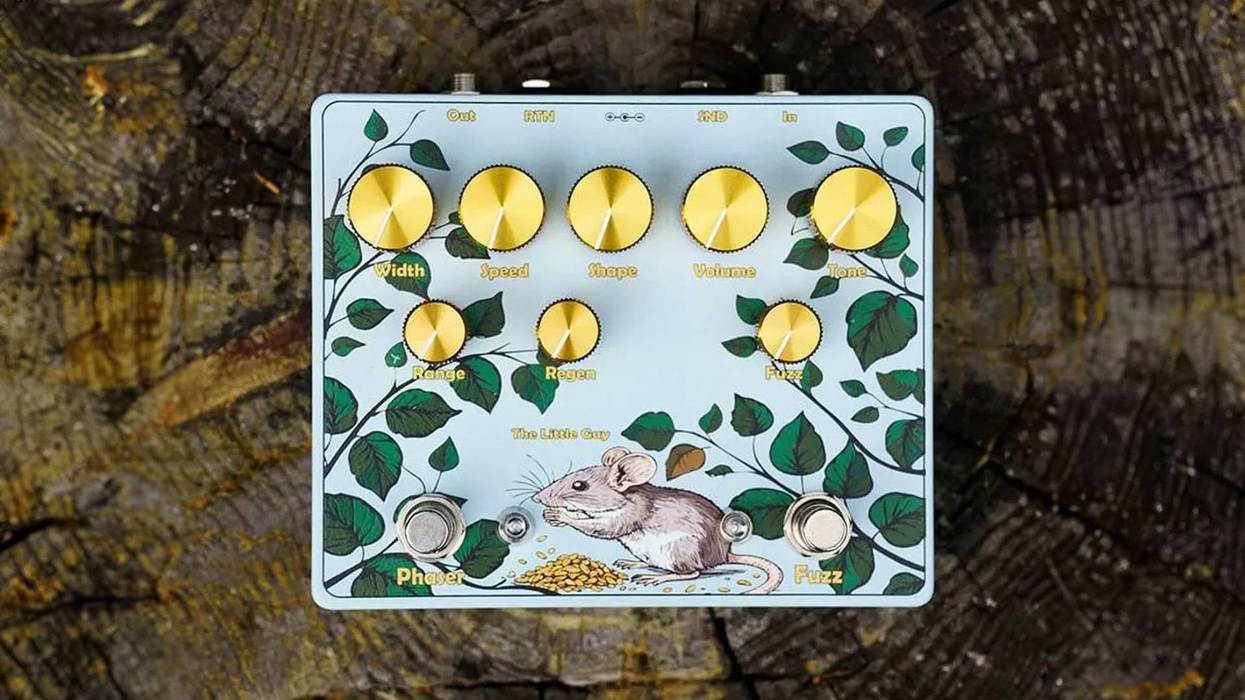
Looks can be deceiving. But there is something extra playful about the graphical subterfuge Monger Pedals employs to conceal the ferocity of their latest stomp, The Little Guy. Behind the Beatrix Potter/Timmy Willie-styled enclosure art depicting a wee country mouse and creeping vines, there lurks a beastly mash-up of op-amp fuzz and operational transducer amp (OTA)-based phaser. But The Little Guy’s roar is not just ferocious, it's also unconventional—making the most of the unusual phaser section to twist staple psychedelic sounds into many altogether weirder things.
Monger of the Mangled
Op-amp fuzz can take many shapes in the hands of a clever builder, but most players would consider the op-amp Big Muff and the Pro Co RAT as the archetypes of the effect. Of the two, The Little Guy aligns most closely with the Big Muff. I don’t have an op-amp Big Muff in my pedal collection, but the Little Guy (like a real op-amp Big Muff) has a sonic signature much like a raspier 4-silicon transistor Big Muff. Of the Big Muff types I used for comparison, a ram’s head-type sounded most similar to the Little Guy’s fuzz, and the two share a capacity for sizzly, buzzsaw-like tones that define the op-amp Big Muff. That said, the tone control in the Little Guy’s fuzz has enough range that I could dial in sounds nearly equivalent to those from a Sovtek Big Muff, which tends to be rounder and more bass-rich than an op-amp Big Muff.
Certainly, the Little Guy’s fuzz section is versatile. I may not be in the majority in this sentiment, but my favorite among the fuzzy, distorted sounds I coaxed from the circuit were those I derived when fingerpicking (using the flesh of my thumb, rather than nail or pick) and working with low-gain, treble-attenuated fuzz settings. This application is more consistent with Monger’s description of the fuzz as “lo-fi”—often evoking Steve Malkmus, Sonic Youth, and Graham Coxon in their hazier states. Yet it’s a combination that’s surprisingly sensitive to touch dynamics and yields more high-mid range detail and a much more oxygenated tone environment than you would expect. Just switching between neck and bridge pickups can reveal whole worlds of color with this approach. The Little Guy’s fuzz rips at the other end of its operational spectrum, too, and it rarely sounds lo-fi here. Settings in the latter third of the pedal’s gain and tone control range are searing but still massive in a way that suits Fender single-coils and PAF humbuckers alike.
Vexing Vortices
If the Little Guy’s fuzz section is agreeable and intuitive, the phase section is a tougher nut to crack. Familiar sounds in the fashion of a Phase 90 or Small Stone (the latter of which shares an OTA as foundation for its architecture) lurk among the interactions between the five controls, but tend to be more subtle. In fact, for all the phaser’s weirdo capabilities, in much of its range it generates super-subtle modulations. This isn’t a bad thing, especially if you like phase as a constant, backgrounded presence. The Little Guy excels at producing this mellow phase texture in a way that a Phase 90 or Small Stone cannot.
But there are many other low-key modulation colors here. You can dial in super-slow (and I mean slow) modulation rates, and then emphasize peaks in those lazy cycles by using feedback from the regen control and narrowing the frequency range with the range control. The LFOs width control is excellent for subtly backgrounding modulations so you don't mask tone nuances from elsewhere in your chain. That capability is enhanced by the effect send and return, which lets you situate pedals between the fuzz and phase effect.
"For all of this phaser’s weirdo capabilities, in much of its range it generates super-subtle modulations."
The Little Guy’s weirder phase voices are refreshingly unique. The pedal is able to generate a variety of rich, vowel-y, “wow”-type pulses more reminiscent of a vintage Mu-Tron or Ludwig Phase II. It’s also capable of fresh takes on lively auto-wah and filter sounds, and slow, sweeping versions of these tones can take on a sort of parked-wah-on-nitrous-oxide personality that I don’t encounter every day.
The Verdict
Monger’s The Little Guy sells for just less than $225. That’s a great price for almost any pedal that combines two wide-ranging effects. But it strikes me as an especially good deal when you consider the very high build quality, clear sense of craft, and thoughtful design execution. The Little Guy won’t be a great value for every player. Rather than aping canonical phase sounds, it inhabits many very idiosyncratic corners of the fuzz/phase tone realm. And if you just want a Big Muff and Phase 90, there are simpler, less-expensive, and less space intensive solutions. Consequently, you should consider my enthusiastic tone and value ratings on a sliding scale relative to your needs.
But if you’re on the hunt for variations on the fuzz/phase theme that can set a track apart and inspire new directions, Monger’s Little Guy is brimming with them—particularly if you’re willing to probe the sometimes complex and idiosyncratic interactions between its controls.
The Lamb of God shred king sits down to discuss making LoG's 10th album, Into Oblivion, designing his new signature GibsonLes Paul, and writing his memoir, Desolation. He offers three hot takes on guitar culture.
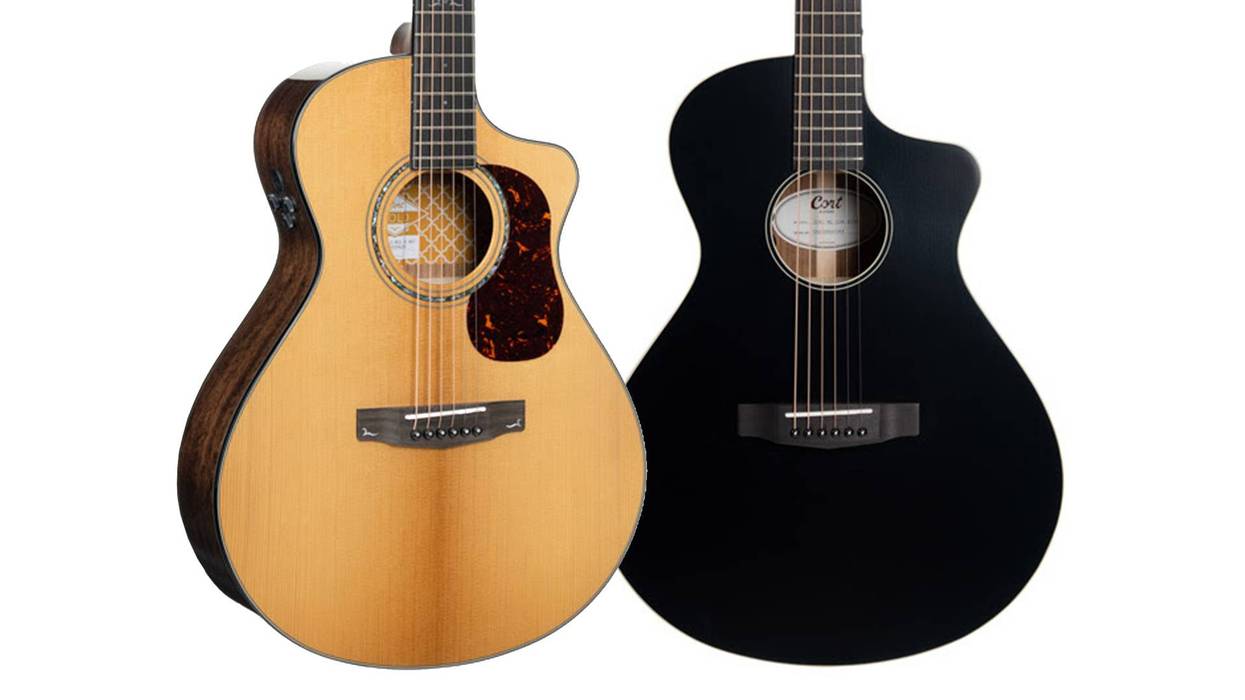
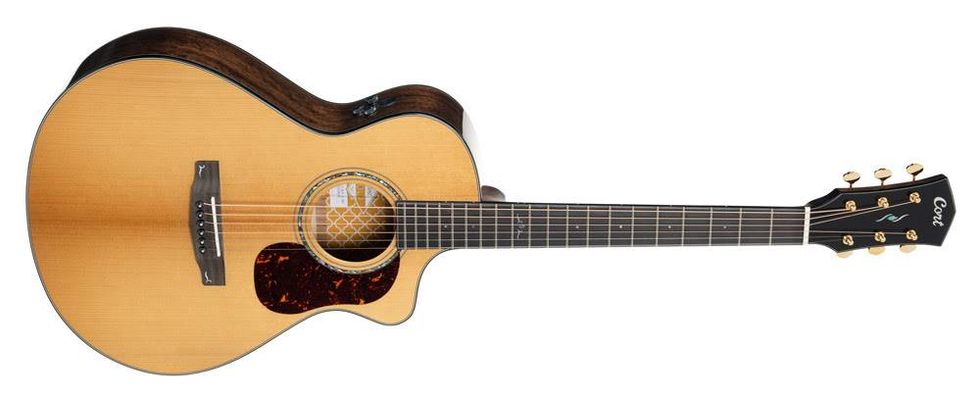
Cort Guitars announces the new Gold-MC6 Ovangkol, an all-solid Modern Concert acoustic guitar designed for players seeking seasoned tone, premium craftsmanship, and stage-ready performance. Available worldwide through local retailers and online, the Gold-MC6 is built to deliver responsive, expressive sound from day one through its torrefied top, carefully selected tonewoods, and professional electronics, all crafted with precision detail.
At the heart of the Gold-MC6 is a torrefied solid Sitka spruce top, heat-treated to bring out the open, responsive character of a well-played instrument, matched with solid ovangkol back and sides to provide warmth, clarity, and dynamic range. The Modern Concert body features a natural gloss finish, black ABS binding, and an abalone rosette with ABS multi-ring design. A walnut-reinforced mahogany neck with a dovetail joint at the 14th fret supports a Comfort C profile and satin finish for effortless playability. The 25.5" scale length is paired with a Macassar ebony fingerboard with a 15.75" radius, 20 frets, and Gold Custom Inlay. The guitar includes a genuine bone nut measuring 1 3/4" (45 mm). Internally, hand-scalloped X-bracing reinforces the instrument’s all-solid construction, ensuring durability and tonal maturity over time.
For amplified performance, the Gold-MC6 is equipped with the Fishman Flex Blend system, combining an internal microphone and under saddle pickup to capture the guitar’s natural acoustic character while providing intuitive onboard control for live performance or recording situations.
Premium hardware completes the build, including Deluxe Vintage Gold tuning machines, a Macassar ebony bridge with ebony bridge pins featuring white dots, and a genuine bone saddle with 54.1 mm bridge string spacing. The guitar ships strung with Elixir Phosphor Bronze Nanoweb Light 12–53 strings and includes a Cort Premium Gig bag.
For more information on the Gold-MC6 Ovangkol and other Cort acoustic instruments, please visit online at www.cortguitars.com.
Street Price: $1399.00 USD
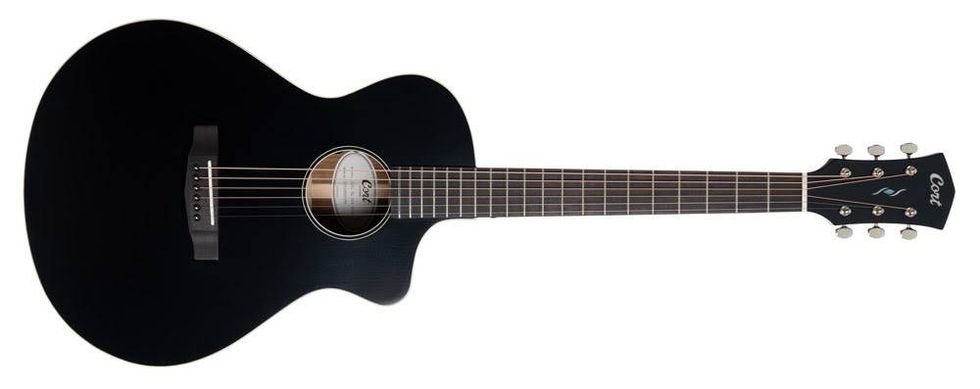
Cort Guitars announces the new Core-MC Ovangkol acoustic guitar, available now worldwide through local retailers and online. Designed for players seeking an all-solid wood instrument that blends contemporary aesthetics with refined acoustic performance, the Core-MC Ovangkol pairs a solid cedar top with solid ovangkol back and sides, modern concert body styling, and onboard Fishman® electronics. With its semi-gloss black top and player-focused construction, the model delivers responsive tone, stage-ready functionality, and detailed craftsmanship built for long-term performance.
The Core-MC Ovangkol features a solid cedar top, known for its inviting, responsive character with smooth highs and rich mids, complemented by solid ovangkol back and sides that contribute low-mid fullness and broad tonal range. The Modern Concert body shape incorporates a slightly smaller waist and sleek cutaway for comfortable playability without sacrificing projection. The guitar is finished with a semi-gloss black top using an ultra-thin, UV-cured process designed to preserve resonance. Construction includes a dovetail neck joint at the 14th fret and hand-scalloped X-bracing. Added body details include aged white ABS binding, a black and aged white ABS rosette, rosewood bridge, and black bridge pins with white dots. The mahogany neck features a comfortable C shape with a semi-gloss finish, a 25.5" (648mm) scale length, and a genuine bone nut measuring 1 11/16" (43mm). The rosewood fingerboard has a 15.75" (R400) radius and 20 frets, with no inlays.
For amplified performance, the Core-MC Ovangkol is equipped with a Fishman® Presys VT preamp system with discreet side-mounted controls. The system provides onboard volume and tone controls for straightforward sound shaping, offering a clean acoustic tone suitable for live and studio applications.
Hardware appointments include vintage open-gear tuning machines and a genuine bone saddle, with 54.1mm bridge string spacing. The guitar ships strung with Elixir® Phosphor Bronze Nanoweb Light 12–53 strings and includes a Cort gig bag. The model is available in Black Top Semi-Gloss (BTSG).
For more information about the Core-MC Ovangkol and additional Cort Guitars models, please visit www.cortguitars.com.
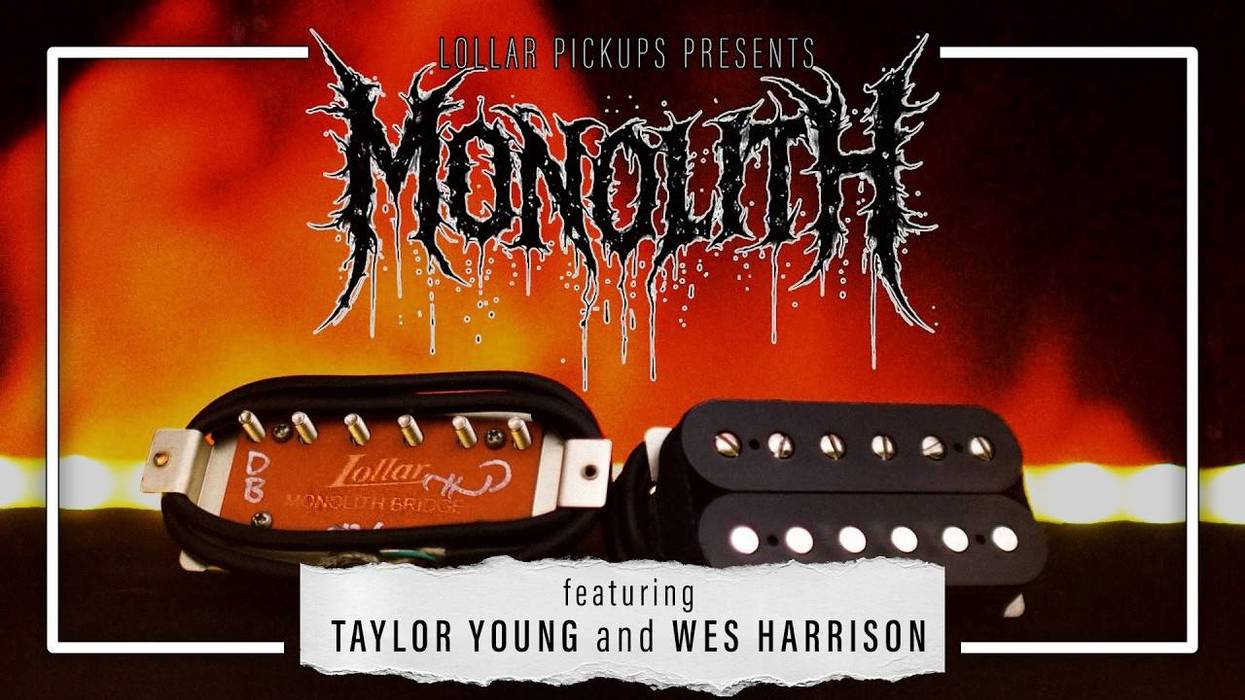
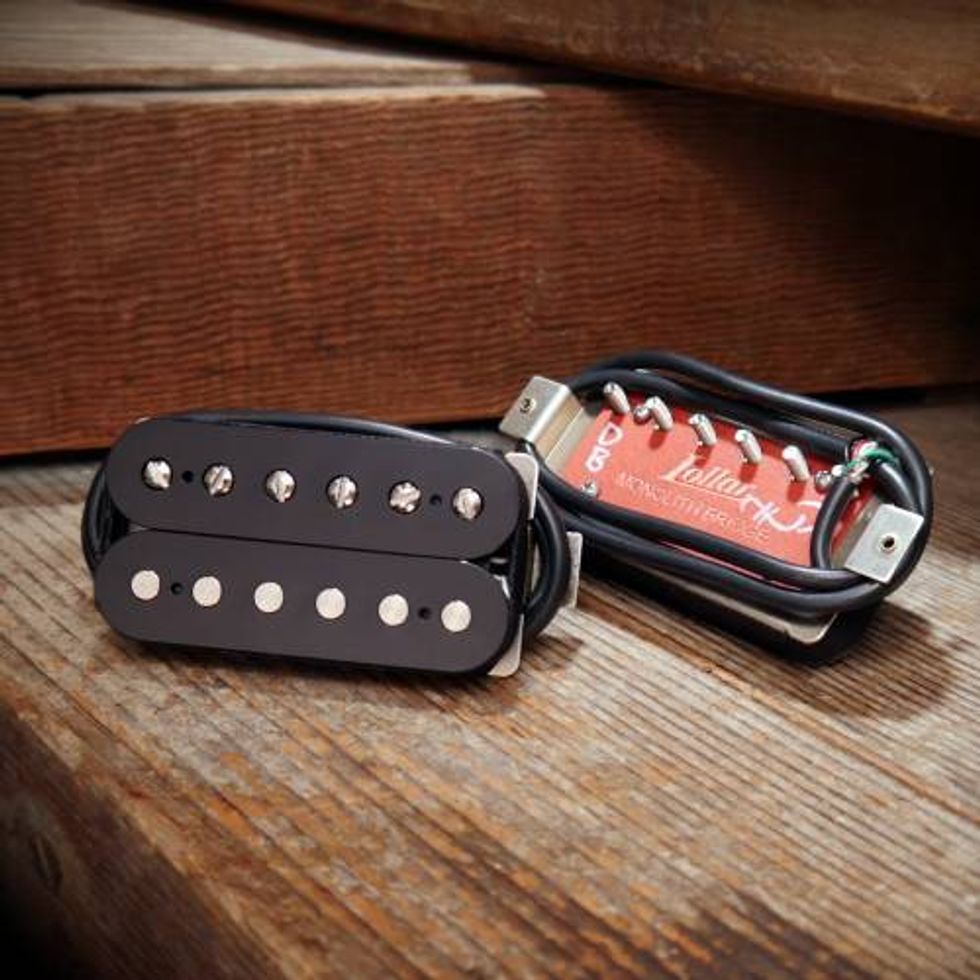
Lollar Pickups has introduced the new Monolith humbucker model, a higher-output pickup designed for guitarists who play both modern and extreme styles of music.
Many high-output humbuckers suffer from either a boxy voicing or a harsh and brittle top end. The Monolith is designed to deliver balanced tone in all positions and increased dynamic and frequency ranges, using AlNiCo 8 magnets.
The bridge position offers a midrange forward sound with increased harmonics and fundamental frequency response and the right amount of compression when palm muting for a satisfying attack and grunt. And, like Lollar’s other pickup designs, the neck position is designed to be open, clear, and balanced with the bridge, offering a prominent midrange that offers a more vocal sound for leads and clean passages.
Splitting the coils on these humbuckers provides a full-bodied single-coil sound. When under gain, the split coils provide the percussive and aggressive tone for lower tunings and extended scale length instruments that progressive and djent players seek.
The Monolith humbuckers are available individually, or as two-piece sets for both 6 and 7-string guitars. For 6-string sets, Lollar also offers an F-spaced bridge position pickup (53 mm) to match a wider string spacing required for guitars with tremolos.