

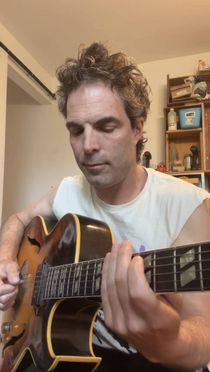
As anyone who has toiled long enough in any art form can tell you, hitting walls is inevitable, even necessary. They exist to remind us that there’s something on the other side, someplace to go that we haven’t discovered yet. We may not see the way over today, but when we start looking, that’s when new ideas reveal themselves (and not always in a way we can anticipate).

Sometime around 2002, up against such a wall, I was gifted a portal into a new way of approaching the guitar. A friend of mine brought me to see the 1993 Tony Gatliff film Latcho Drom. It follows the path of Roma music as it moves from India and Iran through eastern Europe, eventually landing in Spain, evolving and changing along the way, picking up influences yet retaining its unmistakable signifiers. No talking, no written narrative, just people and music. One scene focuses on an older man standing under a tree with a young boy watching on. The man is Nicolae Neacşu (1924-2002), the great Romanian violinist known for his work with the group Taraf de Haïdouks. As he plays and sings mournfully about the dictator Ceaușescu, he begins to tug on a small piece of string, a horsehair from his violin bow that’s tied on to one of his violin strings. The sound is haunting, complex, simple, earthy, and mystifying. I wanted to run out of the theatre right then, grab a guitar, and try it.
Without a horsehair on hand, and after several attempts with dental floss, cotton thread, and fishing line, I landed on a certain quality of polyester sewing thread that was able to produce a similar effect: cheap, thin, textured, stretchy thread. When I finally got the grip and the right tension, and the first vibrations bounced the sound through my fingers, I felt like I’d been handed a secret technique, like a Japanese hiden—a singular masterstroke.
I’ve spent the last thirty years in pursuit of these connections between the guitar and the natural world. Whether it’s through the raw physics of the instrument, drawing from the sounds of animals, looking to other cultures and their instruments, or finding ways to prepare and effect the guitar to break it open, there is no shortage of discoveries to be made. And this one technique, distilled from Roma ingenuity, has been one of the most curious and most useful. I always have a spool of polyester in my gig case. It takes about 30 seconds to tie it on before a show. I most often tie a strand onto the G string and another onto the D (double knots each), so that two arms-length threads are constantly dangling gently and unobtrusively from about an inch in front of the bridge. (You can pull two strings or more at the same time to create harmony.) I can take them up at any time. By scraping my finger nails down the textured polyester thread, the friction creates a vibration that transfers onto the guitar string. It’s similar to the physics of a cuíca, or the feeling you get when you run scissors down a ribbon to make it curl.
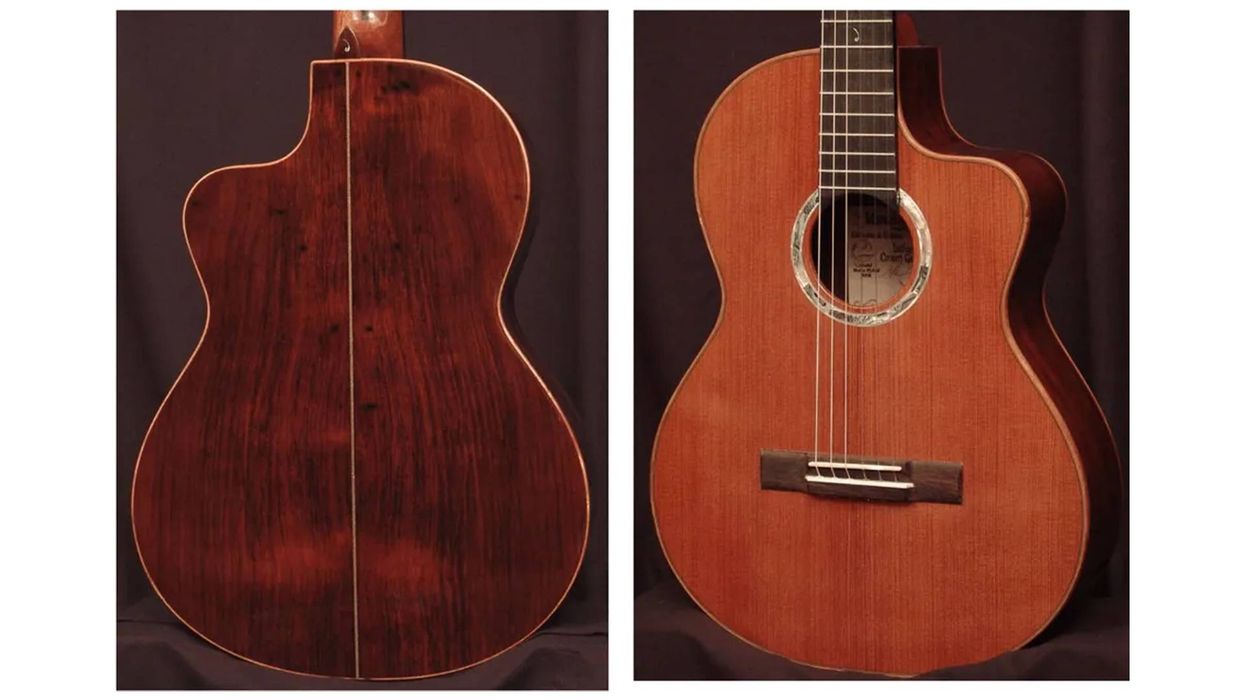
It’s really effective. I most often tie thread onto my 1951 Gibson J-45. There’s a clarity, response, and growl that I get from this instrument that blends well with this technique. I also use it on my ’69 Martin N-10, but because the tension is a bit lower on classical guitars, intonation is less reliable when the thread pulls outward on the nylon strings. At low volume, though, the effect can be sublime. Tied onto an electric guitar and multitracked, a lone producer can emulate an orchestra, creating a more unique sound than using VST. Hit it with distortion, delay, and reverb, and you have the four horses of the apocalypse.
Why not just use a bow? Since guitar bridges, unlike violin bridges, are flat, it’s difficult to bow single-note melodies without hitting multiple strings. This technique produces a similar (if creepier) sound as a bow, but allows the player to focus on a single string.
It’s more complicated to talk about and describe this than it is to just try it. So, give it a shot. Make sure the thread can produce a “zipping” sound when you run your nails down it. That’s the most important thing. The wound strings of the guitar work best as anchors; they lock the thread in place. And you can tie it anywhere along the string horizontally, but the closer you are to the bridge, the clearer and more fundamental tone you get (the further away from the bridge you tie it, the more strange harmonics you get). It’s been a really rewarding way for me to experience another side of the guitar. I hope you get to try it.