

If you look up “acoustic guitar soundport” on the internet, you’ll find a lot of heated debate on forums and blogs about whether or not soundports are a worthwhile addition to an acoustic guitar. For this month’s column, I want to dive into the acoustics of soundports and dispel some myths about them along the way. At the end of this article, I hope to make a good case in favor of soundports or at least change the way you think about them.
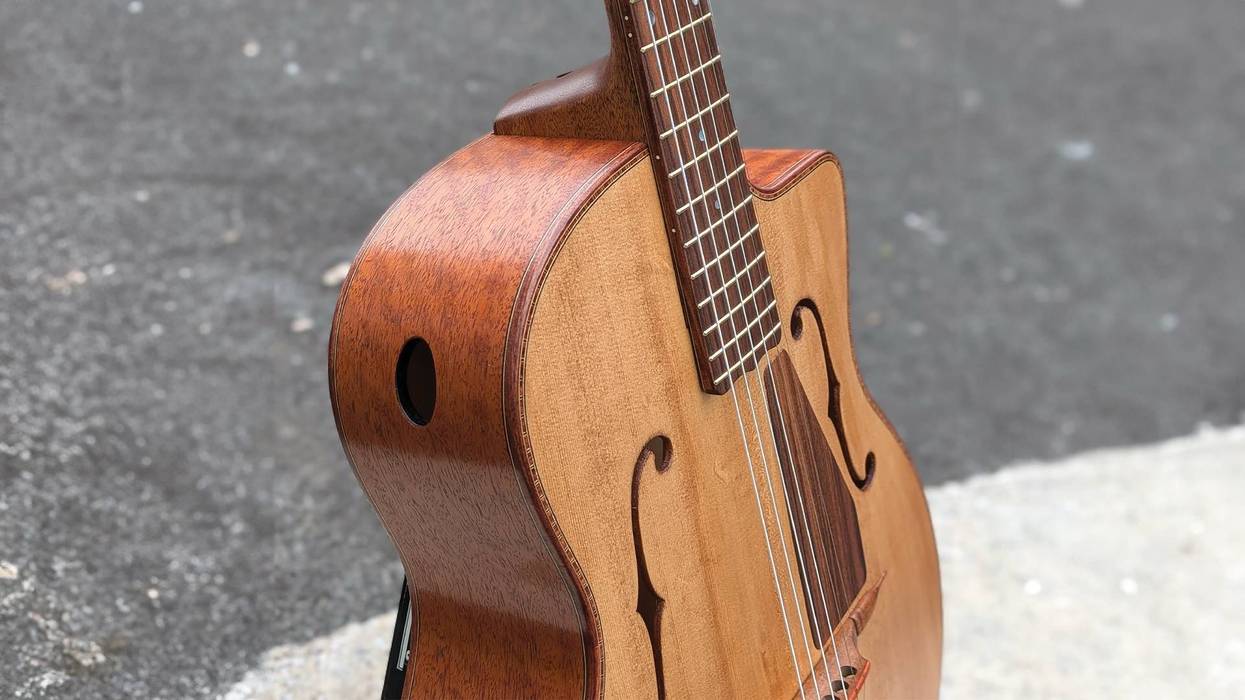
A soundport is a hole—typically only a couple of inches in diameter—through the side of an acoustic guitar, usually located on the upper bout. A soundport can be thought of as a “secondary” soundhole to the main soundhole of a guitar. While the main soundhole directs air away from the player towards the audience, a soundport directs sound up towards the player’s head. This has the effect of increasing the loudness of sound heard by the player.
Most people assume that hearing one’s own playing is the primary motivation behind the addition of a soundport; this is likely the main reason why soundports are more common in the classical world, where there is often no amplified guitar sound sent back to the player. For many classical players, a soundport is the only “monitoring” they’ll get.
Debates about whether or not to get a guitar with a soundport often revolve around how important it is to be able to clearly hear yourself as a player. This design choice is weighed against perceived downsides, such as the non-traditional appearance of a soundport. Some players are of the opinion that the soundport “steals” some of the sound from the main soundhole, making the sound that the audience receives quieter. And it’s fairly universally accepted that a soundport alters the timbre of an acoustic guitar, but whether it’s changed for better or worse is intensely subjective. All of these factors mean that if hearing your own sound isn’t a concern, you’re likely to be hesitant on having a guitar with a soundport.
I actually believe that the main function of a soundport is to modify the timbre of an instrument. In the hands of a skillful luthier, the addition of a soundport has the potential to make a better-sounding guitar. To explain why, let’s take a step back and understand how a soundport works in the context of the whole acoustic system.
An acoustic guitar is a system of interconnected components that each play a role in producing the final sound. The player plucks a string with their finger or pick; the string transfers vibrations through the bridge to the body; the vibrating wood surfaces of the body push against the air around the guitar; and sound waves are produced that reach our ears. Each of these components put their stamp on the sound. We all know that changing the properties of the strings and the body can have a dramatic impact on the sound. But we don’t usually consider the role of air movement.
As the guitar’s body vibrates, air moves in and out of the body though the soundhole. Adding a soundport adds another route for the air to move through. Adding another hole makes it easier for the air to move. Physics tells us that adding ports emphasizes higher frequencies. And in my experience, the frequencies brought out by adding a soundport tend to be pleasant one. A soundport tends to add clarity, airiness, or openness to a guitar’s sound—the same effects we observe in ported speaker cabinets or open-back headphones.
This also supports the conclusion that a soundport does not necessarily reduce the overall volume of a guitar. While some energy is dispersed through the soundport instead of the soundhole, the addition of a soundport actually makes the guitar more efficient at producing certain frequencies. To my ears, most guitars with soundports are not noticeably louder or quieter than guitars without them.
I have to add a caveat to my claim that soundports improve the timbre of a guitar: I said that the frequencies brought out by a soundport tend to be pleasant ones, and that’s been my experience, as well as the experience of my shopmates at the Mile End Guitar Coop. But this isn’t a one-size-fits-all situation. No one can guarantee that taking a forstner bit to your guitar body will automatically improve its sound. The point I’m emphasizing is that many builders today use soundports as part of the whole acoustic system of their guitars. Every component of the system, from the wood selection to the bracing pattern, is designed to work together with the soundhole and soundport. If you’ve heard great-sounding guitars from a luthier and they all include soundports, chances are that little hole is playing an important role in that sound!