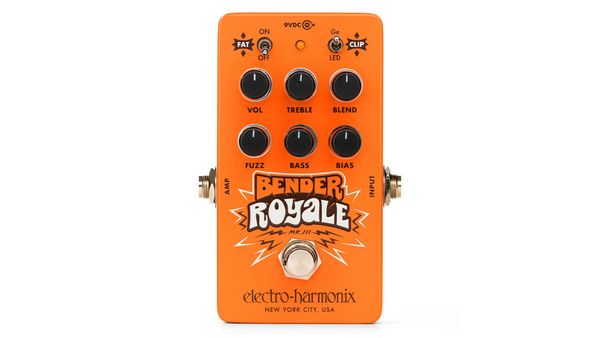

Calculating the possible tones the Electro-Harmonix Bender Royale can produce—especially in relation to its simpler MkIII Tone Bender forebears—is not work for the casual mathematician. Let’s see, take the original 3-knob MkIII template, multiply those possible sounds by three additional knobs and two switches, multiply that again by the range of the extra knobs, and … well, you can see why I'm a guitar journalist rather than a NASA scientist calculating possible trajectories for Mars probes. But you needn’t be a senior researcher at M.I.T. or the Berkeley physics department to understand that the Bender Royale is a fuzz-tone gold mine.
A vintage-based fuzz with this much additional tone sculpting capability can be anathema to many old-school heads. Ordinarily, I might even count myself among that camp—certainly where a circuit as near perfect as the Tone Bender MkIII is concerned. But time and time again, I found myself in thrall to the Bender Royale’s broader sense of possibilities. It’s equally happy in dunderheaded ’60s garage-psych contexts and modern ambient settings. Best of all, its many controls enable intuitive pathways to these very different destinations.
Palace Expansions
I’d be lying if I said I looked over the Bender Royale for the first time without trepidation. I have a few 3-knob Tone Bender MkIII clones that I love and know intimately. I also know that compound tone possibilities can come at the cost of an otherwise simple pedal’s magical essence. But I also love the grand tradition of Electro-Harmonix as demented maximalists. And in this case, faith in the vision of Mike Matthews and his designers is well placed.
Early versions of the 3-transistor Sola Sound Tone Bender architecture were simple 2-knob pedals—just output volume and gain. The MkIII Tone Bender, on which the Bender Royale is based, added a high-pass filter-based tone control, which made it a much more nuanced pedal than its predecessors. On the Bender Royale, the tone section is comprised of treble and bass knobs, and using the two together yields many sounds that aren’t easily found in vintage style MkIIIs—especially when you set them in opposition to each other. Heavy bass settings and attenuated treble, for instance, can shape wooly, mysterious low-mid focused fuzz that’s uncommon in simple ’60s circuits.
The bias control is a familiar feature in modern fuzz design. And like the EQ, it can serve contemporary or vintage-style tone-shaping aims. In the latter scenario, the bias knob helps the Bender Royale assume personality traits of lower voltage vintage fuzzes like the Maestro FZ-1 or Selmer Buzz Tone. It can also help shape the Bender Royale’s output into glitchy, fractured tone scree peppered with odd overtones—or thuddy but substantial no-sustain fuzz that is perfect for doubling a bass line.
Mixing More Magic Potions
I don’t often see wet/dry blend controls on fuzzes, and I understand why some players would fail to see the point. On the Blender Royale though, it’s a feature with transformative power—particularly if you approach fuzz with a song arranger’s mindset. The most convenient framework for describing the sound of the blended wet/dry tones might be the work of My Bloody Valentine’s Kevin Shields (who, not coincidentally, perhaps, is a fan of the MkIII Tone Bender.) If you’ve dived deep on Shield’s MBV sounds, you’ve probably noticed that many of them are not as filthy as legend would suggest. In fact, many of Shield’s classic MBV tones rely on a certain quantity of “cleanliness” to communicate the nuance of his pitch shifting and reverse reverb moves. The Blender Royale’s wet/dry blend makes it easy to shape these textures. And while this function shines in shoegaze-style applications (which often rely on fuzz as a source of dream haze rather than riff underpinnings) it can be invaluable in any song- or melody-first compositional or performance situation where detailed chords are of foremost importance and fuzz works better as a mood enhancer than sledgehammer.
The two switches—a FAT switch that emphasizes low-mid frequencies and one that switches between germanium and harder-edged LED clipping—are the two features I used least. And in general, I preferred the more vintage-aligned germanium clipping and FAT-less EQ profile for their clarity, which emphasizes detail in other control interactions. But they are far from superfluous. The LED-clipping, for example, will interact with treble-forward and off-biased settings to create extra-splintered, narrow output that stands tall, proud, and strange in a mix.
The Verdict
Electro-Harmonix’s Bender Royale may seem to exist in extra-dimensional space at times. But for all the adventure it enables, it is a pedal of great utility. It shines with humbuckers and single-coils, with American- and British-style amps, and for scorching leads and tuneful indie chording. And none of this very real variety in the Bender Royale comes at the expense of vintage MkIII accuracy when you need it. At $149, it has to be a contender for the best fuzz value in the business.


![Rig Rundown: The Black Crowes’ Rich Robinson [2026]](https://www.premierguitar.com/media-library/youtube.jpg?id=66952027&width=1245&height=700&quality=70&coordinates=0%2C0%2C0%2C0)