Guitar effects fall in and out of fashion. But I never quite understood the moment when Tube Screamers ceased to be cool. Players would complain about the midrange bump. Fair enough, mid bumps can suck air out of a signal. But then I’d watch the same players buy some other mid-pumping drive or distortion and rave about it. Perhaps it was the TS’s association with blues rock—an occasional punching bag among guitar’s leading edge. Perhaps it was the rise of the Klon Centaur, the affordable “klones” that followed in its wake, and the resulting chatter about “transparency.” Never mind that the Klon Centaur’s design shares much of its basic architecture with the TS, or as my esteemed former PG editor Joe Gore pointed out, that the sonic differences between the pedals are not always as different as they seem.
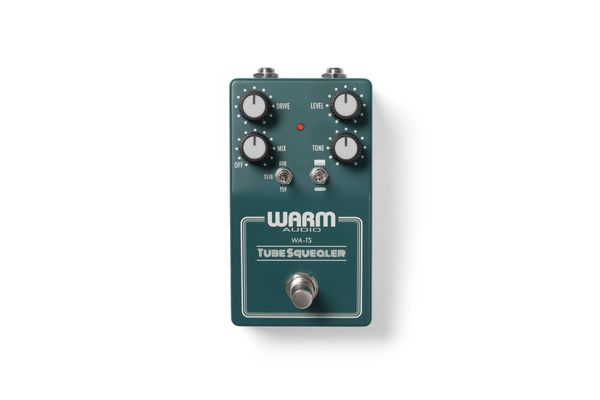
The collective conversation confirmed one thing for me: Guitarists are a weird, fickle bunch. Because for me, Tube Screamers have always been a reliable, forgiving source of overdrive that pair well with fuzz, distortion, and other drives, and amps across the Fender, Vox, and Marshall spectrum (though it really loves the first of these). Warm Audio’s Tube Squealer is a kind of super TS. It combines switchable TS-808, TS-9, and TS-10-style circuitry, a mix control that blends in clean signal (a touch of Klon), a humbucker/single-coil switch that shifts the midrange emphasis from the 800Hz range to the 2kHz range, and a voltage boost switch that engages a voltage doubler (another touch of Klon). It adds up to a very adaptable overdrive.
A Scream Across the Ages
Fundamentally, the Tube Squealer is a really satisfying TS-style overdrive. As a test, I situated it alongside a 1981 Ibanez TS-9 that was my primary overdrive for ages and always sounded excellent to my ears. Compared to the original Tube Screamer, the Tube Squealer in the TS-9 setting, and no clean signal in the overdriven/clean mix, is discernibly more compressed and less oxygenated in the high-end than the Ibanez. But is that better? That depends. Paired with a 16-watt, EL84-powered Carr Bel-Ray in its Vox-style setting, the Tube Squealer’s low-to-mid gain overdrive settings could seem redundant, while the TS-9 added a little more sparkle. On the other hand, the Tube Squealer’s more compressed profile lent a creamy cohesiveness to the Bel-Ray’s output that sounded fantastic with chords, and added a touch of anger to Peter Buck-ish arpeggios in the more aggro Lifes Rich Pageant vein—one of my favorite applications of the effect.
“The wet-dry mix control may be the most valuable feature on the Tube Squealer. It opens up a lot of fine tuning possibilities.”
With a late-’60s Fender Bassman, the Tube Squealer’s more compressed output illuminated the difference between the pedals more starkly. I enjoyed the warm, growly nature of the Tube Squealer’s basic distortion voice. And while the pedal felt more grafted to the amp rather than seamlessly integrated with it, I was reminded of an old J Mascis quote. To paraphrase: “What’s the point of using an effect if it’s transparent?”
There is a way that I was able to close the difference between the more compressed Tube Squealer voice and the more open TS-9, and that was by using the clean signal mix control. By dialing that knob up to noon (give or take, depending on the gain level), I could make the two pedals sound identical enough that most folks would be hard-pressed to tell them apart in a blind test. What that revealed to me is that the mix control may be the most valuable feature on the Tube Squealer. It opens up a lot of fine tuning possibilities.
Do Screamers Squeal Equally?
Though it’s nice to have the three TS voicings, the differences among them can be subtle. At low gain settings, in fact, they can be pretty difficult to tell apart. Higher gain settings make the contrasts more apparent, but even then the variations can sound really minimal. In general, they are evident as subtle EQ shifts. The TS-9 comes off as the most balanced of the three, the 808 seems to bloom a bit more, and the TS-10 has a bump in the low midrange that results in a smoothing effect. These voices are useful and fun to work with if you’re moving between guitars and amps in a studio, but I’d venture that they’d be nearly impossible to discern in a live setting.
The control that makes a big difference is the pickup voicing switch. The shift from the 800Hz peak to the 2kHz peak in the midrange is transformative enough to rip your face off if you’re not careful. With single-coils it’s spiky enough that your bandmates may ask you to take a time out. But the PAF-equipped SG I used in this evaluation became smooth and vicious in the 2k mode. In fact, I’ve rarely heard my Bassman sound so much like a JCM800. And it not only genuinely extends the utility of the Tube Squealer, it’s also raucous, rowdy fun.
The Verdict
Though the Tube Squealer’s three voices may be subtle to the point of a letdown for some potential buyers, the interactive power of the controls, when taken together, is impressive. The clean/dirty blend control adds considerable flexibility and tone shaping potential, and while I preferred the more compressed, classic TS sounds with the pedal in 9V mode, the voltage doubling switch adds a lot to the sound tapestry within. Given the extra utility here—and how close to vintage TS sounds these voices are in their most basic modes—the $149 price is quite reasonable, even when considering that new, basic Ibanez TS-9s are just $99. Even if you use the Tube Squealer to even half of its potential, it’s most certainly not your average pig.