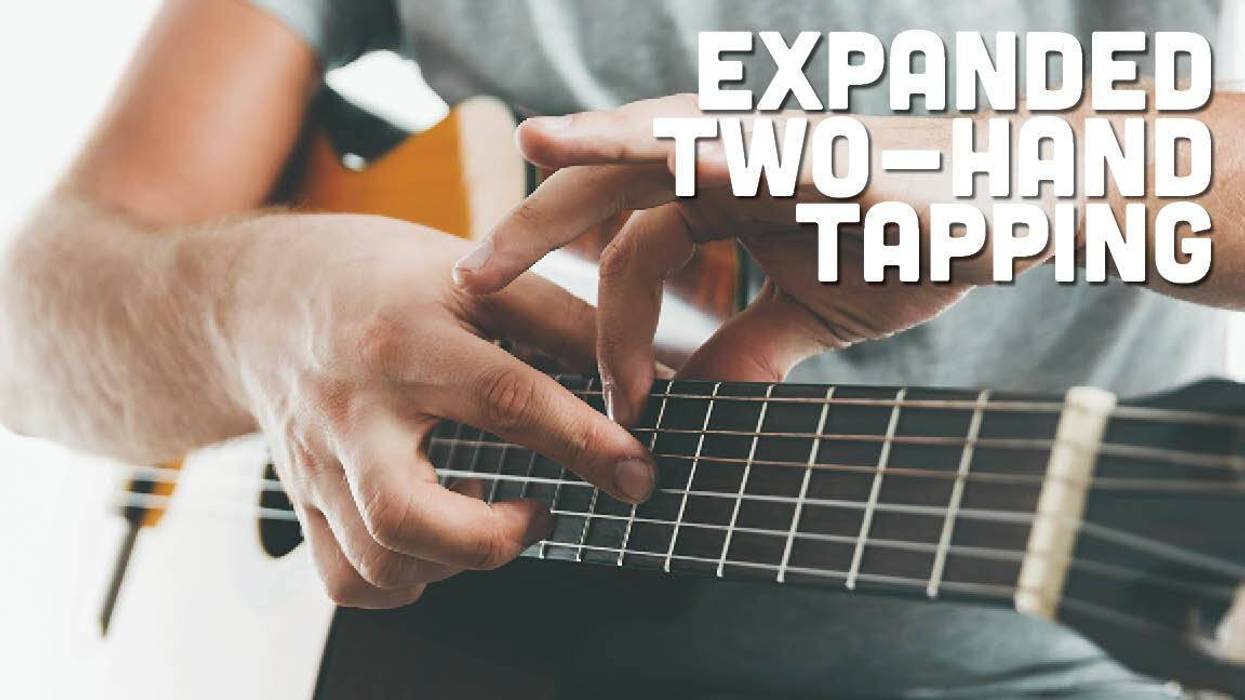
I’ve always loved the unconventional technique of using two-handed tapping in a “chordal” way. In my younger years, I found myself utilizing it for the wow factor. As I matured in my musicianship, I began asking myself, “What is the practical application of this, and how can it be used in a more musical situation?” I began to use the technique as a way to expand solo/chord-melody guitar playing in the style of players such as Stanley Jordan and Victor Wooten. But that is a whole other ball game in terms of time, practice, and development.
As for how this can be used in a simpler and more typical situation, I found the rhythmic,
percussive, and chordal elements of this technique to be extremely fun and expansive when working with small groups such as duos, trios, and quartets. This is especially exciting when applying it to ethnic rhythms such as Latin, Anatolian, and Middle Eastern rhythms.
When I practice this, I think of two main things: left hand and right hand apart, and left hand and right hand together. I would say left and right hand apart is an easier starting point as it doesn’t require the same coordination. I generally like to utilize root, fifth, and octave with the left hand, and extensions like thirds and sevenths with the right hand as they are the color tones.
Explanation of tabs: Below each column of the noted tab, I use the letter R to indicate right hand and L to indicate left hand. They are stacked in a way that represents the tabs. For example, if you see the letter L all the way at the bottom and the letter R on top of that, that would mean your left hand is tapping the lower note while your right hand is tapping the higher note.
Let’s start off with a straightforward syncopated rhythm that focuses on the left and right hand playing apart from each other.
Ex. 1
Ex. 1: Left hand and right hand apart. This example creates a typical 3+3+2 rhythm by playing two individual notes on the left hand, followed by two notes together (two-note combo) on the right hand, repeat, then finish with one note on the left hand and one combo on the right hand.
Ex. 2
Ex. 2: This is the same rhythm and pattern as the first example, but we begin to have some melodic movement in the right hand.
Ex. 3
Ex. 3: Left hand and right hand begin playing together. This example has a bit of a Latin flavor and the juxtaposition of strong down beats in the left hand and syncopations in the right hand creates a cool effect.
Ex. 4
Ex. 4: This is the same rhythm and pattern as Ex. 3 but we have some movement with the extensions of the chords.
Ex. 5
Ex. 5: This example begins to incorporate sliding in the right hand. Whenever I present a new technique, I simplify the overall example to focus on the new technique.
Ex. 6
Ex. 6: This is a standard progression based on the first eight measures of “Blue Bossa.” Clearly, I like minor keys. This example demonstrates more bassline movement with the left hand and application of the style over a longer chord progression. We are keeping the left hand and right hand apart to ease into a busier left hand.
Ex. 7
Ex. 7: This example utilizes all the prior concepts, including slides in the right hand, hammer-ons and pull-offs between the two hands, both hands together, and both hands apart.
I hope these examples help with getting started on some basic—and some not-so-basic—tapping
techniques while playing something that sounds musical and usable.
Tom Bukovac is not a guitar player. Well, technically, he is—but more so, he’s a musician who plays guitar. He’s someone who always strives to make the best musical choice above all else. Bukovac, a first-call Nashville session guitarist and four-time winner of the Academy of Country Music Guitar Player of the Year award, has played on over 1,200 sessions for artists such as Taylor Swift, Keith Urban, and Sheryl Crow, while also being called upon to tour with heavyweights like Joe Walsh and Vince Gill.
Bukovac has gained legions of fans via his YouTube channel (@501chorusecho) where he regularly posts his Homeskoolin’ lessons. There, he imparts nuggets of musical wisdom with humor via extended segments of playing, proving him to be a seemingly endless font of creativity—with a killer collection of guitars.
His latest release is 2024’s In Stereo, an album of original music he co-headlines with fellow Nashville session wizard Guthrie Trapp.
Chords Are the Key
One of Bukovac’s superpowers is his profound understanding of chords, which informs both his lead and rhythm playing. Watch how he uses organ-style voicings to play through a blues in G.
Ex. 1 is inspired by his playing here. While he’s thinking G7 for the entirety of the first four bars, note how he employs various three-note chord fragments, including F and C triads—but not to create a chord change. Think of it more as splashing various “colors” over these four bars of G7. For example, the F triad (F–A–C) brings the b7 (F), 9 (A) and 11 (C). These first three examples are played fingerstyle.
Ex. 1
Bukovac often plays solo in his videos. But even when he’s improvising with single notes, he often deftly uses his fret-hand thumb (usually) to play bass notes that imply the chords he’s hearing in his head. Here, he adds just a few subtle thumps to propel the rhythm as he solos.
Ex. 2 explores similar territory. Be sure to palm-mute the bass notes to keep them nice and punchy. Note your fret-hand thumb should fret all of the notes on the 6th string except the final one, where your 3rd finger is a better choice.
Ex. 2
Bukovac is an encyclopedia of chord voicings, and he is remarkably musical in how he composes with them. This video is over seven minutes of inspired, beautiful music. There’s so much here to explore, even if you just randomly skip around.
Ex. 3 is a variation on his intro here—just simple seventh chords, but voiced in a unique way. Note how the melody clearly sings out, being so far from the accompaniment. There are no thirds in any of these chords; you can alternately think of them as power chords with melody notes on top.
Ex. 3
Grab Yer Pick
Bukovac is equally skilled using a pick. In this video, he’s employing hybrid picking—alternately or simultaneously using the pick and fingers.
Ex. 4 begins in the key of E, then borrows from E minor for the final two chords. In measure three, fret the down-stemmed notes with your middle finger, executing the slides with your pinky.
Ex. 4
Now, for something completely different, as Bukovac’s got a wide range of styles in his bag, here he shows his country-style pickin’ prowess.
Throughout his solo, over F7 throughout, Bukovac again keeps things interesting, here by employing different textures. Played with your pick, Ex. 5 travels from triads to dyads to single notes, ending with some death-defying open-string pull-offs. Be sure to pick close to the bridge for those to give ’em extra bite, and don’t forget the slapback echo.
Ex. 5
In the first two bars of the previous example, Bukovac uses Dm and Cm triads over F7. Let’s use some Bukovac-style creativity to see how we can take this knowledge a step further. You likely already know that, when soloing, you can use the D minor pentatonic scale (D–F–G–A–C) over F7 — remember it’s the same as F major pentatonic (F–G–A–C–D). But how about using the C minor pentatonic scale (C–Eb–F–G–Bb) over F7? The rule of thumb is you can play the minor pentatonic scale a fifth above the root of a dominant seventh chord. Ex. 6 demonstrates with a Bukovac-style lick. Note that the C minor pentatonic scale brings into play the F7 chord’s 5 (C), b7 (Eb), root (F) and 9 (G). The phrase colorfully touches upon C Dorian (C–D–Eb–F–G–A–B) by including an A, the 3 of F7 at the end of bar 1, as well as a D, its 13, at the end of bar 2.
Ex. 6
Bukovac is especially expressive in the way he bends. In this video, he’s executing two half-step bends simultaneously, using the pick.
Ex. 7 is a similar phrase, and, of course, these bends need to be in tune. If this proves to be challenging, the thing to do is simply slow things down. Bend by turning your wrist only, keeping your fingers stationery as it turns. If that doesn’t feel comfortable, try pulling both strings towards the floor. Tricky….
Ex. 7
Next, over the same groove, Bukovac uses his pick-hand index and middle fingers to create a melody over an open D-string drone. Ex. 8 explores similar territory; execute the final bend by pulling the 3rd string towards the floor to allow the open 4th string to continue to ring.
Ex. 8
Practice Creativity
Like so many of his longer videos, here, Bukovac—off the top of his head—continually finds new musical ideas, taking time to explore each one.
Ex. 9 is based on another idea from the same video. Note the final two examples are played with the pick.
Ex. 9
As Bukovac does, let’s create a couple of simple variations on Ex. 9,as demonstrated in Ex. 10.
Ex. 10
Finally, inspired by Bukovac’s creativity, try exploring your own by simply taking time to fool around with the previous two examples. Don’t think too much. Just start playing, and you’ll undoubtedly discover some brand-new ideas of your own.
Improvising over one chord for long stretches of time can be a musician's best friend or worst nightmare. With no harmonic variation, we are left to generate interest through our lines, phrasing, and creativity. When I started learning to improvise, a minor 7 chord and a Dorian mode were the only sounds that I wanted to hear at the time. I found it tremendously helpful to have the harmony stay in one spot while I mined for new ideas to play. Playing over a static chord was crucial in developing my sense of time and phrasing.
The following is the first improvisational device I ever came across. I want to say I got it from a Frank Gambale book. The idea is that there are three minor pentatonic scales "hiding" in any given major scale. If we're in the key of C (C–D–E–F–G–A–B) we can pluck out the D, E, and A minor pentatonic scales. If we frame them over a Dm7 chord, they give us different five-note combinations of the D Dorian mode. In short, we are building minor pentatonic scales off the 2, 3, and 6 of the C major scale.
Viewing this through the lens of D minor (a sibling of C major and the tonal center for this lesson), D minor pentatonic gives us the 1–b3–4–5–b7, E minor pentatonic gives us 2–4–5–6–1, and A minor pentatonic gives us 5–b7–1–2–4. This means you can use your favorite pentatonic licks in three different locations and there are three different sounds we can tap into from the same structure.
If you smashed all of them together, you would get the D Dorian scale (D–E–F–G–A–B–C) with notes in common between the D, E, and A minor pentatonic scales. Ex. 1 uses all three scales, so you can hear the different colors each one creates over the chord.
Ex. 1
Ex. 2 is how I improvise with them, usually weaving in and out using different positional shapes.
Ex. 2
The next idea is one I stole from a guitarist who often came into a music store I worked at. On the surface, it's very easy: Just take two triads (in our example it will be Dm and C) and ping-pong between them. The D minor triad (D–F–A) gives us 1–b3–5, which is very much rooted in the chord, and the C major triad (C–E–G) gives us the b7–9–4, which is much floatier. Also, if you smash these two triads together, you get 1–2–b3–4–5–b7, which is a minor pentatonic scale with an added 2 (or 9). Eric Johnson uses this sound all the time. Ex. 3 is the lick I stole years ago.
Ex. 3
Ex. 4 is how I would improvise with this concept. Many different fingerings work with these, so experiment until you find a layout that's comfortable for your own playing.
Ex. 4
If two triads work, why not seven? This next approach will take all the triads in the key of C (C–Dm–Em–F–G–Am–Bdim) and use them over a Dm7 chord (Ex. 5). Each triad highlights different three-note combinations from the Dorian scale, and all of them sound different. Triads are clear structures that sound strong to our ears, and they can generate nice linear interest when played over one chord. Once again, all of this is 100% inside the scale. Ex. 5 is how each triad sounds over the track, and Ex. 6 is my attempt to improvise with them.
Ex. 5
Ex. 6
If we could find all these possibilities with triads, it's logical to make the structure a little bigger and take a similar approach with 7 chords, or in this case, arpeggios. Naturally, all the diatonic chords will work, but I'll limit this next idea to just Dm7, Fmaj7, Am7, and Cmaj7. I love this approach because as you move further away from the Dm7 shape, each new structure takes out a chord tone and replaces it with an extension. I notice that I usually come up with different lines when I'm thinking about different chord shapes, and this approach is a decent way to facilitate that. Ex. 7 is a good way to get these under your fingers. Just ascend one shape, shift into the next shape on the highest string, then descend and shift to the next on the lowest string.
Ex. 7
Ex. 8 is my improvisation using all four shapes and sounds, but I lean pretty heavily on the Am7.
Ex. 8
This last concept has kept me busy on the fretboard for the last five years or so. Check it out: You can take any idea that works over Dm7 and move the other diatonic chords. The result is six variations of your original lick. In Ex. 9 I play a line that is 4–1–b3–5 over Dm7 and then walk it through the other chords in the key. These notes are still in the key of C, but it sounds drastically different from playing a scale.
Ex. 9
In Ex. 10, I try to think about the shapes from the previous example, but I break up the note order in a random but fun way. The ending line is random but felt good, so I left it in.
Ex. 10
While all these concepts have been presented over a minor chord, you can just as easily apply them to any chord quality, and they work just as well in harmonic or melodic minor. Rewarding sounds are available right inside the harmony, and I am still discovering new ideas through these concepts after many years.
Though the above ideas won't necessarily be appropriate for every style or situation, they will work in quite a few. Developing any approach to the point that it becomes a natural extension of your playing takes considerable work and patience, so just enjoy the process, experiment, and let your ear guide you to the sounds you like. Even over just one chord, there is always something new to find.
It’s a familiar problem: You know your pentatonic scale patterns, but they’re only getting you so far. In this lesson, instructor Caitlin Caggiano breaks down the pentatonic scale and helps you elevate you patterns and deepen your playing. Want to learn how to make your pentatonics feel less boxy and more musical? How to use multiple pentatonic scales to emphasize chord tones? How to add certain notes to add more dimension and color to your playing? This lesson is for you.
Great music tells a story. It builds on a plot and holds the listener’s attention as the story unfolds. We are especially moved by soloists who bare their souls and who keep us riveted with every twist and turn from their narrative. Pentatonics are the backbone of modern guitar vocabulary. Partially because they just sound good, but also because they lay so easily on guitar. There are several ingredients that make a guitarist sound brilliant, but one of the most important is chromaticism. Could there a be a way we could combine these two? Let’s find out.
This term chromaticism comes from the Greek word chroma, which means “color.” Using chromaticism means having the freedom to use all 12 notes over a given chord. Imagine the possibilities and freedom to play any note over a chord in composition or improvising! The quickest way to start adding color notes to the minor pentatonic scale is to add the 2nd and the 6th, which then gives you a Dorian mode. I’ve outlined it below using the A minor pentatonic scale.
A Minor pentatonic: A–C–D–E–G
A Dorian: A–B–C–D–E–F#–G
In general, there are chromatic notes that are outside the chord/scale, and notes that are outside the key. The latter carries a lot of tension against a chord and needs movement or resolution. From my days of playing jazz gigs in Toledo, OH, I recall what legendary trumpeter Jimmy Cook once told me regarding playing outside: “You can go up to the attic, but you have to come back down.” In other words, you can play outside tonally, but you must resolve at some point in order for your music to sound coherent.
Let’s get started on this journey of chromaticism together.
Before we go hog wild and add random notes, let’s begin by taking an A minor pentatonic scale and fill in the chromatic notes between the already existing box pattern. It’s almost arbitrary, but it will enable you to hear different colors added within the scale (Ex. 1).
Chromatic Burst of Energy. In beat 1 of Ex. 2, we start with an A Dorian fragment followed by an extended chromatic line. The line in beat two starts on the b7 (G), highlighting the b5 (Eb) on beat 3, descending chromatically all the way down to B, and ending with A major pentatonic.
Bounce Around! We start on the b5 (Eb) followed by a typical chromatic rotation where we bounce around the b5. This idea lays quite well in the familiar pentatonic box. It’s easy and will add spice to your shredding (Ex. 3).
Side Stepping. A common approach to playing “outside” is side stepping. In other words, take the scale you’d normally use and displace it by a half-step above or below. By doing this, you’ll have instant access to notes that are harmonically outside the key—don’t think of them as wrong notes, just coloring notes. In Ex. 4 we take a pentatonic pattern from E minor pentatonic and sequence it in F minor pentatonic. As the notes can be analyzed over the E5 chord, it’s more important to view them as passing notes. Remember, the power of the sequence overrides the harmony!
Extend the Side Step. Ex. 5 uses the same concept of side stepping above but adds a note (D) to the displaced pattern. By doing so, this breaks the predictability of the phrase and places subsequent notes in new places.
Changing Tones.Ex. 6 is a fun lick to learn that starts with a strong, repeated three-note polyrhythmic figure (A#–B–D). The chromatic part occurs on beat 4 and utilizes changing tones, which is a type of non-harmonic tone.
Don’t Start On 1. The line starts on the 2nd (B), goes up a whole-step to C# followed by a double chromatic approach to Bb, down a whole-step to (G#), and finally resolving to the root (A). Once the A note is reached, there’s a cascading flurry of four-note groups settling in A minor pentatonic (Ex. 7).
Scrambles. This example (Ex. 8) was inspired by the legendary New York guitarist, Mark Hitt. Mark was a unique player, combining a rock sensibility with a jazz quotient. He developed an arsenal of twisting lines using chromaticism that he referred to as “scrambles.”
The pattern alternates between 1–3–4 and 1–2–4 fingerings, a typical fingering of the diminished scale. It can be analyzed where notes of the pentatonic are being targeted, but it’s all about the texture and excitement that is created. Make sure to play the line with slurs to get a fluid, legato sound.
Half-Step Approach. In this instance, we take the Im triad (Am) from the pentatonic scale and approach each chord tone from a half-step below (Ex. 9). This is more of a concept and exercise rather than a lick. This idea can be used with just about any improvising application.
One String Wonder. Ex. 10 highlights a series of chromatically descending half-steps. It’s an easy technique to get down and one I often use. It provides melodic interest, but also serves as an easy way to connect one position to the next. Here, we start on a high F that walks down a fourth to C in half-steps, followed by a C minor blues phrase.
Practice Tip
These chromatic lines sound best when played fast and with conviction. As always, approach new material slowly and accurately. Ignore your inner voice that may tell you that the “outside” notes are wrong. Once you’re able to play the lines up to speed, you’ll be amazed by how impressive it sounds. These ideas that will add motion, color, and excitement to your playing and enhance your musical expression when soloing.