

Now that the recession has faded and sales charts are showing upward curves, manufacturers of America’s favorite instrument are in high gear. But making the same guitars they made a decade ago just won’t do in an age when a 3-year-old laptop is the equivalent of a digital jalopy. Whether it’s torrefaction of tone woods, the return to using animal-hide glue and thinner finishes, or the latest pickup system, the advertised message to consumers is clear: Everybody’s new guitars are better than the ones they were making 15 years ago—or in 2013, for that matter.
All this focus on the latest new trends in acoustic guitars means there are some great bargains for those of you who want a good, clean, used guitar to play. To keep it simple, we’re going to focus on guitars made after 1990.
Part of what works to the advantage of someone shopping for a used guitar is that while acoustic guitar fans revere instruments from the distant past, there’s a persistent dismissal of guitars from more recent decades. Nobody necessarily speaks glowingly about the Gibson acoustics of the 1970s when the hot new technology of that era was the Ovation. But the guitar’s revival—both in quality and production—that began in the late ’80s resulted in increased competition among guitarmakers, and all manufacturers were upping their game by the ’90s. Unless it’s been exposed to climate abuse or rough handling, there’s no reason to be afraid of a 20-year-old guitar that has decent action and frets.
It’s important to observe a few rules on your bargain hunt for a recently used guitar so you can keep possible after-purchase costs to a minimum. Do not fall for the “it’s been well broken-in, so it sounds great” explanation if you notice heavy pick wear and lots of nicks and dings. Such a guitar probably has worn frets and may have other issues related to less-than-careful treatment. I’m not saying there’s anything wrong with guitars that show use, but why not add the character marks yourself? If your goal is a great guitar to play, you’ll break it in quickly. An instrument that’s been languishing in a closet or under the bed is a great find and far more likely to help you avoid costly trips to the repair shop.
Used guitar buyers often have a somewhat skewed understanding of what matters and what doesn’t. Use this to your advantage. For instance, cracks that have been repaired well—especially tight, hairline cracks to the sides or back—have zero impact on a guitar’s sound. (Even repaired top cracks are more of a cosmetic issue than a structural flaw that impacts tone.)
Badly worn frets and bad neck angles, however, can wreak havoc with playability, resulting in high string-action that’s very costly to repair. A guitar with a couple of tight, repaired-but-visible side cracks will often sell for far less than a similar crack-free instrument that needs a neck reset and new frets.
Discontinued models—or models where the manufacturer hasn’t actually dropped the model but has ditched the earlier model code—are other potential bargains. For instance, Taylor ran two very similar lines of acoustics for a few years, one with the same 3-digit model code they’d been using for years, but another with a model code comprising letters and only one digit. These were pitched as pure acoustics to distinguish them from their acoustic/electrics with a “ce” or “e” designation. But a 700 Series Taylor dreadnought and a DN7 had similar woods and pricing. Sound confusing? Evidently, both Taylor and its dealers thought so too. The DN7 and other body shapes in the same series are now history, and many Taylor fans don’t even recognize those models, which makes them harder to sell as used guitars.
Changes in acoustic/electric pickup systems offer another opportunity to find great-sounding used guitars with what many buyers see as near-fatal flaws. When “active electronics” (requiring a battery inside the guitar) became the rage in the 1990s, new acoustics destined to be plugged in were under siege. It seemed most people didn’t want to bother reaching inside the soundhole to change the 9V battery or deal with preamp boxes in their signal chain. If electric guitarists had tone and volume controls at their fingertips, why couldn’t acoustic/electric players have the same convenience?
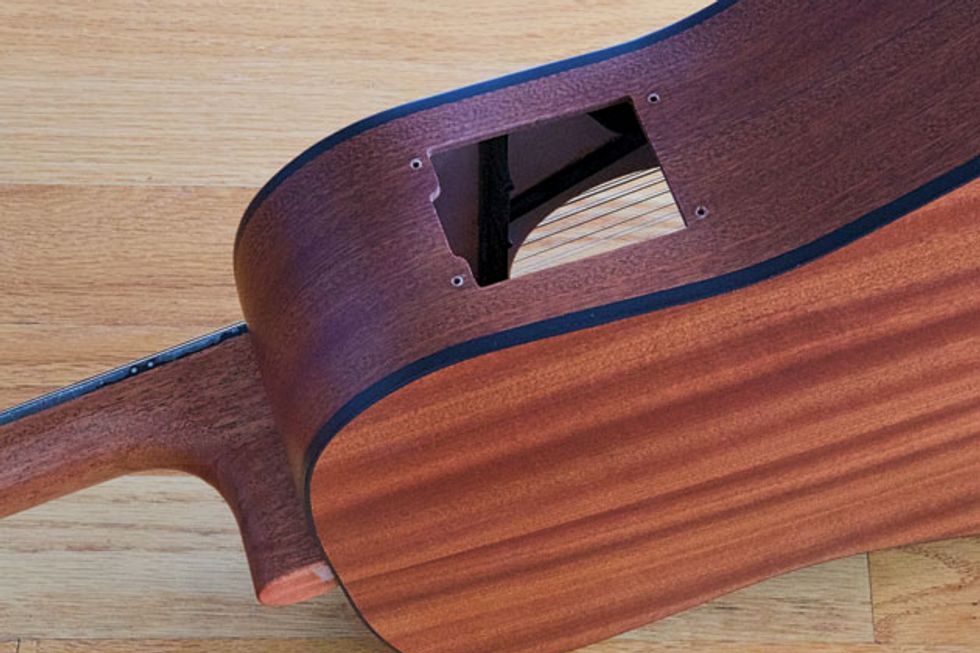
Fortunately, fear of compromising the acoustic tone kept manufacturers from putting a lot of hardware on soundboards, but rectangular control panels got mounted in the upper side instead. This allowed easy access to the battery, tone and volume controls, and later, even notch filters. When internal microphones became the latest gadget, those were added as well. Lots of fancy acoustic/electrics left the factory with a hole the size of a postcard in the upper side.
Today’s pickup systems do far more with discreet controls that you barely even notice. And used guitars with the now-abandoned side-mount technology sell for far less than an equivalent model without it. Some people use those pickup systems and like them, but they can be removed if you don’t. A set list of your greatest hits will cover the hole, as will a bumper sticker advertising your favorite band or political cause. Some people even pay extra for a sound port in the side of their guitar, so maybe you’ll want to just leave the hole alone! Whatever you do, just be sure you save all the parts so your guitar can be returned to it’s original state should you decide to sell it.
You can save a lot of dough if you do your homework, and shop while thinking of your next guitar as a tool for actually making music.






![Rig Rundown: The Black Crowes’ Rich Robinson [2026]](https://www.premierguitar.com/media-library/youtube.jpg?id=66952027&width=1245&height=700&quality=70&coordinates=0%2C0%2C0%2C0)