For years, Taylor Guitars design guru Andy Powers was ruminating on a sound. It was something deep and warm, with the soul of a bygone era—but unrealized in Taylor’s lineup.
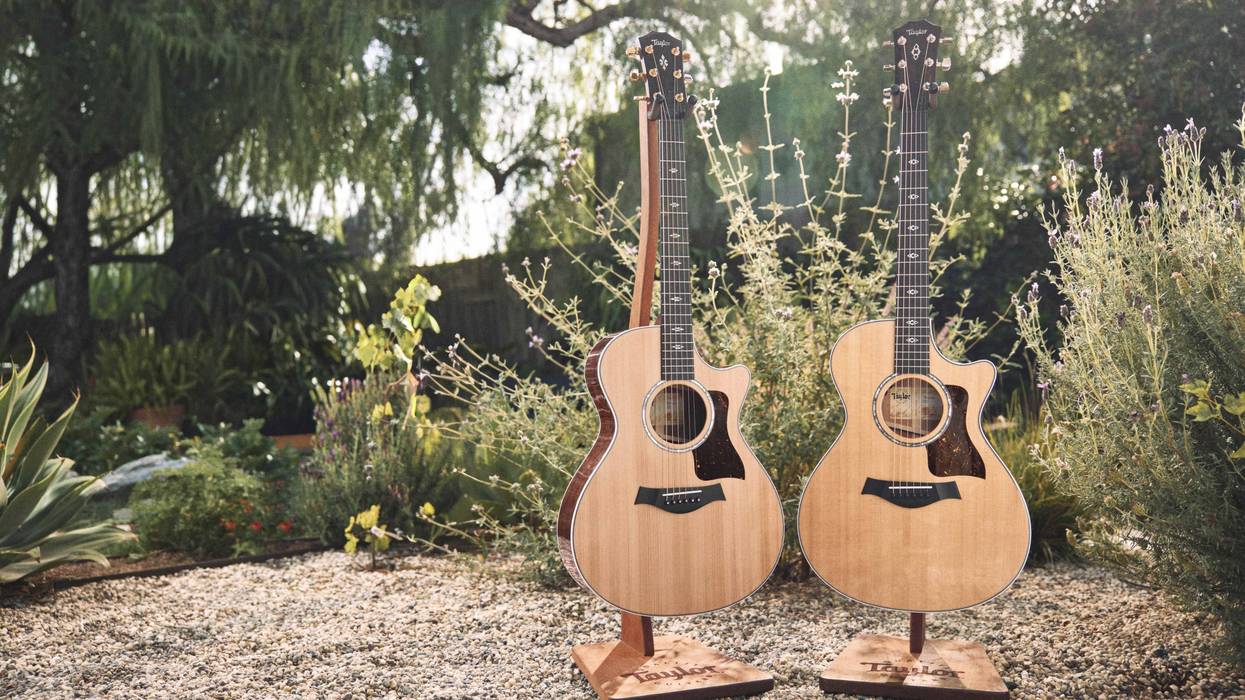
Like any relentless innovator and natural luthier, Powers set out to develop an instrument that could channel this “new-old” sound while preserving the essential feel and musicality of a Taylor guitar. That effort came to life with the unveiling of the Gold Label Collection, launched at the 2025 NAMM Show. This new family of guitars introduced a warmer, fuller, more robust acoustic voice to the Taylor landscape—one that lives comfortably alongside the high-fidelity sound Taylor players have long embraced.
The new heritage-style sound has been made possible by a three-part sonic recipe, including one of two new non-cutaway body shapes (the Super Auditorium and deeper-bodied Grand Pacific, a round-shoulder dreadnought), a new internal bracing pattern and an innovative long-tenon neck joint design.
The Super Auditorium was designed with a slightly longer body and wider lower bout than Taylor’s flagship Grand Auditorium, serving up an open, muscular sound with warm, heavy-bodied trebles. “There’s a kind of honesty in this voice,” Powers says. “It’s not about hi-fi precision or isolated detail—it’s about a more natural kind of musicality. There’s warmth and fullness, but it still responds easily to your touch.” With its comfortable proportions and balanced tone from the lower to upper register, the Super Auditorium retains the versatility of Taylor’s original Grand Auditorium while delivering a fuller, more traditional tone.
But the Super Auditorium wasn’t the only body style envisioned for the collection. Equally central to the lineup is a reimagined version of Powers’ original slope-shoulder dreadnought Grand Pacific, an acoustic shape that doubles down on the sonic warmth and depth that inspired the entire project. For the Gold Label Collection, he’s added an extra 3/8-inch of depth at the soundhole. The extra lung capacity creates a deeper resonant frequency and contributes to a sound that has been compared to “sonic comfort food.” Compared to the Super Auditorium, the Grand Pacific’s broader curves and deeper body yield enhanced low-end power and projection, with a more seasoned, blended sonic character that invites players to really dig in.
The aforementioned long-tenon neck joint is just one design element of Powers’ patented Action Control Neck™—currently featured exclusively on Gold Label models. The glueless, long-tenon design enhances the wood coupling between neck and body, further boosting low-end resonance. Perhaps the most ingenious part of the Action Control Neck’s design is its namesake string height adjustability. Players and technicians can adjust the action in seconds by using a quarter-inch nut driver (or standard truss rod wrench) on a bolt in the neck block, accessible through the soundhole. For guitarists jumping between different climate conditions, playing styles and musical applications, or just looking to dial in their ultimate playing setup, the Action Control Neck is a game changer. And the neck’s slim profile ensures players have the familiar hand-friendly playing experience expected from a Taylor guitar.
The first guitars to showcase the old-school sonic personality of the Gold Label Collection were a group of Super Auditorium models introduced at Taylor’s traditional 800 Series level, including the torrefied spruce/Honduran rosewood Gold Label 814e. After playing a Gold Label Super Auditorium for the first time, singer, songwriter and Asking Alexandria frontman Danny Worsnop says he was “blown away” by the warmth and fullness of the sound, and that he loved the easy neck adjustability. “It is a massive deal,” he says. “When it comes to traveling musicians, it’s absolutely game changing.”
Since the collection’s initial launch, Taylor has introduced a family of powerhouse Gold Label Grand Pacific models—three at Taylor’s 500 Series level, built with solid mahogany and torrefied spruce, and three at the 700 Series level, with Indian rosewood and torrefied spruce. Each model comes with one of three top finish options. The Gold Label 517e and 717e feature a natural top for a classic acoustic look. A black top finish and cream colored pickguard give the Gold Label 517e Blacktop and 717e Blacktop a bold, stage-ready visual presence. Players can choose either a cream or firestripe pickguard for the sunburst-top Gold Label 517e SB and 717e SB. The mahogany models offer a woody, dry attack and seasoned warmth, while the rosewood versions add extra depth and harmonic complexity.
Artists across genres have rallied around the Gold Label Grand Pacific models, praising their warmth, resonance and stage-ready presence. “There’s not a more popular instrument to play in Nashville than an acoustic guitar,” says solo artist Gina Venier, “and I feel like I’ve got the top dog in the game right now.” Others echo that sense of discovery and connection. Chris Conley of Saves the Day calls the Gold Label 717e “the world’s most perfect acoustic guitar,” citing its “neck so buttery and beautiful” and “resonance so rich and warm.” Tiger’s Jaw’s Ben Walsh describes his Gold Label 717e as “the acoustic guitar I will grow old with,” while Jon Simmons of Balance and Composure praises his Gold Label 517e for feeling “so natural to play” and sounding “perfect” both unplugged and onstage. Longtime producer and engineer Ben Moore (Blink 182, Switchfoot) put it succinctly: “At this point, I thought I knew what a Taylor guitar sounds like. I couldn't have been more wrong.”
Each guitar in the Gold Label lineup sports Andy Powers’ modified headstock shape, with an angled back cut and a script-style Taylor logo inlay. His newly stylized pickguard shape is another visual hallmark of the collection and gets a dual-layer treatment with an engraved “Continental” design on 800 Series models.
The Gold Label Collection introduces a new sonic dimension to what’s thought of as the “traditional Taylor sound”—one rooted in tradition and elevated by innovation. Whether you’re drawn to the versatility of the Super Auditorium or the power of the Grand Pacific, these guitars invite players into this new breed of Taylor tone, where old-heritage inspiration meets modern musical expression. Gold Label guitars are available at authorized Taylor dealers.
Ever dreamed of building your own custom electric guitar from scratch? In this 8-part series, StewMac’s Brock Poling walks you through the entire process — no big workshop or expensive CNC machines required! You just need a little patience, imagination, and attention to detail to create a guitar you'll treasure for a lifetime.
T-Style Electric Guitar Kit If you're new to guitar building this kit's a great way to start: this is the classic electric guitar design that's fun to build, and you'll learn a lot.
Episode #2 - Gluing up the foundation of your guitar
Now the real fun begins! In Episode 2, we’re making all the big decisions that will define your custom electric guitar. What body shape will you choose? What types of wood will bring out the tone you want? What style hardware will complete your vision? Join Brock as he walks through his own design process of crafting a stunning rosewood tele, and sharing expert tips along the way.
Episode #3 - Cutting a tele build to its final shape
A great guitar starts with a rock-solid foundation! In Episode 3, Brock walks you through the crucial steps of prepping and gluing up your body blank. Learn how to avoid imperfections in the wood, line everything up perfectly, and clamp it all together for a super strong, stable body.
Episode #4 - Cutting a tele build to its final shape
In Episode 4, Brock walks you through the process of cutting and shaping your guitar body. You’ll learn how to accurately trace your body template, make a rough cut on the bandsaw, and then carefully route the blank to its final shape. By the end of this step, you’ll have a guitar body that looks and feels like the real deal—and you’ll be one step closer to playing your own custom build!
Episode #5 - Picking hardware and routing the neck pocket
Now it’s time to gear up! In Episode 5, we’re going shopping for all the essential hardware that will bring your custom guitar to life—pickups, bridges, ferrules, knobs, jack plates, and more! Once the parts are picked, it’s back to the build. Brock shows you how to customize and use a neck pocket template to anticipate an oil finish, then carefully route the neck pocket for a perfect fit. To wrap things up, we true up the body sides using a variety of sanding cauls for a clean, pro-level result.
Episode #6 - How to get PERFECT bridge placement on your guitar
In Episode 6, we’re focusing on one of the most critical steps in your guitar build—precisely locating and mounting the bridge. A well-placed bridge is essential for great playability, intonation, and tuning stability, so getting this right is a must! Brock walks you through his method of using a surrogate guitar neck to dial in the exact bridge position. Then, we temporarily mount the bridge to the body to determine the perfect placement for the string ferrules—a step that can be tricky, but Brock shares a game-changing tip to get it right every time.
Episode #7 - Creative routing for pickup and control cavities
In Episode 7, Brock guides you through routing the pickup and control cavities using customized templates. He covers what to consider when positioning your pickups and explains why making your own jigs is an essential skill for any guitar builder. And if you make a mistake? No problem—Brock shows how to recover from a routing slip using rosewood dust and superglue.
Episode #8 - Drilling for electronics and prep sanding for finish!
We’ve made it to the final step! In Episode 8, Brock Poling walks you through the last crucial details—drilling holes for the electronic wires, locating and drilling the jack hole, and rounding over the edges for a smooth, comfortable feel. To wrap it all up, Brock carefully sands the entire body, getting it prepped and ready for an oil finish. After this step, your guitar will be fully shaped and ready for a neck!
From cutting-edge pickups to museum-worthy display cases, this Acoustic Gear Showcase is packed with tools to elevate your tone—and your space. Whether you're chasing pristine plugged-in sound, ergonomic performance upgrades, or just a serious vibe boost, these six standouts from Godin, Walden, Mojotone, LAG, and more deliver the goods.
A wall-mounted showcase designed for your most prized instrument. The Nashville safely hangs and displays a variety of guitar bodies in a solid wood and tempered glass case. Includes a locking door, adjustable LED lighting, and your choice of Boveda passive humidification or AMF's 1.5q Active humidification system.
The Godin Multiac Nylon Opal Burst and Ocean Burst, inspired by Godin artists Opal Ocean, feature stunning flame tops and matching headstocks. Made in Canada, they deliver the exceptional tone and playability that have made the Multiac the gold standard for plugged-in nylon-string guitars.
The Mojotone Quiet Coil NC-2 is equipped with new, groundbreaking mic technology that puts this acoustic soundhole pickup into a league of its own when it comes to pure and natural acoustic guitar sound. Our mission was to combine our incredibly natural sounding “mic-voiced” and noise-canceling NC-1 magnetic pickup.
Designed by Peter Stroud (Sheryl Crow and Close Enemies) to help create the tones in his head and heart. Peter has been a big fan of RMSC and we are thrilled to be able to offer a real "official" tone tool just for him. It’s made out of FireCracker Aluminum for speed and tone.
Unlock your creativity! The new LAG HyVibe H2 Series blends craftsmanship with technology, offering built-in effects, looping, and Bluetooth. Pair with the optional HyVibe FS-2 or FS-4 pedal for expanded control of effects and looper functions. No amp required, just pure inspiration.
Get the best sound out of every strum with Walden’s low-mass scalloped-X bracing and glass-fibre reinforced neck. This Grand Auditorium cutaway-electric features an ergonomic armrest—usually found on pricier instruments. A warm, resonant solid Cedar soundboard, paired with African Ovangkol, accentuated by a UV-cured gloss finish and offset position markers.
See and hear Taylor’s Legacy Collection guitars played by his successor, Andy Powers.
Last year, Taylor Guitars capped its 50th Anniversary by introducing a new guitar collection celebrating the contributions of co-founders Bob Taylor and Kurt Listug to the guitar world. The Legacy Collection revives five of Bob Taylor’s classic acoustic models, curated by the legendary luthier and innovator himself. “To imagine that we’re doing guitars that harken to our past, our present and our future all at the same time,” Bob says, “I really like that.”
In developing the collection, Bob preserved the essence of his originals while integrating performance and playability upgrades introduced during his tenure as designer-in-chief. “It’s an up-to-date version of what those guitars would be,” Bob explains, “but with the same sound.”
Visually, these guitars feel classic—clean, understated and unmistakably Taylor. While Bob’s original aesthetic preferences are showcased in his Legacy models, the nod to the past runs deeper than trade dress.
From his earliest builds, Bob favored slim-profile necks because he found them easier to play. That preference set a design precedent that established Taylor’s reputation for smooth-playing, comfortable necks. Legacy models feature slim mahogany necks built with Taylor's patented New Technology (NT) design. “My first neck was a bolted-on neck but not an NT neck,” Bob says. “These are NT necks because it’s a better neck.” Introduced in 1999, the NT neck allowed for unprecedented micro-adjustability while offering a consistent, hand-friendly Taylor playing experience.
What makes this collection unique within the Taylor line is Bob’s use of his X-bracing architecture, favoring his time-tested internal voicing framework over more recent Taylor bracing innovations to evoke a distinctive tone profile. Since Andy Powers—Taylor’s current Chief Guitar Designer, President and CEO—debuted his patented V-Class bracing in 2018, V-Class has become a staple in Taylor’s premium-performance guitars. Still, Bob’s X-bracing pattern produces a richly textured sound with pleasing volume, balance and clarity that long defined the Taylor voice. All Legacy models feature LR Baggs VTC Element electronics, which Bob says “harkens back to those days.”
The team at Taylor thought the best way to demonstrate the sound of the Legacy guitars was to ask Andy Powers, Bob’s successor, to play them. A world-class luthier and musician, Andy has spent the past 14 years leading Taylor’s guitar innovation. In addition to V-Class bracing, his contributions include the Grand Pacific body style, the ultra-refined Builder’s Edition Collection, and most recently, the stunning Gold Label Collection.
Below you’ll find a series of videos that feature Powers playing each Legacy model along with information about the guitars.
Legacy 800 Series Models
First launched in 1975, the 800 Series was Taylor’s first official guitar series. Today, it remains home to some of the brand’s most acclaimed instruments, including the flagship 814ce, Builder’s Edition 814ce and new Gold Label 814e.
The Legacy 800 Series features the 810e Dreadnought and two Jumbos: the 6-string 815e and 12-string 855e. Each model serves up a refined version of the Dreadnought and Jumbo body shapes Bob inherited from Sam Radding—the original owner of the American Dream music shop where Bob and Kurt first met. “I was making my guitars in the molds that Sam had made at American Dream,” Bob recalls. “There was a Jumbo and a Dreadnought. That’s all we had.”
All three Legacy 800 Series guitars feature one of Bob’s favorite tonewood combos. Solid Indian rosewood back and sides are paired with a Sitka spruce top, yielding warm lows, clear trebles and a scooped midrange.
Aesthetic appointments include a three-ring abalone rosette, mother-of-pearl Large Diamond inlays, white binding around the body and fretboard, and Bob’s “straight-ear” peghead design. Both Jumbo models also showcase a mustache-style ebony bridge—a nod to Bob’s early Jumbo builds.
Legacy 810e
The 810 Dreadnought holds a special place in Bob Taylor’s heart. “My first 810, the one I made for myself, was a thrilling guitar for me to make,” he says. “It’s the one and only guitar I played. It didn’t matter how many guitars we made at Taylor, that’s the one I took out and played.” The Legacy 810e brings back that bold, room-filling Dreadnought voice along with the easy playability expected from a Taylor.
Taylor Guitars | Legacy 810e | Playthrough Demo
Legacy 855e
Taylor’s first 12-strings found an audience in 1970s Los Angeles. “I was making guitars that would find their way to McCabe’s in Santa Monica and Westwood Music,” Bob says, “and these guitars were easy to play. Twelve-strings were a popular sound in that music. It was a modern country/folk/rock music genre that was accepting our guitars because they were easy to play. They also liked the sound of them because our guitars were easier to record.” The Legacy 855e, with its resonant Jumbo body, slim neck and gorgeous octave sparkle, carries that tradition forward.
Taylor Guitars | Legacy 855e | Playthrough Demo
Legacy 815e
The Legacy 815e revives Taylor’s original Jumbo 6-string, delivering a big, lush sound with beautifully blooming overtones.
Legacy Grand Auditoriums
In the early 1990s, Bob Taylor heard a consistent refrain from dealers: “Not everybody wants a dreadnought guitar anymore.” Players were asking for something with comparable volume but different proportions—something more comfortable, yet still powerful. This feedback inspired Bob to design a new body style with more elegant curves, more accommodating proportions and a balanced tonal response. The result was the Grand Auditorium, which Taylor introduced in 1994 to celebrate its 20th anniversary.
Thanks to its musical versatility and easy playability, Bob’s Grand Auditorium attracted a wide variety of players. “We came into our own with our Grand Auditorium,” he says. “People were describing it as ‘all around.’ It’s a good strummer and good for fingerstyle, but it’s not totally geared toward strumming or totally geared toward fingerstyle.” Also referred to as the “Swiss-Army Knife” of guitars or the “Goldilocks” guitar, the GA quickly became a favorite among guitarists across playing styles, musical genres and different playing applications including recording and live performance. “That guitar made studio work successful,” Bob says. It gained a wider fanbase with the debut of the “ce” version, which introduced a Venetian cutaway and onboard electronics. “That became one of our hallmarks,” says Bob. “If you want to plug in your guitar, buy a Taylor.”
Today, the Grand Auditorium is Taylor’s best-selling body shape.
The Legacy Collection features two cedar-top Grand Auditoriums inspired by past favorites: the mahogany/cedar 514ce and rosewood/cedar 714ce. Both models incorporate Bob’s original X-bracing pattern for a tonal character reminiscent of their 1990s and 2000s counterparts. Shared aesthetic details include a green abalone three-ring rosette, ebony bridge pins with green abalone dots, a faux-tortoiseshell pickguard and Taylor gold tuning machines.
Taylor Guitars | Legacy 815e | Playthrough Demo
Legacy 514ce
The Legacy 514ce features solid mahogany back and sides paired with a Western Red cedar top, yielding a punchy midrange and dry, woody sonic personality that pairs beautifully with cedar’s soft-touch sensitivity and warmth. It’s a standout choice for fingerstyle players and light strummers who crave nuance and depth. Distinct visual details include faux-tortoise body and fretboard binding, black-and-white top trim, and mother-of-pearl small diamond fretboard inlays.
Taylor Guitars | Legacy 514ce | Playthrough Demo
Legacy 714ce
The Legacy 714ce also features a cedar top, this time matched with solid Indian rosewood back and sides. The result is a richly textured sound with deep lows, clear trebles and a warm, mellow response. Inspiring as it is, this specific wood pairing isn’t currently offered in any other standard Taylor model. Additional aesthetic details include green abalone dot fretboard inlays, black body and fretboard binding, and black-and-white “pinstripe” body purfling.
While the Legacy Collection spotlights Taylor’s past, newer models from the Gold Label, Builder’s Edition and Somos Collections show the company’s legacy is always evolving. Explore the Legacy Collection at taylorguitars.com or visit your local authorized Taylor dealer.
The solo artist and leader of Asking Alexandria and We Are Harlot finds inspiration in an innovative new guitar that he calls “absolutely game changing.”
“I’m a big fan of old things,” says Danny Worsnop. “From cameras to guitars to microphones to cars, I like the stories they tell and the lives they’ve lived. I think old stuff has more soul.”
Best known as the lead vocalist of rock bands Asking Alexandria and We Are Harlot, British-born Worsnop has also released two solo albums that explore country and blues. He’s currently in the studio working on his third solo release.
With his love of vintage aesthetics and appreciation for instruments that age with character, he’s spent much of his life searching for a guitar that feels like home. “I’m always on the quest to find the perfect thing,” he says.
For years, Taylor’s GS Mini-e Koa Plus has been his go-to songwriting companion. “I don’t need a bunch of things to do the job,” he explains. “This guitar was the first one that did that, and it’s been with me for years. The finish is beat up. It’s got shiny spots from the sweat on my arm. This has been my daily driver and workhorse and life partner since I got it. It’s more than a guitar. It has a life and a personality and a sound. You pick up any other GS Mini-e Koa Plus in the world, it doesn't sound like this one.”
With his love of older things, Worsnop acknowledges the challenges of making a deep connection with an out-of-the-box acoustic. “All the nice, shiny new guitars that anyone has sent me over the years are great—I have fun with them,” he says. “But I've never loved them. I find it hard to love new stuff because it kind of doesn't have a life or personality yet.”
Worsnop’s done his best to infuse them with some of his own personality by tweaking them in different ways–chasing a specific feel and sound that makes a guitar feel more like an extension of himself rather than just another utilitarian tool. But his most recent acoustic arrival was different.
“It’s more than a guitar. It has a life and a personality and a sound.”
Striking Gold
Worsnop recently got his hands on Taylor Guitars’ new Gold Label 814e, designed by Andy Powers, the creative visionary behind many of Taylor’s guitar innovations since 2011. For Taylor’s new Gold Label Collection, Powers drew inspiration from the sound of flattop acoustics from the 1930s and 1940s.
Worsnop was immediately drawn to the Gold Label 814e’s vintage-inspired visual aesthetic—influenced by old banjos and mandolins, early Taylor designs, and Powers’ pre-Taylor archtop guitars. But the true revelation came when he played it.
“When I saw this guitar... I mean, it looks super cool, like an older guitar,” he says. “And the second I picked it up, it was different. It was like, this plays like a guitar that is so old and has stories and songs in it already. I fell in love with it.”
Worsnop says that with other Taylors he has owned, including his GS Mini-e Koa Plus, he would often modify them in some way to give them a more vintage sensibility. But not with the Gold Label.
One of the defining features of the Gold Label 814e is its new Super Auditorium body shape. The non-cutaway body bears a clear family resemblance to Taylor’s popular Grand Auditorium, but the Super Auditorium is slightly longer and wider at the lower bout, with a slightly shallower depth. The new body dimensions, combined with Andy’s version of a long-tenon neck and his new fanned V-Class bracing pattern, are all key ingredients in a new sonic recipe that defines the sound of Taylor’s Gold Label collection. The result is a warm, old-heritage voice that’s unlike anything Taylor has ever produced.
Worsnop says the guitar complements him musically because it supports his dynamic vocals with extraordinary volume and responsiveness to a lighter touch.
“Because I sing loud, having something that’s loud enough, but not so loud that when I do drop down you can’t hear me anymore, is important for me,” he explains.
The Gold Label 814e comes with back and sides of solid Honduran rosewood or solid Hawaiian koa (Worsnop has the Honduran rosewood model) paired with a torrefied Sitka spruce soundboard. Each model is available with a natural or sunburst top.
The Revolutionary Action Control Neck™
One of the standout features of the Gold Label 814e is Taylor’s patented new Action Control Neck™, an innovative neck joint design that allows for quick, easy, and precise neck angle adjustments. It marks another step forward from the patented, micro-adjustable design Bob Taylor introduced back in 1999. Unlike traditional neck resets, this system, like Bob’s, is also glue-less, and in this case enables effortless fine-tuning on the fly without having to remove the neck or even the strings, and without the use of shims. By simply using a 1/4" nut driver (or standard truss rod wrench) on a nut in the neck block (accessible through the soundhole), a player can raise or lower the action to dial in an ideal setup.
“It is a massive deal,” says Worsnop. “When it comes to traveling musicians, it’s absolutely game changing. This allows you to do a micro-adjustment without having to get in the car and drive. When I’m in the studio, I like having that precision to be able to make it just perfect.”
For professional musicians, service techs, and recreational players who want to quickly fine-tune their action, the innovative neck design marks a paradigm shift.
In Studio and Onstage
In his Tennessee home, Worsnop has an upstairs studio where he records most of his music. It’s where he’s tested countless guitars, searching for the right fit. Though his trusty songwriting guitar has been the aforementioned GS Mini-e Koa Plus—perfect for capturing spontaneous new ideas—when it comes to recording, the Gold Label 814e has taken center stage.
“I’m working on the new album right now,” he shares. “If I’m at home and I’m just wandering around downstairs, which is usually where and how writing happens, [the GS Mini] is the guitar I’m walking around with. And then as soon as there’s an idea, I’ll go upstairs, and it’s the Gold Label. Honestly, I don’t play anything else up there now. I put the album recording on hold for this guitar. It’s the only guitar on the album.”
And it won’t just live in the studio. Worsnop plans to bring the Gold Label 814e on tour, making it his primary acoustic guitar for live performances.
Performance Highlight: "Ain't No Use"
In a recently recorded performance of his song “Ain’t No Use”, Worsnop showcases why the Gold Label 814e is such a great fit for him. The song, rich with storytelling and emotional depth, aligns well with the guitar’s vintage aesthetic and warm tonal character. It explores the universal tension between who we are and who we want to be, while emphasizing the transformative power of acceptance despite imperfections. The guitar’s deep, open sound and full-bodied, muscular tone are a perfect complement to Worsnop’s soaring, soulful vocals, amplifying the expressiveness of his performance and highlighting a symbiosis between player and instrument. A video of the performance is featured at the top of this article.
For Worsnop, the Gold Label 814e represents the culmination of years of searching, experimenting and refining his sound. It’s an instrument that feels like it has lived a life, carrying with it the soul and character he always craved in an acoustic.
“I have played music since I was 6 years old, and I’ve spent my entire life looking for my instrument,” he reflects. “At 34, I’ve found it.”