
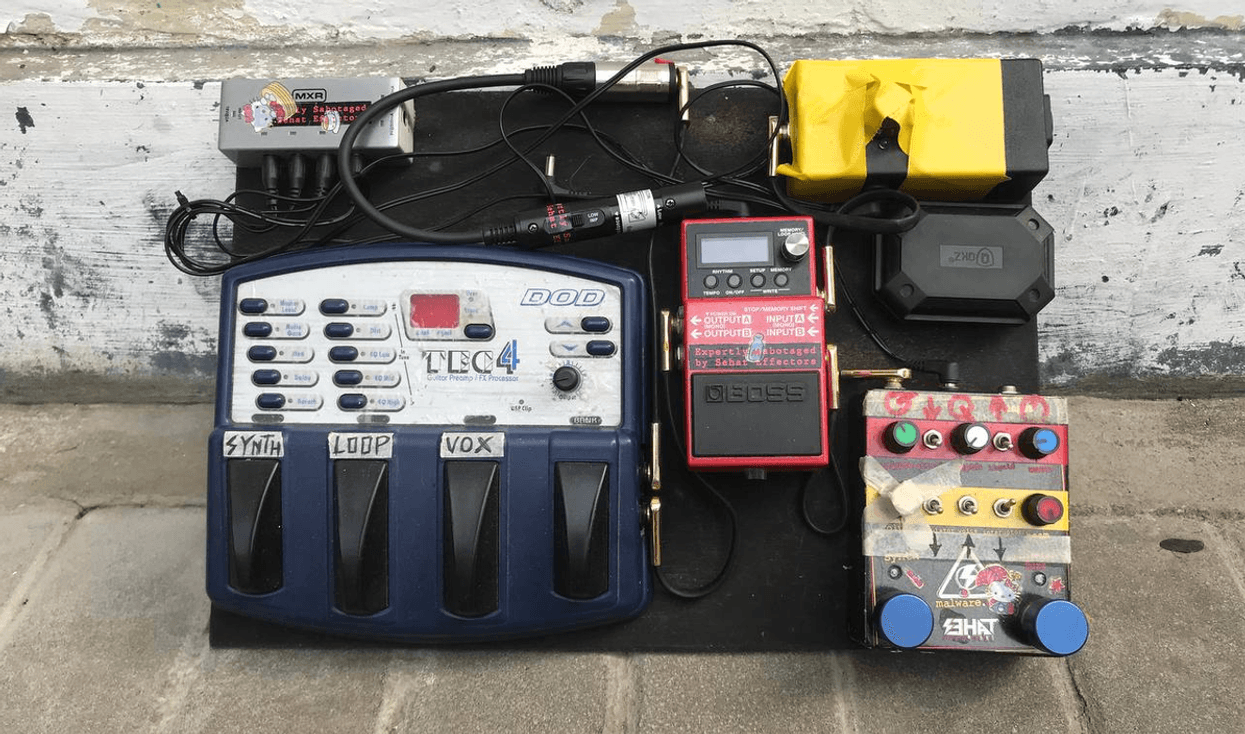

It started with a classic parental fantasy: I was going to launch a punk-rock project with my kid. Standard vocals weren’t going to cut it. We wanted a sound with some real weirdness in it. I wanted a playground: one rig that could handle vocals, a drum machine, a noise generator, and synth patches. Above all, it had to be dead simple. Unfortunately, that kind of all-in-one setup usually means a high-end multi-effects unit like the Headrush Prime or Line 6 Helix Floor. I don’t hate nice things, but my wallet demanded a more practical, if slightly mad-scientist, approach.
That led to a tempting question: Could I pair a basic guitar multi-FX unit with a few stompboxes and call it a day? Armed with optimism and a soldering iron, I set out to find out.
Before you try this, there’s some basic physics to make peace with. Microphones and electric guitars produce very different signals. A dynamic mic puts out a much weaker signal than a guitar pickup, and most guitar pedals are designed for instrument-level signals unless they have a dedicated XLR input. So what happens when you plug a mic straight into a standard stompbox with a cheap XLR-to-1/4" cable? It sounds thin and distant, like shouting into a tin can. Your instinct will be to crank the pedal’s gain until it’s loud enough, and that’s when the trouble starts: a rising noise floor, harsh clipping, and feedback. The fix is good gain staging and a few simple hacks.
Hack number one: the Impedance Converter. This innocent-looking XLR-to-TS adapter houses a tiny internal transformer that magically elevates weak microphone signals to the beefy instrument level your pedals crave. With the gain staging salvaged, your pedals behave like civilized gear instead of screaming banshees. Alternatively, you can pull off a neat party trick with a passive DI box by running it entirely backward: plug your mic into the XLR output and run the TS input straight to your pedal chain. Of course, this upside-down engineering requires an XLR female-to-male adapter to fix the gender mismatch on your cables. Just keep in mind that not all passive DI boxes are born equal, as transformer quality varies.
Hack number two: the active mic preamp or buffer. There are plenty of battery-powered portable mic preamps floating around the gear market these days. Much like the DI box trick, they get the job done, but each comes with its own personality flaws. FET-based mic preamps are particularly adept at boosting weak signals to line level, but beware: that blistering hot output will easily send your stompboxes into nasty clipping territory if you don’t dial back the input gain to a safe harbor.
Now, I hear the gear snobs whispering: “Why not just use a condenser mic?” Sure, on paper, a condenser brings its own active power, pristine gain, and robust output to the party. But this introduces a whole set of stage-rig headaches—namely, sourcing dedicated 48V phantom power on an already chaotic pedalboard. Perhaps you need an additional supply. Perhaps an adapter. Perhaps a dedicated phantom-power box. Perhaps another cable. Before long, your supposedly simple vocal pedalboard has acquired enough supporting infrastructure to qualify as a minor telecommunications installation. It’s an ergonomic nightmare. On a cramped live stage surrounded by loud monitors, guitar cabinets, drum cymbals, and musicians making increasingly poor decisions about volume, it can become a feedback magnet.
“Before long, your supposedly simple vocal pedalboard has acquired enough supporting infrastructure to qualify as a minor telecommunications installation.”
Another option is the mini-mixer. Most compact mixers have an FX send and return. You plug your vocal mic into one of the mixer’s XLR channels, send that signal out the FX send to your pedalboard, and bring the processed signal back in through the FX return. If you’re feeling adventurous, you can plug your guitar into another channel and run both through the same chain of stompboxes. The downside is size and complexity. Even a “mini” mixer takes up a lot of space on a pedalboard, which works against the whole idea of a compact, self-contained rig.
Ultimately, navigating this sonic labyrinth depends entirely on your tolerance for gear logistics and how much chaos you want underfoot. But once you conquer the impedance barrier, a brave new frontier of vocal expression awaits. Imagine taking the stage, stepping up to the mic, and running your vocals straight into a Korg Miku, a screaming wah pedal, and maybe the ghostly pitch-tracking of an EHX Mel9 or Superego. You won’t just sound different—you’ll leave the audience questioning reality itself.