Ken Settle is a Detroit area photographer who
specializes in music photography. Ken began
his career while barely in his teens,
photographing rock’n’roll legend Bob Seger
during his days playing in Detroit hockey rinks
and clubs, and still keeps a full schedule
shooting live photos and portraits of today’s
top artists.
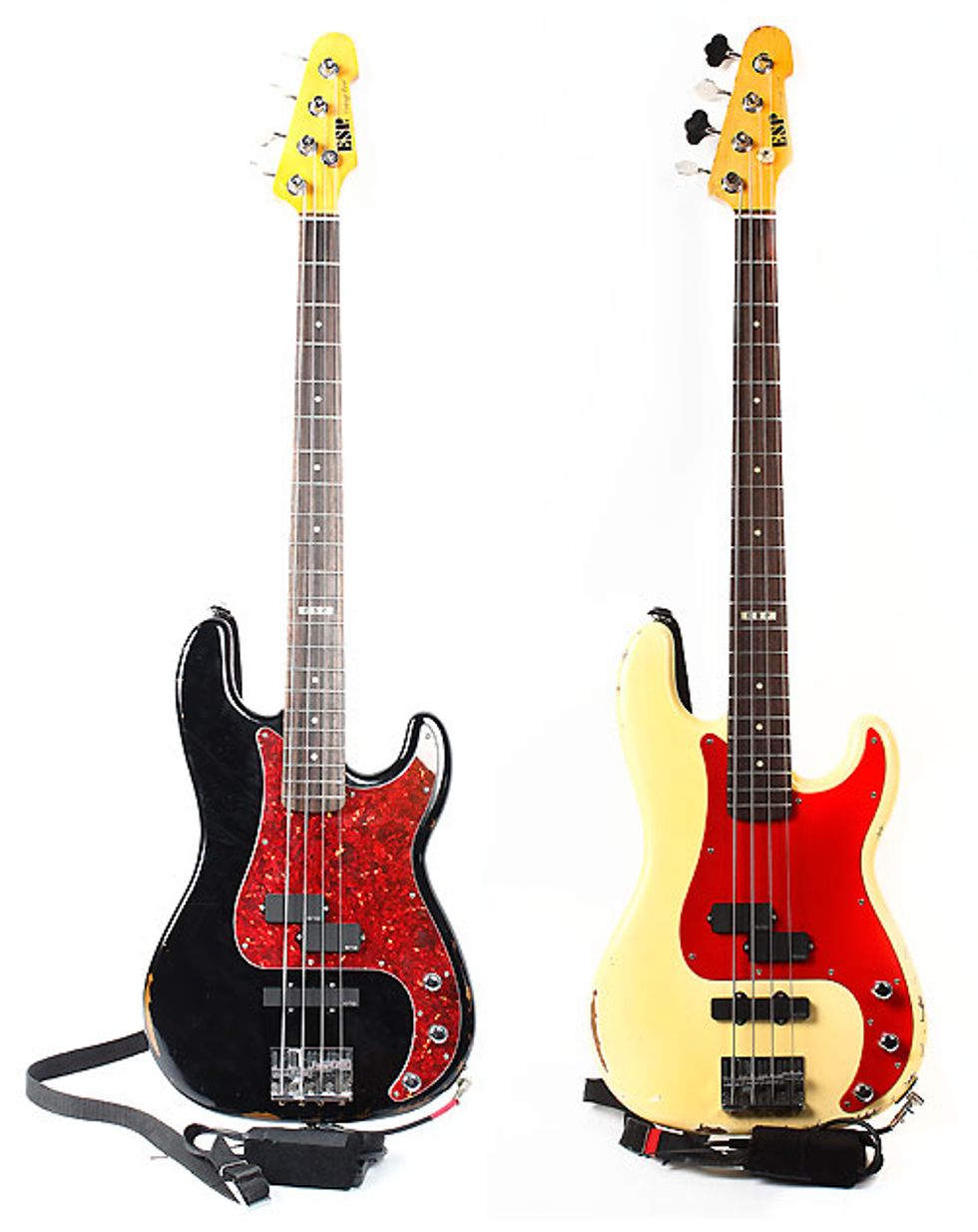
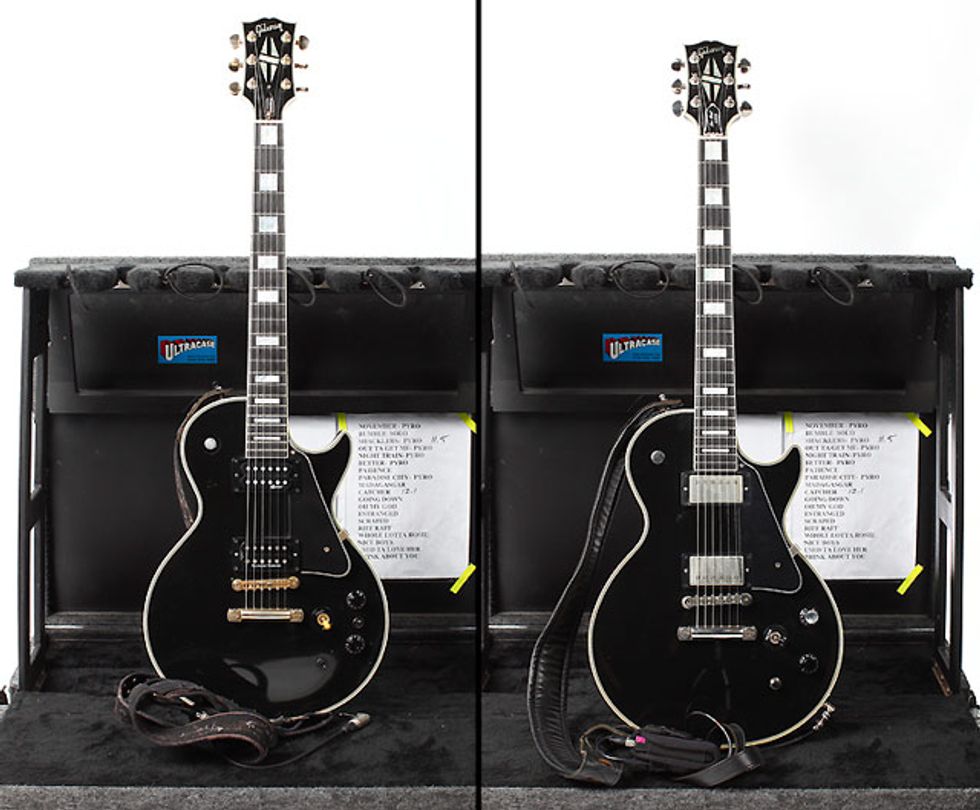
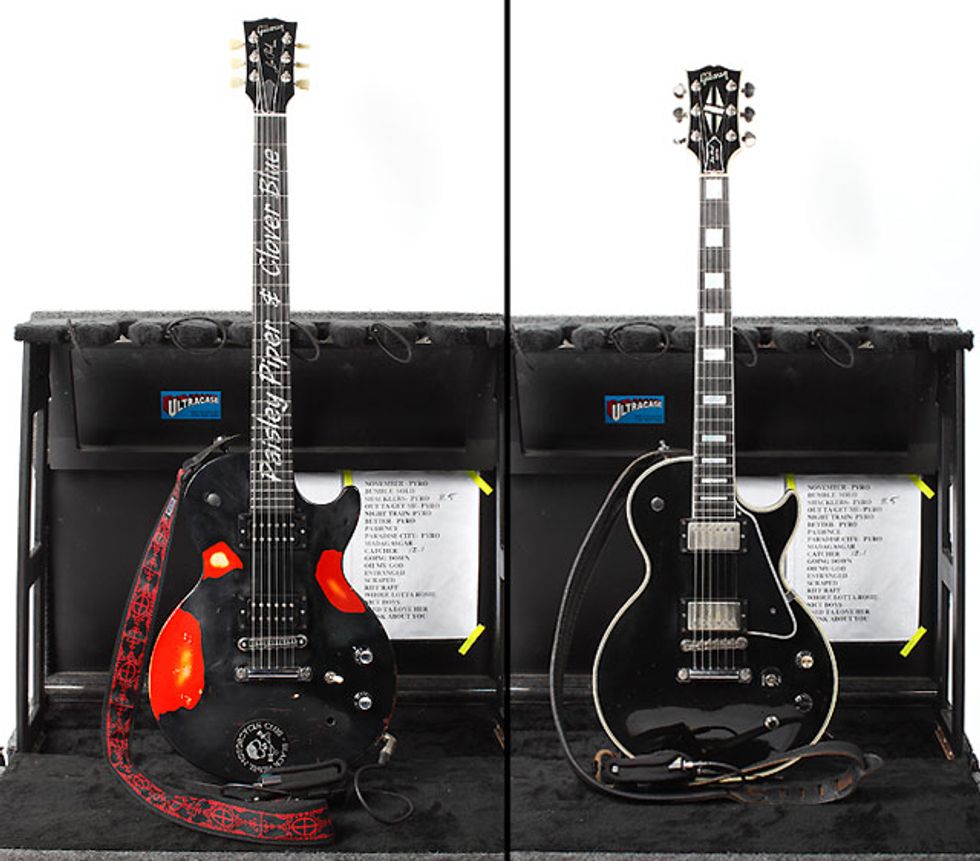
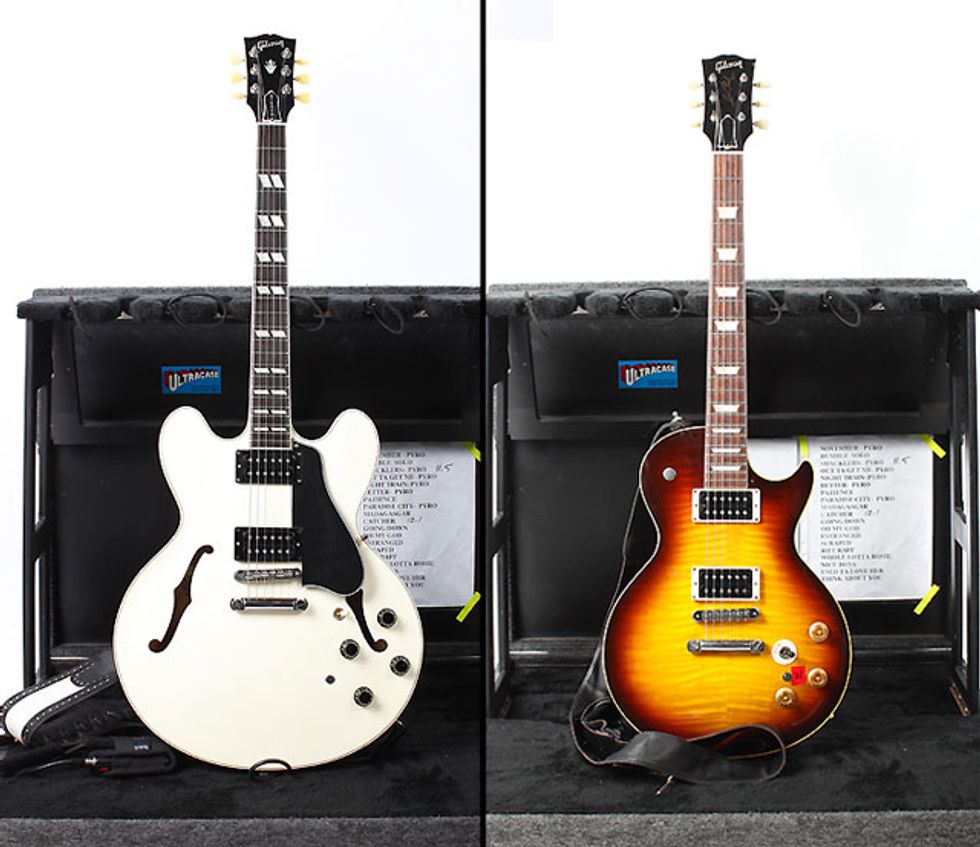
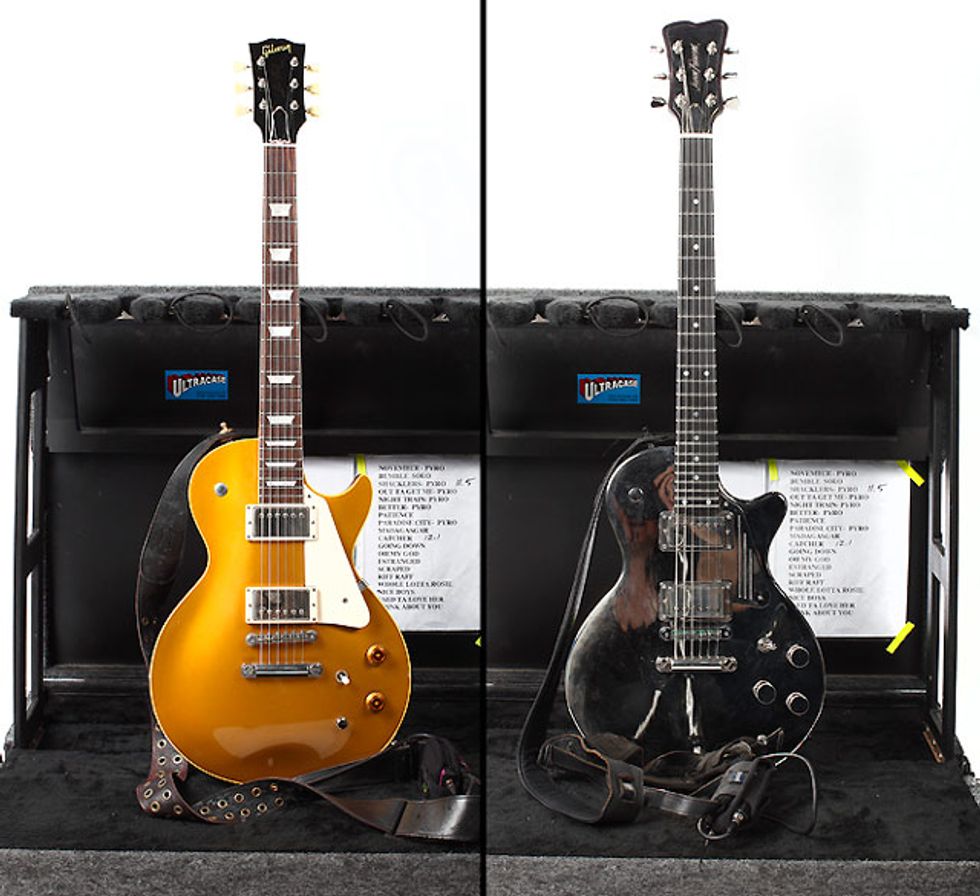
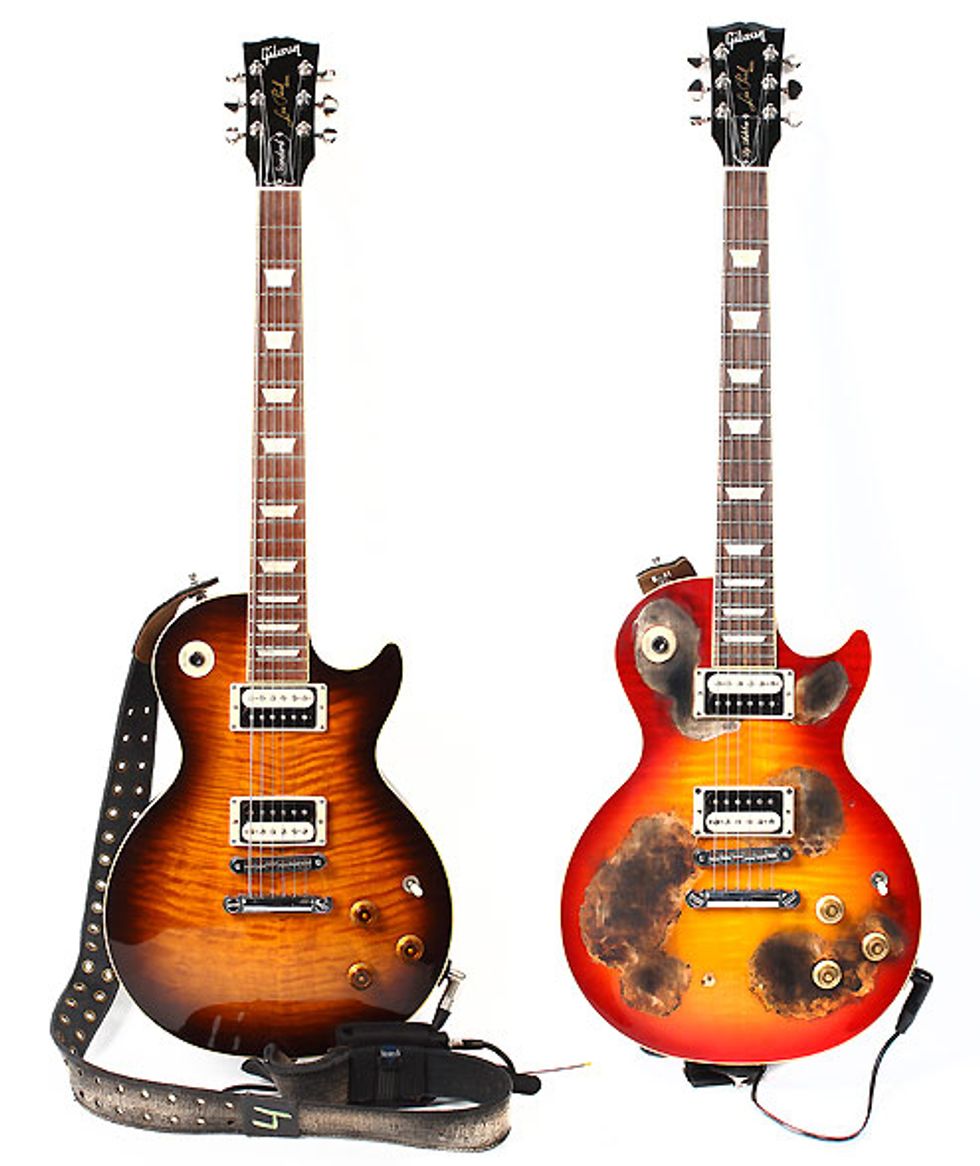
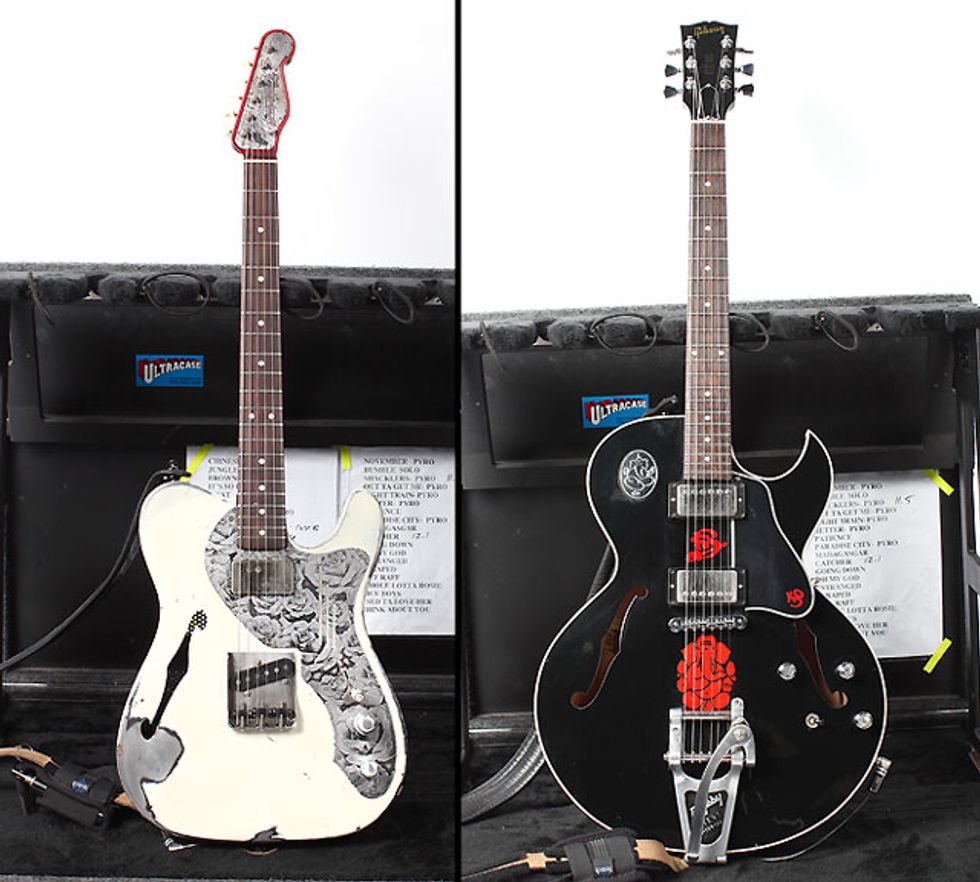
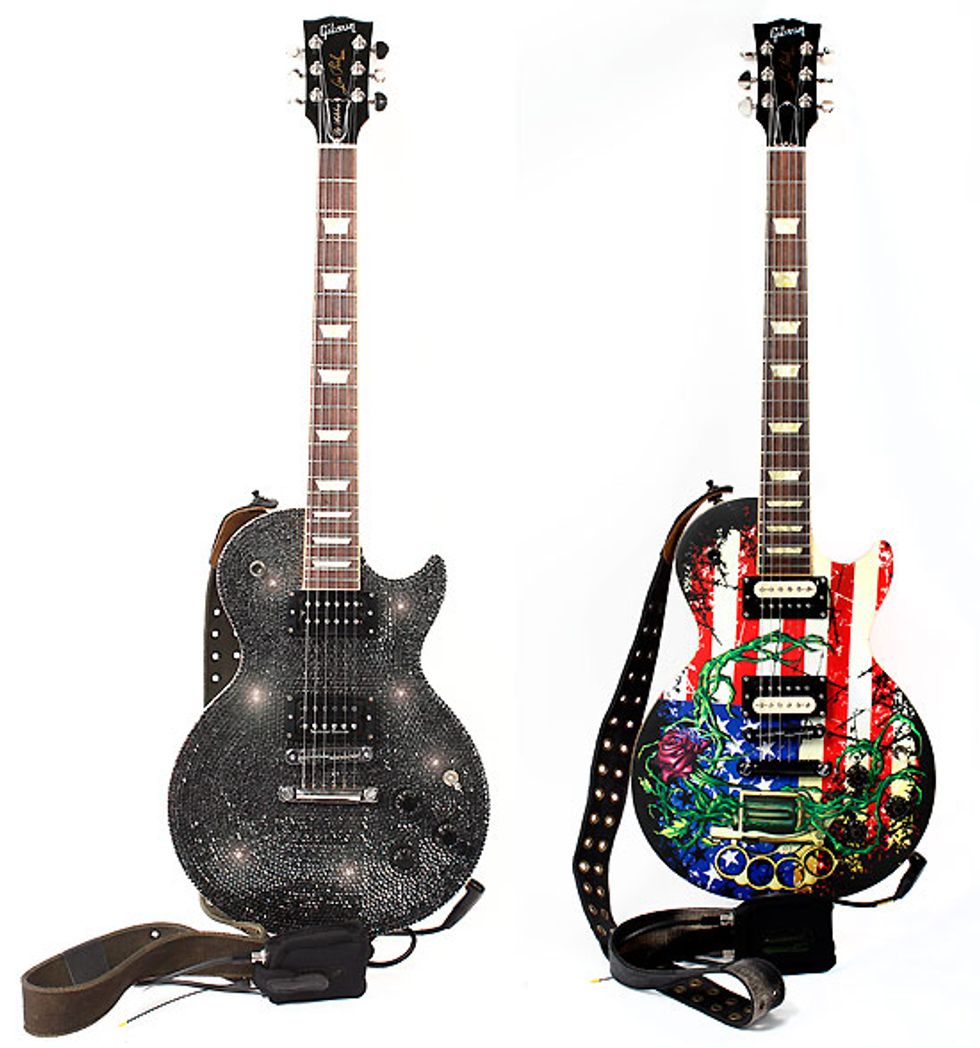
"This duo of black Les Paul Standards both have the pickup selector switch moved down into the normal control set, with the original pickup selector switch plugged, and a kill switch installed in place of another of the guitar's knobs."
Guitar is an unusual instrument, yet somehow we human beings invented it and refined it, both technologically and artistically. There are some days when everything flows, while other days it feels like we’re complete beginners again. This is totally normal. If we really considered how much information our bodies are processing just to be alive in our version of the world, perhaps we’d be a bit kinder to ourselves about our off days and humbler about our good days! I want to share a few perspectives on the core technical aspects of playing that can be helpful to work on and remind ourselves of regularly. Let’s dive in!
Muting
The guitar can be a sensitive instrument. The slightest movements can cause sounds that are both wanted and unwanted to come out. Some of these sounds are natural and part of the character of guitar. However, even though we can’t be perfect we can aim to be as clean as possible in our playing with a few simple maneuvers.
Ensuring the picking hand is covering the strings without bearing down on them too hard keeps the lower strings in check. Depending on your picking-hand style, you can also use the 3rd and 4th fingers to lightly mute the upper three strings.
The fretting hand’s index finger takes control over a lot as well. The fingertip can fret a note on the 5th string and tuck under the 6th string at the same time. The flat side of the index finger from the knuckle area towards the hand can also mute higher strings.
It’s important to consider the type of sound we’re using as well. The more gain or compression we use, the more unwanted noise can come flying out of the guitar. Even with the muting techniques above, if we’re too “hard” with them they can start to create noise themselves. So, keep this in mind.
Less gain gives a more dynamic tone, which is harder to play with, but much easier to control dynamically and keep clean. This isn’t to say it’s better or worse, it’s a stylistic choice. But it’s worth considering how much gain we really do need. Noise gates can help, but they can’t fix or hide poor muting and out of sync hands. (More on keeping sync later in this column.
Keep these muting considerations in mind as we go over the areas of technique to address.
Confidence and Subdivisions
Our fretting hand does a lot of work. Picking synchronization is very important. We’ll look at this next. However, I’ve got some working considerations for the fretting hand.
There are many exercises we can do, but ensuring that you’re not pressing down too hard on the fretboard is the first step. We don’t have to press hard unless we have unreasonably high action. If your action is high and it’s slowing you down, I’d suggest going up a string gauge and lowering the action if you want to keep the “resistance” feel. When we lighten up our touch with the fretting hand, we find that our fingers generally stay closer to the fretboard, which helps with economy of movement.
The next thing to consider is timing. Timing is everything no matter what technique you’re using. If the pistons in the engine aren’t firing at the right time, they’ll go out of sync, all fire at once, and boom, there’s an explosion. I don’t know anything about cars, but it’s an analogy that might make sense. Being aware of the subdivisions you’re playing and where the downbeat is ensures that both hands are confidently making those maneuvers.
Here's an experiment you can try: Take a simple two-octave scale pattern of your choosing. In Ex. 1 I picked a simple D minor scale. The idea is to change subdivisions in each measure. Here, I started with a measure of eighth-notes then went to triplets, back to eighth-notes, 16th-notes, eighth-notes again, and then I wrapped with quarter-notes. No matter where the “1” of the next measure starts within the scale position, we keep the hands synced up. We can make this more complicated by using a sequence of thirds or triads and doing a similar thing. The goal here isn’t to master every position, sequence, and sub-division. It’s to keep testing different areas out, iron out the errors, and keep it fresh. It’s a great warm up when done slow and bound to get you in sync.
Picking Sequences
We also need to do similar things for the picking hand. The same idea we discussed above about subdivisions applies to picking as well. The extra thing to consider of course is pick direction and string skipping.
It’s worth practicing alternate picking here, keeping the confidence and control in place even if purely for technical reasons, to ensure the technique is as even as possible. Take a melody pattern like Ex. 2, where I repeat the same two-measure melody, but I change fingerings in the second half. This changes the amount of picked notes on each string, which changes different aspects of how this melody can feel both technically and from an articulation point of view. A simple way of getting more out of this exercise is to start with an upstroke. With practice, it can be quite an effective picking workout.
String Crossing and Skipping
A lot of guitar playing uses one-note-per-string ideas which can sometimes trip us up. In Ex. 3, I wrote an easy chord progression and created a picking patter that I could alternate pick without losing momentum. It’s a practice that can never get old. Just get creative.
In Ex. 4 we take a minor pentatonic shape (here we are using B minor and F# minor) and move through the pattern with string skipping. A super-simple idea, but worth spending time on. Simple skipping patterns like these keep your playing fresh and focused.
You’re training an impersonal organic system, respect it!
When we’re practicing, we can get quite contracted and tense. There can be a pushiness and anxiety about the process, forcing ourselves through the practice session. We have a lot of internal commentary about how it’s all going, often quite unfair.
“This lick should be fast by now!”
“I don’t have the technique or natural ability to do this.”
“Steve Vai practiced for 10 hours a day, so should I.”
“I’ll never make it as a guitarist.”
All of these thoughts are abstractions as they are not based in reality. What is happening in the moment is practice. Our attention gets divided between these thought patterns and our feeling of anxiety. Very little attention gets spent on really listening and feeling what we’re practicing with no internal commentary. Because of this we become aversive to practice, we feel that practice doesn’t work or that we don’t have a natural ability or talent.
Therefore, wise practice sessions that are simplified and put into short time frames are most effective. It can be helpful to calm ourselves down before practicing so that our practice is effective.
Why do we practice? We practice because it helps us achieve results. We want to play a riff, we listen carefully, we learn the riff, and then we then practice the riff. Generally, that gets results. However, we are impatient. Humans believe that our thoughts can speed up our bodies and brains. This is a misplaced belief. We can set the conditions to get results, but we can’t control the speed at which our body learns. Practicing trains our bodies, our nervous system, our consciousness.
Our bodies are not separate from the world around us; we are what we eat and breathe. Our thoughts are the thoughts we are exposed to, our feelings are consciously and unconsciously triggered by the world around us. We are no different from nature, we are no different from a tree. We don’t will our fingernails to grow, we don’t will our heart and lungs to keeping going. We have no control over our senses, we can’t choose not to hear sounds around us, we can’t choose not to see when we open our eyes. And in the same way, we can’t force our body to speed up.
We must be grateful for the fact we’re alive before we practice, that there’s a body and mind to practice with. Rather than fighting our fingers and our thoughts, we must approach them with compassion. As you’re practicing, your body is busy programming all this information. Just like growing a plant or vegetable, you can set the right conditions, get the soil right, and water it. But you can’t force it to grow immediately, you must treat it with compassion and trust that you’re doing the right process. You can’t plant the seed then as soon as you see any sprouting, start pulling on the sprouts, that will stop growth all together.
In summary: Appreciate your body, your mind, the fact your conscious to even play guitar. Make sure you set reasonable goals in your practice, make your sessions simple and effective. Then, let the practice happen, trust that you’re programming the right information.
For well over 50 years, Bob Weir has been mystifying and delighting fans around the globe with seemingly endless musical ideas, helping to define the sound of the Grateful Dead. Weir has always taken a truly individual approach to rhythm guitar, centered around his affinity for melodic accompaniment. More than just strumming rhythmic patterns, he creates melodies that surround a given chord, adding texture and harmonic depth to the music. The following are examples of the way Weir adds color and rhythmic variety in harmonic patterns and illustrate his artistry as an improviser.
Ex. 1
Ex. 1 shows a contrast in rhythmic activity, where the first two measures are much busier compared to measures three and four. Harmonically, notice the suspended 4th that resolves and leads to the next chord in measure two. Measure two highlights a wide interval of a major 6th and also the 9th, adding color to the triad. Also, in harmonic contrast to the first two measures, measure three and four end the phrase with 3rd-less triads. This is a good example of a compositional quality in Weir’s playing.
Ex. 2
Triadic playing is certainly a component of Weir’s improvisational playing. In Ex. 2, you can see how he breaks up triads by articulating single notes and double-stops with the chord shape. You can see the three D chord shapes in measures one and two starting with a power chord and then sliding into the 3rd (F#) and the next chord shape, grabbing the 1st inversion D triad followed by a root position version of the same chord. Also notable, the use of long and short rhythms adds very musical syncopation. In measure five, note the F#m played completely, then breaking it up with the root followed by double-stop 3rd and 5th of the chord. The next chord, G, is arpeggiated, again in short and long rhythm. That rhythmic idea continues in the last two measures.

Ex. 3
Ex. 3 is another example of breaking up triads, but at a faster tempo. Notice the open E string doubling the 5th of the chord. That’s a nice touch and can be used on other chords as well, adding or doubling any chord tone. In measure three, the A/E chord held for two-and-a-half beats helps to break up the two-beat feel, as does the D/F# in measure four.
Ex. 4
The Dm sequence in Ex. 4 illustrates a Weir-like approach to melodic accompaniment and also a reference to the relative major, F. Beat 3 of measure one and beat 1 of measure two can be seen as using the relative F major, outlined in the diagram in parentheses. Notice the Dm and D5 played in a broken fashion followed by color notes on beat 3 of measure three, sliding double-stops down from D and F to C and E, the 7th and 9th of the Dm chord. The phrase resolves with descending Dm groupings, and a double-stop on the upbeat of 2 that could be thought of as C5, C/D or the 7th and 11th of Dm. Either way, you’re adding color and dimension to static harmony.
Ex. 5
Bending a string within a double-stop is pretty common in Weir’s playing, and you see this in Ex. 5 on beat 4 of measure one. The D# is pre-bent up a half-step to E and released in time down to D#, then pulled off to C#, all while holding on to the G# on the 3rd string. Rhythmic and melodic themes are apparent in Weir’s playing. In measures three and four, you can see variations of a rhythmic idea from measures two. All three measures have a version of a dotted quarter and eighth note rhythm, but end in a slightly different way.

So-called “jazz” or “jazzy” chords were in use long before jazz, but it’s jazz musicians who have, arguably, made those most of 7th and extended harmonies. So, what are they? Simply put, jazz chords are triads—chords built from the 1, 3, and 5 of any given scale—with added 7, 9, 11, or 13 intervals. They can also include alterations, such as b5s, #5s, b9s, and #9s.
Rather than bog you down with more theory, let’s put these chords into practice, with plenty of points of reference from the rock genre. Along the way you should naturally start to develop an ear for, and an understanding of, their colorful sounds and benefits.
Classic Rock
Let’s start with one of the best-selling albums of all time, Pink Floyd’s Dark Side of the Moon. Maybe Floyd’s inclusion of jazzy chords is one of the reasons people still find this album appealing and refreshing.
Ex. 1
Ex. 1 is a variation on the end of Floyd’s “Time”—aka “Breathe (Reprise).” This example, complete with flange effect, demonstrates both Em9 and A13 arpeggios. In the key of D, that’s the IIm chord moving to the V chord, an E Dorian sound. These are followed by the essential chord shapes for both major 7 and minor 7 (in this case Cmaj7, Bm7, Fmaj7, Em7). We end with the so-called “Hendrix chord,” a 7#9, moving to a 7b9 chord (uncommon in rock), resolving to a second major 7 shape. This is a tremendously valuable progression, and time (no pun intended) should be taken to memorize all of the chord shapes.
Ex. 2
Ex. 2 comes to us via Led Zeppelin’s eclectic double album Physical Graffiti, specifically “Ten Years Gone.” This track contains more major 7 chords, including one slash-chord version. A slash chord is when the note in the bass is different than the root of the chord, in this case Bbmaj7/A. Here we also find a diminished 7th chord (this is another fundamental shape all guitarists would do well to memorize) functioning as a hip passing chord between Amaj7 and Em7.
Ex. 3
Ex. 3 has the great Edward Van Halen getting into the jazzy chord game, kind of. This progression, à la “Secrets,” contains sus chords—triads wherein the 3rd is replaced (or suspended) by the 2nd or 4th. And, while not uncommon in jazz, these are probably not the first jazz chords that come to mind. Nevertheless, Van Halen’s use of them is unique and worthy of mention. After running through the sus chords, Eddie lands on a rather ambiguous chord that I have labeled Dmaj9, but which could also be thought of as an A/D. Either way, it’s the sophisticated nature of this chord that earns it a spot in this lesson.
Ex. 4
While Bob Marley is known as a reggae icon, there was plenty of crossover between reggae and rock, which allows us to take a look at Marley’s “Waiting in Vain” in Ex. 4. This example once again features the major 7th shape we worked on in Ex. 1, as well as a new shape for major 7 chords—in this instance, the Gmaj7. This shape can be tricky for players as it employs all four fingers, with the pinky far across the fretboard.
Funky Strums
Ex. 5
Let’s keep moving with some jazz chords in a funky rock situation. Ex. 5 is an imitation of Steely Dan’s “Kid Charlemagne,” featuring four different chord shapes, including an F6, with the bass note fretted with the thumb. Make an effort to mute the 5th string on each of these chords. Also, note how the Bb13 chord substitutes for an E7#9 at the end (other than their roots, the chords share three of the same notes).
Ex. 6
Ex. 6, reminiscent of the Red Hot Chili Peppers’ “If You Have to Ask,” contains the biggest variety of chords in this lesson, and time should be taken to master both the shapes and the funky right-hand strum pattern. These 9th chords are funk essentials but also play a big role in jazz.
Jazzy Metal Arpeggios
Our final two examples represent the world of contemporary metal. In both cases, their functions as mellow, arpeggiated intros that transition into heavier verses and choruses, have their roots in the classic metal of the 1970s and 1980s.
Ex. 7
Ex. 7 was inspired by Deftones’ “Sextape” and contains a lush major 7 shape, moving between the I and IV chords. In the first four measures, the shape contains only fretted notes; in the following four, the open high-E string is included, adding even more color, changing the major 7th into a major 9 and major 6.
Ex. 8
Finally, Ex. 8 features not only jazzy arpeggios, but also some mixed meters, with the time signature moving between 6/8 and 7/8. This progression was inspired by “The Coma Machine” by Between the Buried and Me, and introduces us to both a minor 6 chord and an augmented shape.
Keep It Clean?
You may have noticed that all of the examples in the lesson (except for the last group of arpeggios) feature a clean, non-distorted tone. One reason for this is that all the points of reference (except Ex. 8) I mentioned were recorded with clean tones. Another reason is that using distortion on these chords with extensions can make them sound messy and undefined, detracting from the point of the extensions. By contrast, distortion on power chords makes the chords sound sharp and biting. That said, feel free to crank up the overdrive and test for yourself. With enough experimentation, you may create the perfect combination of rock and jazz.

Who could forget Alex Lifeson’s soul-stirring acceptance speech at the band’s 2013 induction to the Rock and Roll Hall of Fame:
Yes, Rush are a “progressive rock band,” with all the weighty importance that it brings, but at their core is a sense of humor that allows them to not take themselves too seriously. The result is that, while their music may be complex at times, overall, it lacks the pretense and self-importance that can permeate bands of the genre.
Along with with late drummer Neil Peart’s masterful drumming and Geddy Lee’s vocals and powerfully melodic bass lines, it is Lifeson’s striking versatility that has made Rush one of rock’s most unique and compelling musical triangles for over 40 years:
and more, Lifeson’s inspiring creativity and musical savvy quickly become apparent to listeners. Let’s journey through some of the Canadian trio’s most classic songs to see if we can figure out just what makes him tick.
Open Strings Are Our Friends
In the debut episode of Premier Guitar’sShred With Shifty, affable host and Foo Fighters guitarist Chris Shiflett, together with Lifeson himself, break down the latter’s solo from “Limelight,” off of 1981’s Moving Pictures. It kicks off with a clever use of a simple open B string, as shown in Ex. 1.
Ex. 1
As Lifeson explains, he doesn’t pick the harmonic. Instead, he lightly taps the ringing open string with a fret-hand finger at the indicated fret. (Lifeson uses his index; Shiflett, his middle.) Interestingly, the open B string wends its way through much of the song, including its trance-inducing chorus. Ex. 2 is inspired by this stirring section; note how the open B string acts as a hypnotic drone through all of the chords, a signature Lifeson move.
Ex. 2
You can take many open-position chord forms and experiment with moving them up the neck, while letting any open strings ring. Sure, you’ll inevitably hit some clunkers, but a good rule of thumb is, if the open string is in the key, you’ve got a good chance of finding some magic. Lifeson does just that in the intro to “La Villa Strangiato” from 1978’s epic, Hemispheres, as he positions a standard open G chord up at the 8th fret, creating a unique Cadd2 voicing.
Ex. 3 is along the same lines; note how there are two open strings, D and G, that, when added to this very basic chord form, revitalize it to swirling effect.
Ex. 3
As in the “Limelight” solo, Lifeson cleverly weaves the open B string into his “YYZ” solo, Moving Pictures’ bombastic instrumental. Here, though, he employs it as a pedal point, a re-articulated or sustained note generally played below (or sometimes above) an accompanying melodic figure. Ex. 4 closes out his sinewy solo in grand fashion.
Ex. 4
Only the very first note is picked; the rest are sounded by a series of hammer-ons and pull-offs, which require some fret-hand strength to execute. A great exercise is to take the same figure and move it to other open strings, which is also a fun way to learn your scales horizontally across the neck. Throughout his solo, Lifeson employs B Phrygian dominant mode (B–C–D#–E–F#–G–A), which is simply the 5th mode of E harmonic minor (E–F#–G–A–B–C–D#). Fear not, all this means is that it’s the very same E harmonic minor scale, but here, B acts as the root or tonal center instead of E. Examples 5 and 6 apply this scale to the 1st and 3rd strings, respectively.
Ex. 5
Ex. 6
Familiar Chords in Unfamiliar Places
Just as how Lifeson uses open-position chord shapes up the neck with open strings, he also is adept at taking closed triad shapes (no open strings) and cleverly moving them in similar fashion. His solo in “Subdivisions,” from 1982’s Signals, rises to a climactic end this way, as shown in Ex. 7.
Ex. 7
This familiar “D” shape is one of three triad shapes found on each of the guitar’s sets of three strings. In other words, the same three notes (we’re excluding the open 4th string from the previous example) can be rearranged to find two other inversions along the neck. Let’s use them to play the same “Subdivisions” chord progression, but in different registers of the neck, as in Examples8 and 9. Note in bar 2 of each how the new shapes lend themselves to different melodic choices and thus, new chord colors.
Ex. 8
Ex. 9
Navigating Odd Spaces
The previous examples contain some interesting rhythms, something for which Rush is well-known, which includes the use of odd time signatures. Ex. 10 is reminiscent of a chordal interlude in “Jacob’s Ladder” from 1980’s Permanent Waves. Rush is a band that is exceptional at using odd time signatures in a most musical way, and here, they shrewdly shift from 5/4 to 6/4.
Ex. 10
To become more comfortable navigating these tricky time signatures, count either out loud or in your head while listening to the section. Doing so familiarizes you with how these time signatures feel, which eliminates the need for counting.
Lifeson always sounds effortless when soloing in odd time signatures. A key way to accomplish this is to always be aware of where beat 1 is, so, for the moment, a bit more counting. But this time, do it while actually playing, as this will have you feeling at ease sooner than you might think. Lifeson’s solo in Moving Pictures’ “Red Barchetta” is in 7/4; note that an easy way to count your way through 7/4 is to break it down into 4/4 plus 3/4. Ex. 11 illustrates how he deftly negotiates one of the solo’s two-bar phrases in a memorably melodic way.
Ex. 11
The above is just a taste of the palette of colors from which Lifeson draws, as he weaves his guitars throughout Rush’s timeless catalog of songs. He, along with Lee and Peart, created unique and genuinely emotional music, none of which could ever be described as “blah.”
Chops: Intermediate Theory: Intermediate Lesson Overview: • Learn how to construct Dorian scales. • Understand the minor-key harmony of “Last Dance with Mary Jane.” • Develop an ability to hear the raised 6 in a minor scale. Click here to download a printable PDF of this lesson's notation.
I love modes. I love playing them. I love teaching them. But they are tricky to teach because it’s difficult to wrap your head around them without having to dive deep into theory, which isn’t an easy step for some players. As a teacher, I look for ways to make modes fun and relatable, and this always lives and dies by the quality of your examples and source materials. Over this past holiday break, I started researching the mighty 5-watt Fender Champ tube amp. What does this have to do with modes? Read on.
Tom Petty’s guitarist Mike Campbell is a well-known fan of low-wattage Fender amps. I was watching a segment on the history of the Champ and when the main riff to “Last Dance with Mary Jane” came up, it piqued my interest. It was a song I knew well, hadn’t really heard in a long time, and never had a reason to study—until now.
There was something about the song that was unique and I wanted to dig into. And because I needed inspiration for a new lesson, the timing was perfect. The first thing I like to do when figuring out how a tune works is to lay out the main chords as an inventory. For this tune, the chords are pretty simple:
Am–G–D–Am
Yet again, Tom Petty takes a simple harmony and crafts an enduring rock anthem around it. We all joke about three-chord rock, but this is not only three-chord rock, it’s modal as well. So, why is this a Dorian chord progression? Just looking at the chords might be enough if you’d studied harmony a ton, but if you haven’t, the next step we should take is to spell out the chords into their individual notes:
Am = A C E
G = G B D
D = D F# A
Now that we’ve deconstructed the chords, the next task is to decide which note you think is home, or in theory-speak, the I. In this case, it’s pretty clear that A is home. We keep coming back to it, and it really does feel and sound right. With that done, we can take the chord tones and alphabetize them, starting with A. This yields a string of seven notes: A–B–C–D–E–F#–G.
Okay, we’ve taken inventory of all the notes contained in those three chords, starting from our root (A). The next step is to ponder the harmonic consequences of this discovery. What makes this a Dorian progression is the D major chord with an Am tonic. This D triad brings us an F#, which is not the normal F you’d see in an A Aeolian, aka A natural minor, scale (A–B–C–D–E–F–G). With Dorian, you end up with a scale that sounds minor, but with a raised 6, compared to natural minor. This yields an intriguing sound that’s not quite as dark as the minor scale you’re accustomed to. Many people describe and teach Dorian as a minor scale with a raised 6, and that’s exactly what we have here.
To get familiar with this sound, grab “Last Dance with Mary Jane” on your favorite music service and play along in A Dorian. Ex. 1 shows a handy scale diagram based on the 5th fret root of A on the 6th and 1st strings.
Now that we’ve connected the chords to the Dorian mode and we have a scale fingering, let’s hear some riffs in context.
For Ex. 2, I’m keying off the fact that this Dorian scale position is in the same spot as the familiar minor pentatonic scale, so we’re getting to use both the mode and the pentatonic in the same phrase. I’m featuring the F# (or the 6) as the signature note that makes Dorian unique, and also because it’s the 3 of the D major chord. You can play that F# whenever you want in this progression, but it’s extra awesome over the D chord.
With its bluesy beginning, Ex. 3 is another line that relies on the pentatonic scale lurking inside of the Dorian scale. Again, when the D major chord occurs in the second measure, I’m calling attention to it with the F#. It’s a simple way to connect with the Dorian scale and still keep that rock/blues feel we all love.
For our final example (Ex. 4), I stayed away from the pentatonic sound and tried to create a simpler melody with just the Dorian scale. It starts in the middle of the guitar’s range and follows a see-saw pattern of “go up a few, go down a few.” At the start of each chord change—every two beats—I align to the chord in the progression: A for the Am chord, G for the G chord, and F# for the D chord. This is a little bit of voice-leading that reminds me of “While My Guitar Gently Weeps.” It not only helps you anchor the chord progression, but it connects with the mode at the same time. We’re only using a portion of Ex. 1’s two-octave scale pattern—sometimes simple is best.
But wait there’s more! While the opening chords clearly spell out an A Dorian progression, the chorus shifts to yet another modal key. This song keeps on giving us things to learn and practice—how cool. When the chorus starts, we hear the following chords:
Em–A–Em–A–G
As before, let’s pull the chords apart to see what’s inside:
Em = E G B
A = A C# E
G = G B D
And just like last time, we need to determine the root. In this case, it’s clearly E minor, so we’ll call this an E something mode. Starting with E, let’s ascend through the pitches to see what we get:
E–G–A–B–C#–D
This gives us six notes. While we’re missing the second note after E (which, in a seven-note scale, would be some type of F), we can still conclude it’s another Dorian scale, this time in the key of E. Relative to E, C# is a raised 6 and this matches our general idea of Dorian construction: minor scales with a raised 6. It’s really cool that this song allows you to practice in two keys, A Dorian for the verse and E Dorian (E–F#–G–A–B–C#–D) for the chorus.
Ex. 5 is a scale diagram for E Dorian. Note that it’s the same pattern as our previous A Dorian scale, just shifted up to the 12 fret to place the E root on the 6th and 1st strings.
The chorus is my favorite part of the song because it’s a moment where everything comes together—the chords and Petty’s vocal melody combine for a beautifully haunting Dorian sound. Pay attention to the “ry” in the melody of “Mary” to hear that C# over an Em chord—that’s the distinctive Dorian color at work. It’s one of the reasons I’ll keep this song in my arsenal of material for teaching Dorian to students, along with Pink Floyd’s epic “Breathe” from Dark Side of the Moon. (Go work out the Dorian key for that one.) For now, use the above examples for inspiration and find your own riffs and ideas for “Mary Jane.” Let your creativity and ears be your guide.
I hope you enjoyed exploring how to reverse-engineer a simple song. Over time, this process will become faster and you’ll be able to hear the modes more easily. The next time a tune really tickles your ear, take it apart as we’ve done here. Who knows? It may spawn a soloing concept or a song idea you wouldn’t have otherwise considered.