Faith Guitars has launched their updated FX Series of guitars with two new handmade, all-solid-wood electric-acoustic models offering striking exotic tonewoods, enhanced playing comfort, and upgraded cosmetic detailing.
Originally conceived as an exploration of exotic wood colouration techniques, the Faith FX Series has become known for visually remarkable, tonally rich instruments crafted from Solid Figured Javanese Mango. The two newly updated FX models – the FX Dark Natural Gold and FX Moondust Grey – retain their all-solid Mango construction, ebony fittings, and ‘Neptune’ Baby-Jumbo Cutaway design, while introducing significant new features designed to enhance player comfort and visual appeal.
Each updated FX model now features a beautifully sculpted Figured Maple ergonomic forearm contour, introduced to maximise long-playing comfort both on stage and at home. This new contour is paired with upgraded Figured Maple binding and a matching Figured Maple soundhole rosette.
• Faith FX Neptune Cutaway Electro Dark Natural Gold [FNCEDNG]: Finished in a warm, deep golden-brown transparent stain that highlights the natural grain complexity of the figured Mango, ensuring each guitar remains a unique piece.
• Faith FX Neptune Cutaway Electro Moondust Grey [FNCEMD]: A dramatic onyx-black, grey-washed finish that allows the Mango figuring to shine through with subtle depth and dimension.
FX Exotic Series | 2026 | Faith Guitars
Here's the newly upgraded Faith FX Series! New for 2026, a beautiful, Figured Maple ergonomic forearm contour has been introduced to the guitar body to maxim...
Both FX models feature:
– Solid Figured Javanese Mango top, back & sides – Indonesian Ebony fingerboard & bridge – Grover Rotomatic machineheads with Ebony buttons – Graphtech TUSQ nut & saddle
Faith FX models come equipped with the Fishman INK3 preamp system, offering 3-band EQ, an onboard tuner, and a low-profile design paired with a Fishman Sonicore undersaddle pickup. This ensures the FX Series delivers the same tonal richness and clarity amplified as it does acoustically.
The Faith FX models each carry a $1,569 street price. For more information visit faithguitars.com.
This year marks a milestone in music history as Gibson celebrates 100 years of crafting its world-famous flat-top acoustic guitars. From front porches to festival stages, from early folk pioneers to boundary-pushing modern artists, Gibson acoustics have shaped the sound of generations. To honor a century of craftsmanship and innovation, Gibson proudly unveils the latest chapter in its storied acoustic legacy with the return of the Original Collection, featuring the SJ-200 60s Original, LG-2 50s Original, and the J-160E Original. Each model captures the timeless character, unmistakable tone, and handcrafted excellence that have defined Gibson flat-tops since 1926. The Gibson Original Collection is available worldwide at authorized Gibson dealers, at Gibson Garage locations, and on Gibson.com.
Gibson’s tradition of acoustic mastery began with instruments that quickly became the bedrock of American music. Over the decades, these guitars became inseparable from cultural moments and the artists who defined them. From the introspective songwriters of the 1940s to the global icons of the 1960s and 1970s, Gibson flat-tops have been heard on countless historic records and carried on countless shoulders. Today, they continue to resonate with players seeking unmatched expression, enduring quality, and the authentic voice of a century old craft tops have been heard on countless historic records and carried on countless shoulders.
Gibson Original Collection featuring the LG-2 50s, SJ-200 60s, and the J-160E.
At the forefront of this anniversary celebration is the SJ-200 60s Original, a tribute to the era that cemented the guitar’s status as the “King of the Flat-Tops.” First introduced in 1937 and immortalized by artists such as Pete Townshend, Bob Dylan, George Harrison, and Jimmy Page, the SJ-200 became synonymous with power, presence, and unmistakable style. The new 60s SJ-200 Original honors that heritage with a AAA figured maple body, a solid AAA Sitka spruce top, vintage correct 1960s nitrocellulose lacquer, and the iconic no-border pickguard. Every detail—from the graduated mother-of-pearl crown inlays to the rosewood Moustache™ bridge—evokes the golden age of acoustic design while offering the reliability and performance needed by today’s artists.
Gibson Original Collection SJ-200 60s in Vintage Sunburst and Heritage Cherry Sunburst.
Gibson also revisits one of its most beloved small body acoustics with the LG-2 50s Original. First launched in 1942, the LG-2 quickly became a favorite for its balanced voice, compact size, and surprising projection. The new 50s Original revives this classic with era accurate character and craftsmanship, pairing a solid Sitka spruce top with scalloped X-bracing and solid mahogany back and sides. Its comfortable Rounded neck profile, rosewood fretboard, and vintage inspired aesthetic details recapture the charm of the 1950s models that remain highly sought after by collectors and players alike. The guitar’s intimate size and warm, articulate voice make it an ideal companion for songwriting, recording, or everyday playing, while the L.R. Baggs™ VTC pickup ensures it’s ready for any stage.
Gibson Original Collection LG-2 50s in Vintage Sunburst and Antique Natural.
Rounding out the Original Collection is the return of the iconic J-160E Original, a guitar forever linked to the early days of The Beatles and the electrifying shift of youth culture in the 1960s. Introduced in 1954 as one of Gibson’s earliest acoustic electric hybrids, the J-160E blended acoustic tradition with electric innovation. The new J-160E Original retains the guitar’s unmistakable character while elevating it for modern musicians. A solid Sitka spruce top with scalloped X-bracing replaces the laminated top of earlier models, delivering richer acoustic resonance, while the P90 DC pickup offers the classic tone with none of the hum. With its SlimTaper™ neck, trapezoid inlays, gold Top Hat knobs, and belly-up rosewood bridge, the J-160E Original preserves everything players have always loved while offering enhanced performance for contemporary music-making.
Gibson Original Collection J-160E in Vintage Sunburst.
All three Original Collection models are handcrafted in Bozeman, Montana, where Gibson’s team of world class luthiers continues the tradition of meticulous acoustic craftsmanship begun a century ago. From the careful selection of tonewoods to the hand applied finishes and precision shaped necks, each instrument carries forward the legacy of Gibson’s pioneering designs and the artists who made them iconic.
This year, Gibson invites players everywhere to celebrate 100 years of flat‑top excellence. Whether rediscovering a beloved classic, discovering a new favorite, or simply appreciating the soundtracks these instruments have defined, the Original Collection honors the past while inspiring the next century of music. With the SJ‑200 60s Original, LG‑2 50s Original, and J‑160E Original, the Golden Era of acoustics returns—ready to be played, cherished, and passed on for generations to come.
Few effects delivered as much aura and musically transformative power per buck as Electro-Harmonix’s Sovtek Big Muffs from the mid ’90s. Mine set me back probably $50. But man, I might as well have stolen Excalibur from the clutches of King Arthur.
Up to that moment, my piggyback Fender Tremolux, Tube Screamer, and Rickenbacker was perfect for thrashing out ’60s Kinks riffs. But with the Big Muff in the mix, my little rig became a monster—a wrecking ball capable of the potency I savored in Black Sabbath and Dinosaur Jr. From that moment on, my amplifier would be intolerable to the public outside the confines of a rented jam space. I suspect I went to bed that night pondering, like Robert Oppenheimer, tales of Prometheus and the Bhagavad Gita. The Big Muff had unleashed a horrible new power.
“The Fade Font ’94 possesses all the signature qualities of a Big Muff—sustain, mass, and megatonnage.”
Today the Big Muff’s might is legendary, and thanks to a couple of decades of cloning and reissues its power has proliferated among players. But Big Muffs sing many songs. Like their human creators, they are full of quirks, and Wren and Cuff’s Matt Holl and protégé Ray Rosas study these oddities and irregularities fastidiously. The newest product of Holl’s obsession is the Fade Font ’94—a beautiful homage to a ’90s “Tall Font” Sovtek Big Muff in Holl’s sizable collection built with unusual components that shifted its personality to brasher ends. The Fade Font ’94 possesses all the signature qualities of a Big Muff—sustain, mass, and megatonnage. But it’s also nastier and illuminated at the edges by a ripping high-mid ferocity that counterbalances the creaminess that is the signature of most ’90s Big Muffs.
Built to Bruise
The charms of the Fade Font ’94’s olive drab, steel-slab design will no doubt elude some. But as someone who keeps their Sovtek Big Muff on a sort of informal mantle in my studio, I was genuinely thrilled to see how Wren and Cuff reproduced the original’s enclosure with such exactitude and quality. The dimensions are, save for very minor deviations, identical. At a few paces, you’d never suspect you were looking at anything other than an original Sovtek. The difference in quality, however, between Wren and Cuff’s unit and an original Sovtek is easy to see and feel. There’s a proper footswitch. The knobs (near-perfect replicas of the originals) turn with a smooth secure sense absent in Sovteks. And on the inside, the relatively simple circuit is executed masterfully on a through-hole circuit board. I also suspect the paint on the Wren and Cuff won’t flake off within weeks, and I won’t miss the Sovtek’s plastic jacks. So, yes, on the quality and craft side of the equation, Wren and Cuff deliver.
But it’s the sound that puts the Fade Font ’94 over the top. And Matt Holl was right to be excited by the sonic signature of the Muff that inspired this one. The primary design difference in that Big Muff is its use of 150k pots rather than the 100k pots most Muffs use. Holl found several component values elsewhere in the circuit that didn’t match Big Muff design norms. The sonic sum is what you hear here, and in Muff terms it’s something special.
Side by side, five Big Muff circuits can sound equally great for five different reasons. But the Tall Font conveys a sense of balance and playing to strengths—like a top-notch analog desk mix of a record, or a great mastering job. And it makes the Fade Font ’94 sound quite like listening to a Big Muff greatest hits record. It’s plenty bassy, just like a Sovtek should be. But the airy lower-midrange seems to siphon away excess low-end energy that might make a bass trap and convert it to low-mid purr. The high-mid, too, is very activated and detailed without flirting with brick-wall midrange. The top end is full of air, while the low-mid purr becomes a growl. It’s just really balanced across its gain structure and feels exceptionally alive as a result.
It’s got range, too. The tone control is a good friend when probing other voices within the brawny core output. At minimum high-pass levels (and lower gain levels) the Fade Font ’94 has some of the warmly stressed and fractured essence of an overdriven Tweed Deluxe. At more piercing tones and modest gain you can brew many shades of ’60s psych-punk. And when it comes to just doing things a Sovtek Big Muff does—doom, desert, dark psych, or just Gilmour’s smoothest, silkiest flights—the Fade Font ’94 does it all with aplomb and poise.
The Verdict
If you played the Fade Font ’94 without the benefit of side-by-side comparison with other ’90s or ’90s-style Big Muffs you might be hard-pressed to recognize the differences. If you have the ability to do so, though, it becomes hard to un-hear the shift in accent that makes it sound so much more sonorous, well-rounded, and at times, extra aggressive.
Obviously, there are practical downsides to the Fade Font ’94’s lovingly, exactingly executed big-enclosure format. Any player with more than a few additional pedals will struggle to accommodate the big footprint without scaling up to a bigger pedalboard. On the other hand, the Fade Font’s flexibility gives you justification to pare back your fuzz collection. Maybe, like I did over the course of this test, you’ll succumb to the Fade Font ’94’s brutish charms so completely that you’ll find everything but a delay pedal superfluous. For such minimalists, well-heeled maximalists with roadies, pedal aesthetes, or studio rats more concerned with delicious sounds than pedalboard space, the Fade Font ’94’s size won’t get in the way of putting it to use.
Reflecting on my $50 Big Muff purchase back in the ’90s—and the many times I put it back together with a cheap Radio Shack soldering kit and gaffer’s tape—it’s hard to imagine that such a close relative could be elevated to this level of luxury. But once again, Wren and Cuff has shaped magnificence from merely modest perfection. And any player who loves the Big Muff owes it to themselves to experience this intriguing, engaging variation on the theme.
Carondelet Pickups has introduced their newest vintage-style humbuckers: the company’s OTB Ultimates provide a sound and feel that are stunningly close to great examples of original 1957-61 Gibson “Patent Applied For”-sticker humbuckers.
Louisiana-based Carondelet -- pronounced “kuh-RON-da-let” -- teamed up with artist Owen Barry in developing the OTB with the specific goal of “cracking the code” of vintage Gibson PAF humbuckers, but at a fraction of the cost of actual vintage PAFs.
The bridge position Carondelet OTB Ultimate reads 8.2k DCR and the neck position 7.0k DCR. Both positions feature rough-cast Alnico V magnets; historically accurate coil wire, plastics and metallurgy; two-conductor braided shield leads; and are unpotted like original PAFs.
Carondelet OTB Ultimates come with permanent and period-correct American-made raw German nickel silver covers. The “standard” version featuring modern covers with etched Carondelet logo carry a street price of $249 each and $498 per set. The “grail” version features no-logo vintage correct covers created from a 3D scan of an actual 1959 Gibson PAF, and carry a street price of $279 each and $558 per set.
The OTB Bridge position pickup is available in either Gibson-spacing or Fender-spacing, while the Neck position is available in a single vintage Gibson-spacing format.
The OTB in the product name is based on the initials of Owen Timothy Barry, a Nashville-based session and touring player whose resume includes The Chicks, Jackson Browne, Celine Dion, Jennifer Lopez, Gwen Stefani and Tal Wilkenfeld, among many others. Carondelet’s owner Jeff Richard (REE-shard, Cajun French) hand-winds all Carondelet pickups one at a time in his workshop in Baton Rouge. Barry and Richard met at the Amigo Nasvillle guitar show in 2025 and R&D on the OTB Ultimates began shortly thereafter, involving multiple trips between Tennessee and Louisiana and well over 50 pickup prototypes that directly contributed to the final recipe, Richard said.
“Even the simplest guitar pickup has so many variables which forge overall tone and feel,” Richard said. “In the case of a vintage PAF, however, you’re trying to recreate pickups wound 70 years ago by primitive machines, using inconsistent to outright changing techniques, components and materials, in a process overseen by common factory workers who aren’t around today to field how-to questions.”
Said Barry: “In order to create my perfect PAF set with Jeff, I had to fully understand the original recipe. It was an incredibly intensive deep dive, but I knew we had to try and test every variable. This would be the only way to find what created the original PAF magic.”
Carondelet OTB Ultimates are available direct via CarondeletPickups.com; and select vintage/boutique dealers including Carter’s Vintage Guitars in Nashville (cartervintage.com) and LA Vintage Gear in Los Angeles (lavintagegear.com).
Few players have been more instrumental in shaping the sound of modern metalcore than Converge’s Kurt Ballou. But to hear the producer and guitarist tell it, the 6-string was originally a consolation prize, not a calling. “My buddy Rob and I had this pact to start a band together, but we both wanted to play bass because we were both really into Rush and Iron Maiden at the time,” he says, calling in from his God City recording studio in Salem, Massachusetts. “And those bands have fantastic guitar playing, but they also have these bass heroes in Geddy Lee and Steve Harris, respectively. So, we decided that whoever could save up money for a bass first got to be the bass player, and the other one had to play guitar. I obviously lost.”
It’s a good thing the chips fell where they did. Since Converge formed in 1990, Ballou’s chugging-yet-sinuous brand of guitar brutalism has proved to be the perfect foil for vocalist Jacob Bannon’s throat-rending forays into emotional catharsis. It’s a sound that has evolved exponentially since the band’s early days, though never lacking ferocity. “The music that I was making was about trying to find a voice that was true to me and to what my influences were, but wasn’t parroting something that I was a fan of,” Ballou says of the band’s earlier work. “You start out by emulating, and you either emulate poorly and come up with something original, or you just find your own voice and get to something that’s original. I think that’s what we got to eventually, but it took a while.”
A decade into their career, Converge had already solidly established themselves in the extreme music world. But with release of the album Jane Doein 2001—the band’s first to feature the almost supernaturally kinetic rhythm section of drummer Ben Koller and bassist Nate Newton—Converge demonstrated their ability to challenge, and sometimes even transcend, genre tropes with a deft balance of fury and finesse. Their new album, the bleakly titled Love Is Not Enough, is their first in nearly a decade (Bloodmoon: I, a 2021 collaboration with doom metallist Chelsea Wolfe and Stephen Brodsky of Cave In, notwithstanding). “Converge is basically our side hustle,” explains Ballou, who spends most of his time producing and mixing other artists. “So, it’s not like we’re beholden to an 18-month album cycle. But there was definitely a feeling that like, ‘Oh yeah, it's been too long.’”
Ballou with his God City Instruments Craftsman, onstage at Furnace Fest.
Photo by Ben Pike
Love Is Not Enough was well worth the wait. Songs like the album-opening title track are relentless blasts of aggression, replete with riffs and half-time breakdowns sure to incite circle pits the world over, while brooding, delay-and-reverb-drenched midtempo numbers like “Gilded Cage” continue to expand and refine Converge’s palette. Throughout the album, a compositional discipline reigns that never allows the listener’s attention to drift. “It’s a good idea in anything creative to leave people wanting more rather than giving them too much, and if you try to limit how many ideas are in one song, you can increase the impact that that song has by keeping it tight and memorable,” Ballou says. “It’s like when you listen to newer Metallica. I actually think there's a lot of cool shit on St. Anger, but they just beat every idea into the ground. Instead of doing something four times, they do it 32. And if they’re like, ‘Well, part A sounds good going into part B, but part A also sounds good going into part C, and part C sounds good going back to A, but part C also sounds good going to B, then they do it every possible way in the song. These are all cool ideas, but I think it’s better to just find the best ones, tighten up your arrangements, and give people the bestversion of the thing rather than every version of the thing.”
Converge’s economical arrangements are certainly integral to what gives their songs an instantly recognizable contour, but the bespoke alternate tunings that the band have explored since Jane Doe are perhaps what distinguishes them most. “There were only a few songs in the first 10 years of Converge that had any alternate tunings because I was always really against them,” Ballou says. “Every time I tried drop D, I felt like what I was coming up with was really generic and basic. It took a while before I cracked the code to making something that felt like me.” Ballou credits Neil Young’s soundtrack to the 1995 Jim Jarmusch film Dead Man with finally opening his ears to the possibilities of alternate tunings. “It was atmospheric, vibe-y stuff that really spoke to me,” he says. “There was also a guy named Alex Dunham, who was in the bands Hoover and then Regulator Watts and Abilene, who had a similar vibe but also played slide. And so, I started experimenting with slides. But then you realize, like, ‘Oh, I don’t want this major third here. Let me get that out of there.’ And so, you start changing the guitar’s tuning to get the chord shapes you want. Eventually, I just stopped using the slide but stayed with those open tunings.” Ballou also cites other heavy bands like Cave In, Melvins, and Neurosis with providing him with inspiration, as well as indie rock legends (and alternate tuning icons) Sonic Youth.
Bannon and Ballou at Furnace Fest in Birmingham, Alabama, October 5, 2025.
Photo by Ben Pike
“You start out by emulating, and you either emulate poorly and come up with something original, or you just find your own voice and get to something that’s original.”
“I feel like if you really boil it down, Converge is sort of like Sonic Youth meets Slayer meets New York hardcore,” Ballou says. “And I actually have a tuning I call ‘Open Slayer.’ It’s C–F#–C–F#–C–F#, which is a take on Sonic Youth’s C–F–C–F–C–F.” Ballou’s favorite tuning, however, is one that he and the band refer to as “Wacky Tuning.” And while the internet will tell you that it’s C–G–C–F–G#–C, the guitarist will neither confirm nor deny this. “For whatever reason, I’ve put my foot down,” he says, smiling. “I’m not going to say what it is. It’s a challenge for people to figure it out. But we’ve used it almost half the time on every record since Jane Doe.”
For the recording of Love Is Not Enough, Ballou auditioned many of the amps in his studio’s collection, only to return to his stalwarts. “It's funny, when I have a record where there’s a little more time in the budget to experiment, like we have with Converge, I will tend to set up more amps and do shootouts,” Ballou says. “And a lot of times I’m just like, ‘Oh yeah, the shit I use all the time I’m using all the time for a reason—this is the best shit that I have!’ There are a few amps that really are the best at everything.”
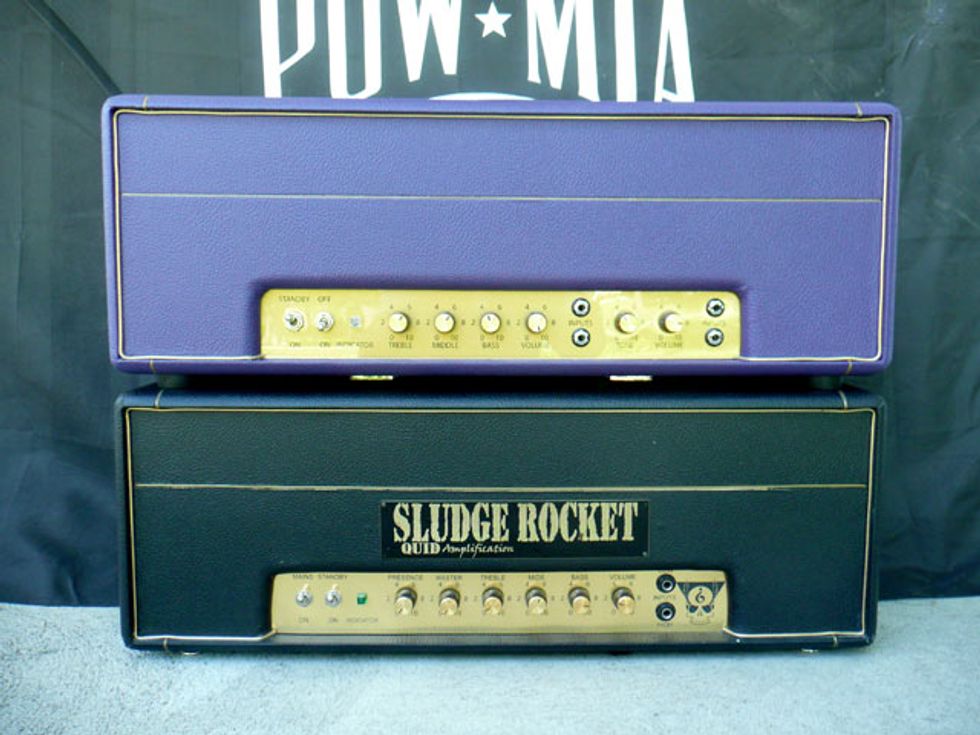
He continues, “On this record, for the main rhythm guitars, the left side is this uncommon amp from Belarus made by Sparrows Sons. There’s a handful of them that are out there. I own two, and they don’t sound the same as each other. My purple one has a very “home brew” kind of vibe. And it’s just really great sounding. I don’t know what kind of circuit it’s based on. And then the right side is a 100-watt HMW, which stands for ‘Heavy Metal Warfare,’ by Dean Costello Audio. Both amps ran through Marshall 1960 cabinets that have a mix of Celestion Classic Lead 80s and Amperian speakers, miked with Shure Unidyne SM57s and Soyuz 1973s.”
Instead of relying exclusively on his amplifiers’ preamp sections to produce crushing gain levels, Ballou prefers to hit the amp’s front end with a pedal. It’s a practice he adopted early on in Converge’s career, when he primarily employed a ’70s-era Traynor YRM-1 45-watt head, which he still owns and used for many of the clean and semi-clean sounds on Love Is Not Enough. “There’s something about starving the low end and tightening things up with a pedal that I still like,” he says. “The Traynor is somewhere between a Fender Twin and a Marshall JMP kind of circuit, so it wasn’t designed to go ‘chug, chug, chug.’ I was forcing it to do that against its will by hitting the front end with a Boss OS-2 [Overdrive/Distortion], which has a really good midrange push to it.”
Converge, 2025 (l–r): bassist Nate Newton, drummer Ben Koller, singer Jacob Bannon, Ballou
Photo by Jason Zucco
When pressed to unpack the concept of “starving the low end” a little more thoroughly, Ballou, who has a degree in aerospace engineering, is more than happy to expound. “In any negative-feedback-based op-amp overdrive, there’s always this sort of shunt to ground that happens in the negative feedback circuit in order to get gain. And basically, you have to high pass that—meaning cutting the lows—because low end tends to overdrive before high end, and you can end up with a signal where the low end is distorted but the highs are clean,” he explains. “So, to get that searing tone with high end and mids compressed and overdriven, you have to starve the bottom end going into the overdrive circuit. To do that, a lot of pedals—like, say, the Boss Metal Zone—have a bunch of EQ stages working under the hood that precondition the signal before the drive section by cutting lows, and then post-condition after the drive section to add it back in. So, you’re starving the bottom end going into it to tighten it up and make it more responsive, and then you’re boosting the bottom end at the output to restore what you’ve lost. The same theory applies when you’re hitting the front of an amp.”
Ballou eventually graduated from the OS-2 to using a Boss GE-7 graphic equalizer pedal “set to a frowny-face EQ with the output gain jacked up,” and now favors the Onslaught, a pedal that he designed for his own God City Instruments brand of stompboxes, guitars, and basses. Although he also used a Wild Customs electric, a pine T-style partscaster with Lindy Fralin pickups, and a First Act Sheena with EMGs, the bulk of the guitar parts on Love Is Not Enough were in fact tracked using GCI guitars that Ballou designed himself.
“My father’s a machinist and owns a machine shop and has CNC mills and stuff, so making shit was always just sort of normal to me,” Ballou says. “There was a summer where the studio was slow and my dad’s shop was slow as well, and I went down the rabbit hole and built about 30 guitars. I was making the bodies that I had designed on the CNC machines, and having Warmoth make the necks with a custom headstock.”
The guitarist would assemble and set up the instruments himself, a process that he found less satisfying than dialing in the design and specifications of the instruments. “I am definitely better at the design aspect of it than I am at the craftsman aspect,” he says. “Now I’ve got a relationship with this fantastic factory in South Korea that’s doing the building for me, but I still do all the quality control of each instrument myself when they get here.”
“I feel like if you really boil it down, Converge is sort of like Sonic Youth meets Slayer meets New York hardcore.”
Kurt Ballou’s Gear
Guitars
God City Instruments Craftsman
God City Instruments Constructivist
God City Instruments Deconstructivist baritone
Amps
Studio:
Dean Costello Audio 100-Watt HMW
Sparrows Son
Traynor YRM-1
Marshall 1960 4x12 cabinets with Celestion and Amperian speakers
Live:
Line 6 Helix into Quilter Labs Tone Block 202 heads
Picks, Strings, & Cables
D’Addario Duralin Standard Light/Medium Gauge (.70mm) picks
D’Addario NYXL (.011–.056) and NYXL Players Choice (.013–.064) custom set for baritone strings
D’Addario cables
While his production runs often sell out—as of this writing, there are no guitars available for sale on the God City Instruments website—one thing that never fails to bedevil Ballou (as surely it must his peers) is the mercurial and unpredictable taste of the guitar-buying community. “I am always amazed at the things that people are particular and not particular about,” he admits. “And people are very, very particular about colorways. Sometimes, I order guitars in a color where I’m like, ‘Yeah, whatever, it’s white,’ and, boom, they sell out. Then sometimes I order a colorway, and I just think like, ‘Oh my God, this color looks fucking awesome!’ And then it’s slow to sell.”
He continues. “I love doing it, but I get really scared because none of this is done through pre-order. So it’s all out of pocket to me. Twice a year, I have to wire half my life savings halfway around the world to get a batch of guitars. And then when they come in, I’m just crossing my fingers that they’ll sell!”