
At what point does a failure evolve into destiny?
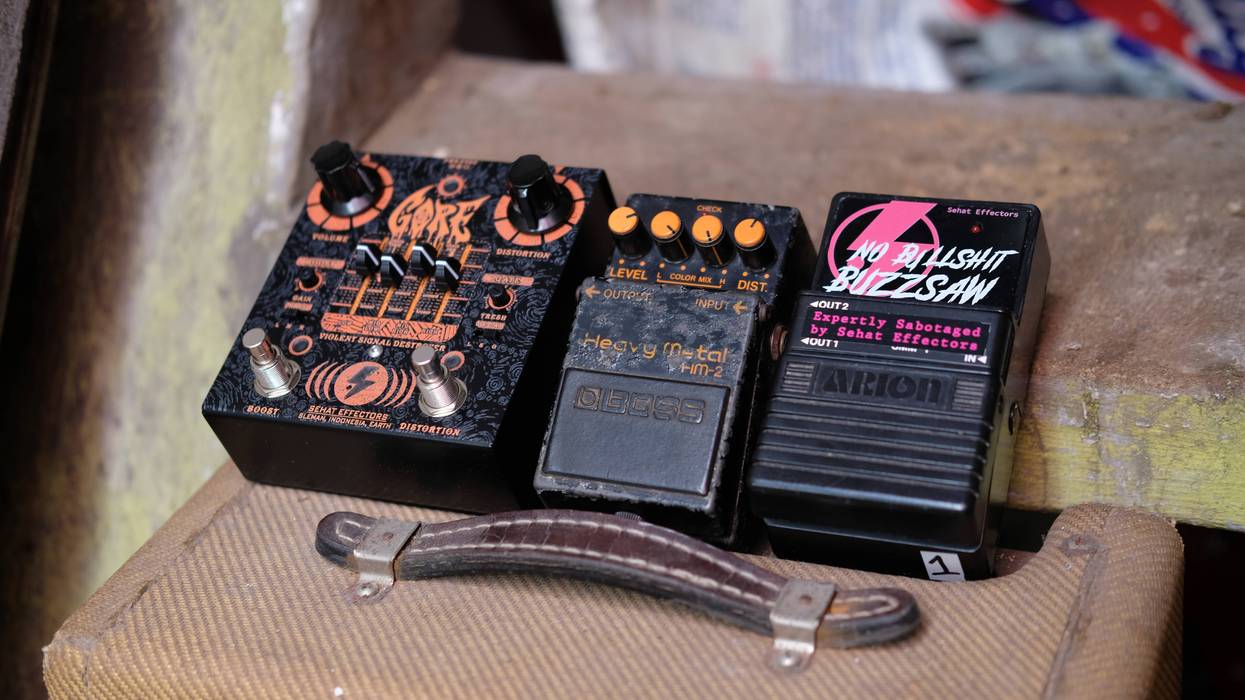
This question struck me recently while watching a Rig Rundown episode featuring acoustic virtuoso Trey Hensley. He explained how the absolute sonic putridity of the Boss HM-2—a pedal he admittedly bought because it sounded like “trash”—actually sparked entirely new musical ideas for him. His revelation implies a profound truth: The concept of “good tone” or “beauty” is deeply fluid, and rarely absolute.
So, how and why did the Boss HM-2, that black-and-orange box born in 1983, manage to dissolve its own intended existence into the abstract, chaotic reality of art itself?
Its inception was a cosmic misunderstanding. The official institution—the pristine laboratories of Boss in Japan—intended to capture the puritanical roar of a Marshall amplifier stack. But the HM-2 abandoned the path of conventional rock and metamorphosed into the physical manifestation of cultural and musical entropy.
To understand the cult of the HM-2, let us dissect the tone stack, deceptively labeled “Color Mix.” This is not your polite, passive treble roll-off. The HM-2 harbors a tyrannical, active 2-band graphic equalizer. The “L” (low) potentiometer locks onto a massive sub-bass shelf precisely at 86 Hz. It is a rib-rattling foundation that ensures the fundamental frequency remains menacing.
Simultaneously, the “H” (high) control is a dual-threat weapon. It is a summation of two crucial resonant peaks: 900Hz and 1.2kHz. When this knob is maxed out—the sacred act of “diming”—these frequencies collaborate in a merciless sonic assault. The juxtaposition of that thick 86 Hz bottom and the piercing 900 Hz + 1.2k Hz sweep creates an illusion of a Swedish chainsaw grinding through a vacuum. It is not merely an EQ; it is a frequency anomaly actively accelerating the degradation of the original guitar signal.
But the true mystery—the core of the HM-2’s existential plot twist—lies hidden within the gain stage. Driven by an obsession with order, the engineers attempted to tame the hurricane of hiss generated by the pedal’s extreme gain. They instituted a primitive, passive noise gate—a rarity in stompboxes of that era—by placing back-to-back diodes acting as an inline dual rectifier on the audio signal path. The intent was logical: to passively gate the noise floor below a certain voltage threshold and restore silence.
Topologically, this method of passive gating is woefully ineffective against such massive gain. Instead of silencing the hiss, this architectural “fix” birthed a cataclysmic side effect: Crossover Distortion.
As the signal transitions across the zero-crossing point, the diodes require a minimum forward voltage to conduct. This unavoidable “dead band” creates a harsh, digital stiffness, mutilating the waveform. The noise gate failed to kill the noise; instead, it created a new kind of noise—a jagged, abrasive sonic artifact. This “defect” became the pedal’s immortal soul.
In the late 1980s, the timeline shifted to Stockholm. The teenage metallurgists behind Entombed and Dismember found this abandoned orange-and-black box in pawn shops. They were not seeking the polished Marshall tones of the L.A. Strip; they sought authentic brutality. By instinctively diming all four knobs, they awakened the unholy alliance of the 86Hz/1.2kHz resonances and that glorious crossover distortion. The “Chainsaw Sound” was born. For the death metal and grindcore underground, the HM-2 became a weapon of sonic warfare.
“The concept of ‘good tone’ or ‘beauty’ itself, is deeply fluid and rarely absolute.”
Yet, history circles back on itself with a brilliant, metaphysical irony. Thousands of miles away in Indonesia, the HM-2 lives a surreal double life on the pedalboard of Rhoma Irama, the undisputed King of Dangdut.
To understand Dangdut is to understand the soul of Indonesia—it is the endemic, rhythmic heartbeat of the working class. Rhoma, a philosopher-musician who preaches social realities through a headless Steinberger, did not look at the HM-2 and see a Swedish chainsaw. He saw a vibrant color palette. By plugging it into the pristine, solid-state headroom of a Roland Jazz Chorus, he extracted a sustaining, highly articulate, yet biting distortion. This juxtaposition became the undisputed gold standard for modern Dangdut guitar tone—the legendary “Soneta Sound.”
Today, we observe the final, cyclical irony of the HM-2. It has survived the ’90s, fueled the crushing walls of sound in the shoegaze revival, and bled into modern industrial electronica.
The ultimate manifestation of its victory is that Boss eventually bowed to the anomaly and released the HM-2W Waza Craft, meticulously reverse-engineering their own 40-year-old mistake to purposely mass-produce the exact crossover distortion they once tried to eliminate. The creators became disciples of their own flawed creation.
In a modern musical landscape drowning in perfectly quantized, digitized, and sterilized productions, the Boss HM-2 stands as the triumphant voice of honest entropy. It is the roar of an unintended consequence, born from a broken noise gate. It challenges us to look at our own rigid structures and realize that, sometimes, the most profound meaning comes when everything falls apart.