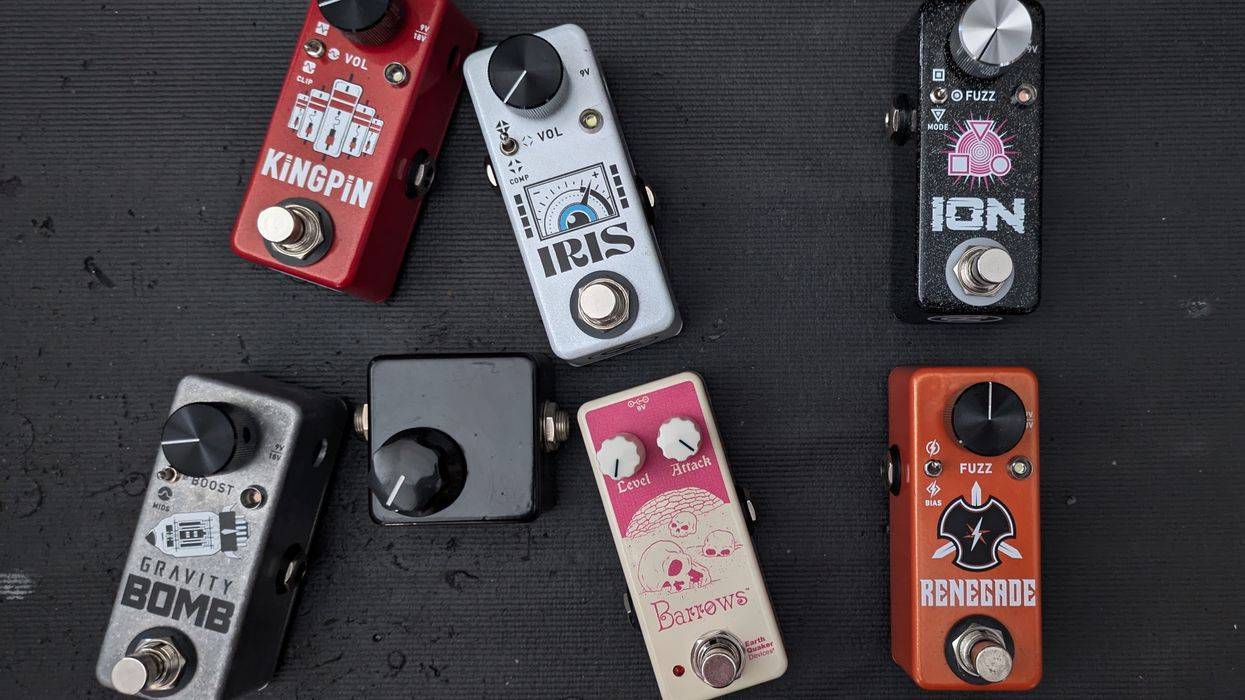


Let’s talk about the range of a pedal control knob—its potential versatility, perceived value, real-world implementation, and creative inspiration. That’s a lot of fancy words to impose upon a 300-degree rotating potentiometer with a knob affixed to it, but here we go!
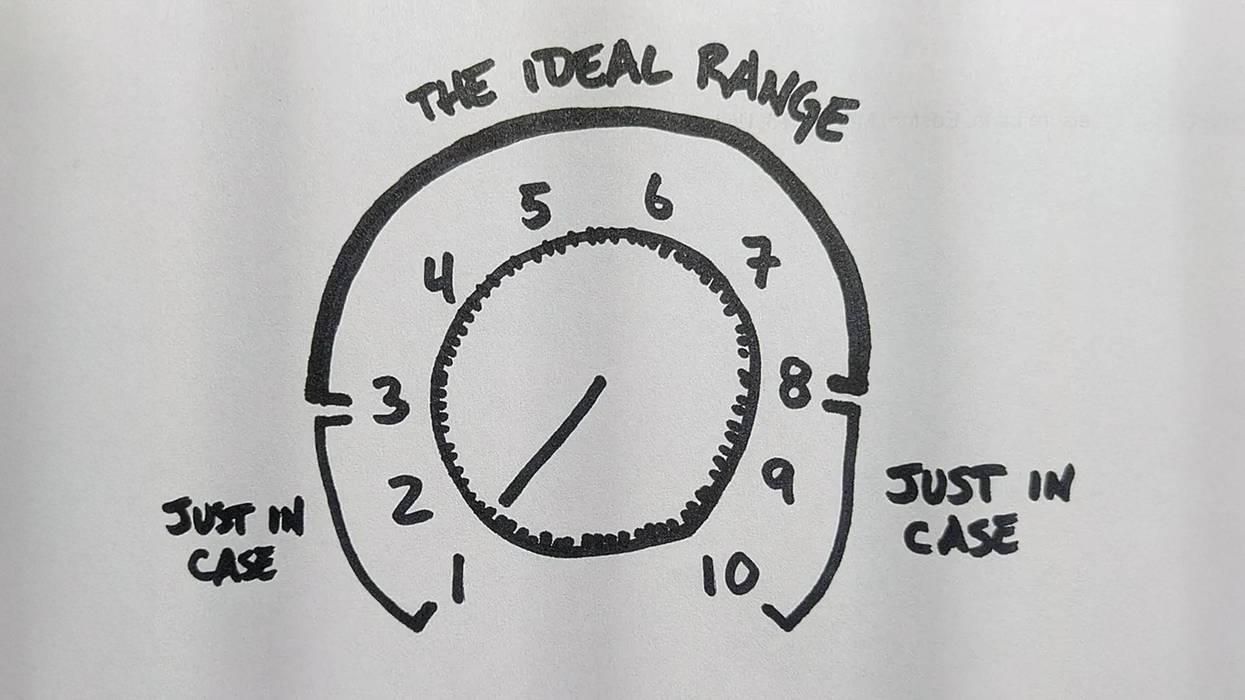
I’ve had this topic in mind since starting my writing career, but it crystallized while I was watching a recent episode of That Pedal Show featuring a CopperSound-loaded pedalboard. Co-host Mick Taylor made a comment about amp control knobs, positing that a knob should live between 3 and 8. A lot of players can relate to this—the idea that the core sounds in this range cover almost everything needed, while still leaving headroom on either side of the dial. This ties into versatility. It feels like the designer tuned it properly.
I’d counter that if a knob does too much—like a digital single-knob EQ—the “usable” range feels diminished. Which circles back to the same idea: The designer needs to tune the control properly.
Let’s talk about first impressions. Whether it’s a demo video or an in-person audition, the first engagement with a pedal almost always starts with “everything at noon.” This feels like a natural, logical starting point, and it ties back to the philosophy that control knobs should be flexible at both ends of their range.
When designing products, manufacturers try to consider all types of rigs. While not everything will work for everyone, the goal is to create products that perform well across different scenarios and setups.
Now let’s consider the outermost ranges of a knob. A reasonable question: “Why do I have to max this knob?” When a control only works at its extreme setting, I immediately wonder if I’m doing something wrong or if the pedal is designed for a more specific application than I realized. Both are plausible.
Here’s a firsthand example. I won’t name the pedal, but there’s a particular dirt box I keep coming back to—it has a great overdrive sound, wide gain range, and a pretty unique circuit. Those qualities make it memorable. But so does its shortcoming: The tone knob always has to be maxed. Any other setting made it too dark. I should mention that I play Telecasters almost exclusively, so it’s not like my guitar was on the darker side of the spectrum.
“When a control only works at its extreme setting, I immediately wonder if I’m doing something wrong.”
Was the tone control an afterthought? Was it only tested with a super bright guitar and amp? What happened here? At this point, the knob may as well not have been there—or it could’ve been hardwired internally to the max position. It’s scenarios like this that call versatility into question.
To counter that—and circle back to the digital EQ knob I mentioned earlier—a knob can have too wide a range. Let’s say this EQ control sweeps from 500 Hz at minimum to 1 kHz at maximum. That’s a fairly wide range covering a prominent part of the guitar’s frequency spectrum. For this hypothetical, let’s assume the entire dial is usable.
Now, let’s say we want to expand the range and add value. What do we do? We make the knob sweep from 250 Hz to 2 kHz. Better, right?
Well … there’s technically a wider range that covers more ground, but two significant problems emerge. First, the extremes become less useful. The low end gets too bass-heavy and conflicts with the bass guitar, while the upper end becomes shrill and unpleasant. Okay, so we just avoid the outermost parts of the dial. Don’t we like having that range available? Sure—but we still want everything outside of 3 and 8 to be friendly and usable. If the first and last 20% of the knob are unusable, then by doubling the frequency range, we’ve actually cut the knob’s usability in half.
The second issue is how the knob feels. At 500 Hz to 1 kHz, there’s a 1.6 Hz difference per degree of rotation. But if we’re only using half the dial’s range, that becomes a 3.3 Hz difference per degree. This often makes the knob feel overly sensitive.
Do you agree, disagree, or find yourself somewhere in between? Try this: Go to your pedalboard and amplifier and count how many knobs you have at your disposal. Then, without turning them, note how many are currently set at maximum or minimum. Any of them?