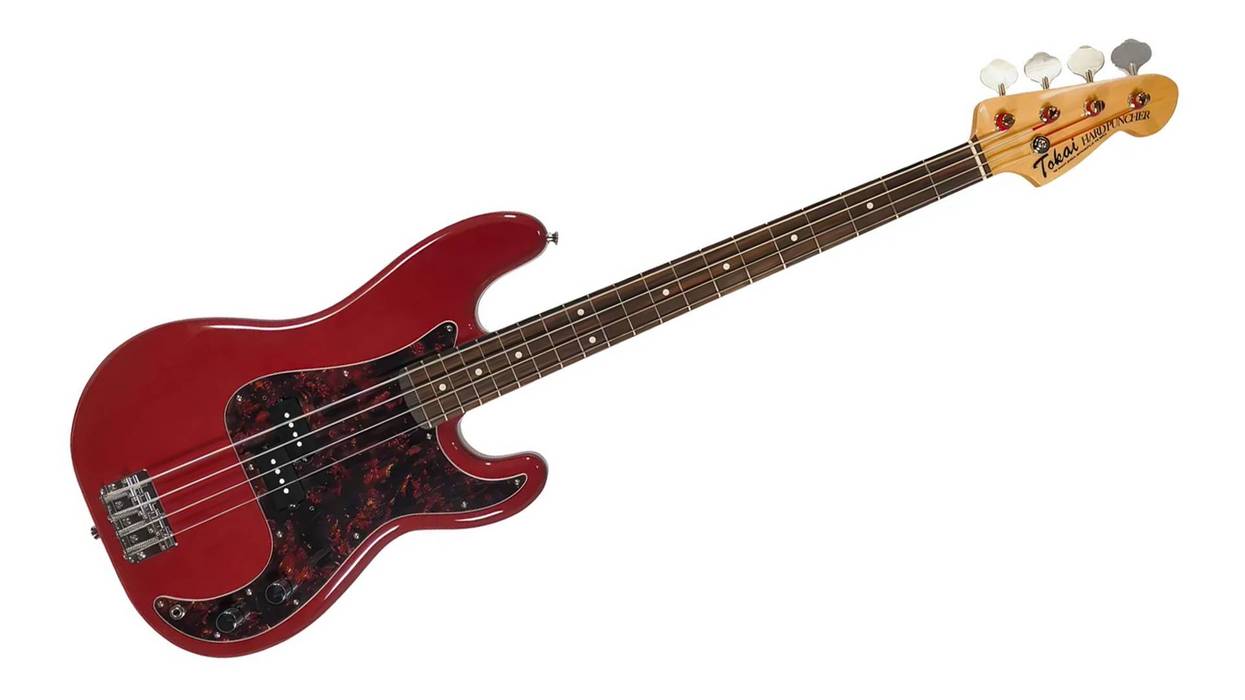
When my editor approached me about reviewing this bass, I had a very visceral sensation of being 12 years old again. That’s when I started playing bass—and perusing basses in a Swedish mail order catalog that had everything from home improvement tools to musical instruments. I distinctly remember scanning that catalog, once upon a time, and spotting a Precision Bass lookalike called the “Hard Puncher,” which, I suppose, sounded much more heroic to a non-native, beginning-English speaker than “P-Bass.”
“When in doubt, don’t.” It’s a pearl of wisdom that offends risk takers and guides more than a few tortoises to the finish line ahead of the rabbits. But in the tone-chasing world this dictum carries extra weight, because depending on your aims, anything you situate between guitar and amplifier can subtract as much as it adds. Indeed, a little restraint can go a long way toward sweetening a sound.
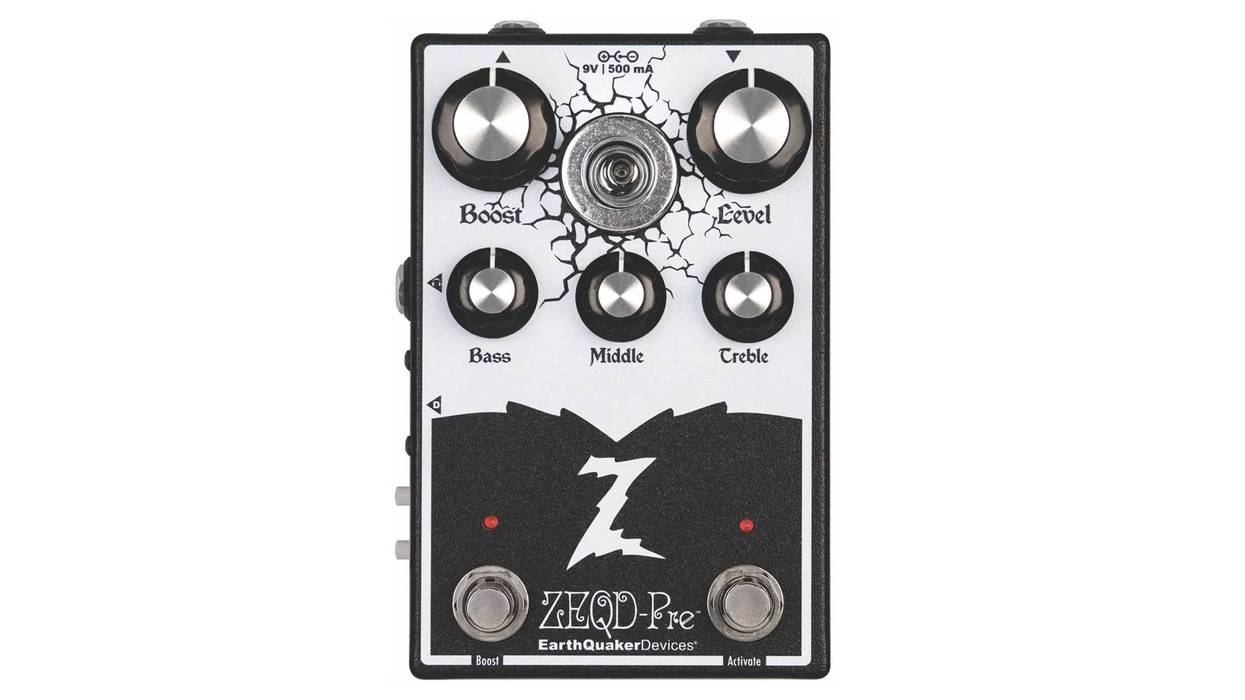
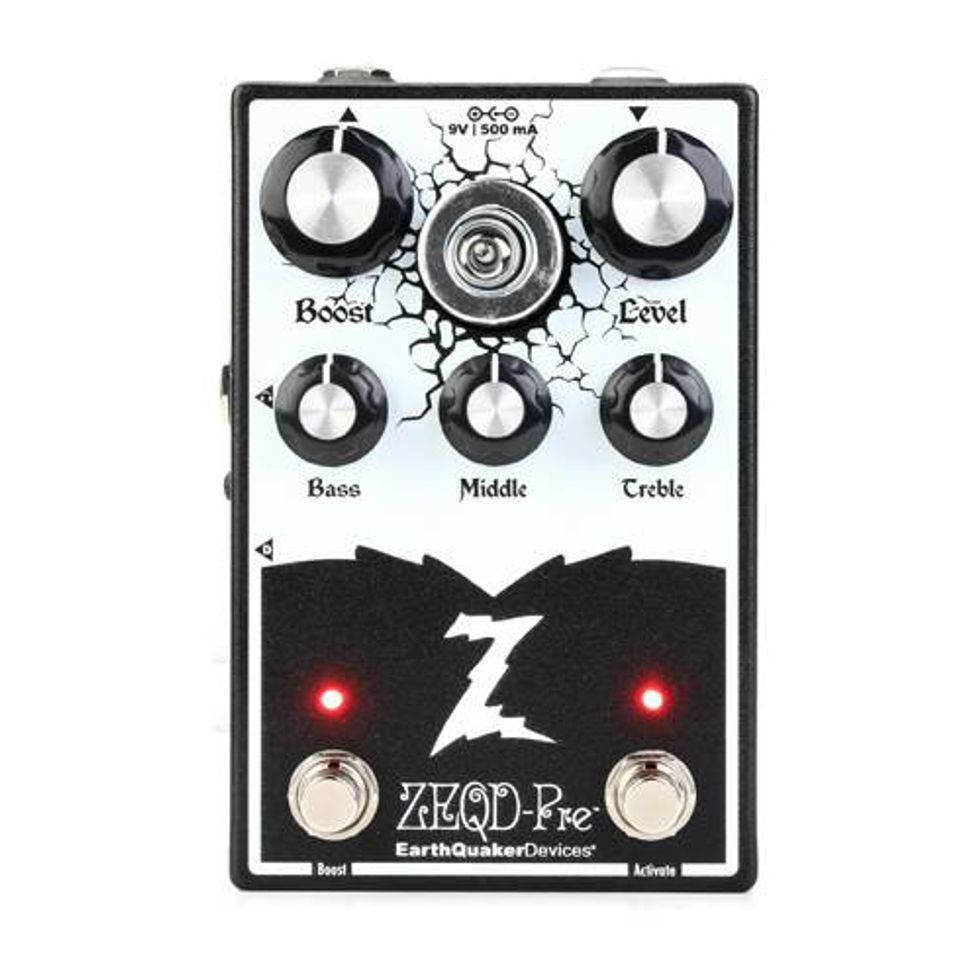
And restraint is one of the things that makes the ZEQD-Pre, a preamp co-designed by EarthQuaker and Mike Zaite (aka Dr. Z), such an elegant piece of kit. The things they didn’t add make it easier to use. The streamlined design also makes the ZEQD-Pre feel truly additive. It can lend body and excitement to big tube amps that sound flat at low volume. And as an analog addition to digital signal chains, it adds real life and a tactile dimension to flat, drab, or spiky DAW and modeler tones.
Feel Free With The Help Of A Pre
Though the ZEQD-Pre is a beautifully integrated whole, it’s effectively made up of two sections. There’s a passive EQ that can do a lot on its own to recast or fine tune the sound of a tube amp or modeler. It also features a boost. Switching on the boost disengages the EQ. But both sections use the level control as an output volume control.
In my first experiments with the ZEQD-Pre, I situated it in front of a 50-watt Fender Bassman and 2x12 cabinet. And though I suspect more potential customers will be interested in the EarthQuaker’s potential in digital environments, it can transform conventional tube amplifiers. I rarely get to turn my Bassman up much past 2 in my house. But the ZEQD-Pre’s EQ section made those modest volumes sound much fuller. The boost is not a high-gain affair, but it adds weight and excites overtones that might otherwise lay dormant at low volume. At higher amp volumes it can add a just-right nudge into the dirty zone that almost always sounds silky rather than harsh.
EarthQuaker Devices ZEQD-Pre Preamp Demo
“It is zingy, responsive, and does much to take away the uncanny valley sense of lifelessness you can feel when interacting with a modeler.”
Use of the EF86 in a preamp is not common—at least relative to the ubiquitous 12AX7. But Dr. Z’s choice of the EF86 for the boost is an inspired one. It is zingy, responsive, and does much to take away the uncanny valley sense of lifelessness you can feel when interacting with a modeler. Those that know the EF86 by its too-hot-to-tame reputation needn’t fear that it will be a handful though. The ZEQD-Pre boost voice is balanced and lively in all the right ways, and these attributes are especially apparent when the pedal is paired with a digital end destination.
When testing the ZEQD-Pre in this capacity—by running a cable from the headphone output straight into the Hi-Z input of my Universal Apollo Twin—I did not make it easy on the EarthQuaker. My main instruments are Jaguars and Jazzmasters, and the relatively thin and trebly output from both of them rarely flatters modeled and DI sounds. But I really liked the tones that I tracked with just the ZEQD-Pre and the DAW—especially without a modeled amp in the mix. The EQ adds body and tone-shaping versatility, and the boost lends real character and color, inhabiting a sweet space that is neither Fender Princeton nor Vox AC15, but which possess some of the smooth richness of the former and the sparkle of the latter. I enjoyed the sound of the ZEQD-Pre direct into the Apollo so much that it ceased to feel like a compromise between amp and modeler. Instead, it felt like something unique—an amp with its own very appealing flavor that I would use for its sonic virtues as much as its convenience.
The Verdict
Though I’ll opt for a tube amp in almost any situation where there is a choice, I’ve warmed to some of our faux-amp friends in the digital domain. That said, I think I would choose the ZEQD-Pre and my pedals over almost any modeler. In direct-to-DAW situations, the ZEQD-Pre is warm, alive, and sounds, well, a lot like a real amp. It also feels like it was designed by people that know how a tube amp should feel under the fingers and in a room.
The ZEQD-Pre makes distortion and fuzz units sound like their real selves. And even without a simulated power amp, the cab sim makes rigs sound great through flat response monitors. The ZEQD is nearly $400, and for most of us, that’s a hefty enough sum to give pause. But the U.S.-made ZEQD-Pre is designed by gifted builders that have poked around the innards of amps and stompboxes for years and built classics in their respective fields. So, you can rest assured that the bars this pedal needed to clear in sonic and quality terms are high ones. I was pleasantly surprised and impressed—to the point where $399 seemed a very reasonable price to pay. And if you’re a tube amp loyalist navigating the worlds of backline-free gigging and digital recording, you may end up similarly smitten.
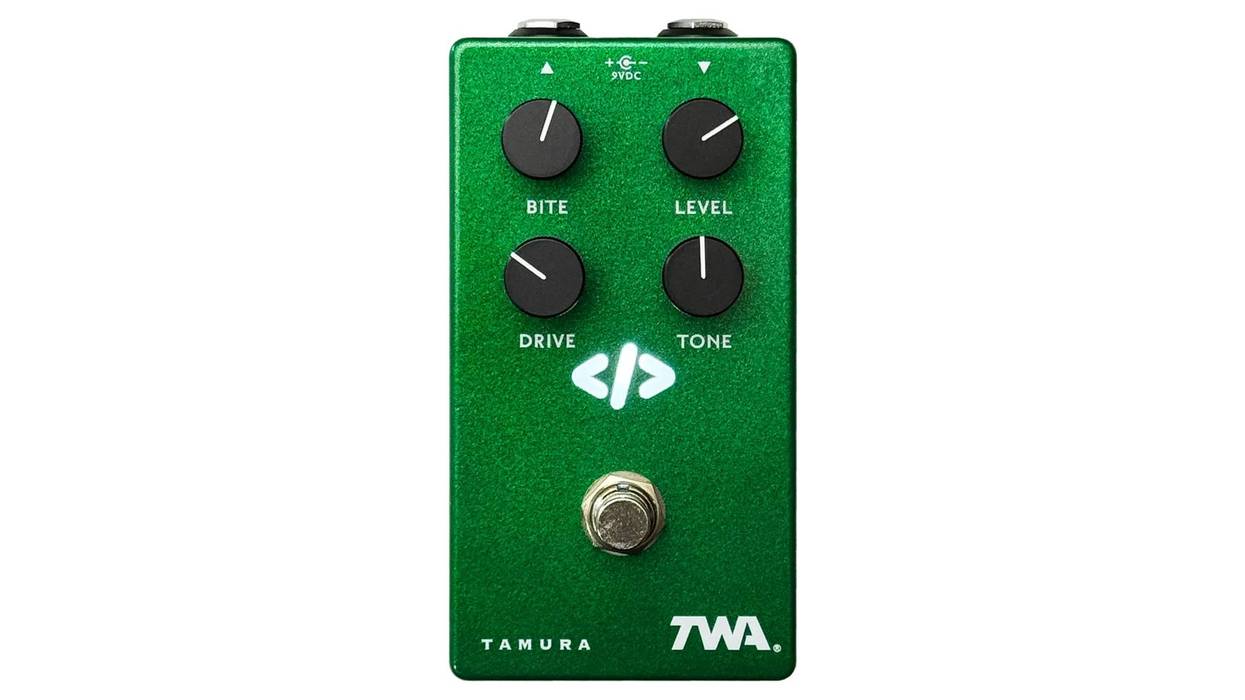
When Japanese engineer Susumu Tamura designed the Maxon OD808 overdrive, he could hardly have known that it and its export twin, the Ibanez TS808 Tube Screamer, would become perhaps the most influential and, probably, imitated pedals in stomp box history. In fact, upon its introduction in 1979, the Tube Screamer, whose smooth sound is characterized by a bass roll off, midrange bump, and slight high-end attenuation, was not an instant success. But as the pedal was adopted by players as disparate as Stevie Ray Vaughan and Kirk Hammett, it gradually became a ubiquitous presence on pedalboards of all persuasions.
The tweedDeluxe circuit sets the gold standard in tone for many of us. And for good reason. It’s simple and responsive, with a warm, compressed, midrange-forward voice that’s perfect for jazz and country lines at low to moderate volumes—and a distinctive, saturated gnarliness in the upper reaches of its output that’s hard to beat for rock. If that’s the sound you hear in your head, many would say a vintage model is still the one to have.
If anyone could top that with a true “tweed killer,” I’d put my money on George Alessandro. That’s not just because his clientele reads like a Mount Rushmore of guitar tone—David Gilmour, Derek Trucks, and Warren Haynes are just a few who’ve cited Alessandro in current gear lists in PG. It’s the combination of his deep firsthand knowledge of the history of guitar amp circuits and his tireless quest to source the finest components that not only land him those rock-star devotees, but easily place his name among mythical amp wizards like Alexander Dumble and Ken Fisher, and make him the guy for the job.
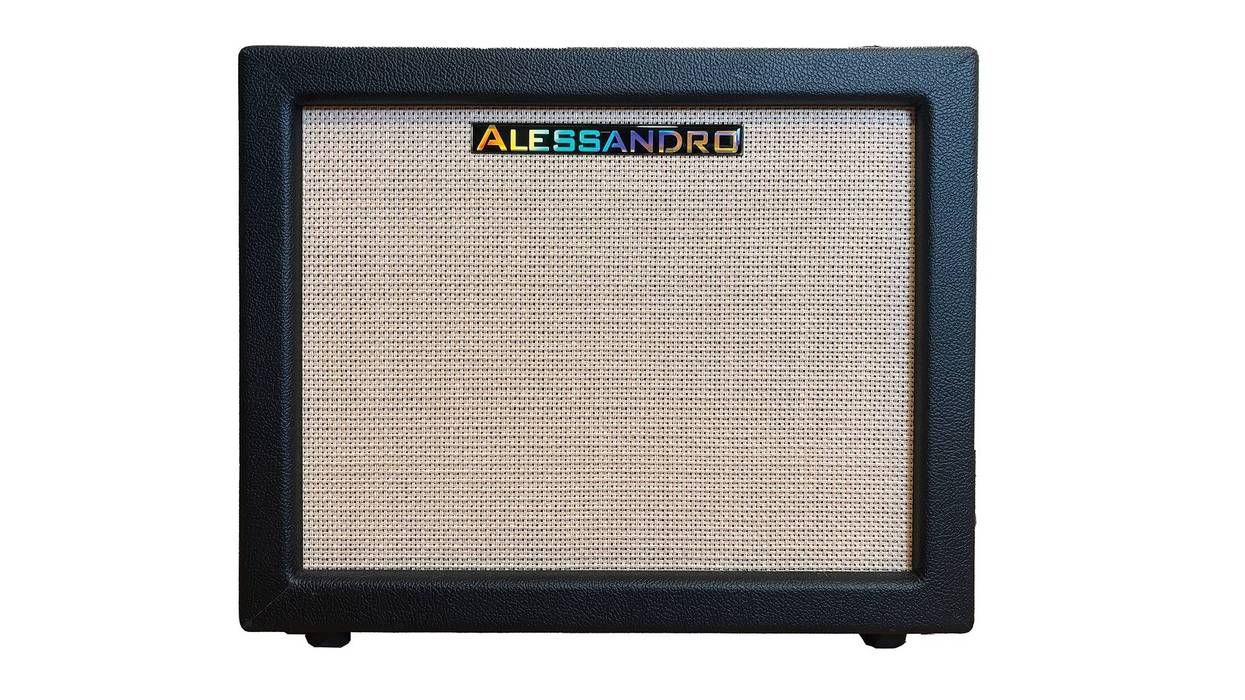
I’ve had the good fortune to play one of Alessandro’s 5E3 copies, and it was so familiar, it felt like what I imagine one of those amps must have sounded like fresh out of the factory in the late ’50s. With his new combo, The Dane, he’s used that circuit as a jumping off point—with a nod toward Dumble as well—and optimized it for a modern pedal-using player. Not only does the 14-watt The Dane deliver the same sonic hallmarks as the 5E3, it offers more headroom and an even wider range of touch-sensitive response.
Do the Evolution
Despite all the tweed Deluxe talk, the Dane is no clone. Instead, it’s inspired by the 5E3 circuit and a Dumble Tweedle Dee—that legendary amp builder’s own tweed Deluxe mod—that landed on Alessandro’s bench for service. From there, Alessandro evolved the design, creating a unique preamp circuit, which uses a pair of ECC83MG/12AX7s. On the user end, the most recognizable change might be the inclusion of a 3-band EQ. Alessandro paired his preamp with a ’50s-style output section that employs a pair of 6V6s. Together, and in conjunction with Alessandro’s signature Eminence GA-SC59, they evoke a vintage vibe, achieving the tube compression and harmonic complexity tweed Deluxe players know well, but with more clean volume.
As a tweed Deluxe player who also loves pedals, I’ve often found myself a little bit conflicted. There’s a weird imaginary line I feel like I cross every time I plug a fuzz—or even worse, a digital pedal—into my 1949 5A3. But if I want to use my prized amp on as many gigs as I do, it’s a necessity. With The Dane, not only is there no conflict, it actually feels more welcoming to pedals. That’s not just about headroom, though that certainly helps—the 3-band EQ really goes the distance when it comes to shaping your sound.
Much like the dynamic interplay between the tone and volume controls on a vintage Deluxe, each of The Dane’s EQ controls seems to shape the whole of the sound. I found this to be especially helpful with dialing in dirt tones. Over the course of a few sessions with The Dane, I plugged in a wide range of gritty pedals, including a Klon KTR, Analog Man King of Tone, EHX Ripped Speaker (there’s some comedy here in using a fuzz that’s supposed to sound a little broken), and an Analog Man Sun Fuzz. In each, I found that I was able to shape their tones with the EQ more than I would ever expect from other amps. And that goes for using those to push The Dane into overdrive as well, which, as ruthlessly delightful as it is to do on a tweed Deluxe, is not especially sculpt-able. With the KTR adding some gain and heading into cranked volume territory, the mid control alone added a heft to my Creston JM-style that felt resolutely heavy and thick—much more so than I would expect from JM-style pickups. And at more polite volumes, I could use the pedal alone to get my overdrive, while still preserving the character and voice of the amp.
Full Control at Your Fingertips
While reviewing The Dane, there’s a quote that kept coming back to me from when I interviewed Alessandro a few years ago: “If I can make it a limitless journey, then I did my job right.” With The Dane, he’s managed to take the tweed Deluxe sound and remove the limits.
I think there are a lot of ways Alessandro gets there, and one of those is through his next-level component sourcing. With the fervor of a hi-fi aficionado, Alessandro has most of his components custom built, with quality control that goes well beyond the consumer-grade level.
The result is that The Dane, like every Alessandro amp I’ve played, responds like a performance sports car: It runs silently, has an ultra wide dynamic range, a broad frequency range, and is fast and articulate, all of which keeps control in the player’s hands. That might be daunting if you’re used to an amp that heavily colors your phrasing by limiting the window of control (though pedals can help with that). But if you want to keep that window wide open, The Dane will get you there.
What, exactly, does that mean? The response, dynamics, and EQ keep the controls in your hands. Playing intensity and attack have more noticeable results. Sustain is there when you need it. In short, The Dane is a thrill to play.
The Verdict
As a devoted tweed Deluxe user, I’m genuinely taken by The Dane. Alessandro has preserved the character of the original while opening it up with more dynamic range, control, and possibility. But it goes beyond that, because The Dane isn’t just a 5E3-style amp—it’s a solution. Whether you’re playing clean articulate lines (I didn’t have an archtop handy, but I can assure you this amp would be the perfect transparent companion for jazz hits) or cranking with abandon, The Dane has the harmonic range and firepower for the gig. Its 14 watts are not only bold and powerful, this combo maintains its composure through its entire output, making it fully usable at all levels. At $3,000, The Dane, handmade by one of the ultimate legends of amp building, is an unrivaled feat.
Running two effects of the same kind concurrently can yield amazing results. Stacked fuzzes or RATs? I’m in heaven. Other effects work less reliably well in pairs. Two reverbs, for instance, can sound killer but can turn an otherwise carefully crafted signal to smog. Twin phasers, in my experience, can be counted among the effects that are delicious together. It takes just two simple one-knob phasers to get very weird. Build two phasers into one, though, and add a few extra tone shaping controls, and the weird gets weirder fast.
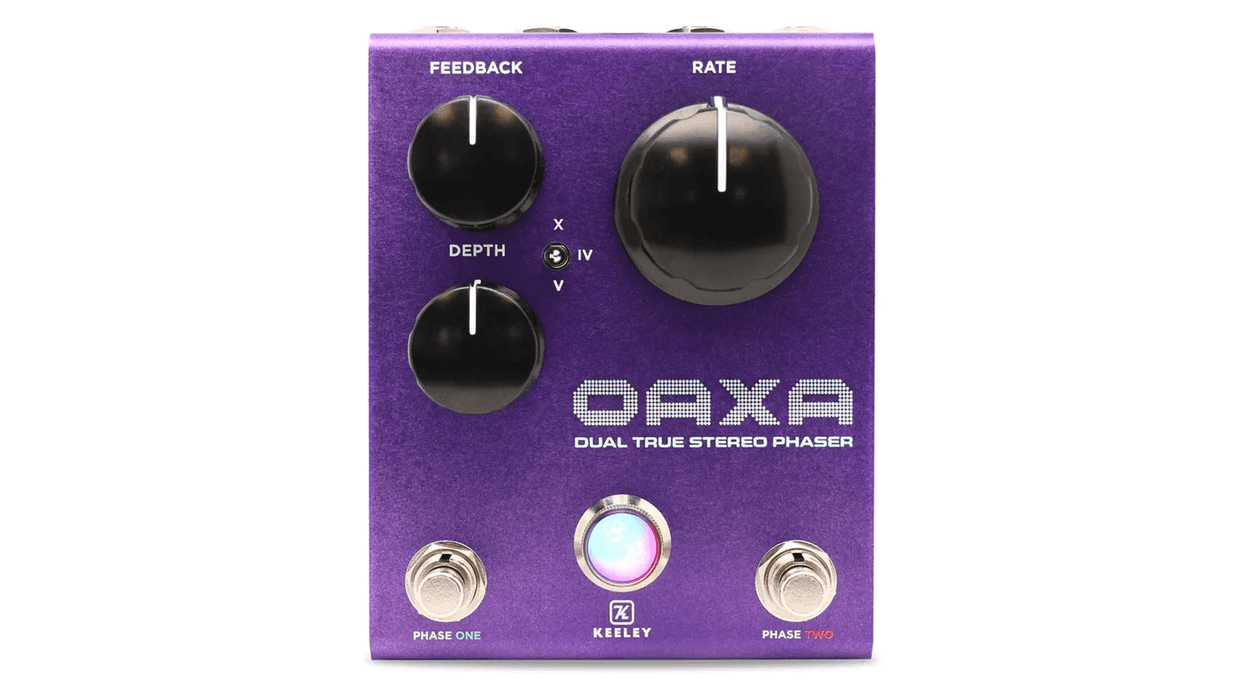
Keeley’s new U.S.-made, digital Oaxa twin phaser can feel nearly as simple and straight ahead as two Small Stones running side by side, and honors the elegance and ease of that solution in many ways. There’s just three knobs—for rate, feedback, and depth. A small 3-position toggle switches between 10-stage phase, 4-stage phase, and a Uni-Vibe-style mode. Two footswitches select between the individual phaser or a combination of the two. If you want to keep things simple, you can dive in no further than that and have a great time. But Oaxa bears many secrets for deeper diggers.
Working the Waves
The phase effect is fun to use intuitively. And adding it in and out can be low stakes. Feeling that a riff sounds lifeless? Add a phaser and twist the rate. Maybe it’ll be exactly what a song needs. Maybe it will sit like rotten mayonnaise. But it won’t have taken much effort to try, and you’ll probably have fun along the way. The Oaxa is deeply satisfying in this manner.
The brilliant, big rate knob can be adjusted with precision using just a toe (provided you have the right shoes). And while the depth and feedback controls might be an affront to Phase 90 and Small Stone users, Oaxa’s controls open up useful phase possibilities without leaving you feeling doomed to get lost in the weeds. The depth control, for instance, has so much range it can render the phaser all but subliminal—making it a killer always-on sweetener that can be nudged in and out of prominence via the depth knob. Those just-barely-there depth settings can also be subtly re-shaped by the similarly rangey feedback control, which acts like a filter, adding wah-like focus at mild depth. At more intense depths, the feedback adds appreciably more vowelly “wow” tonalities that give Oaxa more than a hint of a Mu-Tron’s beautiful vintage essence. This variation—and interactivity—among depth and feedback colors alone makes Oaxa a great production, arrangement, and guitar layering tool, particularly in spacious arrangements.
Bear in mind that all the phase phenomena I’ve described here were observed in the 4-stage phaser voice—my most natural and familiar phase space. But the 3-way toggle can also be configured for 10-stage voicing or as a Uni-Vibe-style phase effect. The 10-stage voice is a little more binary than the 4-stage, and can obscure some overtone nuance in the wash. At extreme depth settings it can even sound almost tremolo-like. For a lot of players, the more focused modulation waves in the 10-stage voice will be a perfect fit for rhythmic delays or staccato passages begging for a little extra wobble and a more interesting tail. The Uni-Vibe style setting, meanwhile, is a pretty authentic version of the effect and delivers a recognizable take on the drippy “whoop”-like phase created by a Uni-Vibe’s optical circuit. Like the real deal, it sounds fantastic with fuzz.
Multiplied by Two ... and More
When both phasers are on, Oaxa’s jewel lamp flashes blue and red, and the visual suggestion of a party is apt. There are deep and crazy sounds here that can take you deep into the wee hours. But not all combinations are magic. Certain pairings of modulation rate and harmonic peaks can obscure details that might make a single phase voice pleasing. But the option to run the two phasers in parallel or series enables more or less detailed versions of a compound phaser voice, respectively. And just-right phase-rate relationships combined with contrasting voices, depth, and feedback can yield fantastic results. Fast-throbbing U-Vibe style modulations combined with slow, deep 4-stage phases are extra dimensional—as are just about any two high-contrast rates. Nailing these combinations and hearing them via stereo—the other great force multiplier on Oaxa—can pull you deeper still into the pedal’s capacities.
The Verdict
Do you remember what I said at the top about the Oaxa being simple? It’s true. It’s just that Oaxa’s elegant design also has a lot in store for troublemakers willing to dig a bit. And if the stereo and dual-phase settings aren’t trouble enough, you can use the footswitches and knobs to introduce compression or extra filtering, or reconfigure the toggle to include 2- and 6-stage phaser voices. I’d venture that using the most basic functions will make the $199 price well worth it over time. But you’ll likely celebrate the day you stumble across one of Oaxa’s more complex finds. I suspect such days will be many in number, too.




![Rig Rundown: The Black Crowes’ Rich Robinson [2026]](https://www.premierguitar.com/media-library/youtube.jpg?id=66952027&width=1245&height=700&quality=70&coordinates=0%2C0%2C0%2C0)