
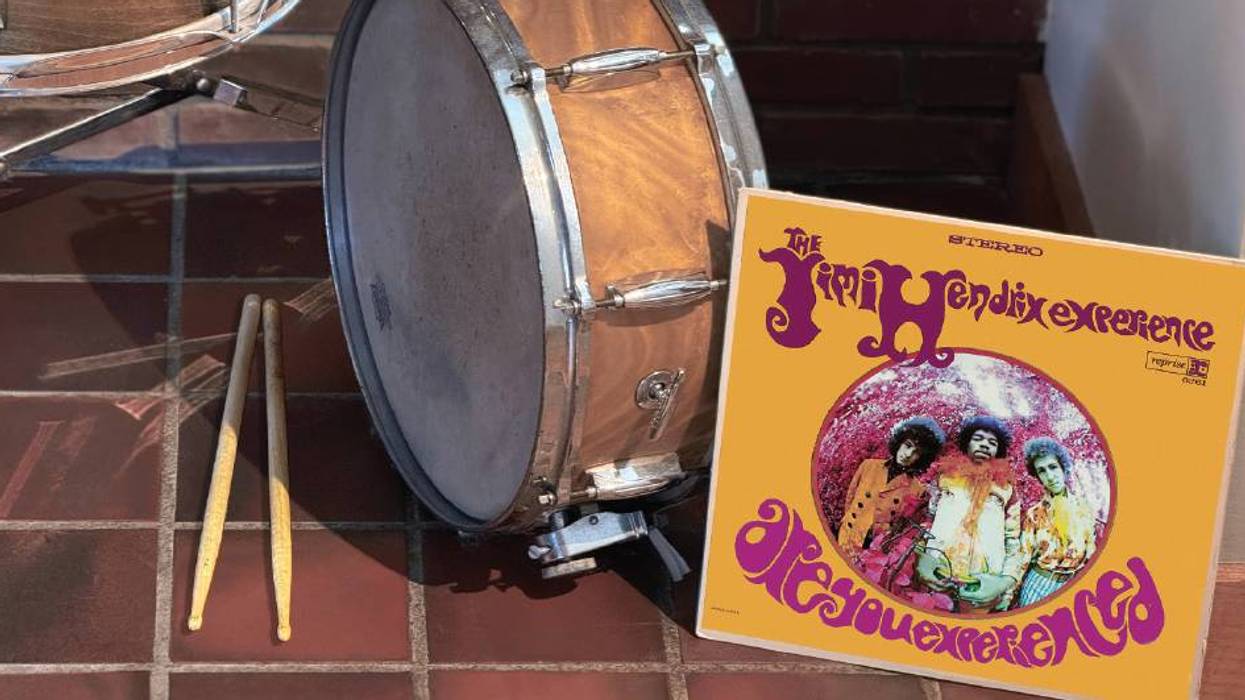

Not long ago, something unexpected happened. Gary, an old friend I hadn’t seen in decades, contacted me and asked if I’d like to get together. He lives at the opposite end of the country and was traveling through New England to see the autumn colors. I agreed immediately.
Gary had been the drummer in my very first band. We were kids then, and like most kids who form a band, we had more enthusiasm than talent, and considerably more ambition than sense. I was looking forward to an afternoon of catching up, comparing notes, and rummaging through the wreckage of our youth. I hadn’t given much thought to those early years in a long time. My memories were little more than a handful of blurry snapshots: bringing Are You Experienced to Gary’s house, playing a “talent” contest in middle school, and a few other fragments that had somehow survived the decades. The intimate details of our lives had long since disappeared. I was hoping that by stitching our memories together, we might be able to reconstruct some of what had been lost. What I didn’t expect was that the afternoon would remind me that some things about being a musician don’t disappear at all.
As we talked in my workshop, the years between then and now began to unfold. Amorphous recollections coalesced and spilled forth, and a timeline emerged. Gary had led a life very different from mine, and he hadn’t played drums in ages. Among other things, he’d been a software designer and a semiconductor engineer. He was a well-traveled, worldly survivor of Silicon Valley. It was intriguing, and more than a little impressive, to hear his stories about the titans of industry he’d rubbed elbows with and the products he’d championed. I hadn’t realized how deeply he’d gotten into jazz, or that he’d never really gotten out of it. His knowledge of music was broad, and we talked the way you’d expect two musicians to converse. The topics tumbled out naturally, and when the conversation turned philosophical, things got even more interesting.
Decades removed from his days of playing drums and guitar, and exploring various styles of jazz, Gary still communicated like a musician. There was a certain way of making connections, following an idea wherever it led, and looking at the world from a slightly askew angle. It was effortless. The hours disappeared, and I was sorry when we had to call it quits. I had an appointment, and he needed to get to New York City in time to return his rental car. It was illuminating for both of us, and I’m looking forward to seeing him again.
If you’ve managed to hang on this far, you may be wondering what the hell any of this has to do with guitars, other than two old dudes who once played in some crappy bands together getting to relive the glory days. I was reminded that musicians—and artists of all kinds—belong to a peculiar fraternity. Call it a group, a circle, a crew, whatever you like. The word isn’t important. Once music, and more importantly making music, gets into your blood, it’s there for life, and it’s an internal compass, or a wavelength. There’s a language we speak and a particular way of seeing things. Curiosity is part of it. So is the tendency to make connections that might not be obvious. We may have different ambitions and experienced varying degrees of success, but somewhere on that wavelength, we’re the same.
Music might become a profession, or it might be a hobby that gets shelved for decades. Either way, it remains something larger than the activity itself. It’s a bond of brothers and sisters—and, in a sincere sense, everyone else is a civilian. I wouldn’t have it any other way.
“Music might become a profession, or it might be a hobby that gets shelved for decades. Either way, it remains something larger than the activity itself.”
Oh, and I almost forgot the best part. Gary found me because he’d overheard a guitarist mention my name in a coffee shop in California. There’s that wavelength again. Maybe that’s the compass I was talking about. It doesn’t necessarily tell us where we’re going. It just has a funny way of pointing us back toward one another, no matter how much time has passed or how far we’ve wandered. Whatever our lives become, musicians share a bond that can transcend time, circumstance, and even ordinary friendship. And when we find our way back into the same room, the circle closes.